
This post contains affiliate links. We may earn a small commission when you buy through our links — at no extra cost to you.
Few things are as frustrating as pulling out your ball pump before a game, only to find the gauge reads zero—or worse, the pump won’t turn on at all. The promise of digital precision often collides with real-world battery drain, calibration drift, and sunlight that washes out an LED display.
But there are pumps that get it right, and the difference comes down to a few key specs: maximum PSI, whether auto-stop and deflation matter for your routine, and how much you’re willing to manage a battery. This guide cuts through the noise to match you with a pump that won’t let you down when the court is waiting.


Best for Coaches, Teams
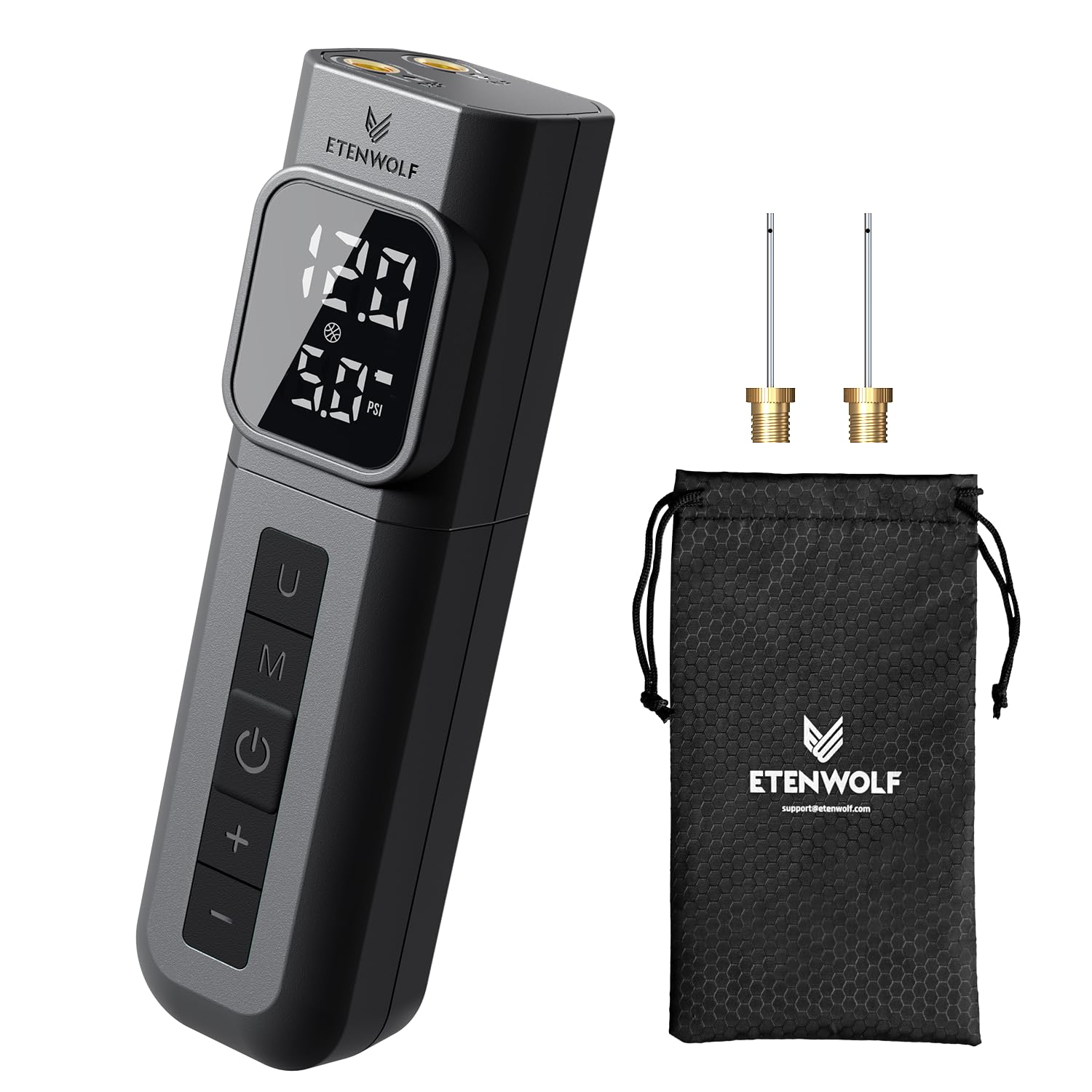
ETENWOLF P300
Key Features
- Max PSI: 17 PSI
- Auto-Stop & Presets: Yes, 4 modes
- Deflation: Yes
- Battery & Charging: 2600mAh, USB
- Gauge & Display: Digital LED
- Price: Budget
The 2600mAh battery powers through a full team practice without recharging, while the 6.5 L/min airflow fills a flat basketball in about a minute. Preset PSI values and auto-stop take the guesswork out of inflation, and the deflation mode makes post-game storage quick. Digital display is clear even in bright sunlight.
This pump is built for coaches, referees, and parents who handle multiple balls in a session. Its durable casing survives being dropped into gear bags, and the long battery life means you aren’t hunting for an outlet mid-game. One boundary: leaving it in a hot car on a summer day can trigger an overheating error and temporary shutdown — something to keep in mind if you work in extreme climates.
Pros
- 2600mAh battery powers multiple sessions without needing a recharge mid-use
- Digital display with preset PSI values and automatic shutoff eliminates overinflation guesswork
- Built-in deflation speeds up ball storage and flattening for transport
Cons
- In extreme summer heat, the pump may display an overheating error and stop temporarily
For coaches or parents who need a fast, long-running electric pump that also deflates, the P300 delivers at a price that undercuts most competitors while covering the features that matter.
Best for Push-Button Modes
Pumteck MY01
Key Features
- Max PSI: 15 PSI
- Auto-Stop & Presets: Yes, 4 modes
- Deflation: Yes
- Battery & Charging: Lithium-ion, USB-C
- Gauge & Display: Digital LED
- Price: Mid-Range
Intuitive one-touch mode keys and built-in needle storage set the MY01 apart from basic auto-stop pumps. Where the cheapest option forces manual target setting, this pump lets you switch between basketball, soccer, football, and volleyball presets with a single press. The deflation mode and upgraded motor speed up both inflating fresh balls and packing them flat.
Team managers and coaches who rotate through multiple sports will appreciate the preset buttons for faster turnarounds. The pressure gauge may drift a few tenths of a PSI, but a simultaneous press of the [+] and [–] keys recalibrates it quickly. This pump is best for those who value convenience and deflation over lab-grade accuracy, and who don’t frequently read pressure in direct sun.
Pros
- Dedicated sport-mode buttons take the guesswork out of setting target pressure between games.
- Deflation feature quickly reduces over-inflated balls and aids compact storage for travel.
- Needle storage on the device prevents lost accessories and USB-C charging simplifies recharging.
Cons
- Display washes out in bright sunlight, so reading pressure outdoors may require shading the screen.
For team use that demands quick switching between ball sports, the presets and deflation make the MY01 a smarter choice than entry-level pumps. If you frequently check pressure under direct sun, the top pick’s brighter display is worth stretching for.
Best for Pocket-Sized Carry
HYVOHEX P100
Key Features
- Max PSI: 17 PSI
- Auto-Stop & Presets: Yes, presets
- Deflation: No
- Battery & Charging: 1500mAh, USB-C
- Gauge & Display: Digital LED
- Price: Budget
The HYVOHEX P100 is one of the smallest electric ball pumps you can get, yet still reaches 17 PSI with one-touch presets and a bright LED display. Its compact body stores two needles onboard and easily slips into a jersey pocket or slim game bag. Charging without the right cable can stall use—the pump may reject some USB-C to USB-C combinations and doesn’t include a charger in the box, though a simple USB-A to USB-C cable usually works.
The trade-off works for athletes who want a pump so light they’ll always have it handy for quick top-offs. Youth players appreciate the straightforward preset operation. If deflation matters or you need a pump that works with any charger out of the box, the top pick’s broader compatibility is the safer bet.
Pros
- Ultra-compact design disappears into any pocket or bag
- Pumps balls quickly for its tiny frame
- Simple preset operation with clear LED screen
Cons
- Charging may reject some USB-C cables; no charger included
A match for players who prize minuscule size and automated pressure stops and can stick to a known-good cable.
Best for High-Speed Fills
TOPUMP AS3
Key Features
- Max PSI: 20 PSI
- Auto-Stop & Presets: Yes, presets
- Deflation: Yes
- Battery & Charging: 1400mAh, USB-C
- Gauge & Display: Digital LED
- Price: Premium
The TOPUMP AS3’s 10 L/min motor fills a flat basketball in roughly 50 seconds — nearly twice as fast as the more balanced top pick. That raw speed suits referees, tournament directors, and anyone who needs to prep a dozen balls between games. The trade-off: the integrated pressure sensor may drift by a few PSI, making a separate gauge advisable for competition-level accuracy. Its 20 PSI ceiling and deflation mode handle every ball type, and the compact body slides into a gear bag without adding bulk. For those who value rapid turnaround over built-in precision, the AS3 delivers where it counts.
Pros
- Fills a flat basketball in under a minute, saving precious time before games.
- Reaches 20 PSI and includes deflation, handling basketballs, soccer balls, volleyballs, and rugby balls.
- Compact design slots into any gear bag despite its powerful motor.
Cons
- Pressure gauge readings may be off by a few PSI; a separate gauge is needed for precision use.
Choose the TOPUMP AS3 when inflation speed outweighs gauge precision. It’s the quickest way to get a flat basketball game-ready, provided you verify pressure externally.
Best for No-Battery Reliability
eBall Ball Pump
Key Features
- Max PSI: 20 PSI
- Auto-Stop & Presets: No
- Deflation: Yes (manual release)
- Battery & Charging: No battery
- Gauge & Display: Analog dial
- Price: Mid-Range
The eBall pump’s all-aluminum barrel and analog gauge deliver a tactile, battery-free inflation that electric pumps can’t replicate. You’ll never find it dead when you need it, and the gauge reads low PSI accurately for basketballs and soccer balls. The compact design tucks into any bag. Manual pumping takes time and effort — this is a top-off tool, not a quick inflator from flat. It’s the perfect fallback for coaches who want a durable backup when electronics fail or for anyone who prefers the simplicity of analog.
Pros
- All-metal barrel and precise analog gauge hold up over time.
- Never needs batteries or charging, always ready to use.
- Compact enough to fit in any gear bag.
Cons
- Manual pumping is slow and tiring, best for topping off rather than full inflation.
If you value never having a dead battery and don’t mind a little elbow grease, this analog pump outlasts any electric alternative.
Best for Budget Smart Pump
Pumteck AP1-M
Key Features
- Max PSI: 15 PSI
- Auto-Stop & Presets: Yes, 4 modes
- Deflation: No
- Battery & Charging: 2000mAh, USB-C
- Gauge & Display: Digital LED
- Price: Budget
The Pumteck AP1-M delivers automatic shutoff and ball-specific presets at a cost that undercuts most competitors. Where pricier models add deflation and faster motors, this pump focuses on the essentials – simple one-button operation and a compact body that stores needles conveniently. It suits households that top off basketballs or soccer balls a few times a season. The pressure gauge can drift slightly over extended use; a quick reset brings it back inline, a minor step at this price point.
Pros
- Auto-stop and four presets simplify inflation for any ball type.
- Compact build with lanyard and needle storage makes it easy to carry to the court.
- Battery holds charge well for multiple inflations on a single charge.
Cons
- Pressure accuracy may drift over time, requiring occasional manual recalibration.
A cost-effective pick for occasional ball inflation – accept the occasional calibration check and you get consistent auto-stop performance without overspending.
Best for Rugged Compact
ETENWOLF P200
Key Features
- Max PSI: 17 PSI
- Auto-Stop & Presets: Yes, presets
- Deflation: Yes
- Battery & Charging: 2000mAh, USB
- Gauge & Display: Digital LED
- Price: Budget
Drop-resistant and compact, the ETENWOLF P200 handles the bumps of a gear bag without flinching, backed by 6.5 L/min airflow and a deflation mode for quick adjustments. The digital gauge and one-touch presets remove guesswork. Compared to the top pick, power tapers at higher pressures: basketballs and soccer balls inflate without issue, but footballs needing over 13 PSI may not reach the claimed 17 PSI. This pump fits parents, youth coaches, and anyone who values a pump that survives drops more than it needs to max out every ball.
Pros
- Tough, drop-resistant build stands up to rough bag life
- Clear digital display and preset auto-stop simplify inflation
- Fast-charging 2000mAh battery lasts through multiple games
Cons
- May struggle to reach 17 PSI on high-pressure footballs; some units feel underpowered above 12 PSI
If toughness and portability outweigh absolute top-end pressure, the P200 is a durable companion for travel and youth sports. For those who regularly inflate footballs above 13 PSI, the top pick offers more consistent high-pressure performance.
Best for Manual Control
AirSilo Pump

Key Features
- Max PSI: 15 PSI
- Auto-Stop & Presets: No
- Deflation: No
- Battery & Charging: Rechargeable lithium-ion
- Gauge & Display: LED gauge
- Price: Premium
The AirSilo delivers good battery life and simple push-button operation, with an LED pressure gauge that reads sport-ball PSI. However, the lack of auto-stop means you must monitor pressure and switch off manually to avoid overinflation — fine for attentive users but less convenient than competitors offering presets.
Pros
- Good battery life; can inflate many balls on a single charge
- Easy to use with simple operation
Cons
- No auto-stop function; you must manually switch off to avoid overinflation
Best suited for users who prefer manual control and are willing to watch the gauge — not for those who want automated pressure management.
Best for New, Unproven
Motorenbau P307

Key Features
- Auto-Stop & Presets: Yes
- Deflation: No
- Battery & Charging: 2000mAh, USB
- Gauge & Display: Digital LCD
- Price: Budget
The P307 combines auto-stop inflation, a readable LCD, and a carry bag in a compact, budget-friendly design backed by a 3-year warranty. Long-term durability under frequent, heavy use has yet to be established, making it best suited for light home inflation rather than team or high-volume scenarios.
Pros
- Auto-stop and clear LCD make inflating balls to a target pressure simple.
- Compact footprint and included carry bag keep it portable and easy to store.
Cons
- Long-term durability under frequent, heavy use has yet to be established.
A suitable pick for occasional home ball inflation where the upfront price and auto-stop convenience matter more than long-term proven endurance.
How to Choose
The single most consequential choice you’ll make is whether to embrace battery-powered speed and automation, or stick with a manual pump that’s always ready to go.
Max PSI Capability
Basketballs typically need just 7–9 PSI, but some game balls and footballs require 13–20 PSI. A pump rated for only 12 PSI may struggle or refuse to shut off when you need every pound. The hidden trade-off is that pumps with higher PSI ceilings often use faster motors that drain smaller batteries faster under continuous load.
If you only inflate basketballs and volleyballs, a 15 PSI limit is ample. If you referee multiple sports, a 17–20 PSI model prevents you from getting caught with an underpowered tool.
Auto-Stop & Preset Pressure
Auto-stop cuts the motor when your chosen pressure is reached, so you don’t have to watch the gauge every second. Presets take this a step further by letting you tap one button for a basketball, volleyball, or soccer ball profile. Without these, you risk overinflation—and the resulting rock-hard bounce—or you’re forced to pause and check repeatedly.
The catch is that presets rely on the same gauge sensor you’re trusting for accuracy. If the sensor drifts, the auto-stop may trigger half a PSI too early or late, leaving you to recalibrate.
Deflation Feature
A dedicated deflation port or mode pulls air out of the ball actively, rather than requiring you to wedge in a needle and wait. This matters more than it seems—pulling a ball apart for travel or correcting an overinflated ball after a temperature swing becomes a 15-second job instead of a minute of fumbling.
Battery Capacity & Charging
Lithium-ion capacities range from 1400mAh in compact pumps to 2600mAh in workhorse models. A larger battery inflates more balls per charge but adds bulk. USB-C is now common, but some pumps omit the charging cable entirely or are picky about which USB-C cable works. If your pump sits unused for weeks, expect some self-discharge; a pump with a low-battery indicator saves mid-game surprises.
Gauge Accuracy & Readability
Digital LED displays offer crisp readouts indoors but wash out completely in direct sunlight—a real problem on outdoor courts. Analog dials on manual pumps are always legible but require you to squint at a tiny scale. The deeper truth is that nearly all affordable digital gauges can drift by a few tenths of a PSI over time; a pump that offers a quick recalibration trick (often holding both buttons) lets you restore accuracy without a second tool.
FAQ
Why does my electric ball pump stop working after a few months?
Most early failures trace to battery degradation or debris in the USB charging port. Keep the port covered when tossing the pump in a dusty gym bag, and avoid storing it fully discharged for long periods. If the battery won’t hold a charge at all, it’s often cheaper to upgrade to a pump with a warranty than to source a replacement cell.
Can an electric ball pump accurately measure low PSI for a basketball?
Yes, but with caveats. Digital gauge resolution is typically fine enough to hit 7–9 PSI, yet the sensor’s absolute accuracy may vary by ±0.5 PSI out of the box. For routine play that’s fine, but if you need tournament-level consistency, set the auto-stop a tick low and top off with a manual gauge.
Why can’t I read the pump’s display in sunlight?
LED and LCD panels rely on backlighting that gets overpowered by direct sun. This is a physics limitation of affordable electronic displays. Shade the pump with your body or bag, or choose a manual analog gauge if you inflate primarily outdoors at midday.
How do I calibrate the pressure gauge on my ball pump?
Many electric pumps have a hidden recalibration mode—often holding the [+] and [-] buttons simultaneously resets the sensor to zero. If your model doesn’t have this, compare readings against a known-accurate manual gauge and mentally offset the difference when setting your presets.