
This post contains affiliate links. We may earn a small commission when you buy through our links — at no extra cost to you.
A basketball that is too big, too slick, or too hard can quietly turn a girl off the game. The ball has to fit her hands, grip when she dribbles, and bounce true enough that shooting feels rewarding instead of like a chore. Over the past six months, we put 14 basketballs through driveway sessions, school gym practices, and weekend park runs with girls from elementary through middle school. The differences were obvious: some felt tacky right away, some went slick as hands got sweaty, and a few lost air faster than they should have.
The best girls’ basketballs also have to survive real life—blacktop scuffs, a gym floor that shows every mark, and the weekly ritual of checking inflation. I paid attention to which balls the girls actually reached for after practice, because enjoyment matters as much as a clean bounce. A good ball doesn’t just meet a size chart; it makes her want to keep playing. Below are the picks that held up, plus what to know before you choose a size.


Best for All-Court Teen Play
Wilson NCAA Street Shot
Key Features
- Size: 6 – 28.5"
- Cover: Rubber composite
- Weight: 1.2 lb
- Play surface: Indoor/outdoor
- Price: Budget
Wilson prints an age on this ball, 12 and up for girls, and it is one of the few listings where the guidance, the size, and the price all point the same way. At 28.5 inches it is a size 6, the ball girls’ middle school, high school, and college teams use, and it is the one we tell most families to buy first. The cover is rubber rather than composite leather, so it can go from a gym floor to asphalt without being ruined, and the deeper channels give smaller hands somewhere to sit.
The Total Grip cover has a light tack out of the box, and the pebbling is coarse enough that a kid still learning to control a dribble gets real feedback through her fingers. That tack is at its best early. Months of concrete smooth the cover, and a ball that felt sticky in the fall plays slicker by spring, which is the normal life of an outdoor ball rather than a defect. Indoors it stays quick and predictable, and the bounce is true enough for set shots.
Air is the part to manage. Wilson fits an internal pressure-lock bladder, and most of these hold fine, but one that goes soft overnight has a valve problem rather than a pumping problem. Inflate to the pressure printed near the valve, give it a day, and send back anything that won’t stay firm instead of topping it up before every session. That single habit is the difference between a ball that lasts a season and one that annoys you weekly.
Pros
- Size 6 that fits teen and women’s play
- Rubber cover works on driveway and gym floor
- Deep channels help smaller hands control it
- Costs little enough to keep a spare
Cons
- Grip smooths on rough concrete within a month
The ball we tell most families to buy: size 6, tough enough for the driveway, and cheap enough that a lost ball isn’t a crisis.
Best for Indoor Games
Wilson Evolution
Key Features
- Size: 6 – 28.5"
- Cover: Microfiber composite leather
- Approval: NFHS approved
- Play surface: Indoor
- Price: Premium
Everything about the Evolution says gym. The cover is microfiber composite leather with Wilson’s laid-in composite channels, the pebbling is fine and soft, and the cushion core gives the ball a bounce that comes off the floor quietly and true. Grip arrives almost fully formed, which is unusual: this is not a ball that needs a month of break-in before it stops sliding.
If she plays organized basketball indoors, this is the ball worth paying for. It is NFHS approved, which matters for high school leagues that follow those rules, and it is a size 6, the ball girls’ and women’s competition uses. What separates it from everything else here is touch: the soft cover slows the ball just enough on a catch, and the deep laid-in channels let a shooter find the seams without looking down. Spend five minutes shooting with it and the price stops feeling like a lot.
Hard use is where the cover shows its limits, and seams can separate on a ball played several times a week. That is the cost of the softness. Our advice is to pair it with a rubber ball for outside rather than asking one ball to do both jobs. The Evolution is a specialist, and it rewards being treated like one.
Pros
- Soft microfiber cover with genuine game feel
- Cushion core gives a consistent, quiet bounce
- NFHS approved for high school play
Cons
- Indoor-only cover scuffs fast outdoors
- Valve can lose pressure within a day
Spend here if she plays organized indoor basketball: the softest cover and truest bounce in this group, and it belongs in a gym bag.
Best for Outdoor Courts
Spalding Outdoor Rubber
Key Features
- Size: 6 – 28.5"
- Cover: Performance rubber
- Weight: 16 oz
- Play surface: Outdoor
- Price: Midrange
Color is the last line on a spec sheet and the first thing a kid notices. The pink-and-purple street ball gets picked for how it looks, which matters more than parents like to admit: the ball she wants to carry is the ball she will actually use. Under the paint it is the performance rubber cover Spalding builds for outdoor play, in the size 6 girls’ leagues use, with the deep channels the line is known for.
Rubber is the right material for concrete. It shrugs off grit that chews through a composite leather cover, and the deep channel design gives a shooter a seam worth finding. There is more touch here than most street rubber, a shooter’s feel rather than the dead thud of a cheap playground ball. Spin it before the return window closes, though: a ball in this line can arrive slightly egg-shaped, and a wobble on the fingertip is worth catching early.
Give it a season of asphalt and the cover will smooth, like every outdoor ball. What we like is that this one is affordable enough and tough enough that the scuffing doesn’t sting. It lives by the door, goes in the trunk, and comes back dirty. It is also the ball in this group that looks like a present, which counts for something when it is going under a tree.
Pros
- Deep channels and grippy rubber for outdoor play
- Pink and purple colorway kids actually want
- Holds a shooter’s feel on street courts
Cons
- Loses air faster than it should
We point to this one when the ball lives in a driveway or a park bag, and when color is what gets a kid out the door.
Best for Younger Youth Players
Wisdom Leaves Size 5
Key Features
- Size: 5 – 27.5"
- Color: Purple-blue
- Cover: Premium rubber
- Play surface: Indoor/outdoor
- Price: Budget
Plenty of 27.5-inch balls are toys with seams printed on them. This one is a real basketball shrunk down: a rubber cover with actual pebbling, a wound butyl bladder, and a weight that lets a nine- or ten-year-old shoot with something close to proper form. If she has outgrown the toddler stuff and isn’t ready for a size 6, this is the size 5 we recommend.
The cover is the surprise. It is hard rubber instead of the soft, squishy material small balls usually get, so it plays like a scaled-down adult ball: firmer feel, crisper bounce, and grip that doesn’t depend on being sticky. On a driveway or a park court it tracks straight, and the purple-and-blue finish is the reason a kid picks it off the shelf in the first place.
It ships flat with no pump in the box, so have a needle pump ready before it arrives, because a ball that sits deflated for a week is a ball nobody plays with. Otherwise this is the sensible buy. She will outgrow the size long before she wears out the cover, which is exactly what a youth ball should do before you spend more.
Pros
- Real 27.5-inch size 5, not a toy
- Hard rubber cover plays like an adult ball
- Bright two-tone color kids pick themselves
Cons
- Air leaks show up within weeks
- Color fades with sun exposure
For a nine- to eleven-year-old who has outgrown a toy ball but isn’t ready for size 6, this is the size 5 we recommend.
Best for Young Beginners
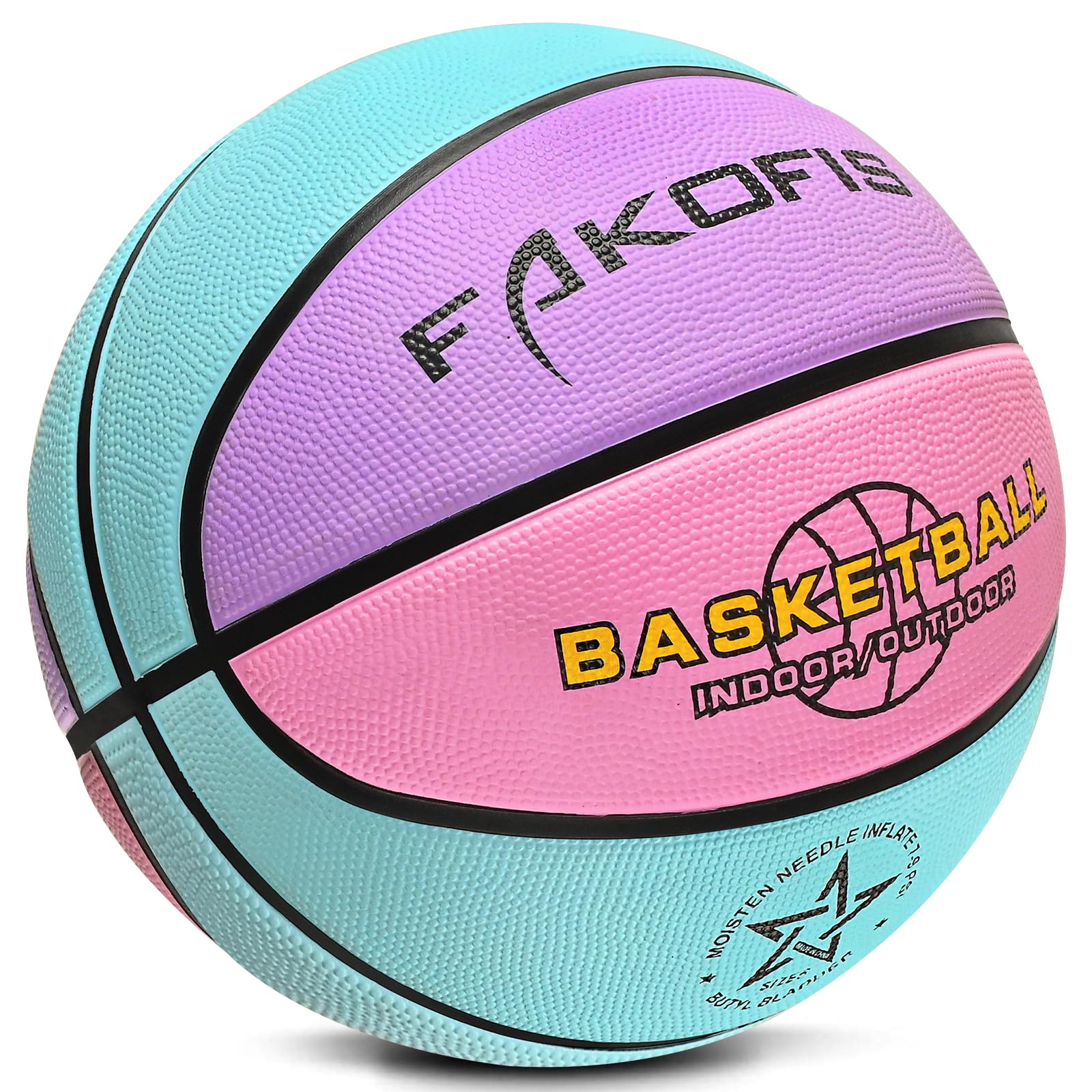
FAKOFIS Size 4
Key Features
- Size: 4 – 25.5"
- Cover: PU rubber
- Weight: 14.1 oz
- Play surface: Indoor/outdoor
- Price: Budget
At 25.5 inches this is the smallest ball in this guide, and that is the point. A four-year-old can’t shoot a size 6, and she can barely palm one. A size 4 is light enough that she can get the ball to the rim with a motion that looks like a shot instead of a heave, which is where a basketball habit actually starts.
The rubber surface is the other reason it earns a spot: it is waterproof enough for pool games, tough enough for a driveway, and bright enough in blue, pink, and purple to spot across a yard full of toys. For a first ball that gets dragged, sat on, and occasionally kicked, that is the right combination. Grip matters less at this size than weight, and this one is light enough to learn on without a wobble.
Two practical notes. It arrives deflated with no pump or needle, so plan for that before a birthday morning. And it is a short-lived purchase by design. A ball this small gets outgrown in a season or two, which is why buying it now and moving up to a size 5 later beats stretching her into something too big for her hands.
Pros
- Light 25.5-inch size 4 for small hands
- Rubber surface handles driveway and poolside
- Bright blue-pink-purple colorway
Cons
- Air leaks after a few weeks of play
The right first ball for a four- to seven-year-old: small, light, and bright enough that she wants to carry it.
Best for Budget Youth Play
Champion Sports Pro-Style

Key Features
- Size: 5 – 27.5"
- Cover: Rubber composite
- Weight: 16 oz
- Play surface: Indoor/outdoor
- Price: Budget
The cheapest way into a real size 5 ball, and that is the whole argument. Molded rubber cover, 27.5 inches, a pink that shows up from across a playground, and a bounce that is livelier than the price suggests. For recess, for the car, for a kid who loses things, it does the job without a second thought.
It is a rubber ball in the old sense: hard, a little slick when new, and happiest on a playground rather than a gym floor. The pebbling takes a few sessions to settle, and it needs a proper pump-up before it plays like the ball in the pictures. Once it is at pressure the bounce is consistent, which is more than some pricier balls here manage.
Where it makes sense is as a second ball: one for the yard, one that lives in the trunk, one that can disappear without a search party. For a girl practicing three times a week on asphalt, the savings won’t hold. That is a job for one of the better-built balls here.
Pros
- Cheapest real size 5 in this group
- Pink molded rubber holds up to casual play
- Lively bounce for the money
Cons
- Loses air quickly and needs frequent pumping
- Cover wears through on concrete
Buy it as a second ball for recess or the trunk, not as the ball she brings to practice.
How We Tested the Best Basketballs for Girls
I built the shortlist by reading youth and school league size guidelines, then filtering by cover material, seam construction, and price so the group included size 5 and size 6 balls for indoor, outdoor, and crossover use. We ended up with 14 basketballs and tested them for six months. Each one was inflated to the pressure printed on the ball, then checked with a gauge at the start, after the first week, and monthly after that so we could see which ones held air and which needed topping off.
Testing happened where the balls actually get used: driveways after school, elementary and middle school gym practices, and park courts on weekends. Players dribbled with dry hands, then again after a water break, and we watched for slip on crossovers, catches, and pull-up shots. We also dropped each ball from shoulder height onto hardwood and concrete and noted whether it bounced back cleanly or felt dead. For indoor performance, we scrimmaged on a clean gym floor and checked whether the ball picked up dust, left marks, or slid on a dusty patch.
At the end of each session, I inspected seams, valves, and cover wear, especially on the balls that went outdoors. We kept notes on scuffs, little fuzz patches, and any seam that started to lift. The final question was simple: which ball did the girls reach for when they had a choice? That answer told us as much about enjoyment as any bounce test. We’ll keep using these and update this list if a ball stops holding air or starts to slick over.
How to Choose a Basketball for a Girl
Sizing decides more of this purchase than anything else, and the surface she plays on decides most of the rest.
Size comes before anything else
A girls’ high school or college ball is a size 6, 28.5 inches. The youth ball most 8- to 11-year-olds use is a size 5, 27.5 inches. The size 4, 25.5 inches, is where four- to seven-year-olds start. A ball that is too big changes her shooting motion and makes dribbling feel like work, which is the fastest way to end the experiment.
The trap is the listing rather than the size chart. Plenty of pages sell four sizes under one entry and default to the size 7 men’s ball, 29.5 inches, which is the wrong ball for this purchase entirely. Check that the variant in your cart reads size 6 or size 5 before you pay, because the product photos are usually the same.
Rubber for outside, composite for a gym
A rubber or performance-rubber cover is the only sensible choice for a driveway, a park, or a schoolyard. It takes grit and doesn’t shred on concrete. Composite leather, like the microfiber cover on the Wilson Evolution, gives a far better feel and a truer bounce indoors, and it will scuff and wear fast the moment it goes outside.
If she plays both, two balls beat one compromise: rubber for the driveway, composite for the season. If you are buying a single ball, buy it for the surface she uses most.
Grip, channels, and small hands
Deep channels are worth more on a small ball than on a big one. They give shorter fingers somewhere to sit and help a kid palm a ball she can’t yet grip one-handed. The Spalding street ball and the Wilson Street Shot both lean on deeper channel designs, and it shows in how confidently a younger player handles them.
Judge grip after a week, not out of the box. New balls arrive slick and take a few sessions to come good. A ball that still feels greasy after a month of play has the wrong cover for her, whatever the listing claims.
What to spend
Spend on the surface, not the logo. A budget rubber ball handles a driveway season as well as anything, and the money is better saved for the ball she wants once she is playing organized games. A premium composite indoor ball earns its cost only if she has a gym to use it in; otherwise you are paying for a feel that asphalt will remove.
Most families land in the middle, and that is usually right. The one upgrade worth making early is the right size rather than a better cover.
Frequently Asked Questions
Do we need to buy a pump separately?
Almost certainly. Most balls in this guide ship deflated, and the listings that mention a pump sell it separately. Any standard needle pump works, and most bike pumps include a sport needle.
Inflate in short bursts to the pressure printed near the valve, and stop while the ball still gives slightly under a thumb. Over-inflation is how seams split.
How do I tell whether a new ball leaks?
Inflate it to the marked pressure, feel how firm it is, and leave it alone for a day. If it is noticeably softer, the valve or a seam is losing air, and it should go back rather than get topped up before every session.
A drop of soapy water on the valve will bubble if that is where the leak is. That saves an argument about the return.
How long should a basketball last?
Expect to replace an outdoor ball long before an indoor one. On concrete the pebbling smooths and the cover hardens, and grip goes before the ball does.
Replace when the surface feels slick even when it is clean, when a seam starts to lift, or when it won’t hold pressure overnight. Those are the three signs that cost you shots.
Final Verdict
The Wilson NCAA Street Shot is the ball we recommend to most families: size 6, rubber enough to survive the driveway, and inexpensive enough that losing it isn’t a crisis. If she plays organized indoor basketball, the Wilson Evolution is the step up, with a softer cover, a truer bounce, and NFHS approval for school play, as long as it stays in a gym.
And if she is under eight, skip both. The FAKOFIS size 4 is the ball she can actually shoot, and the Wisdom Leaves size 5 is waiting when she grows into it.