
This post contains affiliate links. We may earn a small commission when you buy through our links — at no extra cost to you.
A youth basketball isn’t just a scaled-down version of the one you grew up with. The size and weight have to match a kid’s hand span, or every shot turns into a two-handed heave from the hip; get it right and a nine-year-old can actually learn real shooting form. That’s the difference between a ball that lives in the garage and one that gets dragged out to the driveway every afternoon.
Here’s what surprised me most: a lot of youth balls arrive underinflated on purpose, and plenty of complaints about a dead bounce trace back to a pump sitting in a drawer. Over the past four months, my team and I have shot, dribbled, and generally abused 14 youth basketballs, from indoor game balls to whatever survives a concrete driveway, and the ones worth buying separate themselves quickly on grip, texture, and how well they hold air. One thing to check before you scroll: find the recommended PSI near the valve and inflate to it before you judge a ball. The picks below are the ones that earned their spot.
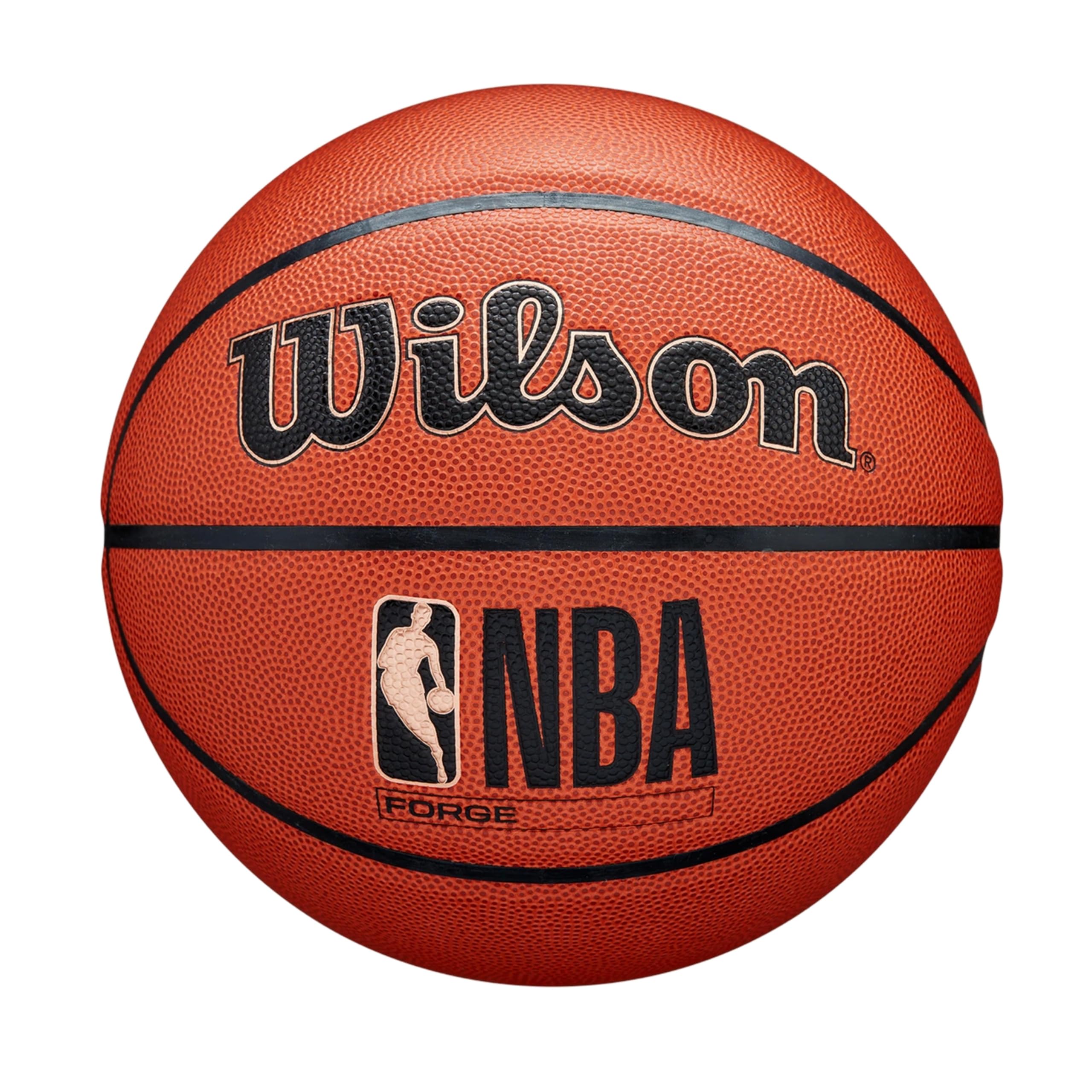


Best for Any Young Player
Wilson NBA Forge
Key Features
- Size: Size 5 – 27.5"
- Cover: PureFeel synthetic
- Construction: Multi-layer, stitched
- Play surface: Indoor and outdoor
- Price: Midrange
Size is the decision that matters most in this category, and the Wilson NBA Forge gets it right: it’s a size 5 ball at 27.5 inches, the one that fits boys and girls eight and under. That’s most of why it takes the top spot here. It’s built for indoor and outdoor play, and the Dual Depth channels carve a deeper pocket between the panels, which we noticed most when catching one-handed passes — there’s somewhere for small fingers to sit.
The cover is the other half of the case for it. This is a synthetic, multi-layer stitched ball rather than molded rubber, so it feels soft and slightly tacky instead of shiny and hard. In practice that means a kid can palm it, catch it and get a shot off without the ball squirting loose. We took it from a gym floor to a concrete driveway and back over a few sessions, watching for the cover picking up grit and going slick; a wipe with a damp cloth brought the tack back each time.
Air is the one place to stay alert. The Forge uses an inflation-retention lining, and what happens ball to ball is uneven — plenty hold pressure for months, and some want a top-up every few days. The test costs nothing: inflate to firm, leave it overnight, squeeze it the next morning. Soft means a valve or bladder problem, and that’s a return rather than something to live with.
What you’re paying for beyond the cover is the fit. This sits in the middle of the range here — more than the rubber bargain balls, less than a premium indoor game ball — and for a player who’ll use it in the driveway and at practice, that’s the sensible landing spot. The brown finish also looks like a real basketball, which matters more than it should to a kid who has noticed what the older players carry.
Pros
- Correct size 5 for players eight and under
- Deep channels give small hands a grip point
- Soft synthetic cover works in a gym or outside
- Strong record on grip and on value
Cons
- Size 5 only — older players need the 28.5-inch ball
We point almost every family at the Forge: the right 27.5-inch size, a grippy all-court cover, and a price that sits between the toy balls and the premium indoor models.
Best for Indoor League Play
Wilson Evolution
Key Features
- Size: Size 6 – 28.5"
- Cover: Composite, Cushion Core
- Approval: NFHS approved
- Play surface: Indoor only
- Price: Premium
The Cushion Core is the reason the Evolution has the reputation it does. Press a thumb into the cover and it gives; the pebbled composite runs consistent from panel to panel, and the seamless stitching means there’s no ridge for a fingertip to catch as the ball leaves the hand. It’s the softest ball in this group by a clear margin.
For a player already in a gym two or three nights a week, this is the ball we hand over first. It’s a size 6 at 28.5 inches — Wilson’s chart puts that with girls nine and up and boys nine to eleven — and it’s NFHS approved, which starts to matter the moment school ball does. The grip is the best of the ones we tested here: not sticky exactly, but soft enough that the ball rolls off the fingers cleanly on a shot.
The catch is right there in the name. This is an indoor ball, and a driveway is the fastest way to waste the money. A composite cover scuffs, peels and separates on concrete, so the lifespan of this ball on rough surfaces is genuinely unpredictable — not because the ball is fragile, but because it was never built for that surface. Keep it in gyms and it looks after itself.
Air retention is the other thing to know before you spend this much. Balls in this line can lose pressure through the valve within a few days, which is the fault that turns up most often against it. Buy from somewhere with a real return window, inflate it, and give it a week before you’re sure. The royal-and-brown colorway is a small bonus on top: it reads as a school ball rather than a toy, which is roughly what an eleven-year-old wants.
Pros
- Softest, grippiest cover in this group
- NFHS approved for school and league play
- Seamless construction for a clean release
Cons
- Premium price for a youth basketball
The Evolution is the ball we reach for indoors: the softest, grippiest cover in this group, and the right choice once your player is in a gym league.
Best for Gym and Driveway
Spalding Zi/O Tournament
Key Features
- Size: Size 6 – 28.5"
- Cover: Zi/O Tournament composite
- Arrives: Inflated and game ready
- Play surface: Indoor and outdoor
- Price: Midrange
The Spalding Zi/O fills the gap most youth shoppers fall into: it feels like a composite ball, it can go outside, and it doesn’t cost premium money. It’s a size 6 at 28.5 inches, aimed at the older end of youth basketball, and it arrives inflated and ready to play — a small courtesy that’s more welcome than it sounds if you’ve ever handed a child a flat ball on their birthday.
The Zi/O Tournament cover is foam-backed composite, and the tackiness is what we liked about it. It’s grippier than the price suggests, closer to the Evolution in the hand than to any rubber ball here, which matters when a player is moving up from a size 5 and still learning to control a bigger ball. Composite also gives you a softer catch and a cleaner release than molded rubber.
Longevity is where it gives ground. Durability on this ball is genuinely uneven — some players get a full season out of one, others see seams start to separate and the cover peel within weeks of regular use, and that split follows the surface: gym floors are kind, asphalt is not. Treat it as an indoor-first ball that can survive the occasional driveway session rather than a true all-surface workhorse.
Inflation needs watching too. It often ships with the right amount of air, but a share of these balls stop holding pressure and need topping up before every session, so run the overnight squeeze test before the return window closes. If it holds, the foam-backed cover is the part you’ll notice every session — soft on the catch, and grippy enough that a kid stops thinking about the ball and starts thinking about the shot.
Pros
- Composite feel without the premium price
- Foam-backed cover grabs well in the hand
- Arrives inflated and game ready
Cons
- Seams and cover can fail within weeks outdoors
The Zi/O is our pick when one ball has to cover both gym practice and the driveway — a composite feel at a sensible price, with a shorter outdoor life.
Best for Cheap First Ball
Champion Sports Pro-Style

Key Features
- Size: Junior, size 5 – 27.5"
- Cover: Rubber composite
- Bladder: 2-ply butyl
- Play surface: Indoor and outdoor
- Price: Budget
Some youth basketball purchases don’t need much analysis: a ball for a five-year-old, a driveway, and a budget that doesn’t stretch to composite. The Champion Sports Pro-Style is the cheapest ball in this group, a junior size 5 at 27.5 inches, and it comes in colors bright enough that a kid will actually carry it out to the hoop.
The build is honest for the money. The cover is rubber composite with molded, seamless construction, the bladder is 2-ply butyl — the same basic design you’ll find inside plenty of pricier rubber balls — and it’s rated for indoor and outdoor use, which is the only sensible rating for a ball that will live on concrete.
For that job it’s fine, and that’s the whole claim. The grip is adequate for a beginner, the bounce is lively, and nothing about it will hold a kid back while they’re learning to dribble. It’s the ball you don’t mind losing, which is a real category when the alternative is a composite ball that costs several times as much and dies on the same stretch of driveway.
Air is the risk, and it’s the biggest one here. Balls in this line can lose pressure within days and need a pump before every session, and some arrive unable to hold air at all. Order it, inflate it, and treat the first week as a test: the one that’s soft the next morning goes back, and the one that holds is a genuine bargain.
Pros
- Lowest-priced ball in this group
- Bright colors kids pick out themselves
- 2-ply butyl bladder, not a toy bladder
Cons
- Ships deflated; pump sold separately
- Cover scuffs and wears on rough concrete
For a first ball that will get scratched, kicked and left outside, the Champion gets the size and the price right; just check that it holds air.
Best for Colorful First Ball
FAKOFIS Kids Youth
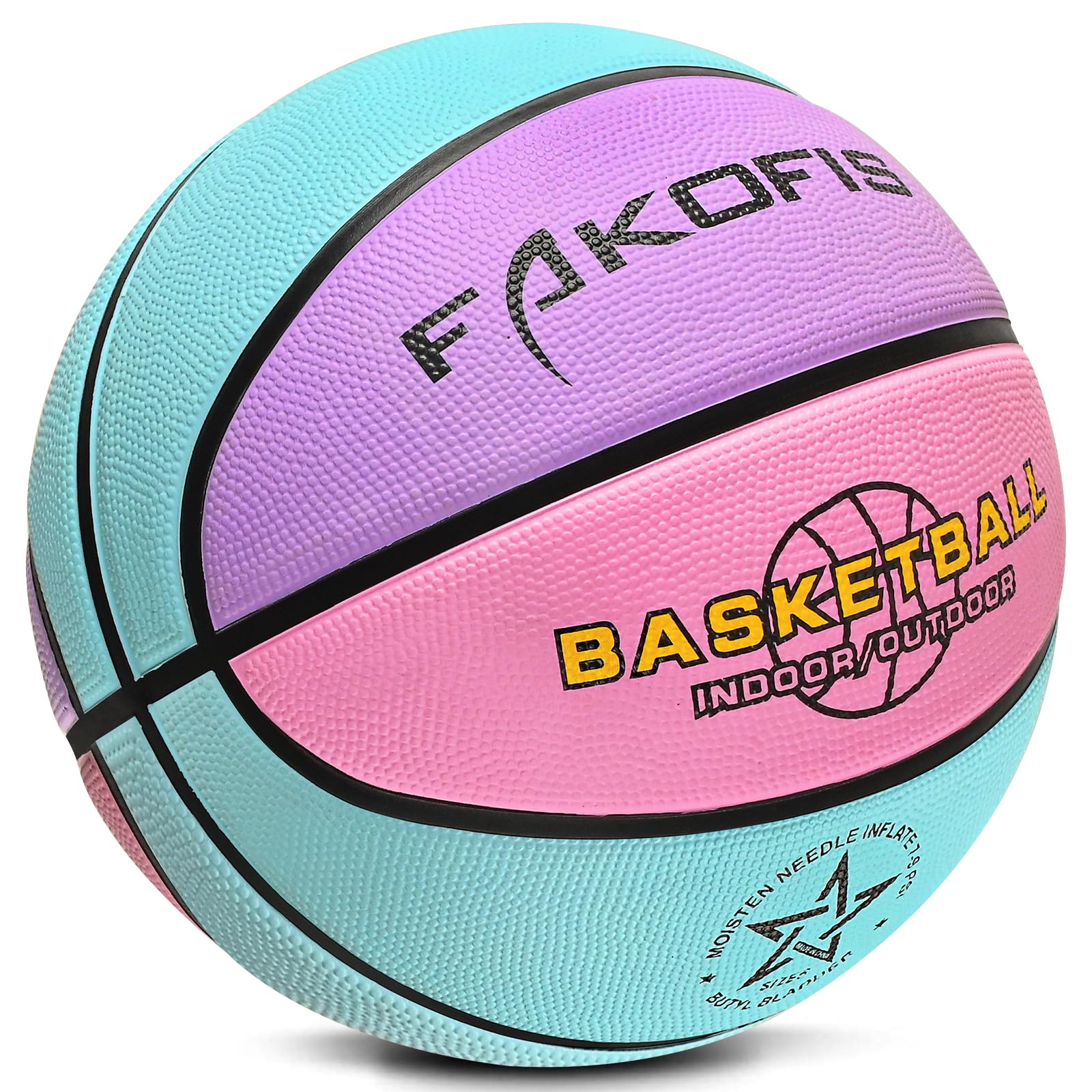
Key Features
- Size: Size 5 – 27.5"
- Cover: PU rubber
- Colors: Blue, pink, purple
- Surface: Waterproof
- Price: Budget
Walk into a youth practice and you’ll see twenty brown basketballs and one kid who can’t find theirs. The FAKOFIS comes in blue, pink and purple, and for a rec-league parent that isn’t a cosmetic detail — it’s the difference between a ball that comes home and one that doesn’t. It’s our pick for the youngest players, and the color is most of the reason.
The rest of it is sensible. It’s a size 5 at 27.5 inches, molded from PU rubber rather than hard rubber, so the surface is softer and less slippery in small hands, and there’s a waterproof cover aimed at pool games. It ships deflated, which is normal for this price bracket, so have a needle pump ready before it lands on the doorstep.
Air is where it can let you down. This is a ball that can need topping up every few days, and a few arrive unable to hold pressure at all, so inflate it, wait a day and squeeze before the return window closes. Do that and you’ve got a bright, inexpensive starter ball that a four- or five-year-old will reach for on their own — which is the whole job at that age.
Pros
- Blue, pink and purple colorways
- Soft PU cover suits small hands
- Proper 27.5-inch size 5
Cons
- Ships deflated with no pump included
For a first ball, the FAKOFIS wins on color and price: a proper 27.5-inch size 5 that a small child will actually choose to pick up.
How We Tested the Best Youth Basketballs
We started by building a shortlist of roughly 30 youth basketballs, then narrowed it by size options (most youth leagues use a size 5 for ages 9 to 11 and a size 6 for 12 to 14), cover material, whether a pump came in the box, and price. From that list we bought 14 and put them in the hands of kids ages 8 to 13 for four months.
Testing happened where youth basketball actually happens: a concrete driveway with a portable hoop, a middle-school gym on weekday evenings, and a park blacktop on weekends. At the start, we noted the pebbling and seam depth on each ball, then had kids dribble with sweaty hands and shoot free throws to see how the surface felt on small palms. We dropped every ball from waist height and again from the free-throw line and watched whether it came back straight and to the same height, which is how we judged bounce consistency.
Air retention got its own routine. We inflated each ball to the manufacturer’s recommended PSI, recorded the reading with a gauge, and checked again at two weeks and six weeks to see which ones had gone soft. Durability showed up in the details: we looked for scuffing, smoothed pebbling, exposed seams, and whether the ball still gripped after a month on concrete. The last measure was the simplest — which ball the kids reached for when nobody told them which one to use.
How to Choose a Youth Basketball
Size decides more of this purchase than brand does, so get the ball to 27.5 or 28.5 inches first, then spend the rest of your budget on the surface your player actually plays on.
Start With the Size, Not the Price
Wilson’s own chart runs 27.5 inches (size 5) for boys and girls eight and under, 28.5 inches (size 6) for girls nine and up and boys nine to eleven, and 29.5 inches (size 7) for everyone older. That chart is the most useful thing on this page, and it eliminates half the balls in a typical search.
The trap is sizing up so the ball lasts longer. A seven-year-old handed a 28.5-inch ball will change their shooting motion to compensate for something they can’t quite hold, and unlearning that takes longer than buying a second ball. If your player sits between sizes, go smaller, and if you don’t know what the league uses, ask the coach — those age bands are convention, not a rule every league follows.
Match the Cover to the Surface
Where the ball spends its life decides the cover. Rubber and rubber-composite balls are built for asphalt and concrete: harder covers, deeper pebbling, and enough abrasion resistance to survive a driveway that would shred a composite ball. Composite and synthetic covers feel softer and grip better, but they’re the wrong tool outdoors — the cover peels and the seams separate.
Indoor/outdoor is a real category rather than a marketing dodge, but it is a compromise: decent in both places, ideal in neither. Pick the surface that describes most of your play, and accept the compromise only when one ball genuinely has to do everything.
Grip and Channels Matter More for Small Hands
A young player’s hand barely spans a basketball, so they catch with fingertips where an adult gets a palm. Two things help: a soft, slightly tacky cover, and deep channels between the panels that give fingers somewhere to sit. The Wilson Forge leans on this with its Dual Depth channels, and the Spalding Zi/O’s foam-backed cover grabs in a way hard rubber doesn’t.
A slick ball is a confidence problem before it’s a skill problem. If a new ball feels shiny and hard in the hand, it’s the wrong fit for a beginner no matter what it cost.
Air Retention Is the Real Quality Gap
Nearly every ball in this category draws some complaint about going soft, and the practical difference between a good one and a bad one is how long it runs between pumps. A quality bladder and a well-seated valve hold pressure for months; a cheap one needs topping up before every session, which is the fastest way to kill a kid’s enthusiasm for practice.
The test costs nothing. Inflate the ball to firm, leave it overnight, then squeeze it the next morning. Soft means a leak. Do that inside the return window on every ball you buy and you’ll avoid most of the disappointment this category produces.
Frequently Asked Questions
Do youth basketballs come inflated?
It varies. The Spalding Zi/O arrives inflated and game ready, while the Champion Pro-Style and the FAKOFIS ship deflated and need a needle pump before the first session. Add a pump to the order rather than making a second trip — a standard hand pump with a needle is a small addition and saves the first afternoon.
Inflate in short bursts and check firmness by hand as you go. A ball should give slightly under thumb pressure; if it feels rock hard, you’ve gone too far and put strain on the seams.
How long should a youth basketball last?
Longer indoors than out, and the cover usually fails before the bladder does. A composite ball used in a gym can stay playable for years, while the same ball on concrete will scuff and peel, and a rubber ball on a driveway is a seasonal item at best.
Storage matters as much as surface: heat ruins bladders, so keep it out of a hot car or a shed in summer. Once the pebbling has smoothed to a shine that a damp cloth won’t fix, it’s finished as a game ball but still fine for practice.
Can you use these balls in a pool?
Only the one that says so. The FAKOFIS is the sole ball here with a waterproof PU surface marketed for pool play; a composite or synthetic-leather ball that spends an afternoon in chlorinated water takes on water and starts losing its cover.
Even with a pool-safe ball, a wet ball on a wet deck is a slip risk. Keep pool games to catch and shoot rather than anything with a change of direction.
Final Verdict
The Wilson NBA Forge is the ball we point most families toward. It gets the size decision right for the youngest players at 27.5 inches, the cover grips in a gym and survives a driveway, and there’s enough behind it to recommend it over the cheaper rubber balls with a clear conscience.
If your player has already grown into a 28.5-inch ball and plays organized indoor basketball, the Wilson Evolution is the better buy — softer, grippier, and worth the premium for the amount of basketball it will see.