
This post contains affiliate links. We may earn a small commission when you buy through our links — at no extra cost to you.
A basketball can feel perfect in the store — tacky, bright, properly inflated — and then spend one week on the driveway and turn into a slick, half-flat thing nobody wants to shoot with. That’s the trap with balls bought for boys: the pebble texture that grips beautifully in a gym can wear down to smooth rubber on asphalt, and a ball that’s quietly lost a few psi bounces off the rim instead of through it. What you actually want is a ball that keeps its grip once hands get sweaty, holds air past the first month, and survives concrete without becoming garage decoration.
Since early spring, my team and I have kept 10 basketballs in rotation across a driveway hoop, a school gym, a park court with cracked asphalt, and one garage where a ball gets bounced while somebody waits for dinner. The biggest thing I’ve learned: a ball that arrives underinflated or slightly out of round never really settles into a true bounce, so check it before you hand it over as a gift. Grip, air retention, and how a cover ages outdoors are what separated these picks — how they play is what your kid will notice first.
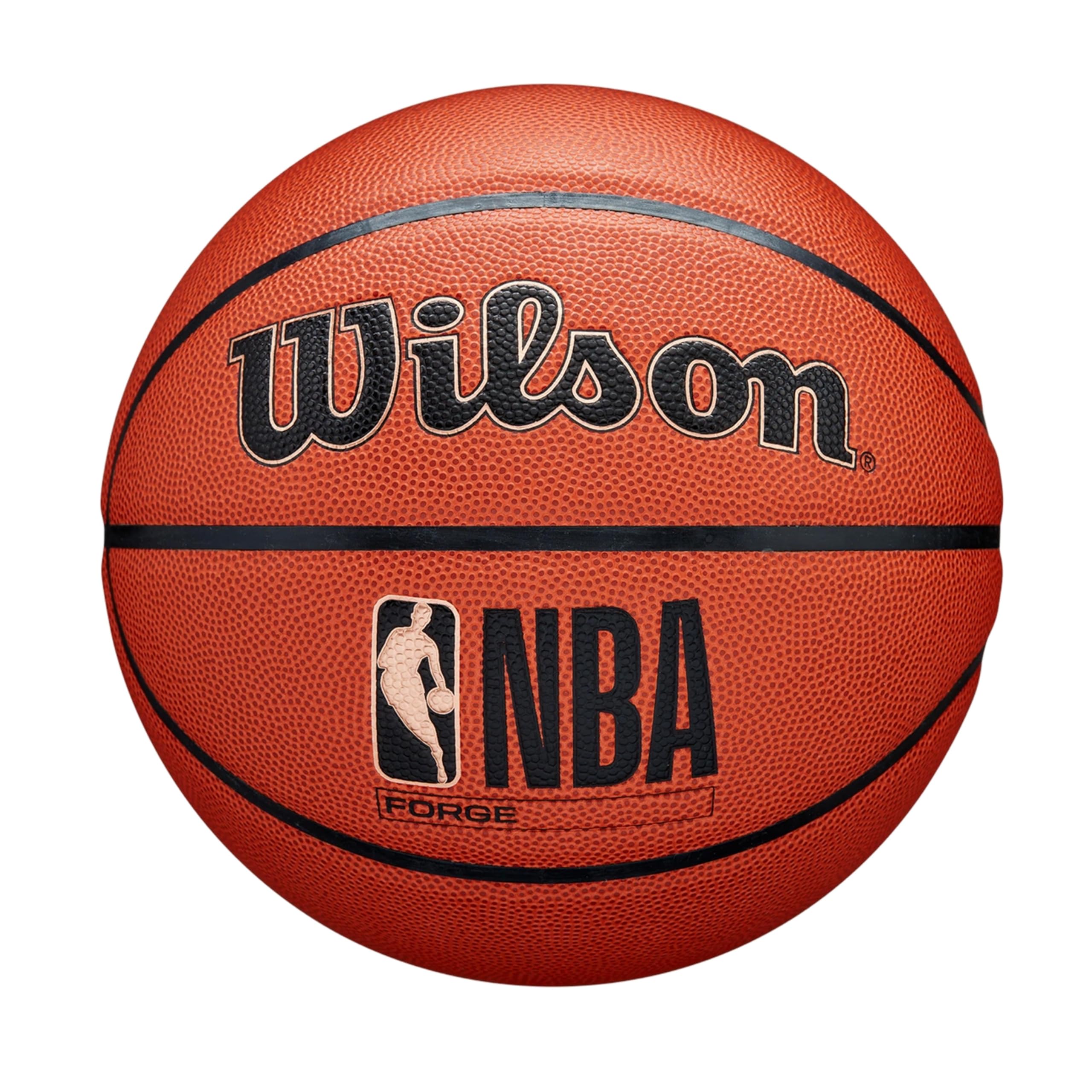


Best for Youth Players
Wilson NBA Forge Size 6
Key Features
- Size: 6 (28.5 in)
- Cover: PureFeel
- Channels: Dual-depth
- Play surface: Indoor/outdoor
- Price: Midrange
The first thing we check with a boys’ basketball is not the logo; it is whether the size lets a kid shoot without changing his form. The Wilson NBA Forge in size 6 gets that right. At 28.5 inches, it is the natural step for a boy who has outgrown a 27.5-inch ball but is not ready for a full 29.5-inch adult ball. That makes it our default for most boys in the 9-to-12 range, and the reason it tops this list.
The Forge is not just a scaled-down adult ball. Its dual-depth channels create a deeper pocket between panels, which gives smaller hands a place to settle without feeling like they are palming a slick rock. The PureFeel cover has a tacky, broken-in feel that we liked on both gym floors and driveway concrete. We also appreciate that Wilson built this as an indoor/outdoor ball; a family can leave it by the back door without treating it like a gym-only piece of equipment.
What keeps this from being a no-brainer for every boy is the size itself. A 12-year-old who is already playing with a 29.5-inch ball will find this one small, and a 7-year-old may still be better served by a size 5. But if you want one ball that fits the broad middle of youth basketball, this is the one we reach for first. It has the feel and control that make practice less frustrating, which matters more than a flashy graphic.
Pros
- Size 6 fits boys moving up from smaller balls
- Dual-depth channels help smaller hands control the ball
- Indoor/outdoor cover adds versatility
- Tacky PureFeel cover improves grip
Cons
- Air retention can need topping up
For most boys 9 to 12, this is the ball we point to first: the size fits, the grip is reassuring, and it works indoors or out.
Best for Teen Boys
Wilson NCAA Final Four Size 7
Key Features
- Size: 7 (29.5 in)
- Cover: Composite leather
- Channels: Deep
- Play surface: Indoor/outdoor
- Price: Midrange
The Forge is our default for the 9-to-12 window; the Wilson NCAA Final Four Edition is the ball we hand a boy who has moved past it. At 29.5 inches, it is the adult size, and it gives a teenager the weight and footprint he will meet in school tryouts and pickup games.
What earns it a place is the cover. Composite leather has a softer, tackier feel than the molded rubber balls here, and the deep channels give your fingers a clear place to sit. We liked the way it walked the line between indoor and outdoor use: it does not feel like a rock on a gym floor, and it is not so delicate that a driveway session feels wasteful. For a boy who practices both in a gym and on the driveway, that versatility is worth more than a specialty cover.
It is not the right ball for a 10-year-old; the size is simply too much for small hands. And if your primary court is rough concrete, a rubber ball will take the abuse with less worry. But for the boy who is already playing full-court games, this is the one that feels closest to the real thing.
Pros
- Full-size 7 for teen players
- Composite leather feels softer than rubber
- Deep channels aid control
- Works indoors and outdoors
Cons
- Air retention can need monitoring
If your boy is 12 or older, this size 7 Wilson earns our nod for its composite-leather feel and indoor/outdoor versatility.
Best for Outdoor Courts
Spalding Street Outdoor Size 7
Key Features
- Size: 7 (29.5 in)
- Cover: Molded rubber
- Weight: 1.7 lb
- Play surface: Outdoor
- Price: Midrange
Concrete is hard on a basketball. It scuffs covers, wears seams, and turns a soft composite ball into a fuzzy mess if you leave it out there. The Spalding Street Outdoor is built for that reality: molded rubber, no stitched seams, and a 29.5-inch size that matches a full-size game ball.
The rubber cover is the whole point. It feels firmer and less plush than the composite-leather picks here, and that is exactly what we want for a ball that will live in a driveway. The deep channels and pebbled surface give a secure grip even when the ball picks up dust, and the molded construction removes the stitched seams that tend to be the first thing to go on an outdoor ball. We also appreciate the honest street-ball look; it does not pretend to be an indoor game ball.
The trade-off is that this is not the ball we choose for a polished gym floor. The rubber feel is less forgiving on the hands, and the heavy 1.7-pound build is noticeable for a smaller player. If your boy plays mostly outdoors and wants a ball he can leave by the hoop, this is the one that earns the outdoor slot; if he splits time indoors, the Wilson Forge or NCAA Final Four is the better fit.
Pros
- Molded rubber takes rough outdoor surfaces
- Deep channels and pebbled surface aid grip
- Full-size 7 for teen and adult play
- No stitched seams to fray
Cons
- Air retention is the weak point
We recommend this Spalding for boys who play mostly on concrete or asphalt, where its rubber cover makes the most sense.
Best for Young Beginners
Champion Sports Pro-Style Size 5
Key Features
- Size: 5 (27.5 in)
- Cover: Rubber composite
- Bladder: 2-ply butyl
- Play surface: Indoor/outdoor
- Price: Budget
A first basketball does not need to be expensive, but it does need to be the right size. The Champion Sports Pro-Style Junior comes in a 27.5-inch size 5, which is the usual next step for a boy who is around 8 or younger. It is also priced like a starter ball, which takes some of the sting out of losing it in the yard.
The rubber composite cover is basic but useful: it grips well enough for dribbling and shooting, and the 2-ply butyl bladder is a more serious air chamber than we expect at this end of the price range. We liked the bright color options because they make the ball easy to spot in a pile of toys. The catch is that this is a budget ball, and air retention is the weak spot; check the valve before each session. For a young beginner who is still learning to dribble, that is a fair trade, but it is not the ball we choose for a serious travel-team player.
Pros
- Size 5 suits boys around 8 and under
- Rubber composite cover grips for basic play
- 2-ply butyl bladder is a stronger budget air chamber
- Bright colors are easy to spot
Cons
- Pump sold separately
For a first real basketball on a tight budget, we like this junior-size Champion, though you need your own pump.
Best for Full-Size Value
Senston Outdoor Size 7 with Pump
Key Features
- Pump: Included
- Size: 7 (29.5 in)
- Cover: Rubber
- Play surface: Indoor/outdoor
- Price: Budget
The Senston gets the practical part right: the pump is in the box. That sounds small until you remember that most basketballs ship deflated, and a ball without a pump is not playable on arrival. For a parent buying a first full-size ball, that makes this a genuine starter package rather than a ball plus a separate errand.
The ball itself is a straightforward rubber outdoor design, with a 29.5-inch size and a cover that is meant for concrete, plastic courts, and wooden floors. We like the seamless construction for outdoor use because there are fewer seams to fray, and the rubber has enough texture to feel secure without being sticky. It is not as soft or as premium-feeling as the composite-leather Wilson picks, but it costs less and includes the accessory you need. If your boy is 12 or older and you want one box that gets him playing, this is an easy value pick; if he is younger, start with the size 5 Champion or size 4 Wisdom Leaves instead.
Pros
- Pump included with the ball
- Rubber cover suits outdoor courts
- Seamless construction reduces fray points
- Full-size 7 for older boys
Cons
We think this Senston is the easiest full-size starter set because the pump comes with the ball and the rubber cover is built for outdoor use.
Best for Playground Style
AND1 Chaos Size 7

Key Features
- Size: 7 (29.5 in)
- Cover: Rubber
- Channels: Deep channel
- Play surface: Indoor/outdoor
- Price: Budget
The AND1 Chaos is the ball that gets noticed. The black-and-white chaos pattern is a long way from a plain orange game ball, and for a boy who wants his own ball to look different from everyone else’s at the park, that matters.
Underneath the graphics, it is a regulation size 7 rubber ball with deep channels and a firm, easy-to-palm feel. We found the grip reassuring for a rubber outdoor ball, and the deep-channel construction gives your fingers a clear guide when you are working on crossovers. It is not a soft composite-leather ball, and it will not feel as plush in the hands as the Wilson NCAA Final Four, but it is not trying to be.
The price is the other part of the appeal. This is a full-size ball that costs about the same as a basic youth ball, which makes it a low-risk choice for a playground or a school bag. It is also easy to spot when it rolls under a bench.
For a boy who is hard on his gear, that is a reasonable compromise. We do not choose it as the main practice ball for a serious player, but we do like it as a knockaround ball that can take a scuff and still look like it belongs on the court.
Pros
- Bold black-and-white design stands out
- Deep channels improve grip
- Regulation size 7 for older boys
- Low-cost full-size playground option
Cons
- Air retention is the weak spot
The AND1 Chaos is our pick for a boy who wants a full-size ball that stands out on the playground without spending much.
Best for Toddlers
Wisdom Leaves Size 4

Key Features
- Size: 4 (25.5 in)
- Cover: Rubber
- Bladder: Butyl
- Play surface: Indoor/outdoor
- Price: Budget
The first dribble is where a toddler’s ball either works or becomes a decoration. The Wisdom Leaves size 4 is 25.5 inches across, small enough for very young hands to push down and catch without the ball fighting back. That is the whole reason it is here.
The rubber cover has a realistic pebbled feel rather than the soft, squishy surface of a toy ball, and the butyl bladder is meant to hold shape. We liked that combination for a boy who wants to copy an older sibling: it looks and feels like a real basketball, just in a size that fits. The bright color options also make it easy to spot when it ends up under a bush.
The limitation is pressure. This is not a ball we trust to stay inflated without attention, and it ships deflated, so have a pump ready before you hand it over. For a 2- or 3-year-old who is just learning to push a ball around, that is manageable; for a 7-year-old ready for real practices, move up to a size 5 instead.
Pros
- Size 4 fits toddlers and very small hands
- Realistic pebbled rubber feel
- Butyl bladder is meant to hold shape
- Bright colors are easy to spot
Cons
For toddlers and very small hands, we choose this size 4 Wisdom Leaves ball, as long as you’re ready to top up the air.
How We Chose and Tested These Basketballs
We started by narrowing the field to balls sold in youth sizes 5 and 6, with a couple of size 7 options for older boys, and ruled out anything without a clear indoor, outdoor, or indoor-outdoor rating. From there we filtered by cover material, price, and whether the listing gave a recommended inflation range, then bought 10 to test.
For four months those 10 balls lived where boys actually play: a driveway hoop on asphalt, a gym floor, a park court, and a backyard with a gravel patch nobody aims for. We inflated each one to its recommended pressure with a handheld gauge and logged the reading, then re-checked every two weeks to see which balls held air and which ones sagged and needed pumping. We also noted how easily each valve accepted a needle without leaking.
Grip got tested at the worst possible moment — 20 minutes into play, hands sweaty, catching one-handed passes and pushing through a crossover. Every couple of weeks we ran a thumbnail across the pebble texture to feel how fast it was smoothing out, and we left the outdoor balls outside through sun and rain to watch for splitting seams, scuffed panels, and colors that faded. Bounce we judged by dropping each ball from waist height and seeing whether it came back to hand cleanly or kicked sideways, which usually meant it had gone out of round.
Nothing was penalized simply for costing less. At the end of four months we set each ball’s price next to how it looked and played, and the ones that held their shape and texture without a premium are the ones that stuck around.
How to Choose a Basketball for Boys
The right ball for a boy is mostly a size decision, followed by a cover that matches where he plays and a grip he can actually hold.
Start With the Size in His Hands
Size matters more than brand. A 25.5-inch size 4 suits toddlers and very small hands; a 27.5-inch size 5 is the usual ball for boys 8 and under; a 28.5-inch size 6 fits most boys 9 to 11; and a 29.5-inch size 7 is the adult ball for boys 12 and up. If he is between sizes, choose the smaller one for practice and skill work. A ball he can control builds better form than one he can barely palm. Our top pick, the Wilson Forge, is a size 6 for exactly that middle window.
Match the Cover to the Court
Where the ball will live matters as much as how it feels in the store. Molded rubber is the practical choice for concrete, asphalt, and dirty outdoor courts because it resists scuffs and has no stitched seams to fray; the Spalding Street Outdoor is built around that job. Composite leather feels softer and tackier, which is why the Wilson NCAA Final Four is the nicer choice for gym floors and mixed indoor/outdoor use. Do not pay for a soft indoor feel if the ball is going straight to a rough driveway; the cover will wear before the grip benefits show up.
Grip and Channels Matter More for Small Hands
A small hand needs a place to sit, not just a rough surface. Deep channels between panels give fingers a guide and make the ball easier to control while dribbling; a tacky cover helps, but it cannot make up for a ball that is too large. When you first hand over a new ball, have him grip it one-handed and try a few dribbles. If his fingers cannot find the channels or the ball feels slick after a wipe-down, size down or choose a tackier cover. The Forge’s dual-depth channels are the clearest example of this done well in our picks.
Plan for Air, Pumps, and Pressure
Most basketballs ship deflated, so a pump is part of the purchase, not an optional extra. The Senston includes one; the Champion does not. Check the valve first, inflate gradually, and stop when the ball holds its shape without feeling rock-hard. A ball that goes soft within a day has a valve or bladder problem, not a grip problem. Keep a needle and pump with the ball and check pressure before a session; that small habit prevents the dead-bounce frustration that makes a good ball feel cheap.
Frequently Asked Questions
How long should a boys’ basketball last?
There is no fixed lifespan because surface and hours matter more than the calendar. A rubber ball used on concrete will show scuffs and seam wear sooner; a composite ball kept indoors can stay playable much longer. Retire a ball when it develops a bulge, deep cuts, or a soft spot that will not hold air after you reseat the valve. A squeeze and a bounce test before each season tell you more than the ball’s age.
How should we store a basketball between games?
Keep it inflated and out of a hot car or direct sun. Heat can soften the cover and stress the bladder, while a damp bag encourages mildew and split seams. A cool, dry garage shelf or closet is fine. Wipe off outdoor grit with a damp cloth before bringing the ball inside, and let it dry completely before storing it. If it lives outside, bring it in when the weather turns.
Is a light-up basketball a good gift for a boy who plays?
It can be a fun after-dark toy, but it is not the ball we choose for regular practice. The lights and batteries add parts that can fail, and the novelty cover may not feel like a game ball. If the boy already plays on a team, buy a standard ball in his league size and keep the light-up version as an extra for the driveway. For a casual player, a brightly colored rubber ball is the safer gift.
Final Verdict
The Wilson NBA Forge in size 6 is the ball we recommend first for most boys in the 9-to-12 range. It fits the hand, grips well, and works indoors or outdoors without asking a parent to own two balls. If your boy is already 12 or older, go straight to the size 7 Wilson NCAA Final Four; its composite leather and deep channels feel more like a game ball. For a concrete-first player, the Spalding Street Outdoor is the tougher trade.