
This post contains affiliate links. We may earn a small commission when you buy through our links — at no extra cost to you.
Many portable ball pumps arrive with promises of easy inflation, only to deliver bent needles after a few uses or gauges that drift a few PSI off reality. The cheapest options rarely survive a full season, while the pricier electric models add the risk of a dead battery right before tip-off. And even the best pumps often have hidden weaknesses – like non-replaceable needles or overheating in direct sun.
The core choice comes down to manual versus electric. Manual pumps are straightforward, affordable, and always ready – but require more effort and time. Electric pumps save your arm but need charging and can have reliability hiccups. This guide explains the key differences – from inflation speed to long-term durability – so you can pick the pump that actually fits your basketball routine. Whether you’re a coach inflating 20 balls a week or a parent touching up a single basketball before practice, the right pump is out there.


Best for Coaches and Team
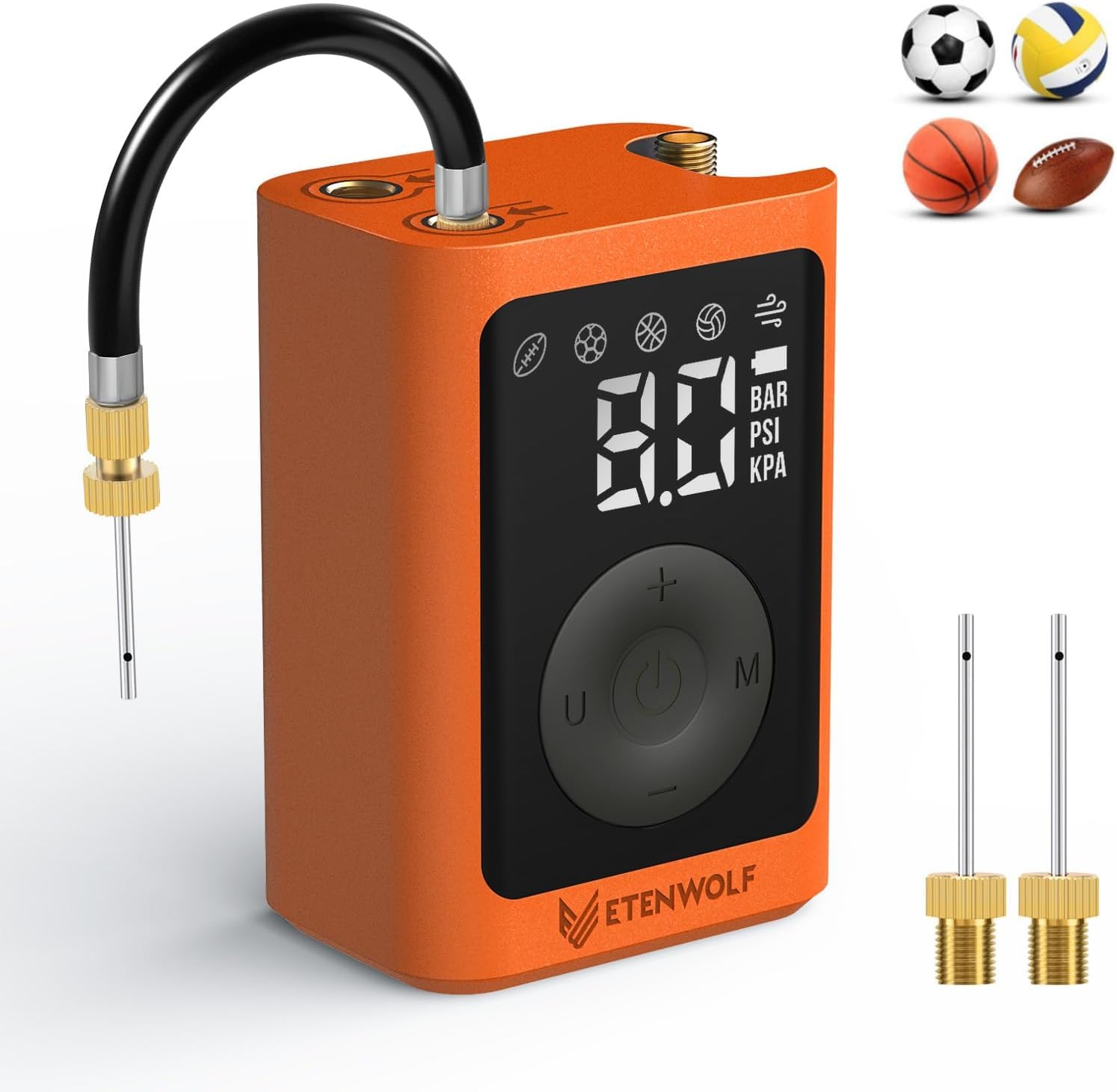
ETENWOLF P300 Plus
Key Features
- Power Source: Electric (USB-C)
- Inflate Mechanism: Electric
- Pressure & Gauge: 2–17 PSI auto-stop
- Needles: 2 needles
- Portability: Storage bag, drop-proof
- Price: $$
The P300 Plus inflates dozens of balls per charge thanks to its 3200mAh battery, and the deflation feature quickly lets down balls for storage. The drop-tested design survives the occasional tumble from a sideline table — a real advantage when gear gets knocked around. Included storage bag keeps the pump, two needles, air hose, and USB-C cable together.
This pump suits coaches and team managers who inflate multiple balls each session. The auto-stop function prevents over-inflation across the 2–17 PSI range, covering basketballs, soccer balls, and volleyballs. However, a small number of units have been noted to stop working after a few months of use. ETENWOLF’s two-year warranty and responsive support address this, so it’s worth checking the warranty terms before committing.
Pros
- Battery lasts through multiple sessions without recharging
- Drop-resistant design survives sideline accidents
- Deflation saves time when packing equipment away
Cons
- Possible early failure in isolated cases – warranty covers replacements
The P300 Plus delivers the battery and toughness needed for regular team use, with deflation as a practical bonus — verify warranty coverage if you plan heavy daily use.
Best for Parents Needing A
Franklin Ball Pump Kit
Key Features
- Power Source: Manual
- Inflate Mechanism: Single-action
- Pressure & Gauge: 150 PSI, gauge
- Needles: 3 needles
- Portability: Carry bag, hose
- Price: $
The Franklin Ball Maintenance Kit delivers everything needed for inflating basketballs, soccer balls, and volleyballs in one compact package. The included pressure gauge and carry bag make it easy to keep in a gym bag or car. Three spare needles and a flexible hose handle most valve types. This manual pump suits parents topping off kids’ balls before practice and youth coaches who need a straightforward backup. Over time the gauge may drift, so those requiring consistent precision for competitive play may want to verify occasionally. It’s not built for heavy daily use, but for occasional field or home use, it gets the job done.
Pros
- Includes a pressure gauge and carry bag for portable convenience.
- Compact and easy to use, even for children.
Cons
- Gauge accuracy may drift over time, affecting precision.
A practical manual pump for budget-conscious parents and occasional use – just keep an eye on the gauge.
Best for Travel and Backpack
REVIVL Ball Pump
Key Features
- Power Source: Manual
- Inflate Mechanism: Dual-action
- Pressure & Gauge: No gauge
- Needles: 5 needles, storage
- Portability: 3 oz, 6 in, storage
- Price: $
At just 3 ounces, REVIVL’s ball pump packs dual-action inflation and a smart needle storage compartment inside the handle, making it the most portable manual pump for athletes who toss it in a gym bag or backpack. For a completely flat basketball or soccer ball, expect to pump many strokes — better suited for touch-ups and travel than reviving fully deflated balls. Best for players who need an emergency backup or quick pressure top-off on the field, not for pre-game inflation on a flat ball.
Pros
- Integrated needle storage right in the handle — no loose accessories in your bag.
- Dual-action mechanism inflates faster than single-action pumps, reducing effort per stroke.
Cons
- Takes many strokes to inflate a completely flat ball — best for topping off, not full inflation.
A compact, lightweight companion for athletes who want a pump that disappears in a bag — just keep expectations realistic for flat balls.
Best for Referees and Serious
eBall Gauge Pump
Key Features
- Power Source: Manual
- Inflate Mechanism: Single-action
- Pressure & Gauge: 20 PSI, precise gauge
- Needles: 3 needles
- Portability: Metal body, pouch
- Price: $$
The metal body gives this pump a dense, durable feel that stands apart from plastic competitors. The built‑in gauge holds its reading over time, and the pressure release valve lets you dial in exact PSI without overinflating.
Where it slows down is moving air: inflating a completely flat basketball takes many strokes. This makes it a better fit for players or referees who already have a quick rough‑inflator and want a precise tool for game‑ready pressure, not for reviving multiple dead balls in a hurry.
Pros
- Metal build that won’t crack or flex under repeated use.
- Gauge accuracy you can trust, plus a release valve for fine adjustments.
- Includes a storage pouch and three needles for different ball types.
Cons
- Low air volume per stroke means a full inflation from flat is slow.
A precise, well‑built manual pump for players who prioritize accurate pressure over inflation speed.
Best for Coaches and Teams
ETENWOLF P300
Key Features
- Power Source: Electric (USB-C)
- Inflate Mechanism: Electric
- Pressure & Gauge: 2–17 PSI auto-stop
- Needles: 2 needles
- Portability: Drop-proof, compact
- Price: $$
The ETENWOLF P300 inflates sports balls quickly with an auto-stop that holds a chosen PSI within a wide 2–17 range. It lacks a storage bag and may stop due to overheating if used in direct sun, but for the price it handles basketballs, soccer balls, and volleyballs without fuss. This pump suits anyone who wants electric convenience without paying extra for accessories like a bag.
Pros
- Auto-stop prevents over-inflation at the selected PSI.
- Battery lasts through many balls per charge.
Cons
- In hot direct sunlight, the pump may trigger an error and stop – best used in shade.
- No carrying bag included for storage or travel.
The P300 delivers consistent electric inflation for most sports balls at a lower cost than the top pick, as long as you keep it out of direct sun and supply your own bag.
Best for Cyclists Who Also
Franklin Foot Pump
Key Features
- Power Source: Foot pedal
- Inflate Mechanism: Foot pedal
- Pressure & Gauge: 100 PSI, gauge
- Portability: Heavy, bulky, gauge
- Price: $$
Foot operation reduces arm fatigue and leaves both hands free to hold valve stems or needles — a real advantage over hand pumps. This model inflates balls, bike tires, and car tires up to 100 PSI, so it pulls double duty in a garage or car trunk. However, at over 2 pounds it’s not a field pump, and the built-in gauge can read several PSI off. The plastic hose connector and gauge housing may also crack if the pump is dropped or stored under weight. That tradeoff is manageable for someone who needs one tool for both sports balls and tire top-offs, but less ideal for dedicated ball inflation.
Pros
- Foot operation leaves hands free and requires less physical effort than hand pumping.
- Works for balls, bike tires, and car tires up to 100 PSI — one pump for multiple uses.
- Alloy steel body provides a stable base during heavy pumping.
Cons
- Pressure gauge can be off by several PSI, making it unreliable for precise ball inflation.
- Plastic hose connector and gauge housing may crack under frequent use or if dropped.
A solid foot pump for mixed tire-and-ball use, but the gauge inaccuracy and plastic parts make it a better fit for cyclists who top off balls occasionally than for anyone needing precise, portable ball inflation.
Best for Coaches Handling Multiple
Pumteck MY01 Electric

Key Features
- Power Source: Electric (USB-C)
- Inflate Mechanism: Electric
- Pressure & Gauge: 15 PSI auto-stop
- Needles: 2 needles
- Portability: Compact, USB-C
- Price: $$
Pumteck’s MY01 offers one-button presets for basketball, soccer, football, and volleyball, plus deflation for travel. However, the auto-stop sensor can occasionally fail, leading to over-inflation, and battery life may degrade within a season. At its price, the ETENWOLF P300 provides similar features with fewer reliability concerns.
Pros
- Preset ball modes make it easy to inflate four sports without manual adjustment.
- Deflation feature helps correct over-inflation and pack balls for travel.
Cons
- Sensor failure may cause the pump to over-inflate balls, requiring manual monitoring.
A convenient choice for coaches who value presets and deflation, but check the unit’s sensor reliability and compare with the ETENWOLF for a more consistent experience.
Best for Budget-Conscious Buyers
SPORTBIT Ball Pump

Key Features
- Power Source: Manual
- Inflate Mechanism: Dual-action
- Pressure & Gauge: 15 PSI, no gauge
- Needles: 5 needles
- Portability: Soft grip, compact
- Price: $
The SPORTBIT Ball Pump uses a dual-action system that inflates on both the push and pull strokes, cutting inflation time for sports balls. It’s compact and comes with five needles. However, the pump mechanism can stop working after a few uses, making it a risk for anyone needing reliable daily inflation.
Pros
- Dual-action inflates on both push and pull, cutting inflation time.
- Compact and includes five needles for different ball valves.
Cons
- Durability concern – the pump mechanism can stop working after a few uses, limiting it to occasional inflation.
Best for occasional touch-ups or as a backup in a sports bag, not for daily coaching or heavy use.
Best for Basketball Players Wanting
Wilson NCAA Pump

Key Features
- Power Source: Manual
- Inflate Mechanism: Dual-action
- Pressure & Gauge: No gauge
- Needles: 1 needle (hidden)
- Portability: 6 inches, pocket
- Price: $
The Wilson NCAA 6-inch dual-action pump is a compact option from a well-known sports brand. It fits easily in a bag and works well for casual inflation. However, it lacks a pressure gauge, and the included needle is stored in the handle, which some buyers may not notice. This makes it a simple backup rather than a primary pump for precise inflation.
Pros
- Compact size fits easily in a gym bag.
- Dual-action design cuts down on pumping effort.
Cons
- No pressure gauge – you’ll need to check ball firmness by feel.
Best for Wilson fans who want a no-gauge backup pump for occasional touch-ups.
Best for Occasional Users Who
Sports Stable Pump

Key Features
- Power Source: Manual
- Inflate Mechanism: Dual-action
- Pressure & Gauge: No gauge
- Needles: 5 needles (non-standard)
- Portability: 9 in, 4.4 oz
- Price: $
This pump inflates on both push and pull, cutting effort for occasional ball prep. Five needles are included, though their non‑standard threading makes replacements hard to find. The plastic build suits light use in a gym bag rather than daily team duty.
Pros
- Dual‑action inflates on both push and pull for faster inflation.
- Includes five needles, so spares are on hand.
Cons
- Needles use a non‑standard fitting that can make replacements hard to find.
Ideal as a backup pump for occasional use when you don’t mind sourcing replacement needles.
Best for Travelers Who Already
HYVOHEX Electric

Key Features
- Power Source: Electric (USB-C)
- Inflate Mechanism: Electric
- Pressure & Gauge: 17 PSI auto-stop
- Needles: 2 needles
- Portability: Compact, pocket
- Price: $$
This pump is impressively small and fast – filling a basketball in under a minute. USB-C charging is convenient if you carry that cable. Some units ship without the charging cable, which can frustrate buyers expecting everything in the box.
Pros
- Compact enough for a pocket or small gym bag.
- Inflation completes in about a minute, no manual effort required.
Cons
- Charging cable may not be included in the box, causing confusion for those without a spare USB‑C cable.
Best for solo travelers who already own a USB‑C cable and want a pocketable electric pump.
Best for Emergency Backup For
DDUO Ball Pump

Key Features
- Power Source: Manual
- Inflate Mechanism: Single-action
- Pressure & Gauge: 20 PSI, no gauge
- Needles: 4 needles
- Portability: 90 g, flexible hose
- Price: $
The DDUO ball pump trades any pretense of durability for the lowest price and lightest carry weight in this set. At 90 grams with four needles and a flexible hose, it fits any pocket or bag. But the build can bend needles or stall after one use – this is strictly for the emergency where you need air right now and won’t depend on the pump again.
Pros
- Extremely lightweight at 90 grams – easy to toss in a gym bag or glovebox.
- Rock-bottom entry price for occasional or one-time inflation needs.
Cons
- Needles may bend and the pump body can stop working after limited use.
Keep one in the car for the rare flat ball at the park, but grab something sturdier if you expect more than a single use.
Best for One-Time Use Or
HDNNC Portable Pump

Key Features
- Power Source: Manual
- Inflate Mechanism: Single-action
- Pressure & Gauge: 20 PSI, no gauge
- Needles: 4 needles
- Portability: 90 g, flexible
- Price: $
The HDNNC Portable Pump offers the lowest entry price among manual ball pumps and comes with four needles and two nozzles. Its lightweight build makes it easy for children to operate. However, the included needles may bend during inflation, limiting this pump to one‑time use or emergency backup rather than regular practice.
Pros
- Ultra-low price with useful accessories
- Light enough for children to handle easily
Cons
- Needles may bend during inflation
Best suited as an emergency backup or for inclusion in charity shoeboxes — not for ongoing practice sessions.
Best for Bulk Purchases For
MINGRU Ball Pump

Key Features
- Power Source: Manual
- Inflate Mechanism: Single-action
- Pressure & Gauge: No gauge
- Needles: 4 needles, 2 nozzles
- Portability: 8 in, 0.15 lbs
- Price: $
This pump packs four needles and two nozzles at a budget-friendly price, making it easy to include in donation drives or shoebox gifts. The compact 8-inch size fits small packages. However, quality control is hit-or-miss; some units may arrive with broken parts, so it’s best reserved for non-critical use where a replacement is readily available.
Pros
- Budget-friendly with four needles and two nozzles.
- Compact size fits Operation Christmas Child shoeboxes.
Cons
- Quality varies between units; some may arrive damaged.
Best for one-off donations or events where a replacement is easy to grab – not for regular practice sessions.
How to Choose
The biggest decision is whether to go manual for reliability or electric for speed – each has clear trade-offs in battery life, gauge accuracy, and durability.
Power Source: Manual vs Electric
Manual pumps are mechanical and need no charging – they work every time you pick them up, but require arm strength and patience for multiple balls. Electric pumps inflate in under a minute with the push of a button, but rely on a rechargeable battery that degrades over time and a motor that can fail.
For a coach inflating 20 balls before practice, an electric pump saves significant time but must be kept charged. For a parent doing occasional touch-ups, a manual pump is foolproof and cheaper.
Inflate Mechanism: Single-Action vs Dual-Action
Dual-action pumps push air on both the push and pull strokes, cutting the number of strokes in half. However, the air volume per stroke is often less, so the actual time savings for a completely flat basketball may only be 30–40%.
Single-action pumps are simpler, more durable, and often produce a more consistent seal. For quick touch-ups on a partially inflated ball, the difference is small. For a full inflation from flat, dual-action is noticeably faster.
Pressure Range and Gauge Accuracy
Most built-in gauges on budget manual pumps drift over time – often by 2–3 PSI after a season of use. Electric pumps with digital displays and auto-stop eliminate guesswork, but the sensor can fail, causing over-inflation.
For basketball players who need a consistent 7.5–8.5 PSI, a standalone gauge is more reliable than any built-in one. If you rely on the pump gauge, verify it periodically against a known accurate gauge.
Needle Quality and Quantity
Needles are the first component to break – cheap ones bend or snap after a few uses. Look for needles made of hardened steel with standard threads. Most budget pumps include 4–5 needles, but they often bend easily.
Spare needles are inexpensive, but non-standard fittings (like those on the Sports Stable pump) make replacements hard to find. For team use, having 5+ needles ensures you can replace a bent one quickly.
Portability: Weight, Size, and Storage
Manual pumps range from 3 oz (REVIVL) to 8 oz, while electric pumps add 4–8 oz due to the battery and motor. A carry bag or integrated needle compartment prevents lost accessories.
If you carry a pump in a gym bag, a sub-4 oz manual with storage is ideal. For a coach with a team duffel, a slightly larger electric with a bag offers the best balance of power and portability.
FAQ
Why does my electric ball pump stop inflating halfway or fail after a few months?
The most common cause is battery degradation – li-ion cells lose capacity over time, especially if fully drained repeatedly. Motor overheating or a loose USB port can also cause mid-inflation stops. To extend lifespan, avoid extreme heat and keep the battery above 20% charge. If it fails early, check the warranty – many brands offer replacement.
Can I use a ball pump needle with a tire inflator or bike pump?
Yes, but you need a needle valve adapter. Most bike pumps have a Schrader valve, while ball pump needles require a needle valve. Many manual ball pumps include an adapter. If you plan to inflate both balls and tires, get a pump that includes the appropriate fittings to avoid damaging valves.
How do I fix an inaccurate pressure gauge on a portable ball pump?
Built-in gauges on budget manual pumps often drift and cannot be recalibrated. If accuracy matters for game play, compare the reading to a standalone gauge and note the offset. If the offset is consistent, you can add or subtract that difference. If the gauge is erratic, replace the pump – a new one costs less than a quality standalone gauge.
Is dual-action actually faster than a regular hand pump for basketballs?
Yes, dual-action pushes air on both strokes, reducing the number of strokes by about 30–40% compared to a single-action pump. For a completely flat basketball, dual-action saves noticeable time and effort. For a ball that only needs a few pumps, the difference is small. It’s a worthwhile upgrade if you inflate from flat regularly.