
This post contains affiliate links. We may earn a small commission when you buy through our links — at no extra cost to you.
A basketball inflator should be simple, but the market offers a confusing split between cheap hand pumps that often snap after a few uses and electric models that add convenience yet sometimes suffer from battery or reliability issues. Many buyers end up replacing their pump within months, frustrated by bent needles or a dead motor.
The real choice isn’t manual versus electric — it’s matching the tool to how often you inflate. A parent topping off a single ball every few weeks has different needs than a coach running through 20 balls before practice. The right pump saves time and money by lasting exactly as long as you need it to.
This guide focuses on durability, accuracy, and real-world use-case fit. Whether you want a pocket-sized electric pump for the gym bag or a rugged foot pump for the garage, the picks below help you avoid the common pitfalls that turn a simple task into a recurring expense.




Best for Players, Families
Pumteck MY01
Key Features
- Mechanism: Electric rechargeable
- Pressure Gauge: Digital
- Durability: Plastic, drop-prone
- Portability: Compact
- Price: $$
The Pumteck MY01 offers one-button presets for basketball, soccer, football, and volleyball, with fast inflation and USB-C charging. A quick press starts the pump, and auto-shutoff stops at the correct PSI for each sport – no guesswork, no over-inflating. The battery holds charge for weeks of regular use, and USB-C means no hunting for a proprietary cable.
In real use, the pump fills a flat basketball to proper pressure in under a minute. The deflation function is handy for storage or travel – it sucks air out of a ball in about the same time. Where the MY01 shows its limits is the built-in pressure reading: it can be off by 0.5-1 PSI. For casual pickup games that variance hardly matters; for tournament-level prep, users should confirm with a separate gauge.
Best for basketball players, coaches, or anyone who inflates multiple balls regularly and wants the convenience of electric presets. Not meant for ultra-budget buyers who prefer a hand pump, nor for sports balls that need more than 15 PSI (some footballs are out of range). The pressure-inconsistency tradeoff matters most to precision-oriented users – for everyone else, the preset automation more than compensates.
Pros
- One-button presets with auto shutoff – dials in the right pressure for each ball without fiddling.
- Inflates a ball in under a minute – no slow pumping required.
- Deflation function makes storage and travel simpler – reverses airflow with the same hardware.
Cons
- Pressure reading can vary by 0.5-1 PSI – check with a dedicated gauge when exact PSI matters.
- A small percentage of units have been noted to stop working after several months of use.
If you want an electric pump that sets the pressure for you and fills a ball faster than a manual pump, the Pumteck MY01 delivers that convenience for a reasonable price – just keep a manual gauge handy for precision jobs.
Best for Budget Families
Franklin Ball Kit
Key Features
- Mechanism: Manual hand pump
- Pressure Gauge: Analog
- Durability: Plastic pump
- Portability: Compact with case
- Price: $
The Franklin Ball Maintenance Kit gives you a pump, three needles, hose, gauge, and carry bag for a budget-friendly price — a complete starter kit for casual ball inflation. The pump and needles can be prone to bending or breaking under frequent use, so this is best suited for occasional home use rather than regular team practice.
Its compact carrying case fits easily in a gym bag, and the manual pump delivers enough pressure for basketballs and soccer balls. The included pressure gauge provides a rough estimate, though its accuracy can drift over time.
Pros
- Compact carry bag makes the kit easy to store in a gym bag or backpack
- Complete set includes three needles and a pressure gauge so you can start inflating immediately
- Manual pump can inflate a partially flat basketball in under a minute
Cons
- Pressure gauge may lose accuracy over time, requiring a separate check for precise inflation
- Pump handle can snap and needles may bend under repeated use
A practical, low-cost option for families who only need to top off a ball every few weeks — not for coaches or teams inflating multiple balls weekly.
Best for Coaches, Teams
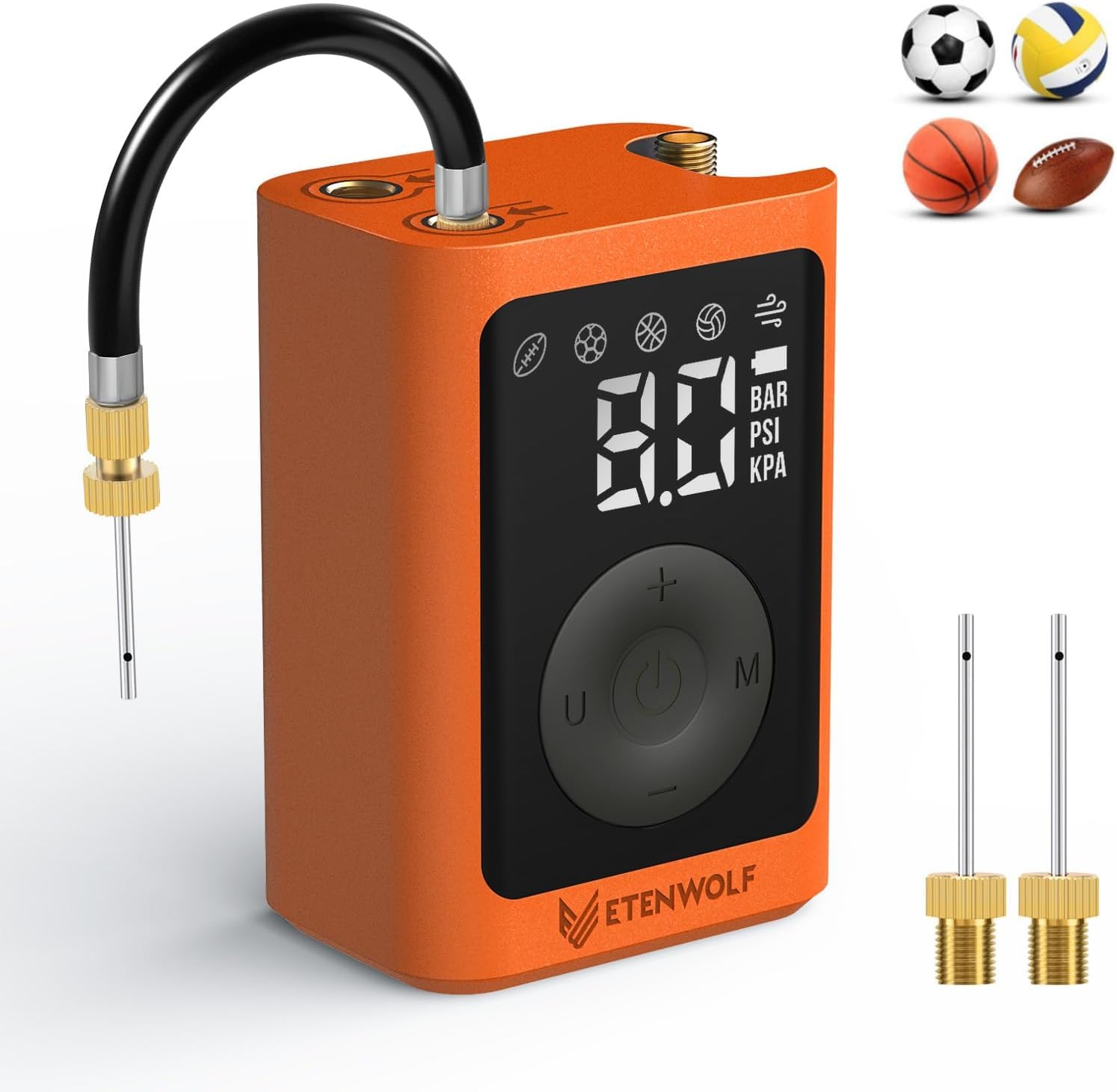
ETENWOLF P300 Plus
Key Features
- Mechanism: Electric rechargeable
- Pressure Gauge: Digital
- Durability: Drop-resistant build
- Portability: Medium with pouch
- Price: $$
The ETENWOLF P300 Plus packs a 3200mAh battery that handles dozens of inflations between charges, and its build takes falls from bench height without issue. Where the top pick balances speed and portability, this pump leans into capacity and toughness for heavy use.
This pump suits coaches or teams inflating 20+ balls per session. The included carrying bag is snug when the hose is attached, so you’ll likely want a larger pouch for daily transport — a minor trade-off for the extra battery life.
Pros
- Large battery supports multiple practice sessions without needing a recharge.
- Drop-resistant design withstands falls up to five feet without damage.
- Fast inflation with auto-stop prevents overinflation and saves time.
Cons
- Included bag requires careful arrangement to fit the pump with hose attached.
- Some units may develop electronic errors after extended heavy use.
For coaches who need a pump that can handle daily sessions without dying mid-practice, the P300 Plus delivers — just plan to replace the carry bag.
Best for Cyclists, Hand Fatigue
Franklin Foot Pump
Key Features
- Mechanism: Foot pump
- Pressure Gauge: Analog
- Durability: Alloy steel body
- Portability: Large, no case
- Price: $$
Foot pedal operation removes the arm strain of pumping dozens of strokes by hand, while the 100 PSI max pressure handles both basketballs and bike tires. The alloy steel body feels solid underfoot, though the built-in gauge tends to read off by 10 PSI or more—fine for getting a ball game-ready, not for precise tire inflation.
This pump is best suited for cyclists who already have a bike pump and want a no-hand option for game balls, or for anyone with hand or arm discomfort. Plan on bringing your own pressure gauge for exact PSI, and pick up a separate set of needles—none are included in the box.
Pros
- Effortless foot operation eliminates hand fatigue during inflation.
- High pressure capability (100 PSI) works for both bike tires and basketballs.
- Sturdy metal construction holds up well to regular use.
Cons
- Pressure gauge readings can deviate by up to 10 PSI, so precise inflation requires a separate tool.
- Plastic hose fittings may weaken or crack over time, especially if stored under pressure.
A practical foot pump for cyclists who also inflate sports balls, provided you supply your own gauge and needles.
Best for Serious Players
eBall Metal Pump
Key Features
- Mechanism: Manual hand pump
- Pressure Gauge: Analog
- Durability: Aluminum, brass
- Portability: Compact with pouch
- Price: $$
The eBall Metal Pump’s aluminum-and-brass body feels substantial and durable, a clear step up from basic plastic hand pumps. The integrated pressure gauge holds calibration well for most uses and the release valve lets you bleed off excess air without removing the pump. That combination of accuracy and control is what sets it apart – you can dial in a ball to your exact preference, stroke by stroke.
This is the pump for serious players, referees, or officials who need to fine-tune ball pressure and want a tool that won’t flex or wear out. The tradeoff is speed: inflating a completely flat ball requires many strokes, and the pump isn’t suited for quick work on multiple balls. For someone who checks pressure before each game and values precision, the slower pace is a fair compromise.
Pros
- Metal body construction that feels robust and should outlast plastic pumps
- Accurate pressure gauge with a convenient release valve for fine adjustments
- Compact enough to carry in a gym bag, includes a storage pouch and three needles
Cons
- Inflation is slow – many strokes required to fill a fully flat ball, limiting its use for quick pump-up sessions
- Gauge accuracy can drift over time, so periodic verification against a known reference is wise
A well-built manual pump for anyone who treats ball pressure as part of their game – just don’t expect it to rescue a flat ball in a hurry.
Best for Travel, Minimalists
HYVOHEX Electric
Key Features
- Mechanism: Electric rechargeable
- Pressure Gauge: Digital
- Durability: Plastic
- Portability: Pocket-sized
- Price: $$
At roughly the size of a deck of cards, the HYVOHEX Electric Ball Pump slips into a gym bag pocket or even a jacket. Despite its tiny footprint, it pushes air quickly — a flat basketball reaches playable pressure in under 30 seconds with an automatic stop at your target PSI. That convenience places it well ahead of the top pick’s slightly larger frame for anyone who prioritizes absolute portability over preset modes or deflation capability.
This pump suits minimalists and young athletes who carry a USB-C cable for their phone anyway. The digital display and integrated needle storage keep things simple, though the battery indicator can show inaccurate levels between charges — something to keep an eye on rather than a dealbreaker. It is not built for coaches inflating dozens of balls in one session; the 1500mAh battery runs low after about 6–8 full inflations.
Pros
- Fits in the palm of your hand — easy to store or carry anywhere.
- Inflates a ball in seconds with automatic stop at your chosen PSI.
- Digital display and built-in needle storage make setup straightforward.
Cons
- No USB-C charging cable in the box — you must supply your own.
- Battery level indicator can be inaccurate on some units; occasional charging hiccups are possible.
If you want the lightest, most packable electric pump and already own a USB-C cable, this is a smart buy. For anyone who prefers a complete kit or needs to inflate a high volume of balls, the top pick with presets and deflation is a safer bet.
Best for Kids, Beginners
SPORTBIT Push-Pull

Key Features
- Mechanism: Manual dual-action
- Durability: Plastic
- Portability: Compact
- Price: $
The SPORTBIT pump uses a push-pull mechanism that a child can operate independently, and the compact kit includes five spare needles for convenience. However, its 15 PSI maximum limits use to topping off partially inflated balls rather than reviving fully flat ones, and longevity varies between units. For parents wanting a spare pump in the car for kids to inflate their own balls after practice, this budget-friendly option hits the mark.
Pros
- Push-pull mechanism lets young children inflate balls without assistance.
- Comes with five spare needles, adding convenience at a low price.
Cons
- Low 15 PSI max means it cannot fully inflate completely flat basketballs.
- Durability can vary between units; some may require replacement sooner than expected.
Best as a spare pump for kids to use after school, not for coaches or teams needing consistent daily performance.
Best for Families, Youth
REVIVL Dual Action

Key Features
- Mechanism: Manual dual-action
- Durability: Plastic
- Portability: Compact, needle storage
- Price: $
This dual-action pump keeps five needles tucked inside the handle, so they’re always at hand when you need them. The push-pull design inflates faster than a single-action pump, but airflow is still modest — bringing a flat soccer ball to game pressure requires a deliberate session of pumping. For a parent grabbing it from the garage to top off a ball before practice, the compact size and integrated storage are a real convenience. Coaches or teams inflating dozens of balls weekly will find the plastic construction too light for heavy repetition and the stroke count too high for efficiency.
Pros
- Needle storage in the handle prevents losing needles — ideal for families with kids.
- Dual-action pumps on both push and pull, making it slightly faster than basic models.
Cons
- Airflow is moderate; fully inflating a larger ball like a basketball takes many strokes.
This pump fits best in a home where needle loss is the main concern and pumping a few dozen strokes per ball is acceptable — not for heavy-duty use.
Best for Backup Pump
Wilson 6" Dual Action

Key Features
- Mechanism: Manual dual-action
- Durability: Plastic
- Portability: Compact
- Price: $
Wilson brings its brand name to the budget-friendly pump segment with a dual-action design that inflates a basketball quickly. The compact handle stores an inflation needle, solving one common frustration. However, in some packages the needle may not be included, and the plastic construction can feel less substantial than pricier options. This pump works well as a spare for occasional topping-off rather than a primary tool.
Pros
- Wilson name indicates consistent build quality.
- Dual-action design inflates single balls quickly.
Cons
- Needle may be missing from the package in some cases.
- Plastic body can feel less durable than expected for regular use.
This pump suits someone who wants a low-cost backup for occasional use and doesn’t mind checking the package contents immediately.
Best for Occasional Use
Pumteck Electric V1

Key Features
- Mechanism: Electric rechargeable
- Pressure Gauge: Digital
- Durability: Plastic
- Portability: Compact
- Price: $$
The Pumteck electric pump offers a no-fuss way to inflate basketballs and similar sports balls: set the desired pressure, press start, and it stops automatically. Inflation is quick—around a minute for a standard basketball—and the compact size fits easily in a gym bag. The catch is the 12 PSI ceiling, which rules out higher-pressure balls like some footballs, and battery longevity can be inconsistent, with some units holding charge less effectively after months of use. Reliability varies between copies, so this pump suits occasional home use rather than weekly team sessions, and the lower max pressure limits its scope from the start.
Pros
- Auto-stop with pressure setting makes inflation hands-free and easy.
- Inflates a basketball in roughly one minute with portable battery operation.
Cons
- Only reaches 12 PSI, so higher-pressure balls like certain footballs are not compatible.
- Battery performance may degrade over time, and some units have charging issues after several months.
A budget-friendly entry into electric pumps for casual basketball inflation, provided you stay under the 12 PSI limit and accept that the battery and overall longevity are not built for heavy use.
Best for Emergency Only
HDNNC Portable Pump

Key Features
- Mechanism: Manual hand pump
- Durability: Fragile plastic
- Portability: Compact
- Price: $
The HDNNC pump is budget-friendly and comes with four needles, two nozzles, and an extension hose, making it a complete kit for emergency inflation of a basketball or similar ball. However, the low price reflects material compromises: the plastic components can become unreliable after a handful of uses, and each stroke pushes very little air, so getting a fully flat ball playable requires patience. This pump is best suited for one-time use or as a backup when replacement is acceptable.
Pros
- Includes four needles, two nozzles, and an extension hose at a low price.
- Compact size fits easily in a gym bag for occasional backup.
Cons
- Low air volume per stroke makes inflation noticeably slow.
- Plastic components may stop working after a limited number of uses.
Keep this pump in a glove compartment or gym bag for the rare occasion a ball needs a quick top-up, but don’t rely on it for regular use.
How to Choose
The best basketball inflator for you depends on how often you play and whether you prioritize speed or simplicity.
Inflation Mechanism
Manual hand pumps are cheap and require no batteries, but they demand physical effort and take longer to fully inflate a flat ball. Electric pumps push air quickly and stop automatically at your set pressure, but they rely on a battery that must be charged — and a dead battery means no inflation at all.
Foot pumps offer a middle ground: no hand fatigue, no electricity needed, but they are bulkier and often lack a reliable gauge. If you inflate a ball every few days, a hand pump is fine. For weekly team sessions, an electric pump saves real time.
Pressure Gauge Accuracy
Built-in gauges on budget manual pumps are often off by 1–2 PSI, which can affect ball feel during play. Electric pumps with digital readouts tend to be more accurate, but even they can drift by 0.5–1 PSI over time. If you need tournament-level precision, verify with a separate, calibrated gauge.
The trade-off: a separate gauge adds cost and something else to carry. For most casual play, the built-in gauge on a quality pump is close enough. The key is knowing that all gauges eventually lose accuracy, especially if the pump is dropped or stored in a hot car.
Durability of Pump and Needles
Needles bend or break most often because they are inserted dry at an angle. Wetting the needle before use reduces friction and extends its life. The pump body itself — whether plastic or metal — determines how long it survives. Plastic pumps under $10 often crack at the handle or cylinder within months.
For regular use, a metal-bodied pump or one with reinforced plastic joints is worth the extra cost. The trade-off is weight: metal pumps are heavier and less portable. If you only inflate once a month, a plastic pump may last years if stored carefully.
Portability and Storage
A pump that lives in your gym bag needs to be small and self-contained. Pocket-sized electric models are ideal for travel but have smaller batteries that may not handle multiple full inflations. Larger manual pumps with built-in needle storage and a carry case trade portability for durability and convenience.
Consider where you store the pump. A foot pump is great for the garage but too big for a backpack. Many electric pumps come with a pouch that barely holds the pump with the hose attached — check the bag size in reviews. The best portable option is the one you actually carry.
FAQ
Why do my inflation needles keep breaking, and how can I prevent it?
Needles typically break because they are inserted dry at a steep angle. Always wet the needle with water or saliva before pushing it into the valve. Also ensure the needle is aligned straight with the valve — any angle puts stress on the thin metal. Replace bent needles immediately to avoid damaging the ball’s valve.
How accurate are the built-in pressure gauges on ball pumps?
Most built-in gauges on manual pumps are accurate within 1–2 PSI when new, but accuracy drifts over time, especially if the pump is dropped or exposed to heat. Digital gauges on electric pumps are generally more consistent. If precise pressure matters for competition, verify with a separate, calibrated gauge.
Can I use a basketball pump for bike tires or other inflatables?
Yes, as long as the pump can reach the required PSI. Basketballs need 7–9 PSI, bike tires often need 30–100 PSI. Some hand pumps and foot pumps can handle 100 PSI, but many budget electric pumps top out at 15 PSI and cannot inflate bike tires. Check the max pressure spec before using on anything other than sports balls.
How long does an electric ball pump battery last between charges?
It depends on battery capacity and how many balls you inflate per session. A 2000mAh battery typically inflates 8–12 balls before needing a charge. Larger 3200mAh models can handle 20+ balls. Most electric pumps hold a charge for weeks when idle, but battery performance degrades after a year of regular use.