
This post contains affiliate links. We may earn a small commission when you buy through our links — at no extra cost to you.
Most electric ball pumps look identical on a spec sheet: a small cylinder, a digital gauge, and a USB port. After a few months, the differences surface. Some hold charge for weeks, others die mid-season. The real difference is which pump maintains accurate pressure.
This guide focuses on pumps that survive regular use and consistent calibration. Models that don’t drift after a few inflations and batteries that last beyond the first charge cycle. Whether you’re a coach topping off a dozen balls or a player with a gym bag, the right pump saves time.
The choice involves trade-offs between speed, portability, and gauge reliability. Electric pumps offer convenience; manual pumps win on accuracy and durability. Match the tool to your use frequency and pressure precision needs.


Best for Coaches, Parents
ETENWOLF P300
Key Features
- Max PSI: 17
- Battery: 2600mAh
- Auto Shutoff: Yes
- Deflation: Yes
- Price: $
Battery life is the standout feature here — the 2600mAh cell keeps the pump running for weeks of regular use without needing a charge. Drop it from five feet onto concrete? It survives. The auto-stop function shuts off at the preset PSI, so even kids can inflate basketballs, soccer balls, and volleyballs without overfilling. At half the size of a soda can, it slips into a gear bag without notice.
This pump suits coaches, parents, and weekend players who want consistent pressure without fiddling with manual pumps. It handles up to 17 PSI — fine for most sports balls, not for tires or high-pressure gear. The major tradeoff: it cannot be used while charging, so plan ahead. In extreme heat (triple-digit Texas summers, for instance), the motor may trigger a thermal error and pause mid-inflation. That’s an edge case for most buyers, but worth knowing if you inflate balls in direct sun on a hot day.
Pros
- Battery holds charge for weeks of regular use, reducing recharging frequency.
- Presets and auto-stop make operation simple enough for children to use independently.
- Compact enough to fit in a small pocket or ball bag without adding bulk.
Cons
- In very hot outdoor conditions, the pump may overheat and display an error — rare but possible.
- Cannot be used while the battery is charging, so plan inflation sessions ahead.
For coaches, parents, and players who want an electric ball pump with dependable battery life and accurate auto-stop without spending twice the price, the P300 is the clear choice.
Best for Coaches, Referees
Pumteck MY01
The Pumteck MY01’s preset modes cover basketball, soccer, football, and volleyball with automatic shutoff at each target pressure, and the deflation switch allows quick adjustments between uses. Pressure accuracy can vary between units, so those needing consistent PSI readings may want to double-check with a separate gauge. This pump is best suited for officials and coaches who inflate different balls regularly and appreciate the deflation feature for mid-session fine-tuning.
Pros
- Battery holds charge well between uses, supporting multiple sessions on a single charge.
- Easy to use with preset modes and automatic shutoff at the desired pressure.
- Deflation switch enables pressure reduction without needing a separate tool.
Cons
- Pressure sensor may over- or under-inflate by a small margin — verifying with a separate gauge is advisable for precision tasks.
- Included pouch is a bit tight; the pump fits best when stored without the hose attached.
Coaches who prioritize preset convenience over exact gauge precision will find the MY01 a capable daily companion.
Best for Teams
TOPUMP Electric Pump
Key Features
- Max PSI: 20
- Battery: 1400mAh
- Auto Shutoff: Yes
- Deflation: Yes
- Price: $$$
The TOPUMP inflates a basketball in under a minute, outpacing any competitor in this category. That speed comes at the cost of a pressure gauge that can overmeasure by 0.5–1.0 PSI and a 1400mAh battery that may need a mid-session recharge for heavy use. It’s best suited for teams that value rapid inflation over pinpoint accuracy and can accept occasional charging breaks.
Pros
- Inflates a basketball in about 50 seconds — fastest in category.
- Palm-sized design with carrying case.
- Digital display and deflation button simplify operation.
Cons
- Pressure gauge may read 0.5–1.0 PSI high — fine for casual play, not for tournament-ready balls.
- Battery drains faster than rivals during multi-ball sessions.
The TOPUMP delivers the fastest inflation speed available — but only if you can overlook gauge drift and smaller battery. For most daily pumpers, the ETENWOLF P300 offers better value.
Best for Players
eBall Manual Pump
The eBall pump’s aluminum and brass body gives it a sturdy edge over plastic alternatives, and the release valve paired with an easy-to-read gauge makes precise pressure checks simple. The plastic collar that holds the inflation needle can loosen or crack over time – worth inspecting before each use.
This pump suits players who need occasional pressure adjustments on already-inflated balls. The slow airflow makes reviving a fully flat ball tedious, so stick to topping off. Compact size fits easily in a bag.
Pros
- Sturdy metal construction handles regular use
- Accurate pressure gauge with a clear, easy-to-read scale
- Compact size slips into a bag without taking much space
Cons
- Slow airflow – topping off is fine, but fully flat balls demand many strokes
A sturdy manual pump with a precise gauge – best for topping off basketballs and other sports balls where accuracy matters more than speed.
Best for Budget Buyers
HYVOHEX Electric Pump
The HYVOHEX delivers automatic shutoff at a target PSI and a digital display for under $20, making it the cheapest route into electric pumps with a gauge. It lacks the battery longevity of pricier models like the P300, but for occasional use on soccer and basketballs, the 1500mAh battery gets the job done. This suits budget-conscious buyers who need a simple, portable pump for pre-game touch-ups and don’t mind checking if a USB-C cable is included — some units arrive without one or have compatibility quirks with certain chargers.
Pros
- Auto-stop at set PSI prevents overinflation with minimal effort.
- Compact enough to slip into a pocket or gear bag.
- Consistent inflation for soccer and basketballs at a low price.
Cons
- Charging cable may be missing or incompatible with some USB-C chargers.
This is the right pick if you want a functional electric pump on a tight budget and are willing to verify the cable situation. For daily use with multiple balls, consider the P300 instead.
Best for Travelers, Players
Pumteck AP1-M
The Pumteck AP1-M is the smallest electric pump we’ve tested, with a built-in lanyard and onboard needle storage that makes it easy to keep in a gym bag. Its 4 L/min airflow is adequate for topping off a slightly under-inflated basketball, but inflating a fully flat ball takes noticeably longer than faster pumps like the ETENWOLF P300. This tradeoff suits travelers and players who need occasional touch-ups rather than coaches managing multiple balls in a single session.
Pros
- Consistent inflation performance that quickly reaches target pressure for most sports balls.
- Auto-stop and preset modes make operation simple and hands-free.
- USB-C charging keeps the battery topped off for weeks between uses.
Cons
- Inflating a fully flat basketball takes a bit longer than pumps with 6.5 L/min airflow.
If you prioritize portability over speed, the AP1-M is a capable companion for gym bag carry.
Best for P300 Alternative
ETENWOLF P200
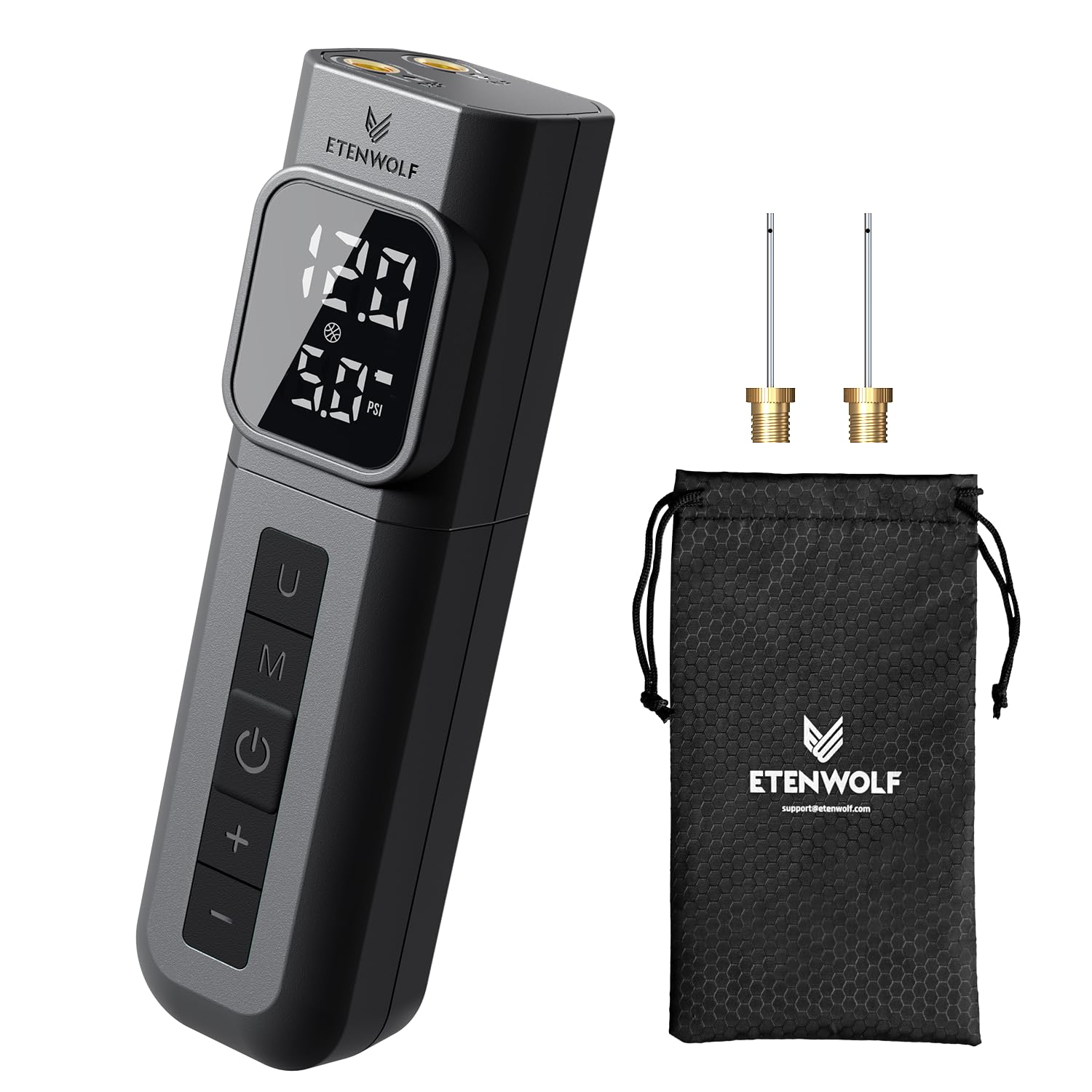
Key Features
- Max PSI: 17
- Battery: 2000mAh
- Auto Shutoff: Yes
- Deflation: Yes
- Price: $$
Fast inflation and simple presets make the P200 easy to use. It costs more than the top-pick P300 while offering a smaller battery and requiring a manual needle swap for deflation. Best as a backup when the P300 is out of stock.
Pros
- Fast inflation fills a ball in seconds
- Presets and auto-stop make operation simple
Cons
- Manual needle swap needed between inflation and deflation
A capable backup when the top-pick P300 is unavailable, but you’ll pay more for less battery life.
Best for Budget Buyers
Franklin Sports Manual

For occasional inflation of basketballs and similar sports balls, the dual-action pump and readable gauge provide good value under $20. However, the plastic collar securing the needle is fragile — it can loosen or snap, which undermines reliability for those who want a set-and-forget tool. This pump suits budget buyers willing to reinforce the needle connection or accept occasional maintenance.
Pros
- Dual-action design inflates on both strokes, cutting inflation time compared to single-action pumps.
- Built-in analog gauge allows pressure checks without separate equipment.
Cons
- Plastic collar securing the needle may break, and the needle can come loose during pumping, needing reinforcement.
Best suited for occasional use by budget-conscious buyers who don’t mind reinforcing the needle connection or replacing the collar if it breaks.
Best for Manual Control
AirSilo Electric Pump

The AirSilo pump delivers solid build quality and enough battery life to inflate several balls per charge, making it workable for basketballs and similar sports balls when you’re willing to keep an eye on the gauge. The trade-off: no automatic shutoff means you must stop it manually, and inflation speed runs slower than many alternatives — a combination that limits its appeal when auto-stop pumps cost less.
Pros
- Build quality holds up well for the price — the unit feels durable in hand.
- Battery lasts through multiple ball inflations before needing a recharge.
Cons
- Manual shutoff requires your full attention during inflation — overinflation is possible if you step away.
A functional pick if you prefer manual control and can stay present during inflation, but the same budget gets you auto-stop convenience elsewhere.
How to Choose
The real differentiator in a crowded market is not spec-sheet numbers but how long the battery lasts and whether the gauge stays accurate after months of use.
Maximum PSI Range
A basketball requires 7–9 PSI, but many pumps cap at 12–15 PSI. If you also inflate footballs (13 PSI) or rugby balls (up to 20 PSI), a higher maximum matters. Pumps with a 17–20 PSI ceiling cover all sports balls without strain.
A low max PSI forces the motor to run at full capacity near its limit, which accelerates wear. For occasional basketball-only use, 15 PSI is fine. For multi-sport coaches, 17 PSI or higher gives headroom and longer motor life.
Battery Capacity and Recharge Time
Battery capacity (mAh) directly determines how many balls you can inflate per charge. A 2600mAh battery can inflate 20+ basketballs on a single charge; a 1400mAh battery might run out mid-session. Recharge time is also critical: USB-C fast charging cuts downtime to under 2 hours.
Battery degradation is the most common failure point. Units that lack proper power management lose capacity after a few months. Look for at least 2000mAh and a warranty of 2 years to protect against premature battery failure.
Auto-Shutoff and Gauge Accuracy
Auto-shutoff stops inflation at the preset PSI, preventing overinflation and saving you from watching the gauge constantly. Not all electric pumps have it — some require manual stopping, which risks bursting a ball if you get distracted.
Gauge accuracy varies widely even among auto-stop pumps. The sensor can drift by 0.5–1.0 PSI after repeated use. Manual analog gauges are often more consistent, but they require you to pump and read simultaneously. For consistent pressure, choose a pump with positive reviews on gauge stability.
Portability and Storage
Size matters if the pump lives in a gym bag or travel backpack. The smallest models are roughly half the size of a soda can and weigh under 200g. Built-in needle storage and a lanyard prevent losing components. Larger pumps with cases offer better protection but take up more space.
Weight also affects drop risk. A pump that survives a 5-foot drop test (like the ETENWOLF P300) is far more practical for on-the-go use. Plastic bodies are lighter but more prone to cracking; metal manual pumps are heavier but nearly indestructible.
Additional Features: Presets, Deflation, and Case
Preset modes let you select ball type (basketball, soccer, etc.) and automatically stop at the correct PSI. This is a time-saver for coaches who inflate multiple types. Deflation capability is handy for storing balls or adjusting over-inflated ones — but not essential if you only top off.
A carrying case protects the pump during transport, but many included cases are too small to fit the pump with hose attached. If the case is a priority, check user photos first. Presets and deflation add complexity that can introduce calibration errors, so weigh convenience against reliability.
FAQ
What PSI should a basketball be inflated to?
The NBA recommends 7.5–8.5 PSI for official games. For casual play, 7–9 PSI is a safe range. Check the ball’s sidewall — it usually has a printed PSI range. Using a pump with an accurate gauge prevents under- or over-inflation, which affects bounce and grip.
Can an electric ball pump overinflate if the gauge is inaccurate?
Yes. If the gauge reads 0.5–1.0 PSI higher than actual, the pump will stop late and overinflate. This is a documented issue on some models. To avoid damage, test your pump’s gauge against a known accurate manual gauge occasionally. If you notice a discrepancy, stop inflating manually before the set point.
Do I really need a deflation feature on a basketball pump?
Not for routine top-offs. Deflation is useful if you frequently store balls at lower pressure or need to adjust an over-inflated ball. Coaches who pack balls tightly for travel may appreciate it. For a casual player, skipping deflation is fine; a simple needle push releases air slowly.
Why does my rechargeable ball pump stop working after a few months?
Battery degradation is the top cause. Many pumps use cheap lithium cells that lose capacity quickly, especially if stored fully discharged or charged with a high-voltage fast charger. Choosing a pump with a 2-year warranty and at least 2000mAh battery reduces this risk. Also, avoid leaving it plugged in after full charge.