
This post contains affiliate links. We may earn a small commission when you buy through our links — at no extra cost to you.
Every hoop owner dreams of shooting without chasing balls across the yard. But many shot returners introduce new problems: nets that trap the ball, plastic clips that snap, or return chutes that spin out of position. The difference between a useful tool and a headache usually comes down to build quality and hoop compatibility.
This guide breaks down the key trade-offs between rim-mounted attachments and standalone net systems. A simple plastic attachment works fine for occasional use but won’t survive outdoor seasons. A steel returner costs more but holds up longer. The right choice depends on your hoop type, budget, and how often you practice.
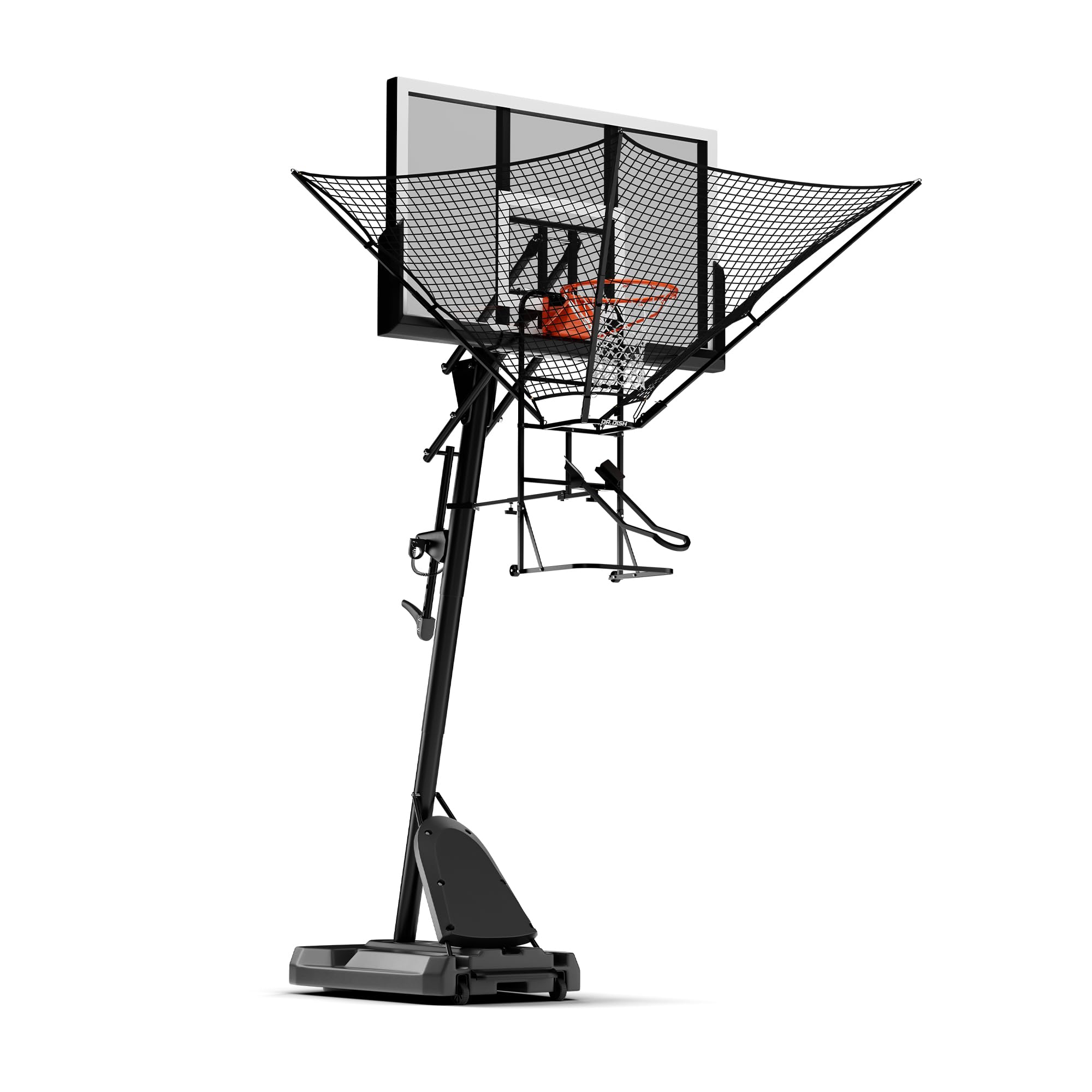


Best for Serious Training
Dr. Dish IC3 Rebounder
Key Features
- Attachment Type: Standalone rebounder
- Material: Alloy steel
- Installation: Folds, assembly required
- Return Reliability: Net-to-rim jams
- Compatibility: Standard rims
- Price: $$$
The Dr. Dish IC3’s heavy-duty steel frame and 17-inch net height deliver a consistent feedback loop that forces a higher shooting arc and maximizes rep volume. The 35-pound alloy steel build folds for storage, making it portable for team practices or solo sessions. Ball jams can occur between the return net and hoop net, but adjusting tension or trimming the hoop net usually resolves the issue quickly.
This rebounder is best for serious players, coaches running drills, and buyers willing to invest in long-term equipment. The premium build demands patience during setup — the assembly instructions aren’t well-organized, so expect to spend extra time figuring out steps. Those who prioritize durability and training effectiveness over convenience will find the tradeoffs acceptable.
Pros
- Sturdy alloy steel frame handles heavy daily use without flexing
- 17-inch net height encourages a proper shooting arc and increases shot volume
- Folds compactly for storage or transport to different courts
Cons
- Balls may get stuck between the return net and hoop net, requiring manual retrieval
- Assembly instructions can be confusing, leading to longer setup time
Serious players and teams who want high-volume, arc-correcting practice will get the most from this rebounder’s professional-grade build and training design.
Best for Casual Shooters
SKLZ Kick-Out
Key Features
- Attachment Type: Rim-mount chute
- Material: Plastic and alloy steel
- Installation: Tool-free, clip on
- Return Reliability: Chute self-rotates
- Compatibility: Most rims
- Price: $
The rotating chute returns made shots from anywhere on the court, and the 360° swivel lets you aim the return path without moving the hoop. This makes it simple to keep the ball coming back to you during solo shooting sessions.
Best for casual shooters and kids who want a quick return feature without investing in a heavy-duty unit. The plastic clips and straps can wear out within a season, and the chute may twist on its own over time — occasional ladder adjustments are part of the routine.
Pros
- Returns made shots from any position on the court, reducing ball-chasing.
- 360° swivel allows easy directional adjustment of the return chute.
- Low price point makes it an affordable entry into a ball-return setup.
Cons
- Plastic clips and straps can break within weeks of use, especially under frequent outdoor exposure.
- Chute may rotate on its own during play, requiring a ladder to realign.
This is a solid pick for occasional shooters who want a low-cost return feature and are okay with replacing parts annually.
Best for Backyard Families
Franklin Pass Back Net
Key Features
- Attachment Type: Standalone net system
- Material: Fiberglass, polyester net
- Installation: 2-person assembly
- Return Reliability: Catches makes and misses
- Compatibility: Round poles only
- Price: $$
The 10×8 ft net catches both made shots and misses, cutting down on ball chasing significantly. As a standalone system, it attaches to round poles with brackets, offering more coverage than rim-mounted return nets.
This suits backyard families with a compatible round pole hoop who want to minimize ball chasing. Some units may have weld breakage or net tearing within months, and square-pole hoops may require modifications for a secure fit.
Pros
- Large net area catches both makes and misses, reducing ball chasing.
- Two-person assembly is relatively straightforward for basic DIY skills.
Cons
- Some units experience weld breakage or net tearing within months.
- Attaching to square poles may require modifications.
For backyard families with a round pole hoop, this net’s large coverage area is a practical solution, despite occasional quality variance.
Best for Indoor/covered Use
GADFISH Metal Return

Key Features
- Attachment Type: Rim-mount metal hooks
- Material: Metal with paint
- Installation: Tool-free, 3 hooks
- Return Reliability: Screws loosen over time
- Compatibility: 18" rims
- Price: $
This return attachment swaps plastic for metal without the usual price jump. Assembly is tool-free, and the metal frame feels sturdier than budget alternatives. However, the black paint can’t prevent rust when left in rain, and screws may loosen over time, adding some wobble. It’s a practical upgrade for indoor or covered hoops, but exposed outdoor courts will test its limits.
Pros
- Tool-free assembly that takes minutes to install.
- Metal construction offers more rigidity than plastic at a similar cost.
Cons
- Screws loosen and rust forms outdoors, requiring periodic tightening and indoor storage.
Choose this when your hoop stays under a roof or covered patio — it’s a sensible metal alternative for dry conditions.
Best for Short-Term Use
Spalding Back Atcha

Key Features
- Attachment Type: Rim-mount plastic
- Material: Plastic
- Installation: Snap-on
- Return Reliability: Ball frequently stuck
- Compatibility: Spalding rims only
- Price: $
The Spalding Back Atcha snaps onto compatible Spalding rims in seconds and returns made shots at a low price. Its plastic construction can crack and fade within a season or two of outdoor use, and the ball return may be inconsistent on non-standard hoops. This is a short-term accessory for occasional use on a Spalding-branded hoop.
Pros
- Snaps onto compatible Spalding rims without tools.
- Returns made shots consistently on Spalding-branded hoops.
Cons
- Plastic housing may crack and fade after extended outdoor use.
Best for occasional backyard shooters with a Spalding hoop who see this as a disposable accessory rather than a long-term training tool.
Best for Large Coverage
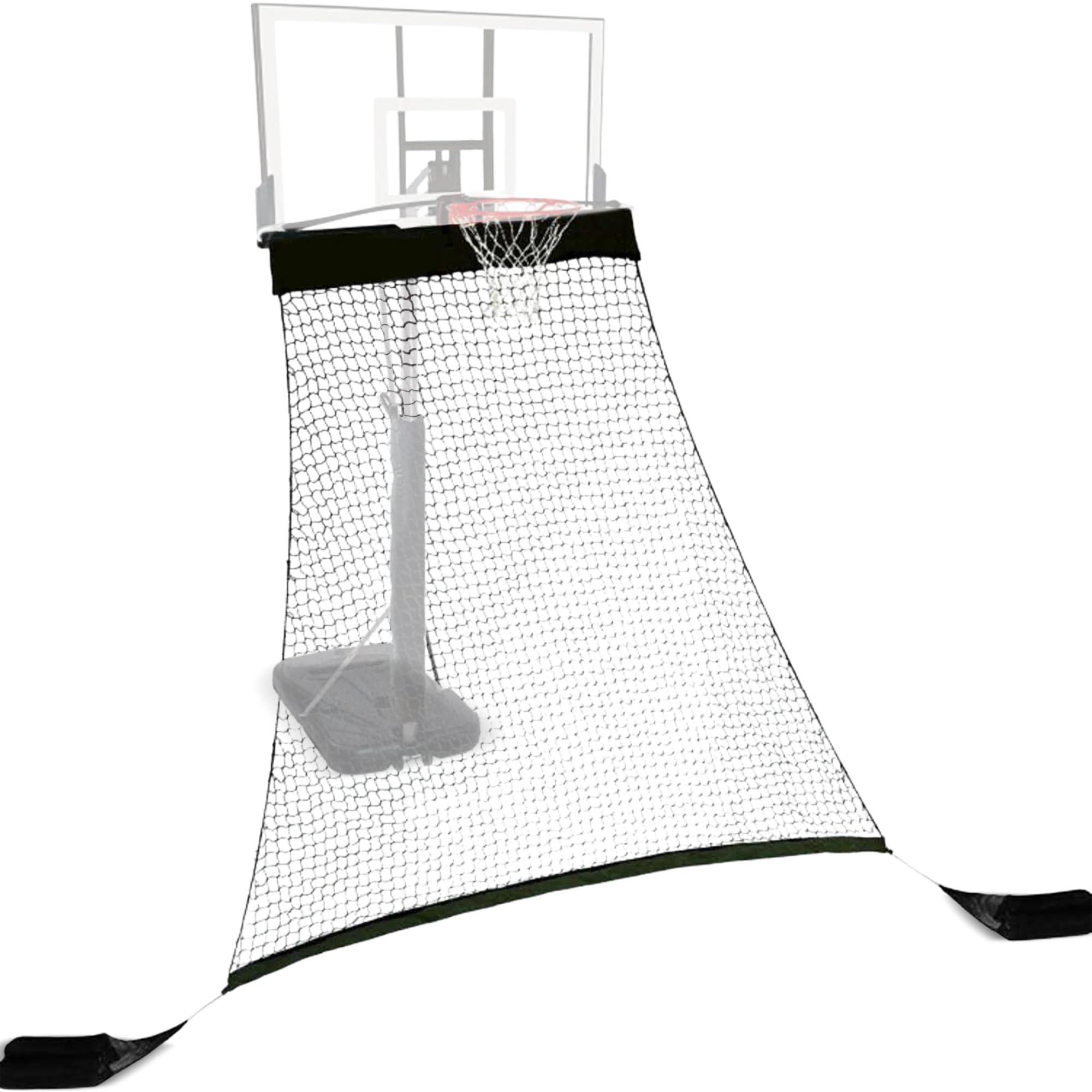
Hathaway Net System
Key Features
- Attachment Type: Standalone net system
- Material: Polyester net, webbing
- Installation: Tool-free webbing harness
- Return Reliability: Large coverage
- Compatibility: Portable hoop, anchors
- Price: $$
The 10x9x5 ft net catches missed shots from a wide radius, and the tool-free webbing harness attaches quickly to most hoops. Four refillable water bags keep the system portable without permanent installation. Without customer feedback, long-term durability under sun and rain remains unconfirmed — best for buyers who prioritize coverage and easy setup and are comfortable with unverified performance.
Pros
- Expansive 10x9x5 ft net captures shots from a wide radius, reducing ball chasing.
- Attaches to the hoop without tools using a webbing harness for fast setup.
Cons
- Outdoor durability over multiple seasons is unconfirmed — net and webbing may wear faster than expected under sun and rain exposure.
Fits best if you need a large, portable net system and are willing to accept unverified longevity — ideal for casual backyard use rather than daily training.
Best for Early Adopters
ProSlam 4-Hook

Key Features
- Attachment Type: Rim-mount 4 hooks
- Material: Alloy steel with coating
- Installation: Tool-free, adjustable chute
- Return Reliability: Stability reported variable
- Compatibility: Most rims
- Price: $$
The ProSlam attachment uses four steel hooks to secure the return chute, and the angle can be rotated to send the ball back to different shooting spots. That design sounds solid on paper, but early reports indicate some units have come apart after just a couple of weeks of use. With limited feedback on long-term build quality, this is best suited for buyers who want to test a metal 4-hook system and can easily return it if durability falls short.
Pros
- Four stainless steel hooks for a stable, wobble-free attachment.
- Adjustable chute angle returns the ball to your preferred spot.
Cons
- Some units have come apart after two weeks of use, making durability a gamble for now.
Worth a try if you’re comfortable rolling the dice on a newer metal attachment and have a straightforward return option; otherwise, stick with more established models.
How to Choose
The most important buying insight: a shot returner’s effectiveness depends more on your hoop type and practice intensity than on any single feature.
Attachment Type
Rim-mounted attachments clip directly to the rim and return only made shots from a narrow arc. They’re compact and affordable but miss wide shots entirely. Standalone net systems sit behind the hoop and catch both makes and misses, covering a much larger area but requiring a flat surface and wind anchoring.
For solo shooting practice, a rim mount works if you shoot consistently. For family use or players who take a lot of off-target shots, a net system saves more chasing.
Material Quality
Plastic attachments dominate the budget segment but degrade under UV and temperature swings. Within a year, clips become brittle and nets fade. Metal options hold shape longer, but painted steel rusts quickly in rain—look for galvanized or coated steel. Alloy steel frames like the Dr. Dish IC3 resist corrosion and handle daily use without bending.
If you plan to leave the returner outdoors permanently, prioritize stainless steel hardware or a powder-coated finish. Indoor-only use makes plastic acceptable for occasional sessions.
Installation
Tool-free clip-on designs take under a minute to attach, but their stability depends on hook design and rim shape. Four-hook systems spread the load and resist twisting better than two-hook versions. Standalone nets often require two people to assemble the frame and tension the net correctly.
A quick install is convenient, but a poorly secured returner shifts with every shot, forcing you to climb a ladder to reposition it. Factor in your patience for adjustments.
Return Reliability
Ball jams happen when the return net sits too close to the hoop net or when the chute angle is off. Many rim attachments require the hoop net to be tucked inside the return net—a detail overlooked in manuals. Chute-based returns self-rotate from shot impact, so look for models with a locking mechanism or friction clamp.
Standalone nets rarely jam but can sag over time, reducing the return angle. Polyester netting with tight mesh holds its shape longer than loose-knit alternatives.
Compatibility
Universal fit is the most exaggerated claim in this category. Rim attachments designed for Spalding hoops often require modifications on other brands. Square poles are a common mismatch—check if the bracket accepts square tubes before buying. Standalone nets with water anchors work with any hoop but need a flat, stable ground area.
Measure your rim diameter and pole shape before ordering. A returner that doesn’t fit securely becomes a safety hazard when the ball hits it.
FAQ
Why does my basketball return attachment keep getting the ball stuck?
Basketball returners jam when the hoop net sits outside the return net instead of tucked inside. Adjust the hoop net so it passes through the returner’s opening, not around it. Also, trim any dangling net strings that catch the ball. If the chute has an adjustable angle, tilt it to a steeper drop so the ball rolls out freely.
Will a rim-mounted return work on a breakaway rim?
Yes, most rim-mounted returners attach to the rim hooks and work with breakaway rims. However, if your rim flexes heavily during shots, the returner may shift or lose alignment. Look for models with a four-hook design or a strap that secures to the backboard for extra stability.
How long do plastic basketball return attachments usually last outdoors?
Plastic returners exposed to direct sunlight and rain typically become brittle and crack within 6 to 12 months. UV degrades the plastic, and temperature swings cause warping. If you keep the hoop outdoors, expect to replace a plastic attachment every season. Metal or coated steel versions last 2 to 4 years when sheltered.
Can I use a rebounder net system with a portable basketball hoop?
Yes, if the net system anchors independently with weights or ground stakes. Many standalone rebounders attach to the pole, but portable hoops can tip over if the net pulls on the pole. Choose a system with separate water- or sand-filled base weights that don’t rely on the hoop’s stability.