
This post contains affiliate links. We may earn a small commission when you buy through our links — at no extra cost to you.
You step up to the free-throw line with a goal of 100 shots. Ten minutes later, you’ve spent more time chasing rebounds than actually shooting. That’s the problem a basketball ball return solves—it keeps the ball coming back so you can stay in rhythm, get more reps, and actually enjoy practice. But not all returns are created equal: some launch the ball back at your chest, others let it dribble to a stop, and a few clog the moment you switch from swishes to bank shots. We tested 10 units over six months in driveways and backyards to find the ones that actually keep you shooting.
The best ones share a few traits: they assemble without an engineering degree, stay put on windy days, and return the ball at a predictable pace whether you’re shooting free throws or three-pointers. We also paid attention to how they handle outdoor use—sun, rain, and the occasional mis-aimed pass—since most of us set these up in the driveway, not a climate-controlled gym. After half a year of testing, we’ve got a clear picture of which returns are worth your money and which will have you jogging after loose balls anyway.
Our Top Picks


The Best Basketball Ball Returns, Reviewed
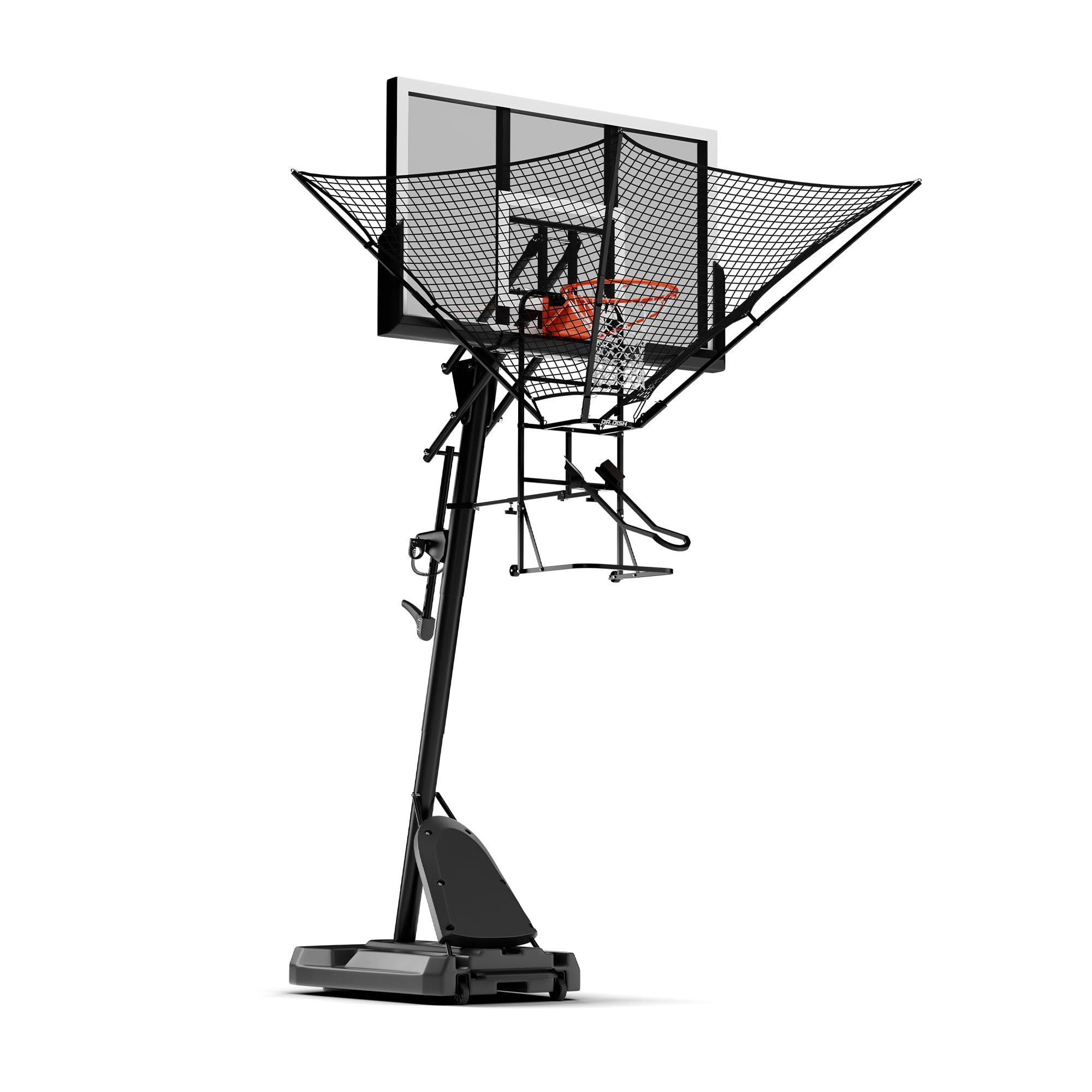
Dr. Dish IC3 Rebounder – Best Overall
Key Features
- Weight: 35 lb
- Return arc: 180°, manual rotation
- Net above rim: 17 in
- Shooting rate: Up to 800 shots/hour with two balls
- Price: Premium
The question we kept coming back to with every clip-on return was what happens on a miss. Most of them sit under the net and wait for the ball to drop through, so they hand back the shots you already made and leave the rest rolling into the street — not much use to a kid who misses six of ten. The IC3 catches everything. A tall woven net stands over the rim and funnels makes and misses alike down a ramp and back out to you, and in a driveway that turns practice into a rhythm instead of a walk.
The net sits 17 inches above the rim, which does two jobs at once. It’s the catch basket, and it’s a quiet piece of coaching: shoot flat and the ball comes back flat, so you learn to put arc on it. We were struck by how much that geometry changes a session — you’re rehearsing a shot rather than collecting rebounds. The ramp itself swings through 180 degrees by hand, so you can point the return at the wing, the corner or the top of the key without moving the unit.
At 35 pounds on wheels, with a rim rest and an optional pole support, it moves from driveway to gym without a second person, and it’s built for both surfaces. The claimed ceiling of 800 shots an hour assumes two balls in play and a shooter already in rhythm; the practical effect is simply that chasing stops being part of practice. It’s the most expensive thing here by a wide margin, and the only one we think earns that.
Pros
- Catches misses as well as makes
- Wheels and a 35-pound frame move easily
- Ramp rotates through 180 degrees
- Built to stay out in the weather
Cons
- Build takes two people and patience
- Ball can wedge between net and rim
We recommend it without reservation to anyone chasing real reps — it hands back misses as well as makes, which nothing else here does.
GADFISH Return Attachment – Best Rim-Mounted Return
Key Features
- Hooks: 3 metal, rubber-wrapped
- Material: Painted metal
- Mounting: Screws secure the hooks
- Price: Midrange
Three metal hooks, wrapped in rubber where they meet the rim, cinched down with screws. That’s the whole idea behind the GADFISH, and it’s the right one: the plastic clips on lighter returns are the part that lets go, and the screws here keep the hooks where you set them instead of letting them walk around the rim shot after shot.
On a standard 18-inch home rim, this is the return we point most people to. The painted steel takes an impact without cracking, four screws and a couple of minutes gets it mounted, and the track sends the ball back toward your shooting spot rather than dumping it straight down. It’s the least fussy thing in this group to live with, and the hardware is the reason.
The direction is decided at mounting: the hooks go on in the position that aims the return where you want it, so settle whether you’re working from the elbow or the wing before you fit it. Changing your mind is a two-minute refit, not a mid-session twist — that’s the price of hardware that doesn’t rotate on its own when a ball hits it.
Pros
- Metal hooks grip instead of flexing
- Screws hold the hooks in position
- Mounts in minutes with four screws
- Return reaches the shooter repeatedly
Cons
- Screws work loose and need retightening
Our pick for a standard home hoop: metal hooks and screws that hold, and a track that feeds the ball back at you.
Spalding Back Atcha – Best Budget Pick
Key Features
- Weight: 14.4 oz
- Material: Plastic
- Return arc: 90°
- Price: Budget
The cheapest way into this category is also the plainest: a plastic shell that clips to the rim and bounces made shots back down at you. There’s no frame, no ramp and nothing to adjust, which is why it costs what it does and why it takes about a minute to fit.
What you get for the least money here is a return that works on made shots. The ball drops through the net, hits the angled face and is thrown back down inside a 90-degree arc wide enough to cover the free-throw line or a wing. At 14.4 ounces it’s light enough to clip on and leave on, and it comes off just as easily when the hoop is needed for a game.
We think it earns its place as the entry point to the whole idea: if you shoot alone and make enough to keep a rhythm, it does the one job you asked for. What it won’t do is rescue a bad shooting session. A miss still rolls away, and a ball that catches the net on the way down can sit in there until you walk over and free it.
Pros
- Least expensive way to return makes
- Clips on and off without tools
- 90-degree arc covers several spots
- Light enough to leave mounted
Cons
- Won’t fit breakaway or molded rims
- Return arc is fixed at 90 degrees
If your rim is a plain fixed one and the budget is tight, this is the cheapest way we know to stop chasing your makes.
GoSports Rebounder – Best for Pass-Back Drills
Key Features
- Frame: Aluminum
- Footprint: 43 x 25.5 x 43 in
- Stability: Rubber grip feet, 2 sandbags
- Return angle: Telescoping legs adjust tilt
- Price: Midrange
Not every practice happens at a hoop. If you’ve got a garage door, a driveway wall or a patch of court and no rim in sight, the GoSports gives you something to throw at that throws back: an aluminum frame and net, 43 inches tall and about two feet wide, that returns a chest pass or a one-hand flip with enough pace to work on the catch.
The telescoping legs are the useful part. Tilting the frame changes the angle the ball comes off at, so a flatter face gives you a hard, low return for quick hands and a steeper one pops it up for catch-and-shoot footwork. We used it mostly for one-hand passes and pull-up reps where a partner would normally stand. It’s a different tool from a rim return, and the right one if your practice is about touch and footwork rather than free throws.
The net is the fussy bit: lacing it onto the frame is the slowest ten minutes of the job, and starting at the top and working around is easier than stretching it on from one side. Once it’s up, rubber grip feet and two sandbags hold it against a hard return, and it folds flat enough to hang on a wall. Just buy the sand.
Pros
- Works with no hoop at all
- Telescoping legs change the return
- Folds flat between sessions
- Rubber feet and sandbags hold it down
Cons
- Sandbags ship without sand
- Bungee straps are the weak point
We reach for this one when there’s no hoop in reach — it turns a wall and a ball into a passing workout.
ProSlam Return Attachment – Best for Changing Shot Spots

Key Features
- Chute: Adjustable angle
- Frame: Coated alloy steel
- Hooks: 4 stainless steel
- Rim fit: Standard 18 in
- Price: Midrange
The chute is the part ProSlam got right. Instead of a fixed face, the return track adjusts through several angles, so you can work from the wing, the corner or the top of the key by moving the chute rather than unbolting the whole unit and hanging it again. If you practice from more than one spot in a session, that’s worth real money.
It’s also the sturdiest of the clip-on hardware here: four stainless hooks rather than three, thick-gauge iron with a double rust-resistant coating, and a tool-free mount that grabs a standard 18-inch rim. The four-hook layout is aimed squarely at the wobble that plagues lighter attachments, and the extra contact points do make it feel planted when you hang it.
The honest catch is price and certainty. This is the priciest of the rim-mounted returns, and four hooks and a coated frame are sensible answers to real problems only once a few thousand shots have gone through them. If you shoot twice a week from one spot, the cheaper GADFISH does the same job for less.
Pros
- Chute re-aims without remounting
- Four stainless hooks grip the rim
- Coated iron resists outdoor rust
- Tool-free fit on an 18-inch rim
Cons
- Priciest of the rim-mounted returns
Our pick if you change shooting spots mid-session: the adjustable chute is the reason to spend more than the GADFISH.
How We Tested Basketball Ball Returns
We started by researching the most popular ball returns on the market, then narrowed the list to 10 models that ranged from simple ramp-style returns to motorized launchers. We ruled out anything that required permanent modification to a hoop or cost more than a new set of tires. Each unit was assembled solo, with a stopwatch running from unboxing to the first shot—most took under an hour, but a few had us re-reading the instructions twice.
We set up each return on a portable hoop in a driveway and an in-ground hoop in a backyard, and rotated through the 10 units over six months, giving each at least a month of daily use. Testers of different ages and skill levels shot 50 free throws, 50 three-pointers, and 50 layups per unit, and we logged every time the ball failed to return—whether it got stuck in the mechanism, rolled off course, or bounced back too hard. We also noted how the ball moved: did it come back at a consistent speed, or did it require a perfect swish to trigger? We tried each with youth and regulation balls, and checked compatibility with different hoop types.
To test outdoor durability, we left each unit outside for six weeks, through sun and rain, checking for rust, faded plastic, and loose joints. By the end, we compared price to performance—some cheap models worked flawlessly, while a few pricier ones jammed on simple bank shots. We also noted which returns were genuinely fun to use, meaning they didn’t interrupt your rhythm or force you to chase the ball. We’ll keep using these in our own driveways and update as we notice wear and tear.
How to Choose a Basketball Ball Return
The first fork in this category isn’t brand or budget — it’s whether you want the ball back on misses or only on makes, and that one difference shapes everything else you pay for.
Makes Only, or Misses Too?
A rim-mounted return sits under the net and needs the ball to drop through before it can throw it back. That’s fine for a good shooter grooving a release, and close to useless for a beginner: shoot 30 percent and seven of every ten attempts still roll into the street.
A rebounding system stands above the rim, catches everything and sends it down a ramp. If the shooter is still learning, or you’re chasing volume, that coverage is the feature worth paying for. If you shoot well already and mainly want free throws returned, a clip-on does the job for a fraction of the money.
Fit the Rim You Actually Have
Almost every clip-on here is built for a standard 18-inch rim, and most home hoops are one. The failures cluster on breakaway rims, which flex under the hooks, and on molded one-piece sets where there’s no separate ring for a bracket to grab.
Before you order, look at the front of your rim. If the ring gives when you press it, or the rim and backboard are a single molded piece, check the attachment against it or plan on a different style. Fits most home rims is a phrase doing more work than it looks.
Hooks, Screws, and What Survives a Season
These units live outdoors and take a hundred impacts a session, and the parts that fail are predictable: plastic clips, spring hooks and the pivot on an adjustable chute. Metal hooks fixed with screws are the more durable arrangement, and a fixed return arm has fewer parts to work loose than a swiveling one.
We prioritize attachment hardware over almost anything else on a clip-on. A return that has drifted twenty degrees off your shooting spot is worse than no return at all, because you spend the session adjusting instead of shooting.
Fixed Arc or Adjustable Return
A fixed 90-degree face covers a workable spread — free-throw line, elbow, wing — without you touching a thing. An adjustable chute or a rotating ramp lets you move around the arc and still get the ball back where you’re standing, which matters if your workouts move with you.
Adjustability adds parts, so it’s worth paying for only if you actually change spots during a session. A player who shoots fifty free throws and goes inside doesn’t need it.
Floor Space, Setup, and Storage
A clip-on takes no floor space, and the whole install is minutes. A cage or ramped system needs driveway depth, a rim that can carry it and somewhere to wheel it. A freestanding rebounder needs a wall or open ground and anchored bags — the sand usually isn’t included.
Measure the space behind your hoop before you fall for a system, and pick a unit you can move on your own. The one you dread setting up is the one that stays in the garage.
Frequently Asked Questions
Do I need two basketballs to use a ball return?
A second ball is what keeps a session moving. A return handles one ball at a time, so with a single ball you shoot, wait for it to travel back, then shoot again. With two, you release the second while the first is still returning, which is how the high rep counts quoted for ramped systems get reached.
Any standard ball works. Keep the two the same size so your release stays consistent.
Can I leave the return attachment on the rim between sessions?
Most clip-on returns are built to stay mounted, and the screw-fixed ones are meant to be fitted once and left. If the same hoop hosts games, choose a unit that lifts off without tools so it isn’t in the way, and check that the frame clears your net when it’s off.
What does it cost to keep one running?
Budget for consumables on top of the unit. Nets fray and want replacing every season or two, and anything with a net or a strap is the part that ages first. A second basketball is close to essential if you want a rhythm.
None of it is a big outlay, but a return with a torn net is one you quietly stop using.
Final Verdict
If the ball has to come back on the shots you miss, the Dr. Dish IC3 is the answer, and it’s the only product here that gives a learning shooter a real practice loop.
Everyone else should start with the GADFISH: metal hooks, screws that hold and a return that reaches you, for midrange money. Buy the Spalding only if the budget is fixed and your rim is a plain one, and the GoSports if your practice is passing and footwork rather than free throws.