
This post contains affiliate links. We may earn a small commission when you buy through our links — at no extra cost to you.
The worst part of solo shooting practice isn’t the miss—it’s the slow walk to retrieve the ball while your rhythm goes cold. A basketball return net fixes that by sending makes and misses back in a catchable roll, so you get up more shots without turning every drill into a fetch session. The best ones make practice fun; the weak ones wobble, assemble badly, or spit the ball sideways. After six months with 12 return nets in my driveway and on a gym floor, I’m convinced ball control, stability, durability, and plain build quality separate the keepers from the clutter.
Adjustability and shot capacity matter more than the product photos let on: a net that can’t be angled for free throws, mid-range, and deep shots gets old fast, and one that jams after a few makes breaks your rhythm. I also weighed versatility across hoops and surfaces, assembly time, and whether the price felt fair after months of use. The picks below kept returning the ball cleanly and still felt solid after hundreds of shots.
Our Top Picks



The Best Basketball Return Nets, Reviewed
SKLZ Kick-Out Return Attachment – Best Overall
Key Features
- Mount: Rim clips
- Returns: Made shots, rotating chute
- Material: Plastic over alloy steel
- Adjustment: Twist handle
- Price: Midrange
Twist the handle at the base of the chute and the Kick-Out points anywhere on the court — top of the key, elbow, block — so a made shot comes back to the spot you’re shooting from instead of dropping straight down under the rim. That adjustment is the whole reason it sits at the top of this group. Set it once for a free-throw session and you get a steady loop of catch, shoot, catch without moving your feet; swing it to the wing for the next drill and the loop follows.
The build is plastic over an alloy steel frame, and it clips onto the rim rather than bolting to it, which is why it goes on and off in a couple of minutes and can travel between hoops. Assembly is the patience test: the frame and net go together far faster with a second pair of hands, and doing it on the ground before you climb a ladder saves a lot of frustration. Once it’s seated the chute holds its setting, though hard shots can nudge it off its mark, so a quick twist before each drill keeps the return pointing where you want it.
Coverage is the catch: only made shots come back. Misses carom off the rim and away exactly as they did before, so this is a tool for a player already putting the ball through — free throws, catch-and-shoot reps, a kid who wants fifty makes before dinner. If balls leaving the driveway on every miss is the real problem, the Hathaway and Franklin nets below catch those instead. If the hoop lives outdoors all summer and takes a beating, the GADFISH’s metal hooks are the tougher build. Everyone else should start here.
Pros
- Points made shots at any spot on the court
- Clips on and off a standard rim in minutes
- Twist handle changes direction without tools
- Turns a make into a rep, not a retrieval
Cons
- Only made shots come back; misses still bounce away
- Plastic hooks and clips are the wear point
The return attachment we tell most players to buy: the chute points wherever you’re shooting from, it clips onto a standard rim, and it turns a made shot into another rep instead of a jog.
GADFISH Basketball Return Attachment – Best Fixed-Direction Attachment
Key Features
- Mount: 3 screw-mounted metal hooks
- Returns: Made shots, set direction
- Material: Painted metal
- Warranty: Lifetime
- Price: Budget
Three metal hooks, each with a rubber sleeve and a screw to snug it down, is a plainer approach than a clip-on chute, and for plenty of shooters a better one. The rubber grips the rim instead of sliding across it, and the screws hold firmer than a plastic clip under a hard make. You set the return direction when you mount it — unhook, turn, hook back — which suits a shooter working one spot far more than a coach running a circuit.
What we appreciate most is how little there is to go wrong. It’s painted metal throughout, assembly is four screws and a minute of work, and there’s no chute to drift or clip to pop loose mid-session. The hooks want re-tightening now and then, which is the price of a mount that doesn’t shift in the meantime. For someone who plants at the free-throw line and stays there, this is the tougher of the two rim-mounted options in this group, and it’s the cheaper one.
Pros
- Metal hooks grip the rim without sliding
- Screw mounting holds firmer than plastic clips
- Four-screw assembly takes a minute
Cons
- Weld joints can fail under hard, repeated rim contact
For a shooter who works one spot at a time, the GADFISH’s screw-down metal hooks grip the rim firmer than the plastic clips on the other attachments here, and it costs less than our top pick.
Hathaway Rebounder Return System – Best Value Full Net
Key Features
- Anchors: 4 refillable 1.5-gallon bags
- Storage: Nylon carry bag
- Net size: 10 ft x 9 ft x 5 ft
- Fits hoops: 48-60 inches
- Price: Midrange
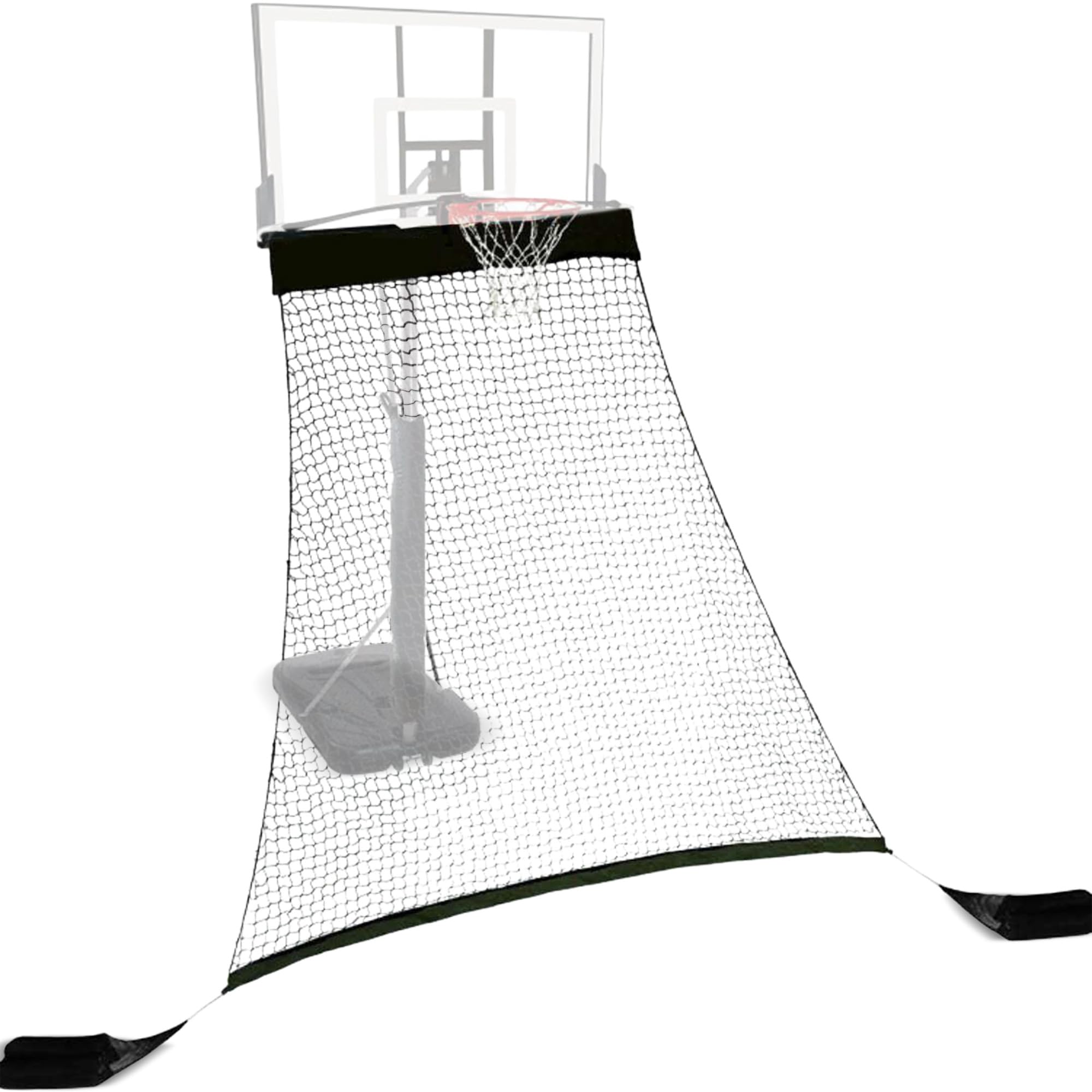
A rim attachment only pays off on made shots. The Hathaway takes the other half of the problem: a 10 ft x 9 ft x 5 ft polyester net that hangs off the hoop and catches what comes off the rim, so the airball and the long rebound stay in your driveway instead of the neighbor’s flowerbed. The coverage is the point — you’re not collecting makes, you’re deleting the jog that follows every miss.
It goes on without tools. A webbing harness wraps the hoop and the net hangs from that, and the listing rates it for 48- to 60-inch hoops, so measure across yours before you order. Four 1.5-gallon bags anchor the far end and you fill them on site — water is the easy option, sand the permanent one. The whole thing packs into a nylon bag, which matters more for the off-season than for a weekly trip to the park.
What you give up is the pass. This net catches the ball and holds it rather than feeding it back to your shooting spot the way a chute does, so you’ll still walk over between sets. For a family driveway where three people shoot at once and the goal is fewer balls in the street, that’s a trade worth making, and it’s the least expensive full-size net here by a wide margin. It’s the one we point at a hoop that never moves.
Pros
- Catches misses, not just made shots
- Tool-free webbing harness fits 48-60 inch hoops
- Four refillable anchor bags hold it steady
- Packs into a nylon bag for storage
Cons
- Anchor bags can split and spill their fill
The lowest-cost way to stop chasing misses: a 10-by-9-foot hoop-mounted net with four refillable anchors that keeps the ball in your driveway instead of the neighbor’s flowerbed.
Franklin Defender Pro Rebounder – Best for Portable Hoops
Key Features
- Mount: Any portable hoop system
- Weight: 16 lb
- Storage: Folds for storage
- Net size: 10 ft x 8 ft
- Price: Premium
Most return nets assume a pole that never moves. The Defender Pro assumes the opposite: it straps to any portable basketball system, so the net travels with the hoop instead of staying behind when the whole thing folds into the garage. At 10 feet wide and 8 feet tall it covers a wide arc behind the board, and the fiberglass frame keeps the unit at 7.24 kg, light enough to reposition without help.
The fold-up design is what we keep coming back to. The arms collapse and the net gathers in against the pole, so it stops dominating a driveway that also has to fit a car. That’s the difference between a net you leave up and one you resent by July. First assembly is a two-person job — the frame wants to be standing while the net is laced — and after that it’s a couple of straps and a fold.
If your hoop never moves, the Hathaway covers similar ground for less money and doesn’t ask you to lace a frame. The Defender Pro is worth its price when portability is the whole point: a hoop you wheel to the edge of the driveway, a season that ends with everything stowed.
Pros
- Straps to any portable hoop system
- Folds flat against the pole
- 10-by-8-foot catch area
- Fiberglass frame at 7.24 kg
Cons
- Netting is the first thing to tear
If your hoop is a portable system you roll out and put away, the Defender Pro straps on without tools, folds flat against the pole, and gives you a 10-by-8-foot catch area.
Dr. Dish IC3 Shot Trainer – Best for High-Volume Training
Key Features
- Return: 180-degree rotating ramp
- Weight: 35 lb
- Coverage: Made and missed shots
- Portability: Wheels
- Price: Premium
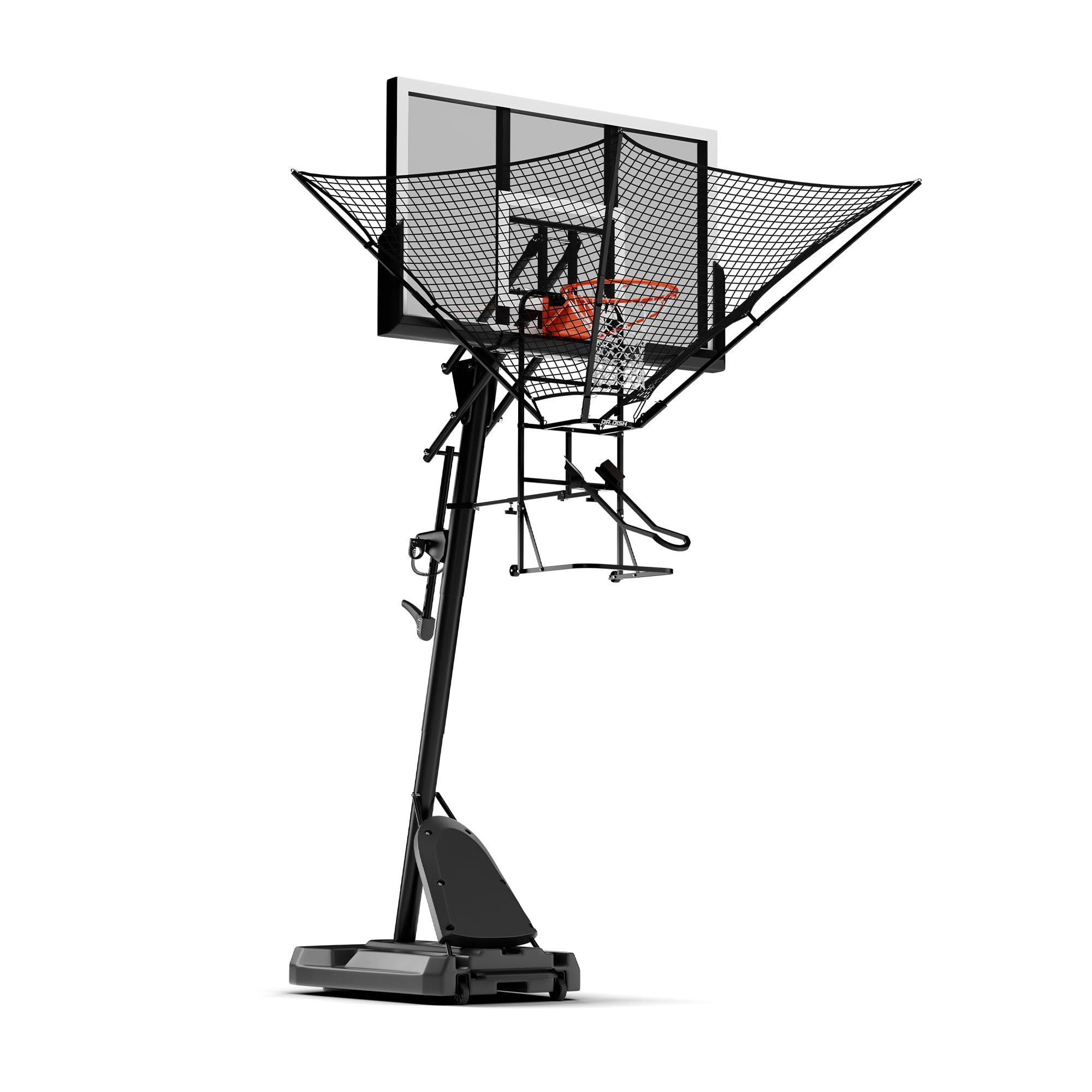
The listing claims up to 800 shots an hour with two balls, and the honest version is that this is the only device here built to get close: it returns makes and misses alike through a ramp you swing around the court. Nothing else in this group touches a missed shot. If you’re running structured workouts rather than shooting around, that difference is the whole ballgame — you stop being your own rebounder.
The mechanism is straightforward. A 3-inch weave net on a vertical frame rests on the rim with the net sitting 17 inches above it, and the return ramp rotates by hand through 180 degrees so you can work one spot or move around the arc. Because the net sits above the rim it also demands arc — a flat jumper hits the netting and dies, which is the kind of feedback a shooting coach charges for. Wheels and 35 pounds make it movable, indoors or out.
The build is the part to plan for. Assemble it with a second person and the pictures to hand, because the printed instructions are thin and the frame is awkward alone — the sort of job to finish the day before, not an hour before practice. Past that, this is the tool that turns a half hour in the driveway into a workout.
Pros
- Returns both made and missed shots
- Ramp rotates 180 degrees around the court
- Raised net trains arc on the jumper
- Wheels and 35 pounds make it movable
Cons
- Balls can wedge between the net and the rim
This is the one we point serious shooters to when the budget allows: it returns made and missed shots, swings the return through 180 degrees, and turns a session into hundreds of reps.
GoSports Basketball Rebounder – Best for Pass-Back Drills

Key Features
- Type: Freestanding pass-back rebounder
- Frame: Adjustable aluminum
- Anchors: Two sandbags, sand not included
- Footprint: 43 x 25.5 x 43 inches
- Price: Midrange
Start with what this isn’t: it doesn’t clip to a rim, it doesn’t catch shots, and it won’t stop a missed jumper from reaching the street. The GoSports is a freestanding rebounder — you throw the ball at it and it comes back — with telescoping legs that change the angle of the net and the height of the return. Rubber grip feet and two sandbags hold it upright, and it folds down when you’re done.
Where it earns a place is the drill a rim chute can’t do: catch-and-shoot footwork, pass-back reps, one-hand form work when nobody’s around to feed you. There’s a real pleasure in a training aid that sets up in a driveway in minutes and asks nothing of your hoop. It also earns its keep in a household where basketball isn’t the only sport, since the same net takes a soccer ball or a baseball. Treat it as a training partner rather than a ball return and it does that job well; buy it expecting the ball to come back off your rim and you’ll be disappointed.
Pros
- Works without a partner or a hoop
- Telescoping legs set return angle and height
- Takes soccer balls and baseballs too
Cons
- Sand for the two ballast bags isn’t included
- Straps and bungees are the wear point
Worth owning for pass-back and form work when you have no partner and nothing to hang a net on — just don’t expect it to catch shots or mount to a rim.
How We Tested Basketball Return Nets
My team and I started with a list of roughly 30 return nets sold for home courts, driveways, and gym use, then filtered by attachment style, footprint, frame material, net design, adjustability, and price. We landed on 12 models and used each for six months.
Setup happened in my driveway on a Saturday morning: I timed how long each took me to assemble alone, noted whether the instructions made sense without extra tools, and took the first shot only after checking that every strap and joint felt snug. During twice-weekly sessions on my driveway and a gym floor, I shot free throws, elbow jumpers, and deeper attempts, changing the return angle between sets. I watched whether the ball came back flat and catchable or bounced away, how many makes it could handle before a jam, and whether the frame crept after a hard rim shot or a gust of wind. Friends joined for catch-and-shoot drills; the nets that kept us moving were the ones we wanted to use again.
Durability got the slow test: I left several outside between sessions, checked seams and straps for fraying, looked for rust at joints, and re-tightened anything that loosened. At the end, I compared what each net cost against how it still played, how quickly it packed down, and whether it worked on different hoop heights and surfaces. The ones that scored best did not need babying—they assembled without drama, stayed put, returned the ball with enough control to shoot again, and were still fun after the novelty wore off.
How to Choose a Basketball Return Net
The first decision isn’t budget or brand — it’s whether you need the ball fed back to you after makes, or caught before it leaves the yard.
Return attachments, catch nets and rebounders
Rim attachments sit on the hoop and send made shots back toward a spot you choose. They’re the simplest and cheapest route, but they only work on makes — a miss behaves exactly as it did before you bought one. Hoop-mounted catch nets hang off the rim and swallow everything around it, so misses stay in the driveway, though the ball collects at the base. Self-contained rebounders go further again, catching makes and misses and returning them through a ramp. Pick by what ends your drill: chasing makes, chasing misses, or neither.
The mount has to match the hoop you own
The most common way a return net disappoints is fit, not performance. Clip-on plastic attachments want a clean standard rim and can struggle with breakaway rims and thicker rims, while screw-mounted metal hooks clamp more widely. Hoop-mounted nets are usually rated for a hoop width — 48 to 60 inches on the Hathaway — so measure across your hoop before ordering. If your hoop is a portable system on a pole, look for straps rather than clips, because the strap is the only thing holding the net on.
Hooks, welds, netting and how long these last
Every return device here has a wear point, and knowing yours tells you how to buy. On a rim attachment it’s the hooks and clips that take the impact; on a hoop-mounted net it’s the netting and the anchor bags; on the big rebounders it’s the net above the rim. Metal hooks outlast plastic ones, anchor bags you can replace outlast sewn-in ones, and a net you take down in winter outlasts one that stays up. If the hoop lives outside year-round, spend the extra on metal and plan to bring the soft parts in.
Setup, storage and living with it
These range from a clip that goes on in a couple of minutes to a frame-and-net build that goes far faster with a second pair of hands. Be honest about which one you’re buying: a net that folds against the pole stays up all season, and one that doesn’t ends up in the garage by August. If your season ends with snow, favor a design with a storage bag or a fold, and empty the anchor bags before you put them away — water left in them over a freeze is asking for a split.
Frequently Asked Questions
Do return nets improve your shooting, or just save time?
Mostly they buy reps. A return device keeps you shooting instead of walking, and at the free-throw line that means more attempts in the same half hour. Only one design here shapes the shot itself: the Dr. Dish’s net sits 17 inches above the rim, so a flat jumper dies in it. If form is your goal rather than volume, that’s the feature worth paying for; otherwise any return device earns its keep through repetition.
How much do I need to spend on a basketball return net?
Rim attachments are the entry point and cover most driveway shooters. Full hoop-mounted catch nets sit in the middle and buy you coverage of misses. Self-contained rebounders are the top of the range and only pay off for structured, high-volume workouts. A useful test: if you shoot a few times a week and mostly miss short, start at the bottom; if every miss is heading for the street, skip to a catch net.
Can two people use a return net at the same time?
A rim chute feeds one shooting spot, so it suits one shooter at a time. A large catch net lets two or three people shoot together because it isn’t aiming the ball anywhere in particular — you all collect from the same place. The Dr. Dish is the exception that handles a small group, with enough return to keep several shooters moving. For siblings sharing a driveway, the catch net is usually the better family buy.
Final Verdict
The SKLZ Kick-Out is the return net we send most people to, and the reason is simple: it puts the ball back on the spot you’re shooting from, clips to a standard rim, and doesn’t require a training budget. If your problem is misses leaving the yard rather than makes needing collection, the Hathaway’s bigger catch area is the smarter spend.
And if you’re running serious, high-volume workouts rather than shooting around, the Dr. Dish is the only thing here that returns missed shots too. Everyone else should start with the chute.