
This post contains affiliate links. We may earn a small commission when you buy through our links — at no extra cost to you.
The promise of a basketball rebounder is straightforward: step up, shoot, and have the ball returned to your hands without chasing missed shots across the driveway. Yet many budget-friendly attachments create their own set of frustrations—plastic clips that snap after a few weeks of sun, chutes that rotate mid-session until the ball lands in the flower bed, and mounting hooks that refuse to grip your specific hoop.
This guide ditches the marketing hype and focuses on what actually works under a hoop: return mechanisms that stay aligned, materials that withstand outdoor exposure, and designs that fit real-world backboards. By addressing the category’s three biggest pain points—durability, rotation, and compatibility—you’ll find a system that puts the ball back in your hands, reliably, for seasons.
Whether you’re a parent looking to give your young player more touches or a coach who wants efficient solo sessions, the difference between a tool and a toy lies in a few key features we’ll walk through.


Best for Serious Solo Training
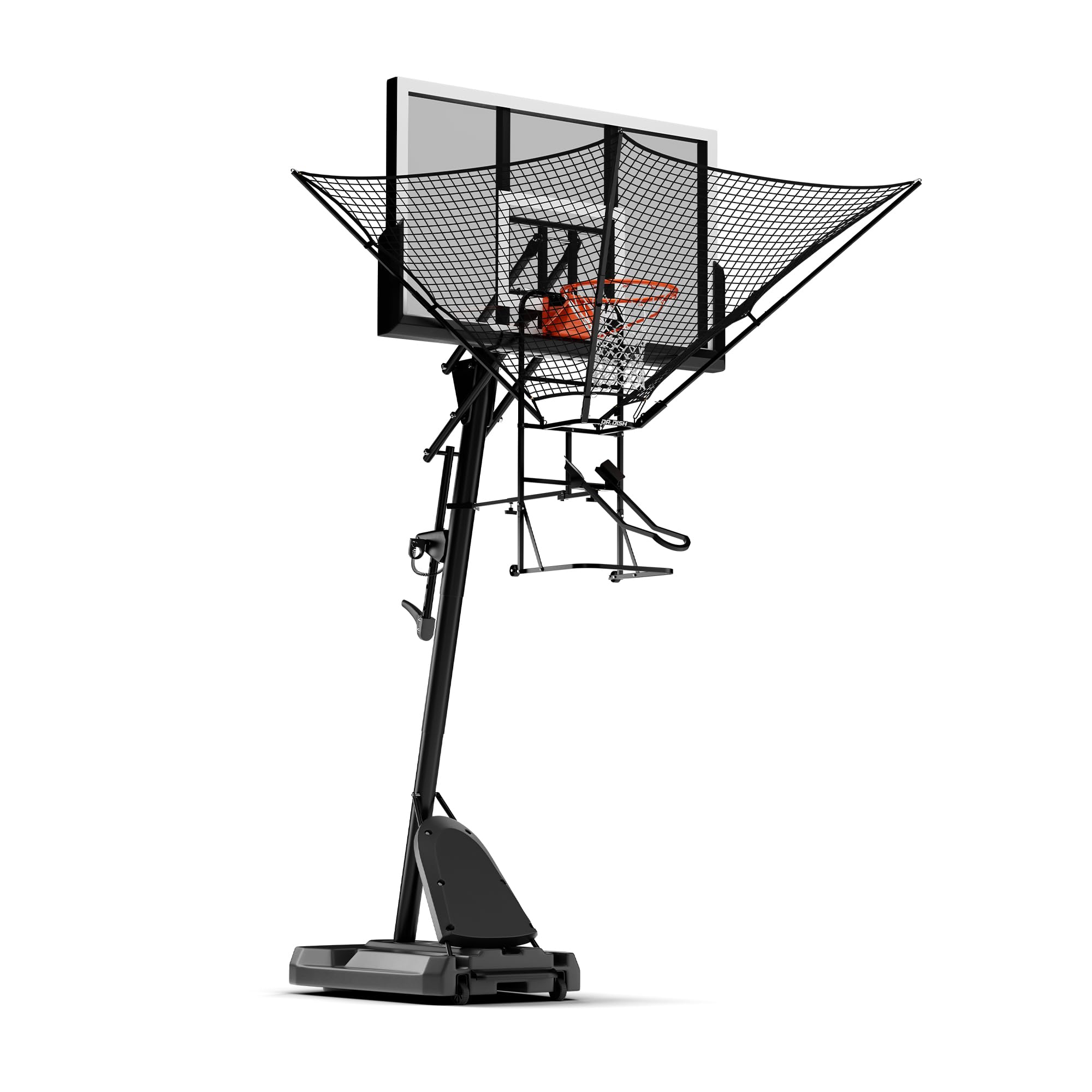
Dr. Dish IC3
Key Features
- Return Mechanism: Net ramp, catches makes/misses
- Material: Alloy steel
- Installation: Assembly, ~1 hour
- Return Reliability: High (occasional sticking)
- Price: Premium
The net return catches made shots, swishes, and airballs, sliding the ball back to your feet without interruption. Because the net sits 17 inches above the rim, only properly-arched shots clear it — flat attempts get rejected, forcing you to lift your release. With two basketballs, you can launch up to 800 shots per hour, a pace that turns a 30-minute session into a high-rep workout. The alloy steel frame weighs 35 lbs and feels durable; built-in wheels make it easy to roll aside. Assembly can take an hour and instructions could be clearer, but once tightened, the unit remains rock-solid even during rapid-fire drills.
The IC3 suits dedicated youth and high school players, coaches, and families where multiple players train daily. The ball-sticking quirk vanishes with a quick tug on the net or a trim, so it’s a manageable tradeoff. Its premium price reflects the steel build and near-perfect return consistency — a worthwhile investment for those who value arc development and volume over upfront cost. Casual shooters or budget-conscious buyers may prefer a simple chute-style returner instead.
Pros
- Alloy steel frame and wheels hold up to years of heavy daily use.
- Net ramp returns made and missed shots smoothly from any spot on the floor.
- 17-inch elevated net trains higher release for better arc and more makes.
Cons
- Assembly instructions can be unclear; first-time setup may take over an hour.
- Ball can get stuck between net and rim on soft shots, but adjusting net tension or trimming solves it.
For dedicated players willing to make a minor net tweak, this system repays the premium price with unmatched training volume and arc consistency.
Best for Yard Containment
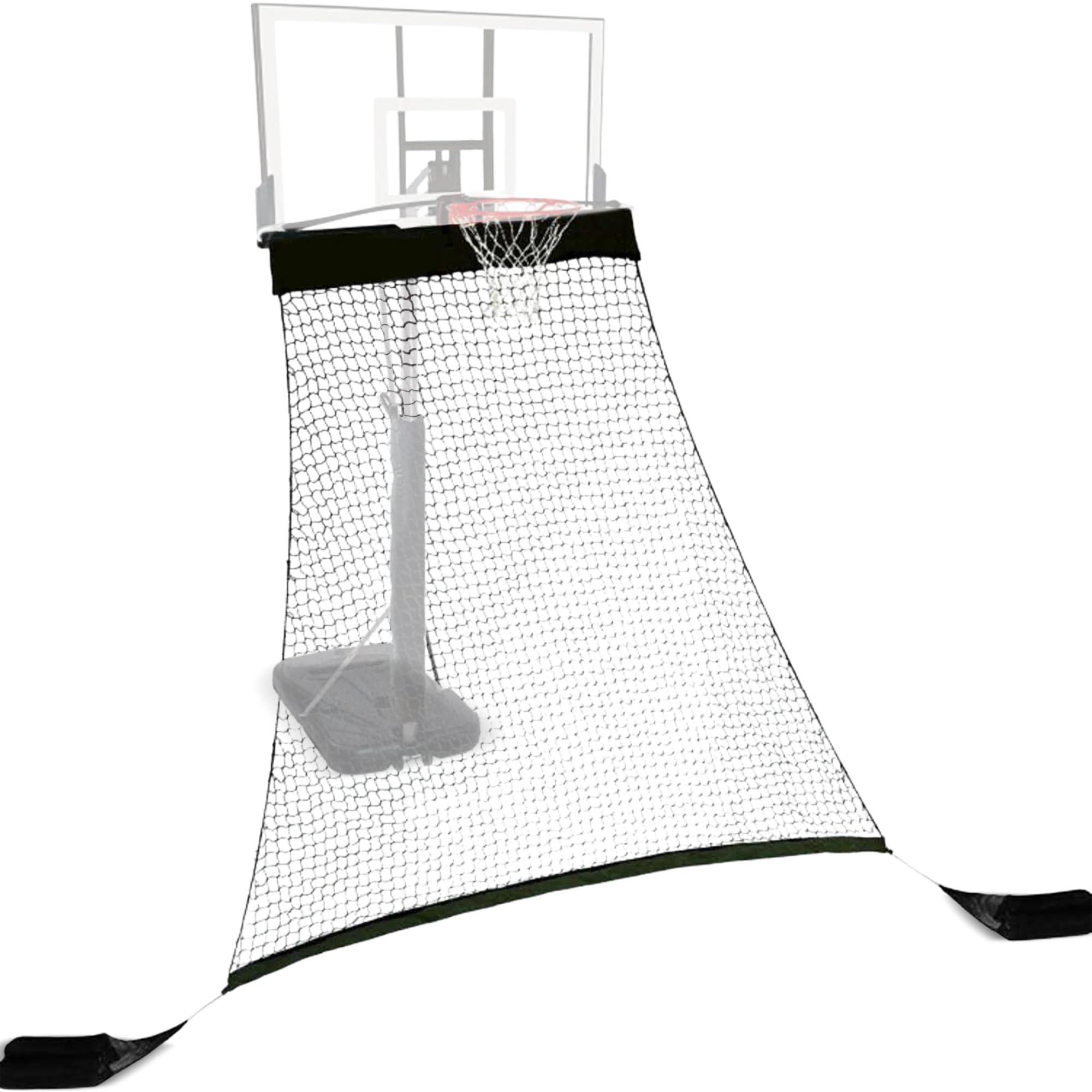
Hathaway Net Return
Key Features
- Return Mechanism: Polyester net enclosure
- Compatibility: 48-60" backboards
- Material: UV-protected polyester
- Installation: Tool-free webbing harness
- Return Reliability: Catches ~80% of misses
- Price: Mid-Range
The Hathaway Rebounder effectively catches roughly 80 percent of missed shots and returns them to the player’s feet, cutting down on chase time. It attaches to standard 48–60 inch hoops and doubles as a yard guard, keeping stray balls from damaging landscaping or drifting into neighboring property. Unlike the top pick’s elevated net that forces a higher shooting arc, this system focuses on containment and volume return – ideal for homeowners who want to practice without retrieving balls. The anchor water bags may leak over time; swapping them for sand improves stability and avoids setup frustrations.
Pros
- Effectively catches and returns about 80% of missed shots, reducing ball chase.
- Tool-free installation using webbing harness – no extra hardware needed.
- Cost-effective compared to other full-net return enclosures.
Cons
- Water anchor bags may leak or tear, compromising stability over time.
A practical choice for players who prioritize containment and return volume over shot-arc training; the anchor bag issue is easily solved with a sand fill.
Best for Spalding Hoop Users
Spalding Back Atcha
Key Features
- Return Mechanism: 90° arc plastic chute
- Compatibility: Spalding rims only
- Material: Plastic
- Installation: Snap-on, no tools
- Return Reliability: Returns makes; sticking issues
- Price: Budget
Catches and returns made shots effectively on compatible Spalding hoops — the chute snaps on without tools and sends the ball back in a predictable 90° arc. The all-plastic build keeps weight and cost low, but it degrades under sun and may not last beyond two outdoor seasons. It only fits Spalding’s Standard, Pro Slam, Arena Slam, and Slam Jam rims; buyers with breakaway or non-Spalding hoops will find it incompatible. For casual shooters willing to accept a disposable, budget-friendly option on a known compatible hoop, this provides a low-cost way to reduce chasing balls.
Pros
- Predictable 90° return sends the ball back after a made basket
- Tool-free snap-on attachment takes seconds
Cons
- Ball can occasionally snag in the net and not return smoothly
A functional, low-cost return aid that treats itself as seasonal gear. Matches well with dedicated short-term practice on compatible rims.
Best for Indoor/budget Metal
GADFISH Metal Return
Key Features
- Return Mechanism: Metal chute with hooks
- Compatibility: Most 18" rims
- Material: Painted metal
- Installation: Quick, simple assembly
- Return Reliability: Direct return; may wobble
- Price: Budget
The GADFISH Metal Return swaps flimsy plastic for a full metal chute and foldable hooks, giving it a weighty, secure feel that budget alternatives can’t match. Where the cheapest options require zip ties to stay put, this one mounts snugly and returns made shots right back to your feet.
That metal construction, however, is best kept under a roof. Left exposed to rain or humidity, surface rust can appear in weeks and weld seams may crack. For covered courts, garage hoops, or players who bring the chute inside after practice, it’s a practical step up from plastic that won’t break the bank.
Pros
- Quick, tool-free assembly that a child can manage
- Returns made shots directly to the shooter
- Metal build feels more solid than plastic competitors
Cons
- May loosen during use and need occasional readjustment on some rims
- Rust and weld failure possible after outdoor exposure to moisture
Indoor and covered-court shooters get a metal chute that outclasses plastic at a budget price; outdoor players should store it inside after each session.
Best for Occasional Tinkerers
SKLZ Kick-Out
Key Features
- Return Mechanism: Rotating plastic chute
- Compatibility: Universal rim clips
- Material: Plastic/alloy steel frame
- Installation: Quick assembly, 2-person
- Return Reliability: Returns makes; frequent rotation
- Price: Budget
The SKLZ Kick-Out returns made shots to the shooter at a budget-friendly price, assembling quickly on most standard rims. To keep it working through a practice session, add zip ties to the rim clips—otherwise they can disconnect, and the chute may rotate away from your chosen return angle. This is a low-cost aid for occasional shooters who can store it indoors between uses and accept some mid-session tinkering.
Pros
- Ball return reliably sends made baskets back to the shooter in a selected direction.
- Assembles quickly and fits most standard rims.
Cons
- Chute rotates on its own, so return direction shifts after repeated shots and requires periodic readjustment.
- Plastic hooks and straps can wear or tear after extended use, potentially shortening the product’s lifespan.
The SKLZ Kick-Out is an entry-level return chute for buyers who value low up-front cost over set-and-forget reliability. A few zip ties and periodic check-ins keep it functional for solo practice sessions on a budget.
Gosports Passback
GoSports Passback

The GoSports Passback offers an adjustable frame for solo catch-and-shoot reps, with telescoping legs to vary angle and height. It can also serve as a multi-sport rebounder for soccer or baseball. However, it’s a freestanding pass-back trainer, not a hoop-attached shot return — it won’t catch or return made baskets.
Pros
- Adjustable frame works for basketball passing, soccer volleys, and baseball fielding.
- Telescoping legs let you vary angle and height for different drills.
Cons
- Stability depends on flat ground and filled sandbags; can tip on uneven surfaces.
This suits players who want a multi-sport pass-back rebounder for form work, but it’s not a solution for returning made shots after a basket.
Sklz Solo Assist
SKLZ Solo Assist

The SKLZ Solo Assist throws game-speed passes to simulate catch-and-shoot drills without a partner, working on any flat surface. However, it doesn’t return shots after a basket — a mismatch for buyers seeking a hoop-mounted rebounder. The net can be stubborn to install and may tear with heavy use.
Pros
- Allows game-speed shooting off a simulated pass
- Sets up on any flat surface for portable driveway or court drills
Cons
- Net can be difficult to install and may tear under repeated use
Worth a look only if your priority is solo catch-and-shoot rhythm work rather than retrieving made baskets.
Franklin Net Guard
Franklin Net Guard

The large net stops stray shots from escaping into streets or neighbor yards, sharply cutting down retrieval runs during casual play. However, it does not redirect the ball back toward the shooter; after each missed shot, you’ll still need to walk to the net to collect it. For buyers seeking a training aid that automatically returns makes and misses, this is a yard guard, not a rebounder.
Pros
- Keeps errant shots from rolling off the court and into neighboring areas.
- Spans 10 feet wide by 8 feet tall for broad coverage behind the hoop.
Cons
- No ball-return functionality; players must retrieve balls from the net area.
If your main headache is balls escaping your driveway or court, the Net Guard earns its keep as a containment tool. For a rebounder that feeds you the ball after each shot, look to a dedicated shot-return system.
Silverback Yard Guard
Silverback Yard Guard

The Silverback Yard Guard effectively contains stray shots, keeping them from damaging cars or landscaping. However, it does not return the ball to the player—it only blocks misses. This makes it a poor fit for solo practice where retrieval interrupts reps. It is also optimized for Silverback in-ground hoops with 4×4 square posts, limiting compatibility.
Pros
- Keeps stray balls contained within the yard, protecting cars and landscaping.
- Folds flat for compact storage when not in use.
Cons
- Does not return the ball to the player; manual retrieval from behind the hoop is required.
For Silverback hoop owners who want to prevent balls from escaping the yard, this is a solid solution — but not a training aid for solo shooting practice.
Stinger X Bounceback
Stinger X Bounceback

High-velocity rebound from the 3.5′ x 3.5′ net accelerates skill work for lacrosse, soccer, and baseball drills. Basketball use is secondary – the net returns passes for solo catch-and-shoot drills, but it is not a hoop-attached shot-return system; it will not feed made shots back.
Pros
- High-velocity rebound accelerates skill repetition for lacrosse, soccer, and baseball.
- Durable steel frame and UV vinyl net stand up to multi-sport outdoor use.
Cons
- Not designed for basketball shot return; the net returns passes, not hoops shots, so it’s secondary for hoop-focused drills.
A fit for cross-training athletes who need a lacrosse or soccer rebounder and also want occasional basketball passing drills. For dedicated made-shot return, a hoop-attached net like the Dr. Dish IC3 is the right tool.
How to Choose
The gap between a frustrating solo session and an efficient one comes down to three things: rim fit, mechanical stability, and material endurance.
Return Mechanism: Chute vs. Net Enclosure
Chute-style attachments clip onto the rim and funnel made shots back toward the shooter using a curved ramp. While simple, their small attachment points can shift under vibration, causing the chute to rotate and altering return direction.
Net enclosures, on the other hand, drape behind and below the backboard, catching missed shots and dropping them near the base. They provide more consistent return for all shots but require more space and installation effort.
Rim and Backboard Compatibility
Even ‘universal’ rim clips have limits. Many budget chutes fail on breakaway rims or non-standard sizes because the clips rely on a specific rim lip thickness or shape. Before buying, measure your rim’s inner diameter and note if it’s a breakaway or solid design. Net enclosures usually strap over the backboard, so they work with most hoop styles but need a backboard width between 48 and 60 inches.
Material and Weather Resistance
Plastic components degrade under UV rays and become brittle after a year of sun exposure. Metal chutes resist impact better but can rust if the coating is thin. Look for powder-coated steel or alloy frames with UV-resistant nets for the longest outdoor life, especially in humid or coastal climates.
Installation and Adjustability
Tool-free snap-on systems sound convenient but often wobble or pop off, requiring ladder trips to re-secure. Full net enclosures with webbing harnesses or water bags need more initial time but stay put. If you’re mounting above a driveway, choose a system that locks firmly with minimal reliance on plastic hooks.
Ball Return Consistency
The whole point is getting the ball back without interruption. Sticking happens when the net or chute creates a pinch point—usually where the return path meets the rim. Some products benefit from trimming excess netting around the rim or adjusting tension. A reliable system returns balls from all angles, not just dead-center makes.
FAQ
Why does my basketball return chute keep turning to the right?
The chute rotates because the rim clips allow it to pivot under the ball’s impact or vibration. Adding zip ties between the chute frame and the rim posts creates friction that prevents rotation. For plastic chutes, also check that the mounting hooks haven’t warped; replace them if they’re loose.
How do I stop the basketball from getting stuck between the net and the rim on my rebounder?
The most common cause is the net catching the ball between the rim and the return surface. Trim the net’s top edge so it can’t wedge into that gap, or use rubber bands to pull the net tighter. Slightly adjusting the return angle can also reduce pinch points.
Do basketball return attachments fit all rims like Spalding, Lifetime, or Goalrilla?
Most budget chutes fit standard 18-inch rims with a thin lip but fail on breakaway or thick-rim designs. Check manufacturer compatibility lists; Spalding Back Atcha only works on specific Spalding models. If your hoop is a Lifetime or Goalrilla, look for hooks with adjustable spacing or choose a net enclosure instead.
Is the Dr. Dish IC3 worth the money for a middle school player?
For a dedicated middle school player shooting 200+ shots daily, the Dr. Dish IC3’s arc training and durable steel build replace hours of chasing balls. The efficiency gains and form improvement often outweigh the initial cost, and it typically lasts through high school. If usage is casual and one season at a time, a lower-cost alternative may suffice.