
This post contains affiliate links. We may earn a small commission when you buy through our links — at no extra cost to you.
A basketball return net should be the simplest training upgrade—catch your shot, send it back, get more reps. But too many players, especially those practicing outdoors, end up with a plastic attachment that snaps at the hooks within weeks or barely returns the ball. The frustration is real, and it stems from a market full of low-cost designs that work only under ideal conditions.
The right return net depends on your rim type, how often you shoot, and whether you need a simple clip-on or a freestanding rebounder that trains shot arc. Instead of spending on something that won’t last the season, this guide helps you match a net to your actual practice environment—so you can focus on your shot, not on chasing the ball or adjusting a drooping chute.

Best for Budget-Friendly Practice
Spalding Back Atcha
Key Features
- Type: Rim attachment
- Material: Plastic
- Return Adjustability: Fixed 90°
- Price: Budget
The Spalding Back Atcha clips onto standard rims in minutes without tools, returning the ball after made shots so you spend less time chasing misses. The lightweight design (8 oz) won’t strain the rim, and the 90° return arc works well for moderate practice sessions.
This is best suited for casual shooters and young players learning on fixed, non-breakaway rims. On breakaway rims the attachment can slip, and prolonged outdoor sun or cold exposure may cause the plastic to become brittle over several months. The ball return is moderate — the ball sometimes hangs up in the net — which is fine for relaxed practice but not for fast-paced drills.
Pros
- Installs quickly without tools on standard rims
- Reduces time spent chasing missed shots during practice
- Lightweight design won’t add stress to the hoop
Cons
- After a made shot, the return can be weak and the ball may hang up in the net
- Plastic can become brittle after months of outdoor exposure to sun or cold
A budget-friendly clip-on for casual practice on standard rims — the limitations in durability and weak return are fair tradeoffs at this price point.
Best for Serious Shot Training
Dr. Dish IC3
Key Features
- Type: Standalone rebounder
- Material: Alloy Steel
- Return Adjustability: 180° adjustable
- Price: Premium
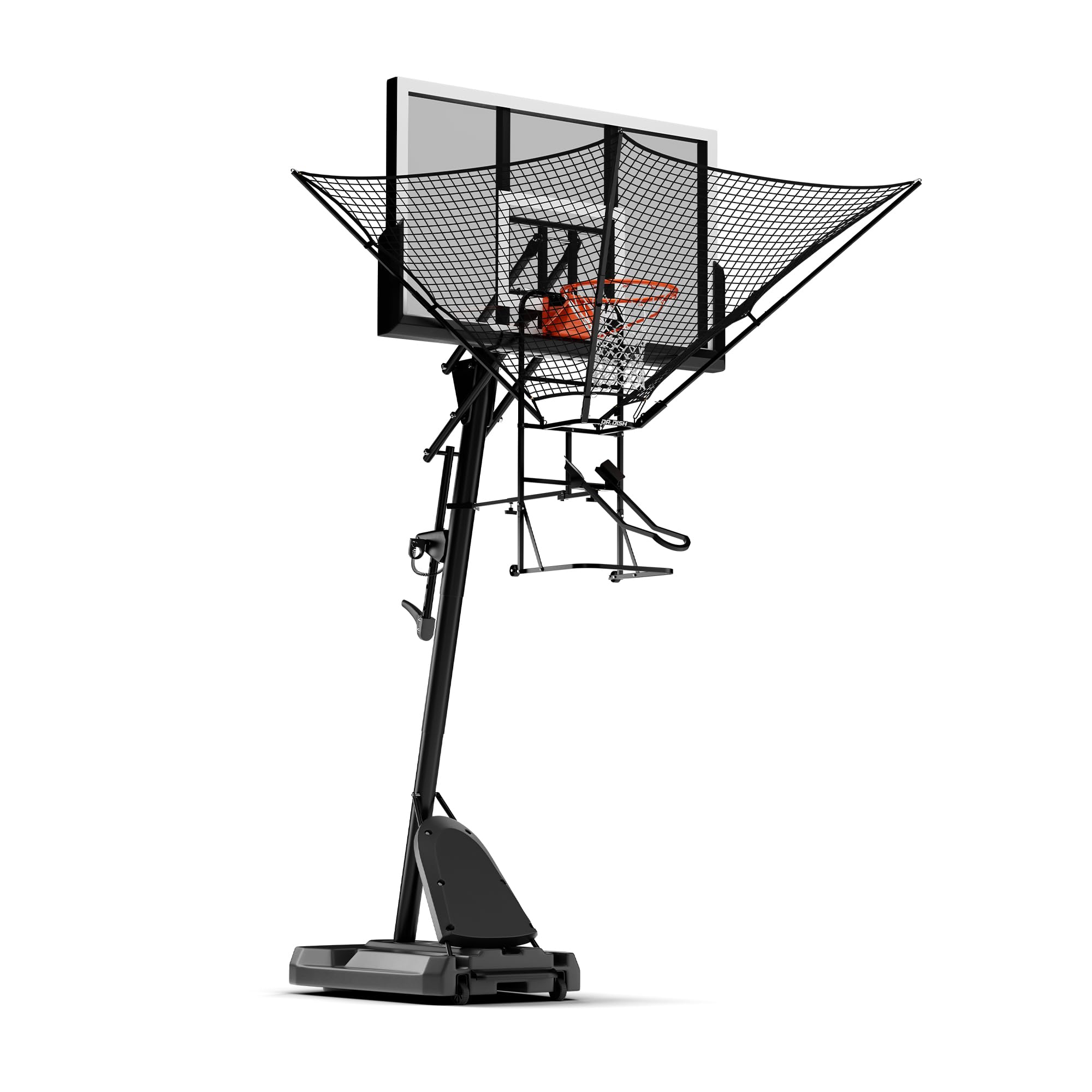
Unlike plastic clip-on return nets that can fail within weeks, the Dr. Dish IC3 stands on a 35-pound alloy steel frame that returns both makes and misses with a 180-degree adjustable chute. The net sits 17 inches above the rim, which forces a higher release point and eliminates flat-line misses during solo sessions.
This rig is for dedicated players or families who practice daily and need high-volume reps without chasing rebounds. Be prepared for a lengthy assembly with unclear instructions, and know that balls can occasionally lodge between the net and rim—adjusting the net resolves it. Casual shooters with limited space will find the footprint and price overkill.
Pros
- Alloy steel frame endures years of daily practice
- Returns both made and missed shots for up to 800 reps per hour
- 17-inch net height above rim enforces proper shot arc
Cons
- Assembly can be time-consuming and instructions are unclear
- Occasionally, a ball may get stuck between the net and rim, disrupting flow
For high-volume training that outlasts any clip-on, the IC3 delivers a durable, arc-correcting solution—just budget time for assembly and the occasional stuck ball.
Best for Passing Drills
GoSports Passback Rebounder

Key Features
- Type: Freestanding rebounder
- Material: Aluminum
- Price: Mid-Range
The GoSports Rebounder excels at returning chest and bounce passes, with an adjustable frame that angles for varied drills. It doesn’t catch shots from a hoop, so it’s a pass-back trainer, not a return net. Occasional bungee cord issues can surface with regular use.
Pros
- Supports varied passing and ball-handling drills across multiple sports.
- Works well for solo catch-and-shoot footwork and reaction training.
Cons
- Bungee cords can lose tension or snap with intensive daily use, requiring eventual replacement.
If your solo training needs focus on passing accuracy and ball handling rather than shot return from a hoop, this rebounder fills that niche.
How to Choose
A return net’s design determines whether it will survive backyard conditions and actually return the ball consistently—rim attachment or standalone, material choice, and adjustability matter more than price.
Type: Rim Attachment vs Standalone Rebounder
Rim attachments clip directly onto the hoop, placing a net or chute under the rim to catch and return the ball. Their compact design and low cost make them easy to add to an existing setup, but physical stress concentrates entirely on the attachment hooks.
Standalone rebounders, like a freestanding net system, sit under the basket and return both makes and misses. They demand floor space and a higher price, but distribute impact across a steel frame—eliminating the weak hook points that doom many clip-ons.
Rim Compatibility
Most clip-on nets are molded to fit standard 18-inch rims with limited thickness. Breakaway rims and heavy-duty hoops like Goalrilla or Lifetime have thicker ring profiles or spring-loaded mechanisms that prevent hooks from seating securely. The result is wobble, slipping, and eventual snap.
If you have a non-standard rim, don’t rely on a clip-on attachment at all. A standalone rebounder bypasses rim fit issues entirely—its performance doesn’t depend on the hoop’s construction.
Build Material
Plastic clip-ons are lightweight and cheap, but prolonged exposure to sun and cold causes embrittlement. Cracking at stress points—especially the hooks—is common after a few months outdoors.
Steel or alloy steel standalone units handle repeated impact and weather better, though they must have a paint or powder coat to resist rust. Metal rim attachments exist, but weak welds often become the new failure point instead of plastic cracks.
Return Direction Adjustability
Fixed-arc attachments return the ball straight back with no means of altering the angle. If the arc is too shallow, the ball may land too close to the basket; too steep and the ball stays in the net.
Rotating chutes let you swivel the return direction, but this mechanism introduces a joint that can drift during use, requiring constant readjustment. Standalone systems often offer 180° adjustability via frame positioning, keeping the return path consistent without relying on a loose chute.
Durability Under Outdoor Conditions
Outdoor practice exposes return nets to rain, UV radiation, and temperature swings. Plastic degrades, metal rusts if coatings are thin, and moving parts seize if not cleaned and lubricated.
The most durable outdoor solution is a coated steel standalone rebounder stored indoors when not in use. For those who must use a clip-on, choosing one with minimal plastic and keeping it out of direct sun when idle will extend its active life by months.
FAQ
Why does my basketball return attachment keep falling off the rim?
Usually due to poor fit—most clip-on nets are designed for standard rims with specific dimensions. Breakaway or thick rims prevent the hooks from seating securely, causing wobble and eventual snap. Check rim compatibility and consider adding rubber padding for a tighter grip if the attachment allows it.
Can a basketball return net work with a breakaway rim?
Most clip-on return nets are not compatible with breakaway rims; the spring-loaded mechanisms interfere with the attachment’s hooks. If you have a breakaway rim, a standalone rebounder is the only reliable option for ball return, as it doesn’t depend on the rim structure at all.
How do I stop the ball from getting stuck in the return net?
The net may be too low or misaligned relative to the ball’s trajectory. Adjust the height so the ball clears the net after shooting. On some standalone rebounders, trimming a small section of net near the rim can prevent hangs—a common fix that doesn’t affect functionality.
Is a metal basketball return attachment better than plastic?
Metal attachments generally resist cracking better than plastic, but many metal models suffer from poor welds that snap or rust quickly. A well-built steel attachment can outlast plastic, but check reviews for weld durability; a plastic net may actually survive longer if it’s not constantly exposed to sun and freezing temperatures.