
This post contains affiliate links. We may earn a small commission when you buy through our links — at no extra cost to you.
Every basketball player knows the feeling: a deep quad knot after a hard game, reaching for a massage gun that promises relief. But many sub-$50 guns quit charging within months, leaving you with a dead weight and a sore muscle. The real problem isn’t power—it’s longevity.
The market splits cleanly: budget guns under $50 have high failure rates, while models between $75 and $130 deliver genuine percussive therapy with motors that last. The trade-off is between portability and raw stall force—a lighter gun that fits in a gym bag may lack the depth to reach your glutes and quads.
This guide cuts through the hype by focusing on the specs that actually matter for basketball recovery: stall force above 50 lbs, real-world battery life, and amplitude that can penetrate deep tissue. You’ll find clear picks for serious training, travel, and tight budgets—without the gamble.




Best for Deep Tissue Recovery
Opove M3 Pro 2
Key Features
- Stall Force: 70 lbs
- Amplitude: 12 mm
- Battery Life: 4–8 hours
- Weight: 2.4 lbs
- Noise: Very quiet
- Price: $$$
The Opove M3 Pro 2 delivers 70 lbs of stall force — enough to work through tight quads, glutes, and deep calf knots without bogging down. The 12 mm amplitude drives percussion deep into muscle tissue, and the motor stays quiet even at 2500 RPM, so you can use it in a locker room or living room without disturbance. Battery life stretches well beyond a week of daily 20-minute sessions, reducing the need to recharge mid-season.
This gun weighs 2.4 lbs, which is noticeable when you’re working your own back or hamstrings for more than a few minutes — the tradeoff for that muscle-penetrating power. No heat or cold attachments are included, so if thermal therapy is a priority, this isn’t the tool. The build quality holds up to frequent drops and travel, and the silicone grip prevents slipping when hands get sweaty after a workout.
Pros
- 70 lbs stall force powers through deep muscle knots without stalling.
- Battery lasts weeks on a single charge with daily use.
- Quieter than comparable high-force massage guns.
Cons
- At 2.4 lbs, arm fatigue may set in during extended self-massage sessions.
- No heat or cold head — thermal therapy is not an option here.
For basketball players who need deep tissue recovery after heavy court time, the Opove M3 Pro 2 delivers raw power and battery stamina that justifies its weight.
Best for Budget Power
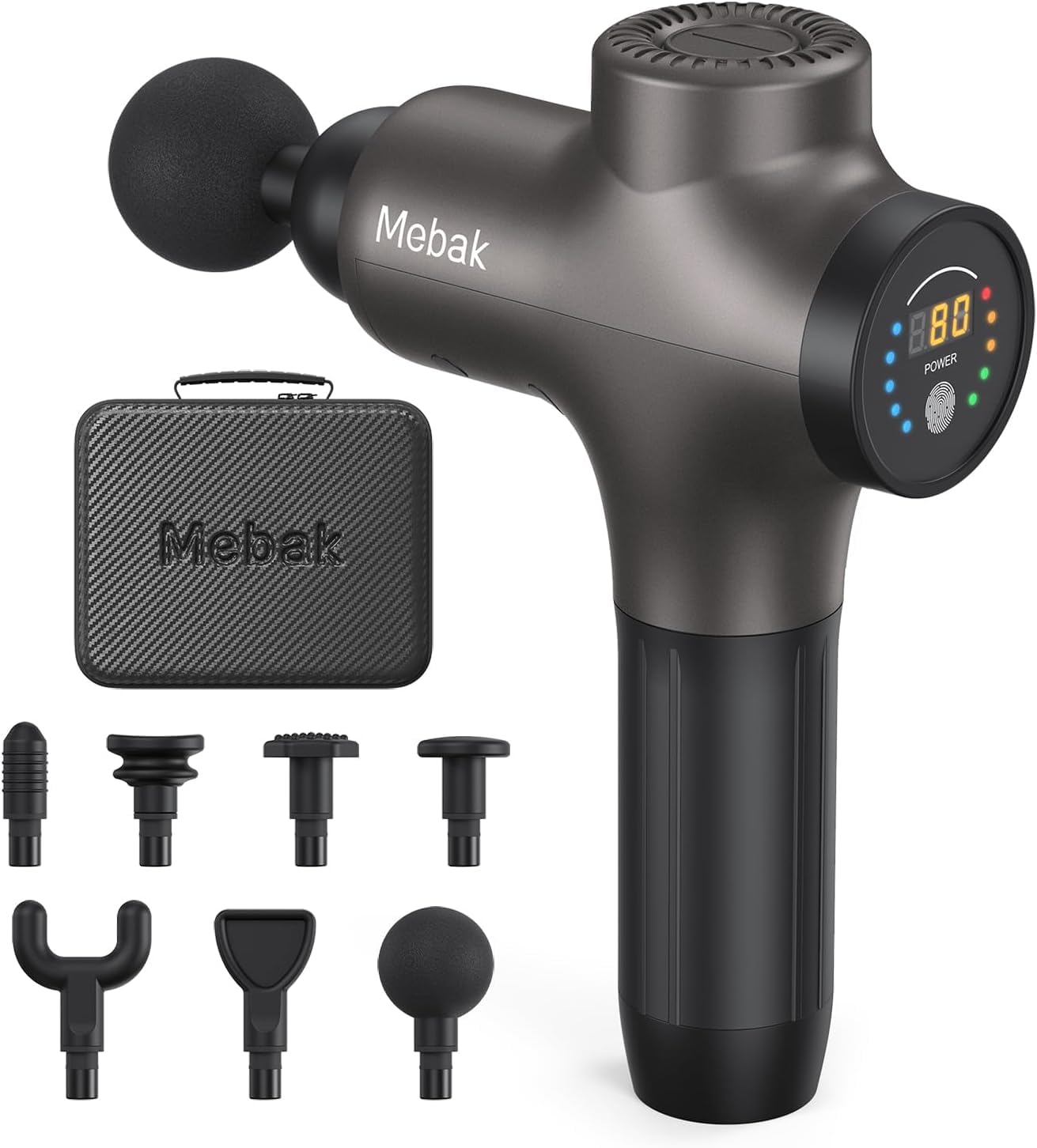
Mebak 3
Key Features
- Stall Force: 53 lbs
- Amplitude: 12 mm
- Battery Life: 6+ hours claimed
- Weight: 1.68 lbs
- Price: $$
The Mebak 3 delivers 53 lbs of stall force and 12mm amplitude at a mid-range price that undercuts premium models by a third. It won’t match the top pick’s 70 lbs force or quieter operation, but for athletes on a budget it’s a legitimate performer. Note that a small number of units may have battery or motor issues, so checking warranty terms is wise. Ideal for basketball players needing reliable deep tissue recovery without the premium price tag, and for frequent travelers thanks to its compact case and light weight.
Pros
- Powerful deep tissue massage with 53 lbs stall force
- Long battery life supports multiple sessions between charges
- Effective pain relief for sore muscles
Cons
- Power unit may occasionally stop charging or lose motor function; warranty support varies
For buyers who prioritize performance per dollar and can accept occasional unit variance, the Mebak 3 is the smart choice over pricier alternatives.
Best for Deep Tissue Enthusiasts
B&B X6 Pro
Key Features
- Stall Force: 55 lbs
- Amplitude: 10.5 mm
- Battery Life: 4 hours
- Weight: 1.9 lbs
- Noise: Moderate
- Price: $$$
With 55 lbs of stall force and a 10.5 mm amplitude, the X6 Pro penetrates deep into muscle tissue for post-workout recovery. The all-metal head transfers force more directly than rubber attachments, making it a strong choice for strength athletes who need aggressive percussion.
The motor is louder than whisper-quiet alternatives, so it’s less suited for shared living spaces or late-night use. The metal head can feel too intense on bony areas without a towel layer. Power button consistency varies between units, so check responsiveness early.
Pros
- 55 lbs stall force powers through dense muscle groups.
- Titanium-alloy head delivers focused, deep percussion.
- Battery lasts through extended recovery sessions.
Cons
- In quiet environments, the motor hum is noticeable compared to whisper-quiet models.
- Power button responsiveness can be inconsistent across units.
A cost-effective choice for athletes who prioritize raw percussive power over quiet operation and are willing to work around the metal head’s intensity.
Best for Heat/cold Therapy
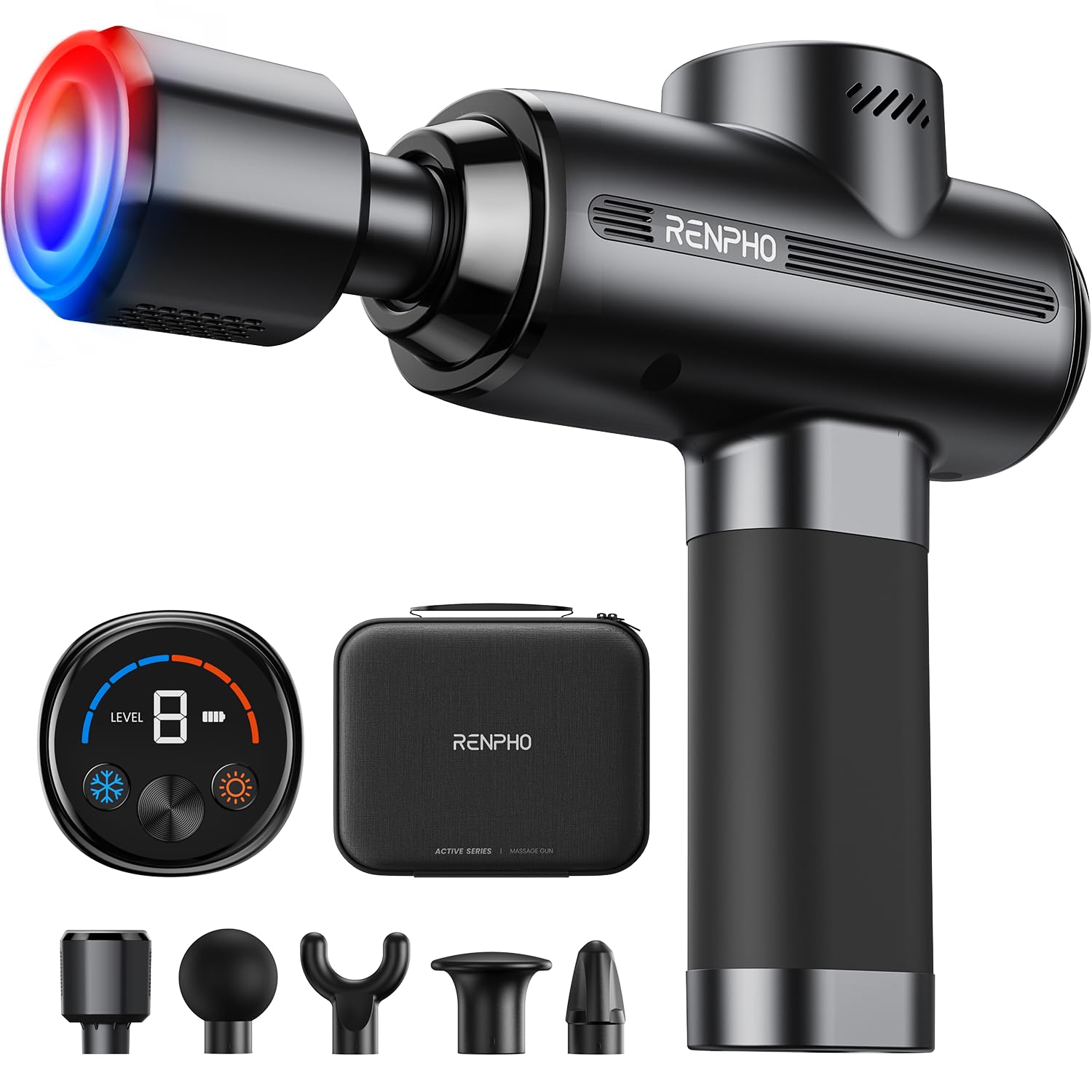
RENPHO Thermacool 2
Key Features
- Amplitude: 10 mm
- Battery Life: 2500 mAh
- Weight: 1.47 lbs
- Noise: 40 dB
- Price: $$
The RENPHO Thermacool 2 stands out with its hot/cold attachment—swap between 113°F heat and 46°F cold in seconds for targeted therapy that helps with both warm-up and recovery. At 1.47 pounds and 40 dB, it’s quiet enough to use without disturbing others, and the 10 mm amplitude provides moderate percussion that suits calves, shoulders, and light muscle soreness.
This gun is best for athletes who want heat/cold therapy as part of their routine but don’t need a deep-tissue workhorse for daily heavy use. The battery and motor can show wear over time—some units may stop charging after months, so it’s a better fit for occasional or rotational use rather than a primary recovery tool.
Pros
- Hot/cold attachment allows quick thermal therapy for pre-warmup or post-workout relief.
- Quiet operation at 40 dB minimizes disturbance in shared spaces.
- Delivers noticeable pain relief for muscle tightness and minor soreness.
Cons
- Battery life may fall short during extended sessions; some units require more frequent charging over time.
- Durability can vary—occasional reports of units losing charging or motor function after a few months.
Choose this if thermal therapy matters more than deep-tissue power and you’re comfortable with possible battery quirks over time.
Best for Travel and Gym Bag
arboleaf Mini
Key Features
- Stall Force: 35 lbs
- Weight: 1.04 lbs
- Noise: Very quiet
- Price: $
The arboleaf Mini is the rare massage gun that disappears into a gym bag — 1.04 lbs of full metal that feels solid, not flimsy. Its 1000–3200 RPM range provides enough vibration for calves, shoulders, and mild soreness, but the 35 lbs stall force is too low to penetrate glutes or quads after a heavy workout. This makes it ideal for travelers, gym bag carriers, or anyone needing a quick warm-up on the go rather than post-game recovery.
Pros
- Compact and portable – fits in any bag without weighing you down.
- Full-metal build gives a sturdy, premium feel at this price.
- Quiet operation won’t disturb others in a locker room or office.
Cons
- 35 lbs stall force is too low for deep glute or quad work — better suited for smaller muscle groups.
- Long-term durability under heavy use may be inconsistent between units.
If your recovery happens on the move — plane, office, or quick warm-up — this is the gun to grab. For deep tissue work, look to the top pick.
Best for Portable Heat/cold
B&B Q2 Pro Mini
At 0.95 pounds with USB-C charging, the BOB AND BRAD Q2 Pro Mini slips into a basketball bag without adding weight. The included heat and cold attachments make it useful for warming up calves and shoulders before a game or cooling down after light activity. For its size, the motor delivers surprising punch—enough to ease tension in smaller muscles without the bulk of a full-size gun.
Where this mini falls short is depth. The 7mm amplitude can’t reach the deep tissue of quads or glutes that athletes need for serious post-game recovery. Battery consistency has also been noted as a possible concern over months of use. This is a travel companion for maintenance work, not a primary recovery tool. If your priority is deep percussion, the industrial-grade metal-head model in this roundup offers 55 lbs of stall force instead.
Pros
- Heat and cold attachments offer targeted thermal therapy on the go.
- Extremely lightweight design fits in a gym bag or carry-on easily.
- More power than expected from a pocket-sized unit.
Cons
- 7mm amplitude is too shallow for deep quad or glute recovery.
- Some units may develop battery or charging issues after a few months.
Great for travel warm-ups and mild soreness in calves or shoulders, but not the gun for serious deep-tissue work after heavy training.
Best for Brand Reliability
Theragun Relief

The TheraGun Relief delivers whisper-quiet operation and a premium build that feels solid in hand, making it a decent companion for light muscle relaxation after a casual workout. However, its low stall force and mere three speed settings mean it cannot handle the deep tissue demands basketball athletes need. You’re paying for the brand reliability and quietness, not power—so if your recovery requires real percussion, look elsewhere in this roundup.
Pros
- Whisper-quiet operation with excellent build quality.
- Effective for general muscle relaxation and light recovery.
Cons
- Low stall force and only 3 speeds limit deep tissue penetration.
Best for brand-loyal buyers who want a quiet, well-built gun for light recovery and are willing to trade deep tissue power for polish.
Best for Budget Occasional Use
TOLOCO

Key Features
- Amplitude: 12 mm
- Battery Life: 6 hours claimed
- Weight: 1.95 lbs
- Price: $
The TOLOCO delivers solid amplitude and ten attachment heads for the price, making it effective for occasional pain relief. However, some units may experience motor or battery problems after a few months, so it’s best suited as a backup rather than a daily driver.
Pros
- Budget-friendly with strong 12mm amplitude.
- Comes with ten attachments for targeted relief.
Cons
- Motor or battery performance may degrade sooner than expected.
Best as an occasional-use backup for budget-minded buyers who can accept the possibility of early wear.
Best for Ultra-Budget Gamble
APHERMA

The APHERMA massage gun offers 30 speed levels and 9 heads for under $26, making it one of the most affordable options available. However, unit-to-unit consistency is a concern—some guns stop charging or lose motor function within months, so it’s best reserved for non-critical, occasional use rather than regular muscle recovery.
Pros
- Very affordable with 30 speed levels and 9 heads included.
- Provides noticeable pain relief for occasional muscle soreness.
Cons
- Motor or charging issues can appear within months, making it a gamble for long-term dependability.
Suitable for someone on an extreme budget who needs a massage gun for infrequent, low-stakes use—not for daily post-workout recovery.
How to Choose
For basketball players, stall force above 50 lbs and real-world battery life matter more than any marketing claim.
Stall Force
Stall force is the pressure the motor can sustain before stopping. Below 50 lbs, the gun may bog down on dense quads or glutes, forcing you to press harder—which fatigues your arm and risks bruising. A model with 55–70 lbs delivers consistent percussion even under heavy load.
Amplitude
Amplitude is the length of the stroke—how deep each impact penetrates. 10 mm is the minimum for reaching deep muscle layers; 12 mm is ideal for post-game recovery. A 7 mm gun (like mini models) is fine for calves and shoulders but won’t loosen tight hip flexors or hamstrings.
Battery Life
Advertised battery life rarely matches real-world use. Many budget guns claim 6+ hours but deliver 2–3 under load. Look for units with at least 2500 mAh and check reviews for runtime complaints. A gun that dies mid-week during tournament season becomes useless.
Weight
Heavier guns (over 2 lbs) provide more stall force but tire your arm during extended self-massage. Lighter guns (under 1.5 lbs) are easier to maneuver but often lack power. The trade-off: choose based on whether you treat yourself or have a partner help.
Noise Level
Loud guns (above 50 dB) can be disruptive in shared locker rooms or hotel rooms. Brushless motors are quieter and more durable. A whisper-quiet (40 dB) gun is preferred for late-night recovery without waking others.
FAQ
What stall force is good for a massage gun for basketball players?
Aim for at least 50 lbs. Basketball players need that force to penetrate dense quads, glutes, and hamstrings. Under 50 lbs, you’ll have to press hard, which fatigues your arms and can cause bruising. The Opove M3 Pro 2 offers 70 lbs, while the Mebak 3 delivers 53 lbs—both are adequate.
Is a 7mm amplitude massage gun enough for deep tissue recovery?
No for major leg muscles. 7 mm is fine for calves, forearms, or shoulders, but won’t reach deep into quads or glutes. For post-game recovery, choose 10 mm or more. Mini guns like the Bob & Brad Q2 Pro Mini are best as warm-up tools, not primary recovery.
Why does my massage gun battery stop charging after a few months?
Cheaper massagers often use low-quality lithium-ion cells and basic charging circuits that fail over time. This is the most common complaint on budget models under $50. To avoid it, invest in a gun from a brand with proven battery longevity, like the Opove M3 Pro 2 or Mebak 3.
Theragun vs budget massage gun for basketball – is the extra cost worth it?
The Theragun Relief is well-built and quiet, but its 3-speed motor and low stall force make it underpowered for basketball deep tissue. A mid-range model like the Opove M3 Pro 2 offers far more power and battery life for less money. You’re paying for brand trust, not performance.