
This post contains affiliate links. We may earn a small commission when you buy through our links — at no extra cost to you.
Many basketball players grab a foam roller only to find it too painful against sore quads or too short to roll out the entire back after a game. The gap between marketing promises and real-world feel is wider than most expect.
The real choice isn’t between brands — it’s between priorities. A compact roller fits in a gym bag but forces you to reposition for back work. A full-length roller covers everything in one pass but takes up space and often comes in a very firm density that can be uncomfortable if you’re not used to it.
This guide breaks down which rollers deliver on their claims, focusing on the two specs that matter most: length and density. Because the right tool for your playing schedule and pain tolerance makes the difference between regular recovery and a painful chore.




Best for Portable Deep Tissue
TriggerPoint Grid 1.0
Key Features
- Density/Firmness: Extra Firm
- Length: 13 inches
- Material: EVA foam over hollow
- Surface Texture: Grid pattern
- Price: Mid-Range
The TriggerPoint Grid 1.0 uses a multi-density GRID pattern that creates variable pressure across the roller, effectively working into muscle knots and trigger points without the flat, uniform feel of basic foam cylinders. The extra-firm density holds its shape even after months of regular use, which matters for athletes who need reliable post-game recovery.
At 13 inches long, this roller is small enough to toss in a duffel bag for road games or gym sessions. The tradeoff is that full back coverage requires repositioning — you roll the upper back, then shift to the lower back. For basketball players who mainly target legs and glutes, this length is actually convenient; for those expecting a single-pass back rollout, the shorter length will feel limiting.
This roller is a strong fit for basketball players who want a firm, durable tool for calves, quads, hamstrings, and glutes, and who are comfortable with a bit of repositioning for back work. The aggressive firmness can be too intense for beginners or anyone with low pain tolerance, but athletes used to deep tissue pressure will appreciate how directly it reaches underlying knots.
Pros
- Multi-density grid provides variable pressure for targeted trigger point release
- Durable EVA foam and hollow core maintain shape under repeated heavy use
- Compact size packs easily for travel without sacrificing muscle recovery effectiveness
Cons
- The 13-inch length may require repositioning for full back coverage
- For basketball players new to foam rolling, the extra-firm density can be uncomfortable
Best for athletes who prioritize portability and firm pressure over one-pass back coverage, and who want a roller that stands up to frequent travel and heavy use.
Best for Full Back Coverage
Amazon Basics 36"
Key Features
- Density/Firmness: Firm
- Length: 36 inches
- Material: Polypropylene
- Surface Texture: Smooth
- Price: Budget
This 36-inch foam roller covers your entire back and legs in a single pass, saving time compared to shorter models that require constant repositioning. Its cost per inch is among the lowest in this roundup, making it a practical option for home use. The solid polypropylene core maintains consistent firmness across the length, and unlike compact rollers like the top-pick Grid 1.0, you don’t need to stop and adjust mid-session.
Basketball players looking for full-length coverage after games will appreciate the ability to roll out hamstrings, quads, and back without interruption. The high-density foam is very firm — effective for breaking up knots in large muscle groups, but may cause discomfort if you’re not accustomed to aggressive pressure. Some units have shown minor foam shedding over time, so periodic inspection is wise. This roller suits athletes who prioritize length and value over portability or a softer touch.
Pros
- Covers full back and legs without repositioning
- Exceptional value for a 36-inch roller
- Effective for back and leg relief, plus posture exercises
Cons
- Foam particles may shed over time
- Very firm density can be uncomfortable for beginners
Best for basketball players who want full-length coverage for home recovery and can handle firm pressure — but those new to foam rolling may find it too aggressive.
Best for Intense Trigger Point
RumbleRoller Original
Key Features
- Density/Firmness: Medium-Firm
- Length: 12 inches
- Material: Foam with patterned bumps
- Surface Texture: Bump texture
- Price: Premium
The RumbleRoller Original stands apart from standard foam rollers with its patterned bump texture that digs into muscle tissue more aggressively than smooth or grid-pattern rollers. This design is particularly effective at loosening stubborn knots and providing deep tissue massage that smoother rollers cannot replicate.
For basketball players who routinely work out muscle tightness after games, the RumbleRoller Original offers a targeted solution for calves, quads, and glutes. However, the pressure is extremely intense and can be painful — it is not suitable for beginners or anyone with low pain tolerance. This roller is best reserved for conditioned athletes who require aggressive myofascial release and are comfortable with significant discomfort during use.
Pros
- Effective at loosening deep muscle knots and working out stubborn kinks.
- Solid construction with durable foam that withstands repeated heavy use.
- Provides targeted pain relief for sore muscles after intense activity.
Cons
- The 12-inch length requires frequent repositioning for full back coverage, which may be inconvenient for taller users.
This roller fits experienced basketball players who want aggressive trigger point release and can tolerate high pressure. For those who need a gentler option, consider a longer, smoother foam roller.
Best for Beginners & Rehab
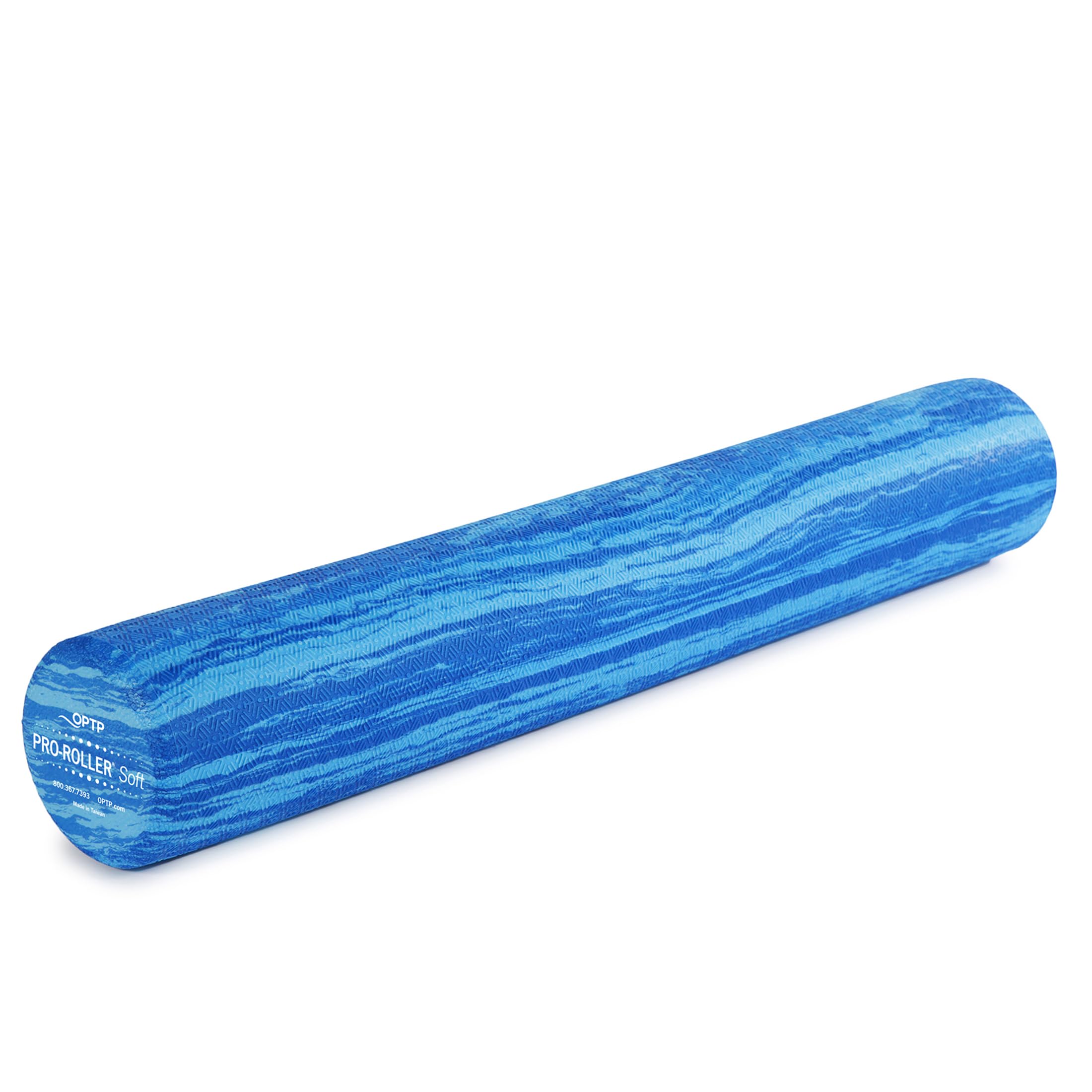
OPTP Pro-Roller Soft
Key Features
- Density/Firmness: Soft
- Length: 36 inches
- Material: Closed-cell EVA
- Surface Texture: Smooth
- Price: Premium
This is the only true soft-density, full-length foam roller available — professional-grade closed-cell EVA foam that maintains consistent softness across the entire 36-inch length. Physical therapists commonly recommend it for post-injury work and for anyone who finds standard firm rollers too painful to use effectively.
Basketball players seeking post-game muscle recovery typically need medium to high density to break up deep knots in quads, hamstrings, and glutes. The OPTP Pro-Roller Soft provides gentle pressure that may not generate enough tension for effective self-myofascial release in conditioned athletes. It suits beginners, injury rehabilitation, and those with high pain sensitivity far better than experienced players looking to dig into tight tissue. The premium price also stands out against simpler 36-inch rollers of comparable length.
Pros
- High-quality closed-cell EVA foam holds its shape over time
- Effective for relieving back and muscle pain with gentle pressure
- Comfortable for users who find standard rollers too hard
Cons
- Soft density may not provide enough resistance for deep tissue work
- Premium price for a simple foam cylinder compared to other 36-inch options
A well-made recovery tool for gentle use and rehab, but basketball players needing deep pressure should look at the TriggerPoint Grid 1.0 or a firm full-length roller instead.
Best for Travel & Targeted
ProsourceFit 12"
Key Features
- Density/Firmness: Firm
- Length: 12 inches
- Material: EPP
- Price: Budget
The ProsourceFit 12-inch roller delivers a dense EPP core at a budget-friendly price, making it one of the most affordable firm foam rollers available. Its compact size suits gym bags and travel, but the short length means it is better suited for spot treatment on calves and hamstrings than full back rolling.
This roller works well for basketball players who need post-game recovery for legs and are accustomed to high density. The firm surface provides deep pressure for myofascial release in small muscle groups, but beginners or those with low pain tolerance may find it too intense. For back coverage or sensitive users, a longer or softer alternative would be more appropriate.
Pros
- Solid EPP construction handles regular use without flattening over time.
- Provides targeted relief for calves, hamstrings, and IT bands after intense workouts.
- Budget-friendly price makes it easy to own as a travel or gym bag roller.
Cons
- Firm density can be too intense for beginners or those with low pain tolerance.
- 12-inch length requires frequent repositioning for back rolling; not a one-pass tool.
An affordable, specialized tool for athletes who need a portable roller for small muscle groups and are comfortable with firm pressure. Not for back work or beginners.
Best for Travel & Sensitive
TriggerPoint CORE 12"
Key Features
- Density/Firmness: Soft
- Length: 12 inches
- Material: EVA foam
- Surface Texture: Grid pattern
- Price: Budget
The TriggerPoint CORE delivers the brand’s known build quality in a compact 12″ by 4″ package with a noticeably softer foam core. Its multi-density grid still provides targeted feedback, but the reduced diameter and gentle compression make it a different tool than the firmer, longer Grid 1.0 that leads our recommendations.
Basketball players looking for a roller they can toss in a gym bag or suitcase will appreciate the portability. It works well for calves, quads, and light spinal mobilization — but the small size forces repositioning on the back and hamstrings, and the softness won’t release deep knots after a tough game. This is a recovery tool for maintenance days, not for breaking up the kind of tension that accumulates from two hours of sprinting and jumping.
Pros
- Well-constructed EVA foam with a durable grid pattern
- Eases lower back and hip tightness with moderate pressure
- Lightweight and small enough for carry-on luggage
Cons
- 4-inch diameter requires multiple passes to cover the full back
- Soft foam may feel insufficient for athletes accustomed to firm rollers
If you need a roller that fits in a duffel bag and you’re okay with gentler pressure, the CORE is a capable travel companion. For serious post-game recovery, the Grid 1.0 or a full-length option will deliver the depth basketball players need.
Best for Portable Deep Tissue
TriggerPoint Grid Orange

Key Features
- Density/Firmness: Extra Firm
- Length: 13 inches
- Material: EVA foam
- Surface Texture: Grid pattern
- Price: Mid-Range
This orange variant of the TriggerPoint Grid foam roller is identical in design to the black Grid 1.0 – same multi-density foam, same firmness, same 13-inch length. It provides effective muscle relief for post-game recovery, and its compact size makes it easy to pack for travel. However, the short length requires repositioning to roll out the entire back, a tradeoff for portability. If the orange color doesn’t bother you and the price is lower than the black version, this is a sensible alternative.
Pros
- Effective for targeted muscle relief in back and legs.
- Portable 13-inch length fits easily in gym bags for travel.
Cons
- Short length means you’ll need to reposition for full back coverage.
Choose this if you want the same proven Grid design at a potential discount and don’t mind the orange color or the need to reposition for back work.
Best for Maximum Aggression
RumbleRoller Extra Firm

Key Features
- Density/Firmness: Extra Firm
- Length: 12 inches
- Material: Foam with raised bumps
- Surface Texture: Raised bumps
- Price: Premium
The RumbleRoller Extra Firm effectively breaks up deep muscle adhesions with its aggressive raised-bump texture, but the extreme intensity suits only athletes with a high pain tolerance. Discomfort can be severe enough to cause bruising on sensitive areas, making this a poor match for most basketball players seeking routine post-game recovery. For those who need the most intense release possible and can tolerate significant discomfort, this roller delivers — but for general use, the pain is a dealbreaker.
Pros
- Highly effective at deep tissue manipulation and fascia release
- Top quality construction with durable foam and raised bumps
Cons
- Extra firm texture can be severely painful for users with average pain tolerance
- May cause bruising when used on sensitive or bony areas
Best reserved for conditioned athletes who require maximum trigger point aggression and can tolerate the accompanying discomfort — not a general-use recovery tool for basketball players.
Best for Targeted Rolling
Rolling With It 18"

Key Features
- Density/Firmness: Firm
- Length: 18 inches
- Material: EVA foam
- Price: Mid-Range
This 18-inch firm EVA foam roller delivers effective muscle massage for specific areas like hamstrings and calves, with solid build quality that holds up to regular use. However, its length requires repositioning for full back coverage, and the firm density may be too intense for those new to foam rolling. It’s a capable option for basketball players needing a portable tool for post-game leg recovery, but faces stiff competition from longer, more versatile designs at similar price points.
Pros
- High quality construction with durable EVA foam that withstands repeated use.
- Effectively relieves muscle soreness and aids recovery after workouts.
Cons
- Firm density can be too intense for users with low pain tolerance or those new to foam rolling.
- 18-inch length requires repositioning for full back coverage, limiting one-pass rolling.
Best suited for basketball players who prioritize portability and targeted leg recovery over full back coverage.
Best for Starter Kit
321 Strong Set

Key Features
- Density/Firmness: Medium-Firm
- Length: 12.4 inches
- Material: Hollow core
- Price: Mid-Range
This kit delivers good value by bundling a foam roller, massage stick, stretching strap, and two balls into one package, with the accessories fitting snugly inside the hollow roller for easy storage. The main roller’s firm density works well for deep pressure, but its hollow core construction can deform or lose its end caps under repeated heavy use — a tradeoff for the lightweight storage design. The included tools are effective for post-workout recovery, though serious athletes may outgrow the roller’s durability.
Pros
- Complete kit includes roller, stick, strap, and balls — covers a variety of recovery techniques.
- Accessories store inside the roller for easy transport and organization.
Cons
- Hollow core may deform or end caps can detach under heavy use.
Best suited for beginners who want to sample different recovery methods without a large investment; not the right choice for basketball players who roll multiple times per week.
Best for Full Back Coverage
TriggerPoint Grid 2.0

Key Features
- Density/Firmness: Extra Firm
- Length: 26 inches
- Material: EVA foam over rigid hollow
- Price: Premium
The TriggerPoint Grid 2.0 extends the popular 13-inch design to 26 inches, allowing basketball players to roll their entire back in a single pass. The multi-density EVA foam provides targeted pressure for muscle recovery. However, some units have separated at the seam over time, and the premium cost is hard to justify when the shorter Grid 1.0 offers similar effectiveness with fewer durability concerns. This roller suits those who absolutely need full back length and are comfortable with occasional unit variance.
Pros
- Solid build quality with a multi-density grid that targets different muscle groups
- Helps reduce post-game muscle soreness and stiffness
Cons
- Occasional seam separation has been noted, which can affect long-term structural integrity
- Premium-priced compared to the 13-inch version that delivers nearly identical performance
Best for basketball players who prioritize full back coverage from a TriggerPoint roller and are willing to accept the possibility of seam separation in exchange for the longer length.
Best for Professional Firm
OPTP Pro-Roller Standard

Key Features
- Density/Firmness: Firm
- Length: 36 inches
- Material: Closed-cell EVA
- Price: Premium
The OPTP PRO-ROLLER is built from closed-cell EVA foam that holds its shape through heavy use, making it a favorite in physical therapy settings. Its standard density is notably firm — too hard for anyone with low pain tolerance or sensitive muscles. For a basketball player who needs aggressive post-game release and accepts a premium price for a simple design, this delivers consistent deep pressure on legs and back without sagging over time.
Pros
- Closed-cell EVA construction holds its shape under repeated heavy use.
- Effective for stretching legs and back with consistent, unyielding firmness.
Cons
- Very firm — may be too hard for anyone not accustomed to high-density rollers.
- Premium price for a basic foam cylinder compared to similarly sized alternatives.
A good pick for basketball players who want a durable, rigid roller for deep tissue work and are willing to pay a premium for a PT-grade tool — but skip it if you prefer a softer touch or a budget-friendly option.
Best for Intense Small Areas
Original Body Roller

Key Features
- Density/Firmness: Firm
- Length: 12.5 inches
- Material: EPP
- Surface Texture: 3-zone textured
- Price: Budget
The Original Body Roller delivers targeted pressure for small muscle groups at a budget-friendly price. Its 3-zone textured EPP design provides firm, direct release on calves and IT bands, but the extreme hardness and 12.5-inch length make it impractical for back rolling or anyone with low pain tolerance. Basketball players needing full-leg or back recovery will find the constant repositioning cumbersome.
Pros
- Delivers intense pressure on small areas like calves and IT bands
- Sturdy EPP construction holds up well over time
Cons
- Extremely firm surface can be painful for sore or sensitive muscles
- Short 12.5-inch length requires constant repositioning for anything beyond calves
Best for athletes who want a cheap, firm tool for targeted calf or IT band work and don’t need back coverage.
Best for Casual Starter
Bornew Set

This bundle offers a foam roller, muscle stick, stretching strap, and two massage balls at a price that is hard to beat. It provides a convenient starting point for self-massage and light recovery. However, the main roller is made from a hard, styrofoam-like material that lacks the density and durability needed for regular post-workout use. The included bag and accessories also feel flimsy. This set is suited for occasional, gentle recovery rather than the consistent deep tissue work a basketball player needs after games.
Pros
- Good variety of tools in one set
- Provides pain relief for back and muscles
Cons
- Main roller can be too firm for comfortable use on sensitive areas
Best for someone who wants a low-cost introduction to foam rolling and doesn’t need the roller to hold up to regular use.
Best for Textured Deep Tissue
321 Strong Medium

Key Features
- Density/Firmness: Medium
- Length: 12.5 inches
- Material: EVA foam
- Surface Texture: 3-zone textured
- Price: Mid-Range
The 321 Strong’s textured 3-zone pattern provides solid grip for targeting knots in calves and shoulders. That intensity works well for conditioned basketball players who want a deeper massage than standard foam rollers offer. However, the ‘medium’ density hits harder than expected—closer to firm—which can be uncomfortable for lower back work. Its 12.5-inch length also means repositioning is required to cover the full spine, a tradeoff for those expecting one-pass rolling.
Pros
- Provides noticeable relief for tight back muscles and post-workout soreness.
- Textured surface helps target deep knots in thighs and calves.
Cons
- Firmness may be too aggressive for lower back use—best suited for muscle groups that can handle higher pressure.
- 12.5-inch length requires repositioning to cover the full back.
Best for basketball players who prefer intense pressure and don’t mind repositioning; not for those seeking a true medium-density roller or one-pass back coverage.
How to Choose
The two specs that determine whether a foam roller will actually work for your recovery are length and density — most basketball players underestimate both.
Density and Firmness
Density determines how deeply the roller presses into muscle tissue. A soft roller (like the OPTP Soft) compresses easily and is ideal for beginners or anyone with low pain tolerance, but it won’t reach deep trigger points. A firm or extra-firm roller delivers intense pressure that can release knots quickly, but the same force that helps a conditioned athlete can cause bruising or discourage regular use in someone less accustomed.
The catch is that ‘medium’ labeling is inconsistent across brands. Several rollers marketed as medium are perceived as firm by a large share of users. If you’re unsure, start with a soft or medium-density roller from a brand with consistent reviews, and only move to firm if you find the soft one too gentle.
Length
Length dictates how much of your body you can roll without repositioning. A 12- to 13-inch roller is highly portable — it fits in a basketball bag — but you’ll need to shuffle your body across the floor to cover your entire back or hamstrings. A 36-inch roller lets you lie down and roll from shoulders to glutes in one motion, saving time and frustration.
The trade-off is storage and portability. A full-length roller won’t fit in a gym bag and takes up significant floor space at home. If you roll exclusively at home and have room, go long. If you travel to games or share a small apartment, a compact roller is more practical, even if it means more repositioning.
Material
Material affects durability, weight, and feel. EVA foam is the most common — it’s lightweight, resilient, and comes in smooth or textured surfaces. Polypropylene and EPP are denser and harder, often used in budget rollers, but they can feel like styrofoam and may shed particles over time. Hollow-core designs (like the TriggerPoint Grid) reduce weight but introduce a risk of splitting at the seam if the roller is overloaded or dropped repeatedly.
Closed-cell EVA (used in OPTP rollers) is the most durable option — it resists moisture, doesn’t flatten, and cleans easily. For a roller that will see daily use by a basketball player, closed-cell EVA or a well-constructed hollow-core with a solid outer shell is the safest bet.
Surface Texture
Surface texture determines how the roller interacts with muscle tissue. Smooth rollers provide even, gentle pressure — good for general recovery and beginners. Grid or ribbed patterns (like the TriggerPoint GRID) mimic the feel of a therapist’s knuckles, offering varying pressure zones that can target knots more effectively. Bump textures (like the RumbleRoller) deliver aggressive, point-specific pressure that breaks up deep adhesions.
The hidden trade-off: textured rollers can be painful on bony areas (spine, ribs) and may cause discomfort if used incorrectly. Smooth rollers are more forgiving but less effective for trigger point work. If you’re new to foam rolling, start with smooth and add texture as your tolerance builds.
FAQ
Why does my foam roller hurt too much?
Most foam rollers marketed as ‘deep tissue’ are actually very firm. If you’re new to rolling or have low pain tolerance, start with a soft-density roller like the OPTP Pro-Roller Soft. Also, avoid rolling directly on bone — stick to muscle bellies. If pain persists, you may be using too much body weight; try supporting some weight with your arms or opposite leg.
How long should a foam roller be for a basketball player?
For full back and leg coverage without repositioning, choose a 36-inch roller. If you travel often or have limited storage, a 13-inch roller works but requires more effort. For most basketball players who roll at home, a 26- to 36-inch roller is the most efficient choice.
Is a hollow core foam roller better than solid?
Hollow core rollers are lighter and easier to carry, but they can split at the seam if overused or dropped. Solid foam rollers (especially closed-cell EVA) are heavier but more durable. For a basketball player who needs portability, a well-built hollow core like the TriggerPoint Grid is fine. For rugged home use, a solid roller is safer.
Can I use a soft foam roller for deep tissue?
A soft roller compresses easily and won’t reach deep muscle layers. If you need deep trigger point release, you need at least a medium-density roller. Soft rollers are best for maintenance, light stretching, and recovery after mild workouts — not for breaking up chronic knots.