
This post contains affiliate links. We may earn a small commission when you buy through our links — at no extra cost to you.
Compression boots do one job: squeeze your legs in rhythmic waves so blood and fluid keep moving after a full game. For basketball players, that matters most between back-to-backs, long bus rides, and the next run. I’ve spent enough nights with throbbing calves on the drive home to know the difference between a well-built boot that helps and one that just looks expensive. The right pair should fit a range of calf sizes without pinching, deliver compression you can feel, and make recovery less of a chore.
Over eight months, my team and I tested six pairs the way players actually use them—after practice, in hotel rooms before games, and on the couch after pickup. We paid attention to recovery, not just specs: whether our legs felt fresher the next morning, how long the battery ran, and whether the settings were easy to adjust while sore. Fit, durability, and whether the price made sense separated the keepers from the gym-bag clutter. The options below are the ones we kept reaching for.
Our Top Picks


The Best Compression Boots for Basketball Players, Reviewed
Hyperice Normatec 3 Legs – Best Overall
Key Features
- Zones: 5 overlapping zones
- Weight: 13.5 lb
- Special feature: Pulse and ZoneBoost
- Compression levels: 7 levels
- Price: Premium
Five overlapping zones and seven pressure levels are why the Normatec 3 Legs is the pair we recommend first for most basketball players. The Pulse sequence works from the feet upward, and ZoneBoost lets you add pressure to a specific area without changing the whole routine. For legs that feel heavy after a game, that foot-to-thigh sweep is the useful part: it gives you a simple, repeatable session rather than a pile of settings to interpret.
We also like the Bluetooth app for saving a routine, though we did not find it essential; the buttons on the control unit are enough for most nights. The five zones matter more than the app. They cover the foot, calf, and thigh in a sequence that feels deliberate, and seven levels give you room to go gentle on a sore day or firmer after travel. The seven levels are not just a bigger number on a page; they let you use the boots on a fresh-game night without wincing.
The control unit takes up real floor space, so this is a system for one room rather than a gym bag. If you plan to move it between rooms or take it to the facility, the lighter wireless picks here make more sense. If it lives beside your couch, the footprint is easy to forgive, and the routine is the reason to keep it there.
Pros
- Five overlapping zones with ZoneBoost
- Seven adjustable pressure levels
- Bluetooth app for custom routines
- Foot-to-thigh sequential massage
Cons
- 13.45-pound kit is heavy
For most basketball players who want a complete full-leg system at home, this is the one we point to first: five zones, seven levels, and a simple routine.
QUINEAR Recovery Boots – Best Value
Key Features
- Modes: 3 modes
- Chambers: 4 air chambers
- Warranty: 24 months
- Pressure levels: 8 intensities (50-120 mmHG)
- Price: Midrange
Eight pressure intensities, three modes, and a pressure sensor that adjusts to leg size are the core of the QUINEAR system. The four chambers run from foot to thigh, and the controller lets you choose a sequence, a circulation pattern, or a combination. The numbers are less interesting than the coverage: this is a full-leg routine, not a calf sleeve with a pump attached.
That combination is why we rank it as the best value in this group. You get 50 to 120 mmHg of adjustable pressure, three timers, and a 24-month warranty, and the controls are straightforward enough to use without the manual after a couple of sessions. For a basketball player who wants the full-leg habit without paying premium prices, it covers the essentials and then some.
The 7.17-pound kit is a home setup rather than a travel companion, and the four chambers do not offer the single-zone targeting of the FIT KING Pro. If it stays near the couch, those are easy compromises for the coverage you get. The feature set is hard to beat for the money, and the straightforward controls make it easy to stick with the routine.
Pros
- Full foot-to-thigh coverage
- Eight intensities and three modes
- 24-month warranty
Cons
- Premature failures on some units
This is the value pick for basketball players who want full-leg coverage and plenty of adjustment without paying premium prices.
Therabody JetBoots Prime – Best for Travel
Key Features
- Fit: Regular 30-34 inch inseam
- Weight: 6 lb
- Battery: 3 hours
- Chambers: 4 overlapping chambers
- Price: Midrange
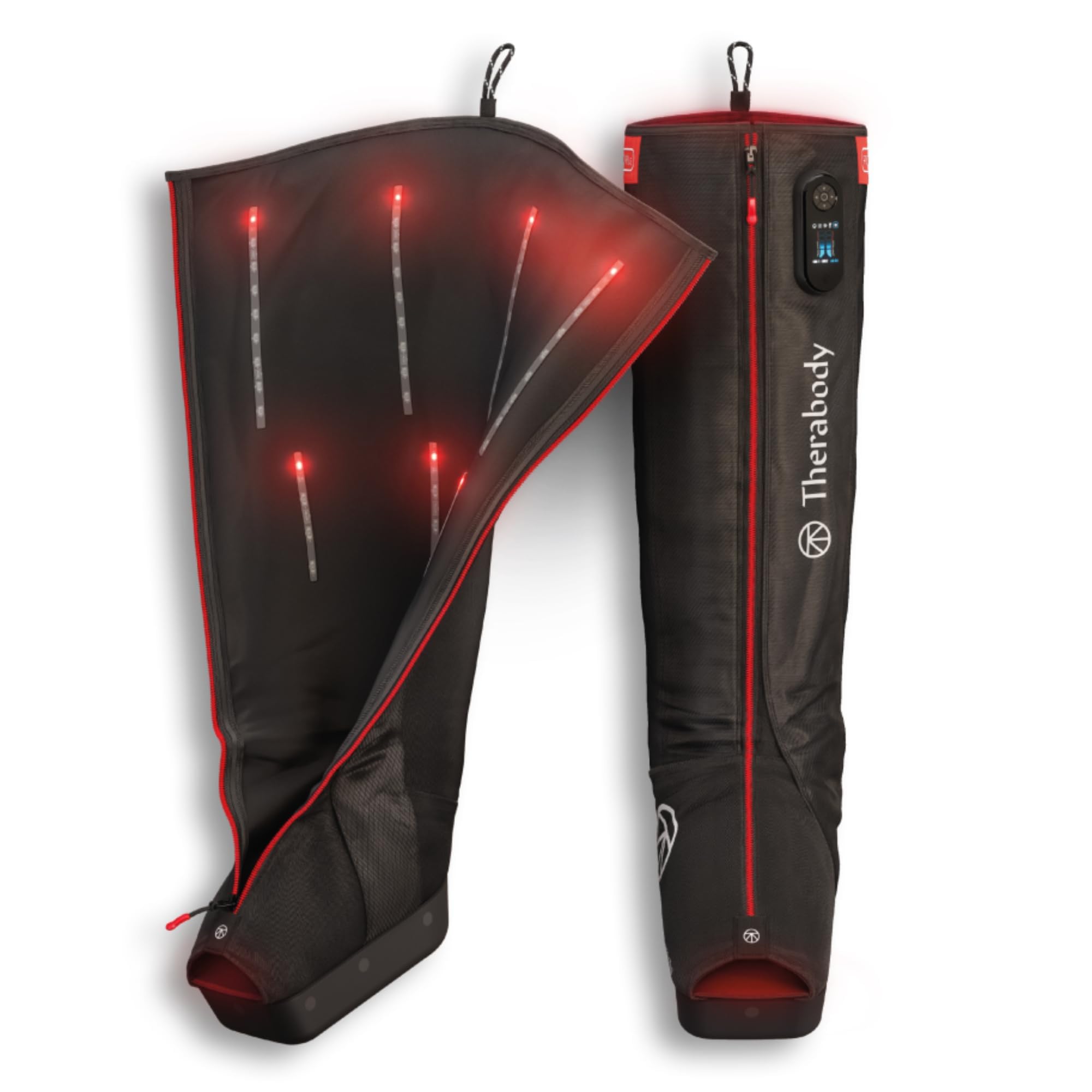
The JetBoots Prime folds up like a pair of pants and fits in a backpack, which is the reason we give it the travel label. At 6 pounds, it is the pair you can carry to the gym, a shootaround, or a weekend trip without dedicating a suitcase to recovery. The boots are fully wireless, and the control panel is built into the leg, so there are no hoses to connect or a pump to find space for.
The four overlapping chambers use TruGrade pressure, and the one-touch panel offers time and pressure settings without an app. We like that simplicity on the road: you zip in, choose a level, and lie back. The three-hour battery covers several sessions between charges, and the drawstring bag keeps the whole thing together.
The Prime is the pair for a player who wants recovery to travel as easily as a pair of shoes. It fits into a gym bag, works without an outlet, and the built-in controls mean you can start a session without hunting for a phone. Once you are lying down, the compact size stops mattering and the routine takes over.
Pros
- Folds into a backpack
- Wireless with 3-hour battery
- Light 6-pound build
Cons
- Only four compression chambers
For basketball players who recover on the move, the JetBoots Prime is the easiest wireless pair to pack, wear, and use without a hose.
FIT KING Pro FT-115A – Best Zone Control
Key Features
- Power: Cordless
- Zones: 5-zone precision control
- Warranty: 2 years
- Pressure levels: 11 pressure levels (50–150 mmHg)
- Price: Midrange
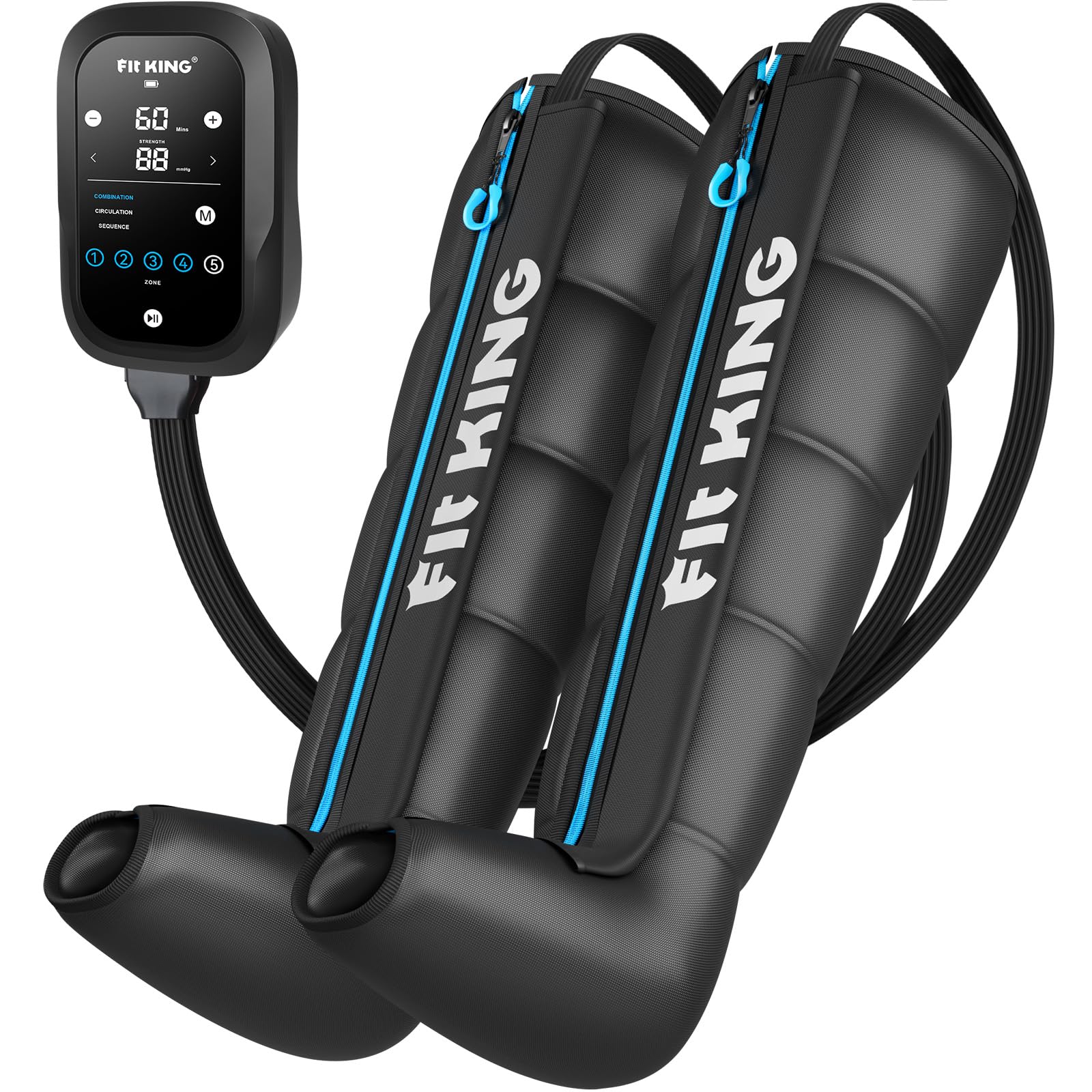
Five independently controlled zones are the reason to look at the FIT KING Pro. The FT-115A splits the leg into foot, lower calf, upper calf, and thigh sections, and you can run the whole leg or focus pressure on one area. The controller also gives you 11 pressure levels from 50 to 150 mmHg, three modes, and ten time settings from 15 to 60 minutes.
The cordless design is the other draw. The included 12V battery means you can use it away from an outlet, and the 9.92-pound kit is still manageable to carry from room to room. The 2-year warranty is a useful buffer on a system with this many controls, and the reinforced stitching and smooth zippers are the kind of details that matter when you are stepping in and out after every game.
We rank it as the best zone-control pick here because that flexibility changes the routine. If one calf is tight after a game, you can spend the session there instead of running a generic full-leg cycle. That control is the reason to choose it over a simpler four-chamber pair, and the cordless design makes it practical for a home setup that moves between rooms.
Pros
- Five independently controlled zones
- 11 pressure levels up to 150 mmHg
- Cordless with 2-year warranty
- Ten session timers from 15 to 60 minutes
Cons
- 9.92-pound kit is home-first
We recommend the FIT KING Pro for players who want to target a specific calf or thigh zone without giving up cordless convenience.
Therabody JetBoots PRO Plus – Best 3-In-1 Recovery
Key Features
- Weight: 11.3 lb
- Battery: Up to 5 hours
- Presets: 8 built-in presets
- Therapies: Compression, vibration, LED light
- Price: Premium
Compression, vibration, and LED light in one wireless pair is the JetBoots PRO Plus’s whole pitch. It has eight built-in presets, a 5-hour battery, and a completely hose-free design. The package is more complex than anything else here, and it is aimed at the player who wants more than air pressure.
The vibration is the part that changes the feel. Air alone can leave a sore calf feeling squeezed without being worked; the vibration adds a different kind of input, and the light therapy is there for the same recovery-minded buyer. The eight presets keep you from building a routine from scratch, which is useful when you are tired after a game and do not want to think.
The trade-offs are real. The extra therapies add complexity without making the basic compression more adjustable than the simpler boots here, and the presets are less flexible than the manual controls on the FIT KING Pro. That is the specialist bargain: you accept a more prescribed routine in exchange for vibration and light.
We rank it as a specialist, not the default. If you want the sensory variety and will use the light and vibration often, it is a legitimate specialist tool; most basketball players will get more value from the Prime or the standard Normatec 3. If you already know vibration helps your legs, the extra modes earn their keep; if you have not tried it, start with a simpler pair.
Pros
- Compression plus vibration and LED light
- Eight built-in presets
- Up to 5-hour battery
Cons
- Heavy at 11.33 pounds
- Premium price for extra therapies
The JetBoots PRO Plus is for the player who wants vibration and light added to compression and will accept the bulk and premium price.
RENUPRO Leg Compression Massager – Low-Cost Full-Leg

Key Features
- Modes: 6 modes
- Timers: 15/20/25-minute timers
- Coverage: Feet, calves, knees, thighs
- Pressure levels: 9 strength levels
- Price: Budget
The RENUPRO system reads like a much more expensive recovery tool: six modes, nine pressure levels, three timers, and coverage from the feet through the calves and knees to the thighs. The overlapping air chambers are designed to mimic natural muscle contractions, and the digital controller is simple enough to set before you sit down. It is the lowest-priced full-leg system in this group.
That feature set is why we see it as the best budget-first full-leg option here. You still get a range of pressure, a choice of modes, and a timer, which is more than some budget boots offer. The zippered sleeves are easy to step into, and the 7.1-pound package is light enough to move around the house without feeling like a piece of gym equipment.
What keeps it in also-consider is long-term certainty. There is not enough history here to call it a proven workhorse, so we treat it as a smart first pair for a player who wants the full-leg routine before spending more. If you want the most established system, the Normatec 3 is the safer call; if not, the six modes give you room to experiment without upgrading later.
Pros
- Six modes and nine pressure levels
- Covers feet, calves, knees and thighs
- Three session timers
Cons
For a budget-first basketball player, the RENUPRO gives full-leg coverage and unusually deep adjustment without a premium commitment.
Musugy Compression Boots – Best for Taller Players

Key Features
- Fit: 36-inch inseam or longer
- Modes: 6 modes
- Chambers: 5 air chambers
- Pressure levels: 9 pressure levels (40–120 mmHg)
- Price: Budget
The Musugy boots are aimed at longer legs: they fit a 36-inch inseam or longer, and the five chambers run high enough to reach the upper thigh on a tall frame. For a basketball player who has been squeezed into boots that stop below the knee, that extra length is the first reason to look here.
The rest of the package is competitive. You get nine pressure levels from 40 to 120 mmHg, six modes, and three timers, plus a pressure sensor that adjusts inflation to leg circumference. The 6.72-pound kit is lighter than most full-leg systems here, and the carrying bag makes it easier to store between sessions.
The fit is also the catch. A system built for a 36-inch inseam will run long on shorter players, and the same sleeve that reaches the upper thigh on a tall frame can bunch around the knee on a smaller one. We treat that as a sizing decision, not a fault: check the inseam range and choose another model if you are between sizes.
We see the Musugy as a specialist pick rather than a default. If you are tall and tired of boots that stop short, it is the one to try first; if you are average height, the FIT KING Pro or Normatec 3 will fit more predictably. The carrying bag is a small thing, but it keeps a long pair out of the way between games.
Pros
- Fits 36-inch inseams and longer
- Five air chambers
- Nine pressure levels and six modes
Cons
Taller basketball players should start with the Musugy: it is built for a 36-inch inseam and still offers five chambers and six modes.
Nekteck Cordless Recovery System – Budget Cordless

Key Features
- Modes: 6 modes
- Battery: 90-120 minutes
- Chambers: 4 air chambers
- Pressure levels: 4 intensities (50-200 mmHg)
- Price: Budget
A 90- to 120-minute battery and a zippered sleeve design are the core of the Nekteck system. It uses four air chambers, six modes, and four pressure intensities from 50 to 200 mmHg, with three timers. The whole kit weighs 6.8 pounds, so it is easy to move from the bedroom to the couch.
We like the zipper for the end of a long day, when bending over to wrestle with a sleeve is the last thing you want. The battery coverage is enough for a session on each leg or a couple of shorter routines, and the 6.8-pound package is light enough to take to a hotel. It is a simple system to live with, and the zippered design makes the routine feel less like a chore.
For a basketball player who wants cordless convenience without a premium commitment, this is the value play. It does not have the zone control or polish of the FIT KING Pro, and the shorter track record means we treat it as a budget option rather than a long-term workhorse. If you want a simple wireless pair for home and travel, it covers the basics.
Pros
- Cordless with 90-120 minute battery
- Full-leg four-chamber coverage
- Light 6.8-pound kit
Cons
- Only four pressure settings
For a budget-minded player who wants cordless recovery, the Nekteck covers the full leg with a long battery and simple controls.
How We Tested Recovery Boots for Basketball Players
We started by researching the recovery boots that show up in pro training rooms and on basketball forums, then narrowed the field by compression range, adjustable settings, battery specs, and packed size. From that shortlist, we brought in six pairs and used them for eight months. Every boot went through the same routine: post-practice recovery, a hotel-room session before a game, and a couch session after pickup.
Fit and compression came first. I have a thicker calf, and my teammate has a leaner one, so we noted where the cuffs dug in, whether the sleeves slid down during a 30-minute session, and how the squeeze felt at the calf versus the thigh. We cycled through every setting, timed how long it took to change modes one-handed, and checked whether the boots remembered our preferences between sessions.
We also tracked the less glamorous stuff. Battery life got timed across multiple sessions per charge, including a full travel day; we folded each pair into a gym bag and noted the footprint in a hotel room. Durability meant checking seams, hoses, and zippers after repeated inflate-deflate cycles. For recovery and effectiveness, we rated how our legs felt the next morning, especially after back-to-backs, and whether stairs or a next-day run felt easier.
Value came down to what the boots delivered for the money: even compression, useful settings, a battery that lasted, and materials that held up. The six pairs that made the cut were the ones we reached for without thinking—and the ones that didn’t, we stopped using by month three.
How to Choose Compression Boots for Basketball Players
The right pair covers your whole leg, fits your inseam, and matches where you actually recover.
Coverage and zone control
This is the first spec to settle because a boot that stops at the calf cannot do the job of a full-leg system. Four chambers are enough for a general foot-to-thigh sweep; five zones let you isolate the foot, calf, or thigh, which is useful when one area is carrying more soreness. More zones are not automatically better if the sleeve is too long or too short for your leg. We prioritise coverage that reaches the upper thigh without bunching at the knee, then look at whether the controller can target a single zone.
Cordless convenience versus a home setup
A battery is the difference between a pair that lives beside the couch and one that goes to the gym. Wireless systems like the JetBoots Prime and FIT KING Pro cost more and add a component that will eventually need charging or replacement, but they remove the hose-and-pump hassle. If your recovery always happens in the same room, a plug-in system is the simpler buy. If you travel for games or want to use the boots at the facility, pay for the battery and check the runtime before you commit.
Fit: measure inseam and calf, not height
The trap is ordering by height alone. Compression boots need to reach from your foot to your upper thigh, and the sleeve has to close around your calf without pinching. Check the listed inseam range and thigh circumference, then compare that with the fit notes for the specific model. A boot that is too long can leave the foot section loose; one that is too short leaves the thigh untreated. If you are between sizes, choose the model with a broader fit range rather than guessing.
Pressure, modes, and session length
Pressure levels are not a scoreboard. A system with 8 to 12 settings gives you room to start gently and progress, but most players will not use the top end. What matters more is whether the modes make sense for you: a sequential foot-to-thigh cycle for general recovery, a targeted zone mode for a specific area, and a timer you can set without fiddling. Start with a shorter session and moderate pressure, then adjust. If the boots feel painful or numb, the setting is wrong for that day.
Durability, warranty, and the cost of repair
Compression boots are a motor, a controller, and a set of air chambers, so the warranty matters as much as the pressure range. A 24-month warranty is a meaningful signal on a lower-cost system; a premium pair should come with support that matches the price. Check whether replacement sleeves or controllers are available, and keep the boots out of tight storage that stresses the zippers. We treat a two-year warranty as the minimum for a system used several times a week.
Frequently Asked Questions
Are compression boots actually useful after a basketball game?
They are a recovery routine, not an injury treatment. A full-leg session can make heavy legs feel less stiff and give you a reason to sit down for 20 minutes after a game, but it does not replace sleep, food, or a gradual return to running. If you want a passive habit that fits between the locker room and the couch, they make sense. Use them consistently after games and travel, not as a one-off.
Do compression boots replace stretching or foam rolling?
No. Boots provide passive sequential pressure while you lie down; stretching and foam rolling ask something of the muscle. They solve different parts of recovery, and the best routine uses both. If you are short on time, use the boots after a game when you want to be off your feet, and keep a short mobility routine for the next morning.
Can I use compression boots with a history of blood clots?
Ask a clinician first. Compression therapy is not appropriate for everyone, especially people with known blood clots, severe circulation problems, or open leg wounds. The same caution applies if you are using medical compression under a doctor’s care. Clear it before you buy rather than testing a session on your own.
Do I need to use both legs at once?
Most full-leg systems are built to run as a pair, and some controllers will not operate a single sleeve alone. If you want to treat one leg after a knock, check that the model supports single-leg use before ordering. Otherwise, plan on sitting through a full pair session.
Final Verdict
The Normatec 3 Legs is the pair we recommend first for most basketball players. Five zones, seven levels, and a simple foot-to-thigh routine make it the easiest complete system to live with, and the recovery payoff is why it stays at the top of this set. If you need to take recovery on the road, the JetBoots Prime is the better travel companion; if the budget is tighter, the QUINEAR system covers the full-leg essentials for less. Start with the one that matches where you recover, not the one with the longest feature list.