
This post contains affiliate links. We may earn a small commission when you buy through our links — at no extra cost to you.
A good pickup run shouldn’t cost you three days of walking down stairs sideways. But that’s the trade a lot of us make — quads full of knots, calves that seize on the drive home, and a foam roller that only reaches so far. A massage gun solves the reach problem: the percussion head gets into glutes, calves, and that spot under the shoulder blade nothing else touches, and it does it in ten minutes on the couch rather than an hour booked with a recovery therapist.
I keep one in my gym bag now, and after eight months with 11 different guns — a few budget picks, a few serious investments — the differences come down to things the spec sheet hides. Stall force matters more than top speed, battery claims are usually measured at the lowest setting, and half the included heads never leave the case. If you’re gearing up for a season of back-to-backs, the picks below are the ones that held up.
Our Top Picks


The Best Massage Guns for Basketball Players, Reviewed
Opove M3 Pro 2 – Best Overall
Key Features
- Amplitude: 12 mm
- Speed range: 5 speeds, up to 2500 RPM
- Stall force: 70 lb
- Battery life: 4-8 hours
- Price: Midrange
Stall force is the figure that decides whether a massage gun is worth owning, and the Opove M3 Pro 2 has more of it than anything else in this group: 70 pounds, against 53 on the Mebak and 45 on the RENPHO. What that buys you is a piston that keeps cycling when you lean your body weight into a quad that’s still tight from a fourth quarter. We pressed harder than we normally bother to, and the stroke never shortened or stuttered. The 12mm amplitude is the longest throw here too, which is the difference between a gun that buzzes the surface of a glute and one that gets underneath it.
The rest is quiet competence rather than showroom features. At 2.6 pounds it’s the heaviest gun here, and the weight is honest — you’ll use two hands on hamstrings and glutes, and one hand on a calf only if you’re determined. Five speeds top out at 2500 RPM, and the lowest is genuinely usable on tissue that’s still sore a day after a game, which isn’t true of everything in this group. The vents are tucked into the shell now, a redesign aimed at heat, and after a long session the body runs warm rather than hot.
Battery is what we watched closest, because a dead gun at the bottom of a gym bag is how most of these disappointments start. Opove rates it at 4-8 hours, and across a couple of weeks of daily sessions we never came close to empty; it went back in the bag with charge left in it. Treat a whole team with it and you’ll charge it nightly. Treat yourself, and you’ll forget where the cable is.
The one thing it won’t do is subtle. Even the first speed carries real force, which is exactly what a tight quad wants and more than a sore neck does. For gentle work on a tender day, the TheraGun Relief is the better tool and we reach for it instead.
Pros
- Most stall force here at 70 lbs
- 12mm amplitude reaches under the muscle
- Battery holds up over weeks of daily use
- Power stays strong under pressure
Cons
- Hard case is bulky in a gym bag
The one we point basketball players to first: 70 pounds of stall force and the deepest stroke here, so it keeps working when you lean into a tight quad.
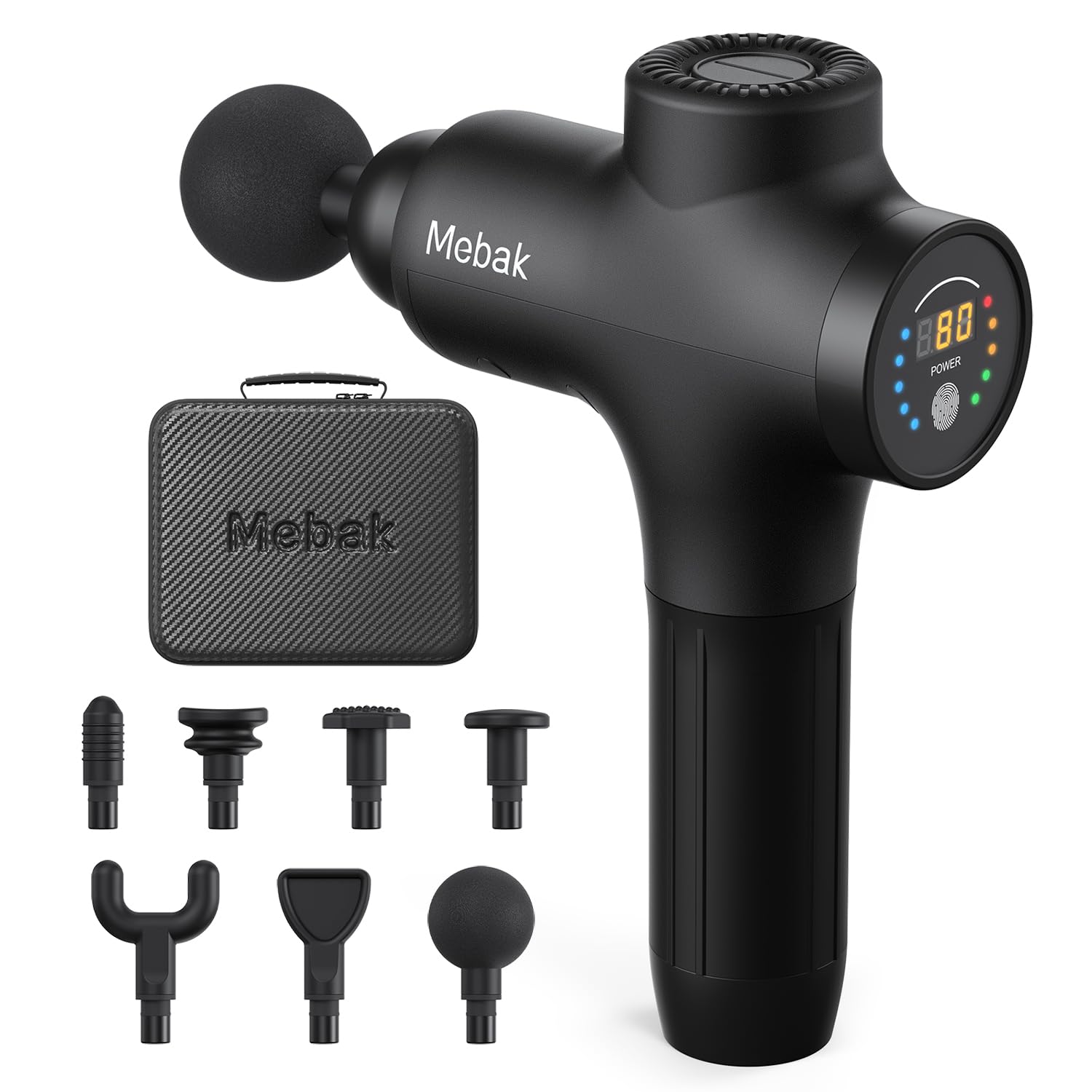
Mebak 3 – Best Value Deep Tissue
Key Features
- Weight: 1.68 lb
- Amplitude: 12 mm
- Speed range: 950-3000 RPM
- Stall force: 53 lb
- Price: Midrange
The Mebak 3 weighs 1.68 pounds, which reads like a footnote until you’re holding a gun against your own hamstring at an awkward angle for a couple of minutes. That’s where we noticed the difference first — in the forearm, not the leg. It’s the gun we hand to someone who wants to work on their own calves without needing a second person in the room.
There’s substance behind the light body. Amplitude is 12mm, the same throw as the Opove, with 53 pounds of stall force behind it instead of 70. On calves, quads and the muscles around the shin it feels every bit as deep. On a dense glute at the end of a hard week you can feel it give up a little sooner, and that’s the honest gap between the two. Five speeds run from 950 to 3000 RPM — the widest spread here — and the top end is brisk without turning into a jackhammer.
We didn’t expect to care about the pressure indicator, and then it changed how we used the gun. An LED strip lights up as you lean in, and it showed us we were pressing much harder than the muscle needed. Seven heads is more than anyone needs, but the flat one is right for a quad and the bullet head gets into the tissue beside the shoulder blade.
It runs quiet, at 39 to 50 dB — quiet enough to use in front of a TV or in a shared gym without drawing looks — and the case holds the gun and all seven heads. For most players this is the sensible buy, and the Opove is for the ones who want the last word in force.
Pros
- Same 12mm amplitude as the top pick
- Light enough for one-handed calf work
- Quiet enough for a shared gym
Cons
- Less stall force than the top pick on glutes
- Long-term reliability is unproven
Our pick for deep tissue without the bulk: the same 12mm stroke as the top pick, 1.68 pounds in the hand, and seven heads to work with.
RENPHO Thermacool 2 – Best for Heat and Cold
Key Features
- Weight: 1.39 lb
- Amplitude: 10 mm
- Stall force: 45 lb
- Temperature range: Up to 113°F heat, down to 46°F cold
- Price: Midrange
A heated massage head sounds like a novelty until you put it against a lower back that’s been sitting in a car for an hour. RENPHO runs four heat levels up to 113°F, which is warm rather than hot — closer to a hot towel than a heating pad — and the combination of warmth and percussion is what made this the gun we reached for before a session rather than after one.
The cold head is the half nobody else here offers. Four levels down to 46°F, and it is properly cold on the skin. We used it on a calf that felt tight and hot after a long session, keeping the head moving rather than holding it in one place, and it’s the reason this gun stayed out of the case that week.
Underneath the temperature controls it’s a 10mm, 45-pound gun with a 3200 RPM ceiling. That’s a real step down in throw from the 12mm pair, and on a glute or a deep quad the head doesn’t reach quite as far — you feel it working the surface rather than the belly of the muscle. Where it shines is everything smaller: the muscle beside the shin, the tissue around the shoulder blade, a forearm after a long shooting session. At 1.39 pounds it’s the lightest full-size gun here, so a long pass doesn’t wear your arm out.
The display shows speed, temperature and battery at a glance, and the heat and speed controls are separate — obvious in principle, rarer than it should be in practice. Battery is the part to keep an eye on: heat draws more of it, and a unit that stops accepting a charge is the failure this category is known for. Buy it somewhere with an easy return and charge it before it goes flat.
Pros
- Heat and cold heads in one tool
- Lightest full-size body here at 1.39 lbs
- High 3200 RPM ceiling with clear controls
Cons
- 10mm stroke feels shallower on glutes
- Battery can stop taking a charge
The only gun here that both heats and cools: warmth before you play, cold afterward, in a 1.39-pound body that’s easy to hold one-handed.
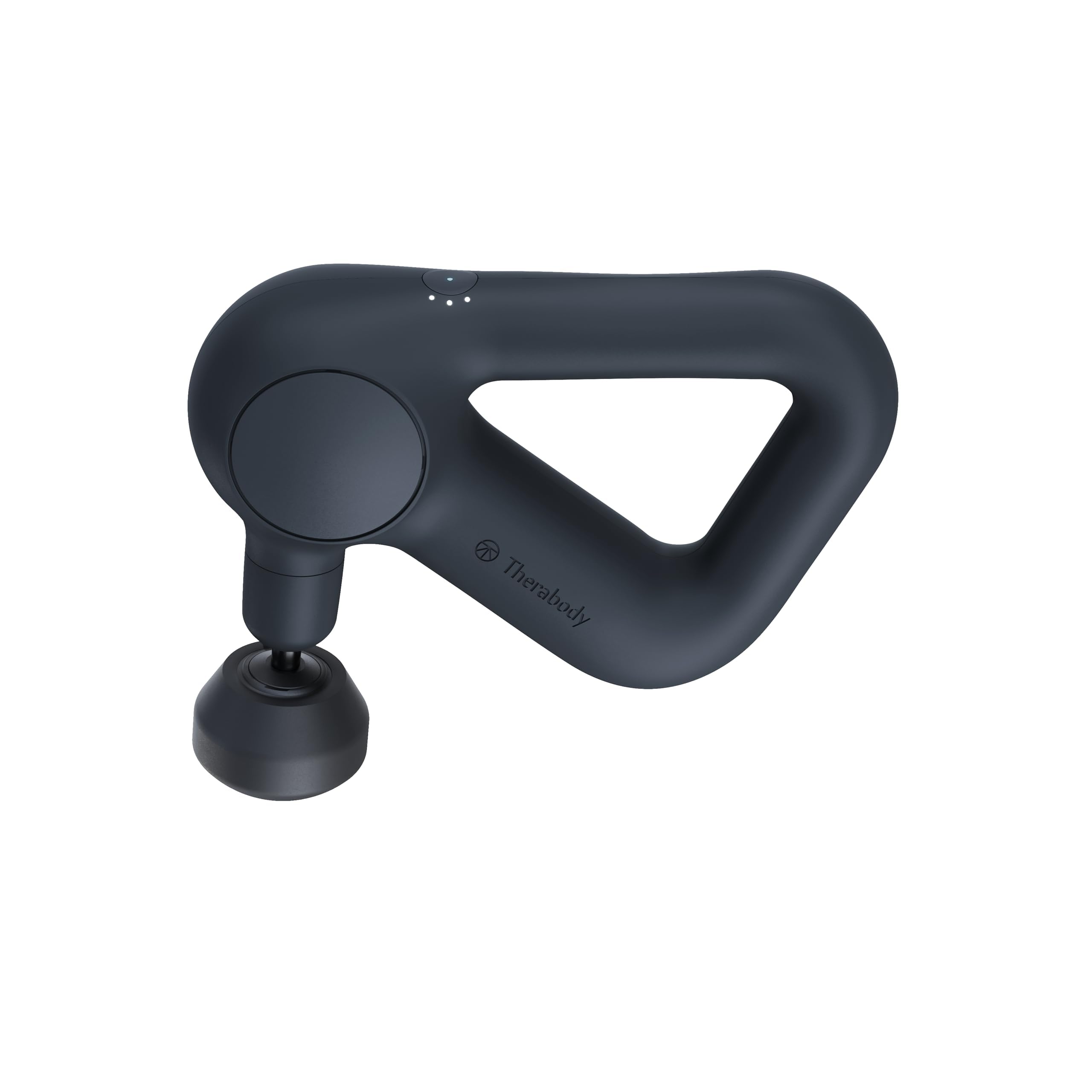
TheraGun Relief – Best for Tender Days
Key Features
- Grip: Patented triangle grip
- Speeds: 3
- Weight: 1.37 lb
- Attachments: 3
- Price: Premium
Three speeds and no attempt to win on force. TheraGun calls this its gentlest gun, and that’s the entire pitch: on the day after a game, when a calf is tender to the touch, most of the guns here still bite even on their lowest setting. The Relief starts soft and stays there — a narrower job than the others do, and one nothing else in this group covers as well.
At 1.37 pounds it’s the lightest gun here, which is why it ends up in a gym bag rather than on a shelf. It’s easy to hold one-handed on the outside of a calf, and the triangular grip is the detail we appreciated most: you can hook your fingers through the opening and come at the middle of your back from an angle instead of reaching over a shoulder.
What it isn’t is a deep-tissue tool. No amplitude or stall-force figure is published for it, and on a tight glute you feel the limit immediately — it soothes the surface and leaves the knot where it is. Three attachments cover the basics, the dampener is the right head for a tender spot, and the motor is quiet enough to use while you’re watching film.
Charging runs over USB-C, and the first month is when to watch it: a unit that stops taking a charge is the failure to catch early, while returns are still simple. Beyond that it’s the least fussy gun here — one button, three speeds, and a body you can hold for as long as you like.
Pros
- Lightest gun here at 1.37 lbs
- Triangle grip reaches your own back
- Genuinely gentle low setting
Cons
- Too gentle for dense knots in glutes
Built for the day after, not the day of: three gentle speeds, 1.37 pounds, and a triangular grip that reaches your own back without help.
Medcursor Massage Gun – Best for Quiet, Small Areas

Key Features
- Noise: From 35 dB
- Weight: 1.5 lb
- Runtime: Up to 4.5 hours
- Massage heads: 6
- Price: Budget
Thirty-five decibels is close to a whisper, and it’s why this gun gets used in places the others don’t: a hotel room, a shared apartment, the sofa in front of a film. We could hold a conversation over it at arm’s length, which is not something we can say about the heavy guns in this group.
It’s a compact gun and we treat it that way. At 1.5 pounds it’s easy to hold one-handed, and it does its best work on forearms, calves, feet and the muscles around the shin. On a dense glute or a deep quad it runs out of travel — no amplitude or stall-force figure is published, and you can feel why. If you want one gun for the big muscles basketball overloads, this isn’t it.
What it does well is remove friction. One button cycles the speeds, the ten-minute timer ends a session before you overdo a spot, and the battery is rated at up to 4.5 hours off a triple 2000 mAh pack — enough for a week of short sessions. Six heads and a small case mean it disappears into a bag. It’s an inexpensive second gun rather than a primary one, and that’s the role it fills for us.
Pros
- Quietest gun here at 35 dB
- Light and easy to hold one-handed
- 10-minute timer caps a session
Cons
- Runs out of travel on glutes and quads
The quiet one: 35 dB, 1.5 pounds and a sensible 10-minute timer — a good second gun for arms, calves and feet, not for a deep glute.
How We Tested 11 Massage Guns
We started with the guns that actually turn up in gym bags and locker rooms — the ones players recommend to each other — then filtered by size (does it fit a side pocket?), stated battery life, attachment variety, and price, from budget to pro-level. That left 11 units, which we lived with for eight months across pickup runs, team practices, weight-room sessions, and more hotel rooms than I’d like to count.
Most of our testing happened within an hour of playing, while the legs were still hot. We worked each gun into a knotted quad and a tight calf for ten minutes, cycling through every speed, then noted whether the next morning’s walk down the stairs felt any different — the only pain-relief test that ever matters. For power, we leaned body weight into the head and watched for the motor bogging down or the stroke shortening. Durability got no special treatment: each gun rode loose in a gym bag, got knocked off a bench onto hardwood, and came along on road trips.
We charged each gun to full, then ran it on the highest setting until it quit, logging the minutes against the manufacturer’s claim — most numbers assume the slowest speed, and a couple of guns fell well short. Every included attachment got used on calves, glutes, and shoulder blades, and we tracked which heads actually reached deep tissue and which stayed in the case. At the end we handed each one to teammates for a week and asked the blunt question: would you spend your own money on this, and does the box justify what it costs?
How to Choose a Massage Gun for Basketball Recovery
For a basketball player, two unfashionable figures decide whether a gun is worth owning — stall force and amplitude — and everything else is comfort.
Stall force is the number that matters under load
RPM tells you how fast the head moves when nothing is pressing on it. Stall force tells you how much pressure it takes before the motor gives up, and since you’ll be leaning into a quad or a glute, that is the figure that decides whether the percussion keeps going or collapses into a buzz.
The guns here run from 45 to 70 pounds. For calves, forearms and feet the low end is plenty. For a dense glute the week after a heavy training block, the extra force of the Opove or the Mebak is what you’re paying for.
Amplitude: how far the head actually reaches
Amplitude is the length of each stroke in millimeters, and it’s the best shorthand for whether a gun feels deep or superficial. The 12mm guns here, the Opove and the Mebak, push further into the muscle before rebounding — which is what you want on quads, hamstrings and glutes.
A 10mm gun like the RENPHO reaches less far, and that isn’t automatically worse: on a tender calf or a thin shoulder, less travel is easier to take. Buy one gun for basketball and you want the deeper stroke.
Weight decides whether you actually use it
Working on your own calves and hamstrings is an awkward job, and a heavy gun makes it worse. Two and a half pounds doesn’t sound like much until you’re holding it at arm’s length for a few minutes, and the arm gives out before the muscle does.
The lighter guns here, from 1.37 to 1.7 pounds, are the ones that get used one-handed without a rest. The heavier Opove earns its weight by hitting harder on glutes, where you can support it with both hands. Be honest about which of those two you’ll actually do.
Heat and cold, and when each one belongs
Warmth before you play loosens tissue and makes a stiff lower back easier to work on. The heated heads here top out around 113°F, which is hot-towel warmth rather than heating-pad heat, and it works best combined with percussion rather than as a substitute for it.
Cold after activity, down around 46°F on the RENPHO, is for tissue that is swollen and hot to the touch. Keep either head moving over the area instead of parking it, and treat both as additions to a session, not the session itself.
What fails, and what to check before you buy
The motor and the battery are where these guns go wrong, and it usually happens inside the first year. Two things protect you: buy where returns are simple, and register the warranty the week it arrives rather than the week it dies.
A gun that stops taking a charge at month four is a warranty claim, not a performance problem. Charge it before long stretches in a bag, use the auto shut-off if your model has one, and don’t leave it plugged in for weeks at a time.
Frequently Asked Questions
How often can I use a massage gun on my legs?
After training is the obvious slot, and a minute per muscle group is a sensible ceiling for a single area — quads, calves, glutes and hamstrings, moving the head the whole time. On rest days, a shorter pass on whatever still feels tight is plenty.
Several guns here cap a session for you: the Medcursor and the Bob and Brad-style ten-minute timers exist because most people overdo it, not underdo it. Ten minutes total is a good rule even on a gun without a timer.
Will one of these actually fit in a gym bag?
The units here run roughly 10 inches long, so the gun itself drops into a standard gym bag’s main compartment without a fight. The Opove measures 9.88 by 6.92 by 2.8 inches, and most of that thickness is the hard case.
If bag space is tight, carry the gun and one attachment and leave the case at home. The Medcursor is the smallest of the group and the easiest to slide into a side pocket.
Can I use it on a bruise or right on my knee?
No. Keep the head on the meat of the muscle — quad, calf, glute, the tissue beside the shoulder blade — and work around the spine, the kneecap and any spot that is bruised, swollen or hot to the touch. Percussion over bone or an acute injury doesn’t do the tissue any favors.
If something has been sore for a week or more without improving, that’s a physio conversation rather than a longer session.
Final Verdict
If you’re buying one gun for basketball, buy the Opove M3 Pro 2. It has the most stall force and the longest stroke in this group, and those two things are what turn a massage gun from a vibrating toy into something that moves a tight quad.
For the same 12mm stroke in a body you can hold one-handed, the Mebak 3 is the pick, and it costs less for the privilege. If your recovery happens the day after a game, when everything is tender, the TheraGun Relief is the gentlest tool here — and the only one we reach for when the muscle is already angry.