
This post contains affiliate links. We may earn a small commission when you buy through our links — at no extra cost to you.
Nobody shops for an ice pack until they need one. Mine was a Tuesday night pickup game, a rolled ankle, and a bag of frozen peas thawing through my sock on the bench. That’s the trouble with icing an injury: the first 24 hours matter more than anything else you’ll do, and a pack that slips, sweats, or goes warm in eight minutes means you quit early. The right one fixes that — cold enough to actually numb the pain, flexible enough to wrap a knee or a shoulder, and big enough to cover the joint that’s swollen.
My team and I have kept 16 ice packs in rotation for three months — in freezer drawers, gym bags, and on the couch where I iced a jammed thumb. Some froze into rigid slabs, a few leaked at the seam by week three, and the ones I keep reaching for share a soft, moldable fill and a strap that stays put. Colder isn’t automatically better, either, and the picks below are the ones that earned a permanent spot in my freezer.


Best for All-Round Icing at Home
NatraCure FlexiKold 2-Pack
Key Features
- Size: Medium
- Construction: Double-sealed, thick nylon
- Packs included: 2
- Price: Premium
A second pack in the box looks like padding until you are icing an ankle at nine at night and the only one in the house is still soft from the last session. That is why the FlexiKold two-pack leads this list. Freeze both, use one, and the spare is firm again before you need it. Medium is the size we reach for most: enough to drape a knee or wrap an ankle, small enough to fold in half and slot into a crowded freezer shelf.
What we noticed first is how it behaves coming out of the freezer. The gel folds around an ankle instead of sitting on top of it like a brick, and the thick nylon shell keeps the seams from digging into a shin. Softness counts for more than it sounds here: a pack that molds to the joint keeps contact with the swollen part, and contact is the entire point of icing.
Cold holds for a normal icing session rather than a marathon, which is exactly the window you need. There is no cloth sleeve in the box, so put a thin towel between the pack and bare skin. The nylon is tough, but it is not a barrier you want pressed against a shin for twenty minutes.
The trade is that this is a lying-down pack. Nothing holds it on while you move, so it suits a sofa and a raised leg rather than a walk around the kitchen. For icing a knee while you keep doing something else, the KingPavonini wrap is the better tool; for a gym bag and a cushion, this is the one we reach for.
Pros
- Two packs keep one always frozen
- Gel stays pliable around a joint
- Double-sealed seams and thick nylon
Cons
- No strap or sleeve included
We point most people to the FlexiKold two-pack: it molds around an ankle or a knee, and the spare is already frozen when the first one gives out.
Best for Icing a Knee
KingPavonini XXL Knee Wrap
Key Features
- Faces: Plush and nylon
- Gel fill: 2.2 lb
- Wrap size: 19 x 10.6 in
- Strap length: 24.8 in
- Price: Midrange
Around a knee, the KingPavonini goes on in about the time it takes to sit down: press the plush side to skin, pull the two elastic straps, and the front and both sides of the joint are covered. We put that convenience first because it decides whether you actually ice on a Tuesday night or tell yourself you will do it tomorrow.
The 19 by 10.6 inch face is wide enough to run past both sides of a kneecap, and the two-sided build is a small stroke of sense. Plush against bare skin when the joint is tender; flip it to the silky nylon side when you want the cold to bite harder. The straps are long and the hook-and-loop holds, including over a brace, which is more than we can say for a flat pack balanced on a cushion.
Cold is the compromise. The gel holds through a decent stretch but fades before the end of a long session, and at close to three pounds the wrap is heavy enough that walking around in it feels like carrying a bag of ice on a hinge. Treat it as a sit-down pack with better manners than most, not something to wear while you tidy up.
Where it earns its place is the knee specifically. Nothing else here covers the back and sides of the joint in one move with nothing to hold, and the straps adjust far enough to go over a pair of shorts. For an ankle, a shoulder, or anything you ice lying flat, a plain pack is simpler and less expensive.
Pros
- Wraps the whole knee, front and sides
- Straps hold it on hands-free
- Two faces for bare skin or harder cold
Cons
- Cold fades before a long session ends
- Heavy to wear while moving around
If the knee is the joint that keeps swelling, this is the pack to buy: it wraps the whole joint, holds itself on, and works without a towel.
Best for Thigh, Hip, Back
Rester’s Choice Large Gel Pack
Key Features
- Size: 11 x 14.5 in
- Weight: 2.6 lb
- Therapy: Hot or cold
- Price: Midrange
Eleven by fourteen and a half inches is a lot of gel. Laid across a thigh or a lower back, the large Rester’s Choice covers the whole sore patch in one go instead of making you shuffle a smaller pack around the edges. At about two and a half pounds it is substantial, and you feel that when you lift it off.
Cold is where this one stands out among the flat packs here: the gel holds through a full icing session with something left, and the thick outer binding does not feel like it is about to split. It comes out of the freezer stiff, so give it a minute or work it with your hands before it wraps properly. It takes heat in the microwave too, which matters if you alternate hot and cold.
The size that makes it the pick for a hip or a quad contusion is the same size that makes it wrong for an ankle, where you will be folding it in thirds and fighting the extra material. Our advice: buy this one for the large areas and keep a medium pack for the joints.
Pros
- Covers a thigh, hip, or lower back in one pass
- Cold holds through a full session
Cons
- Too big for an ankle or wrist
Buy this one when the sore spot is a thigh, hip, or lower back and you want a single pack to cover all of it.
Best for Hands-Free on a Budget
MEDVICE 3-Piece Gel Set
Key Features
- Sleeve: 1, adjustable strap
- Therapy: Hot or cold
- Gel packs: 2
- Price: Budget
Two gel packs and a sleeve with a strap is a lot of kit for the money, and it is the only set here that gives you both. The packs go in the freezer or the microwave; the sleeve goes around a knee, an elbow, or a shoulder and holds the pack where you put it, hands free.
We appreciated the small things. The strap adjusts far enough to go around a calf or over a shoulder, the sleeve is comfortable against skin, and the packs stay pliable enough to fold around a joint. The instructions are printed on the pack itself, which means they survive a trip through the freezer instead of disappearing into a drawer.
Cold fades on the quicker side; you get a session, not a long sit. The wrap also covers the front of a knee far more convincingly than the back. If you want a full wrap-around for a big knee, the KingPavonini is the better spend. For everything else, this is the sensible budget buy.
Pros
- Two gel packs plus a strap in one set
- Sleeve holds the pack without hands
- Instructions printed on the pack
Cons
- One sleeve shared by two packs
Two gel packs and a strap in one box, at the low end of this list: the setup we hand to someone icing a knee or an elbow on the sofa.
Best for Gym Bag
elitehood Ice Bag Set
Key Features
- Fill: Ice and water
- Sizes: 6, 9 and 11 in
- Weight: 3.5 oz (9 in bag)
- Includes: 3 bags and a wrap
- Price: Midrange
Not every icing session starts within reach of a freezer. The elitehood set is three refillable bags, 6, 9 and 11 inches, plus a stretchy wrap, and you fill them two-thirds with ice and a little water. The small one suits a wrist or a teenager’s knee; the large one wraps an adult knee with room to spare.
In a gym bag, the 9-inch bag weighs almost nothing dry, the screw cap opens wide enough to take cubes straight from a machine, and the wrap holds it against a knee or shoulder while you sit on the bench. Water does the work: it spreads the cold across the whole bag instead of leaving you with a lump of cubes and a wet towel.
Two things to know. It only works if there is ice where you are going, so it is a gym, arena, or hotel pick rather than a home one. And check that the cap is seated before the bag goes back in your kit, because a bag that has been knocking around a locker room is exactly where a loose cap shows up.
Pros
- Three sizes for a knee down to a wrist
- No freezer needed, just ice and water
- Strap holds the bag on the joint
Cons
- Needs ice and water where you are icing
Keep this set in the gym bag: no freezer, no waiting, just ice and water from the machine by the court.
Best for Shoulder and Back
REVIX Shoulder Ice Wrap
Key Features
- Strap: Stretchy, hands-free
- Coverage: Back and shoulder
- Gel fill: 30% more than standard
- Freezing point: -13 °F
- Price: Midrange
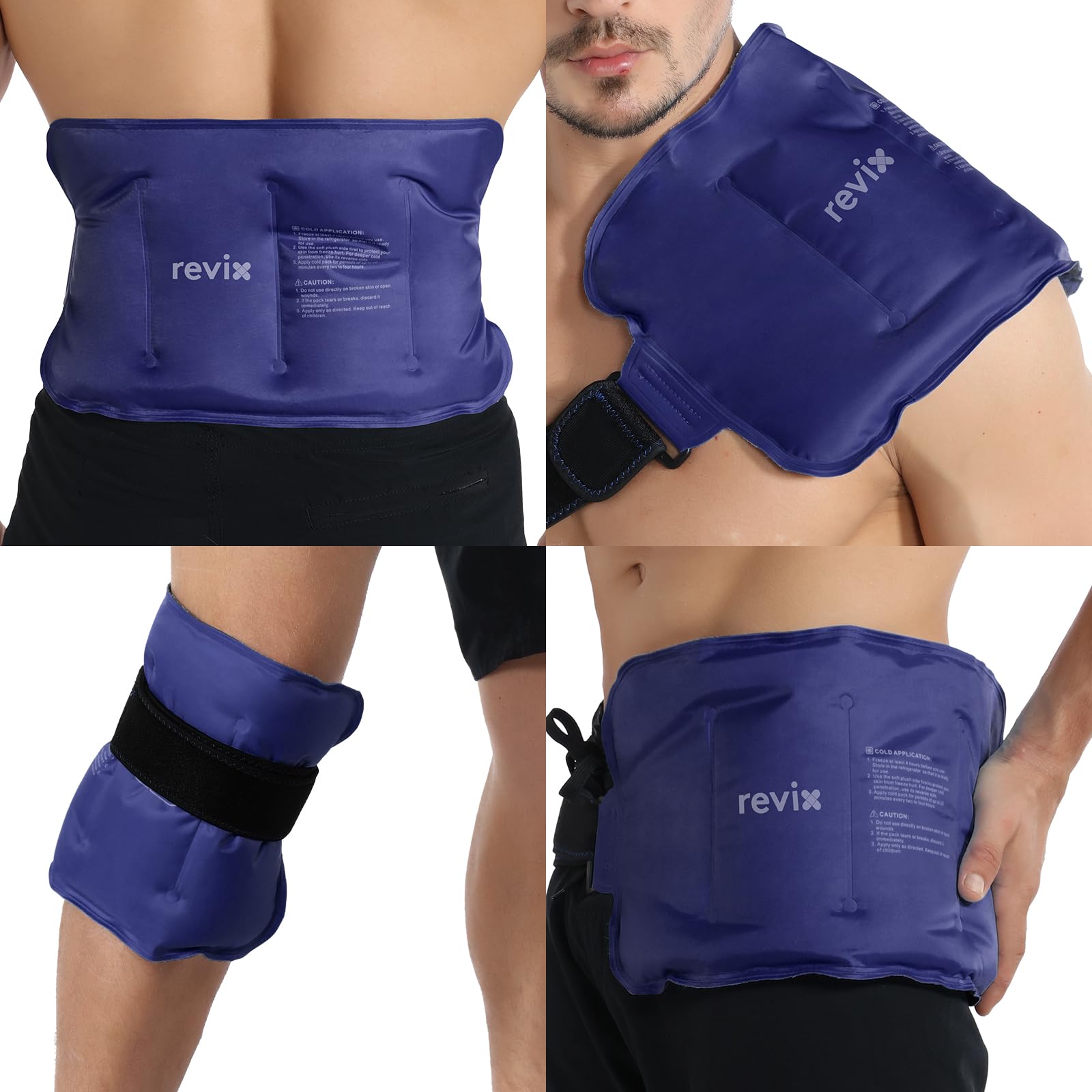
A shoulder is the awkward joint: a flat pack slides off the moment you sit up, and taping one on is a fiddle. The REVIX wrap is shaped for the shoulder and upper back, and it is the pick here for that job. The gel holds its shape at a lower freezing point, so it drapes over the top of the shoulder rather than resting on it like a plank.
The plush lining is the detail that won us over. It goes against bare skin without a towel and stays comfortable while you are propped on a sofa, and the pack is filled generously enough that the cold spreads across the top of the back instead of pooling in one spot. The strap is stretchy and reaches across a normal shoulder or waist.
The shape is the limitation too. Around a knee or an ankle the wrap has too much fabric and not enough purchase, and at a bit over two pounds it is heavy enough that a shoulder-only session is its real calling. Smaller frames should measure before ordering, because the strap runs short on bigger shoulders.
Pros
- Shaped for a shoulder and upper back
- Plush side goes on bare skin
- Stays pliable at a lower freezing point
Cons
- Strap runs short on larger frames
- Awkward on knees and ankles
For a shoulder or upper back, a shaped wrap beats a flat pack, and this one stays put and stays pliable without a towel.
Best for Flat Areas, Back
Perfect Remedy 2-Pack

Key Features
- Gel: 50% more fill
- Therapy: Hot or cold
- Packs included: 2
- Price: Midrange
The Perfect Remedy packs carry more gel than most two-packs here, and on a back or a thigh that thickness is the point: the cold spreads wide instead of concentrating in the middle of the pack.
On a knee it does a job. The packs are large enough to cover a broad area, they hold their cold for a reasonable session, and the pair means one is always coming back from the freezer while the other is in use.
Frozen solid is where it gets fussier. Straight out of the freezer these are stiffer than the FlexiKold or the Rester’s Choice; they bend, but they argue, and molding one around a narrow ankle takes patience. The seams are the soft spot over months of hard use, so give the pack a squeeze before each icing to make sure nothing has started to give.
None of that rules it out. For back icing, for a hip, or for anyone who wants a bigger gel fill and a hot option in the same pack, it is a sound buy and one of the better values here. Buy it for flat areas and treat it as the second choice for joints.
Pros
- Thick gel fill covers a broad area
- Hot and cold in the same pack
Cons
- Stiffens noticeably when frozen
- Seams are the weak point over time
A sound two-pack for back icing and flat areas, provided you do not need the pack to mold around a narrow joint.
Best for Spare in the Bag
BICAREE Ice Bag

Key Features
- Cap: Large-mouth
- Fill: Ice and water
- Size: 9 in
- Weight: 4.2 oz
- Price: Budget
An ice bag looks like something from a hospital supply cupboard, and that is roughly what it is: a rubbery 9-inch bag with a wide screw cap that you fill with ice and water. Empty, it weighs four ounces and folds flat into a kit bag.
What surprised us is how well the old design still works. Ice and a splash of water hold cold longer than gel does, and the bag does not sweat much, so it can sit against a knee without soaking a sock. The wide mouth takes cubes straight from a tray without a funnel and without a fight.
Size is the catch. Nine inches is smaller than the number suggests, and on a big thigh it looks modest, so measure before you plan on it for anything larger than a knee or a shoulder. As a spare that lives in the car or the gym bag for the ankle you roll on a Saturday, it is the cheapest useful thing here, and the one we grab when the gel packs are still solid.
Pros
- Cheap enough to keep as a spare
- Ice holds cold for a long stretch
- Wide cap is easy to fill
Cons
- Smaller than the 9-inch figure suggests
The one to buy as a spare: cheap, light, and content to sit in a kit bag until the night you roll something.
How We Tested the Best Ice Packs for Basketball Injuries
We started with about 50 ice packs pulled from sporting goods aisles and online listings, then narrowed the field by fill type — gel, clay, and soft bead — along with coverage area and strap design, keeping everything in the range a weekend player or a team trainer would actually buy. That left 16 packs, which spent three months in rotation.
Most of them lived in a gym bag and came out after practice, pressed against a rolled ankle, a bruised knee, or a sore shoulder after a Saturday morning of back-to-back games. We took surface readings with a probe at 5, 10, 20, and 30 minutes and noted whether each pack was still numbing at the 20-minute mark, the length of a normal icing session, or already drifting toward cool.
Straight out of the freezer, we tried to fold each one around a forearm and a bent knee. Packs that froze solid got marked down no matter how cold they ran, and so did the ones that beaded with condensation and left a puddle on the couch. Coverage got measured against an ankle, a knee, and a lower back, and we noted which ones slid under a compression sleeve or brace without bunching. Finally, whoever was icing rated the first five minutes for genuine pain relief — sharp and achy versus a real settling numbness — and whether the strap held while they walked to the kitchen. Anything that leaked at the seams, stretched out, or needed two hands to reposition was cut.
How to Choose an Ice Pack for Basketball Injuries
The pack that helps is the one you actually reach for, which makes coverage, a secure hold, and a spare pack more important than any claim about staying cold for hours.
Start With the Joint, Not the Gel
The joint decides the format. An ankle needs a small, moldable pack that can tuck under and around the knuckle of bone; a knee wants a wide face and, if you are not lying down, a strap; a shoulder wants a shaped wrap, because a flat pack slides off the moment you sit up. A thigh or lower back wants area above all else.
Decide which of those you ice most often, then buy for it. One medium pack that wraps two joints adequately beats a giant pack that fits none of them properly, and a knee wrap will not do anything useful for a rolled ankle.
The Icing Window Changes What Staying Cold Means
You are icing for roughly 15 to 20 minutes at a time, so a pack that holds usable cold for that long has done its job. Long cold claims matter less than contact: a pack that molds to the joint and stays there will do more in 15 minutes than a colder one perched on top of the swelling.
If you routinely ice longer than a session, the answer is to swap packs midway, not to buy a bigger one. Skin needs a break between rounds anyway.
Buy Two, or Buy a Wrap
Freezing takes time, and a pack that is still soft in the middle will not do much for you. Two packs solve that in a single purchase, and it is the upgrade we rate highest in this category; the FlexiKold two-pack and the MEDVICE set both build it in.
If you own only one pack, a strap or sleeve is the next best thing. It lets you get up and move while you ice instead of holding a pack in place for the whole session, which is often the difference between icing and skipping it.
Gel Pack or Refillable Ice Bag
A gel pack is a freezer commitment: it needs to live in the freezer and needs time between uses. That is fine at home and useless at a gym with no freezer. A refillable ice bag trades convenience at home for availability anywhere there is an ice machine, and it costs less.
If most of your icing happens at a facility after games, the bag is the smarter buy. If it happens on your sofa with a leg up, gel is easier and stays put better.
Straps, Seams, and the Fit to Check First
Two things fail on ice packs: the strap and the seam. Measure the limb you are icing before you order, because a strap that is generous on a shoulder can be tight on a thigh, and a wrap sized for an average knee can be short on a bigger one.
On seams, look for double-sealed or reinforced edges, and treat a sticky patch or a film of gel on the outside of a pack as the first sign it is on its way out. That pack stops being something you put on bare skin.
Frequently Asked Questions
Can you put an ice pack directly on your skin?
Not for long, and not with a frozen gel pack. Put a thin cloth, a tea towel or a T-shirt, between the pack and the skin, and check underneath every few minutes. If the skin goes white, waxy, or numb, take the pack off and let the area come back to normal before icing again.
Can you microwave a gel ice pack?
Only one sold as hot-and-cold. The large Rester’s Choice pack and the MEDVICE set are both built for the microwave; a freezer-only pack can split or leak under heat. Warm it in short bursts, knead the gel between them so the heat spreads, and test the pack against your wrist before it goes near a sore shoulder.
How can you tell a gel pack is frozen all the way through?
Squeeze the middle. Edges set first, and a pack that is firm at the corners but soft in the center will go warm on you within a few minutes of use. Store packs flat rather than folded or jammed behind something, and give each one enough room for the gel to spread evenly.
Final Verdict
Start with the FlexiKold two-pack. The gel folds around a knee or an ankle instead of sitting on top of it, and the second pack means you are never waiting on the freezer to do its part.
If a knee is the recurring problem, the KingPavonini wrap holds itself in place while you get on with something else. If the sore spot is a thigh or a lower back, the large Rester’s Choice is the one to buy, and a medium pack stays in the rotation for joints.