
This post contains affiliate links. We may earn a small commission when you buy through our links — at no extra cost to you.
KT tape has one job that splits two ways: hold through sweat, sprints, and hard cuts to the basket, then come off after the game without taking skin with it. Most rolls lean too far one direction — the aggressively sticky ones survive the fourth quarter but leave an angry red rectangle behind, and the gentler ones lift at the corners before halftime. I’ve taped my own ankles and knees for years, badly at first, and the gap between rolls shows up ten minutes into live play, not on the label. The right one supports the joint you’re asking it to support, then disappears from your mind until you peel it off.
Over the past four months, my team and I put 16 rolls through league nights, pickup runs, and a lot of sweaty gym time. The ones that held were the ones applied properly: clean, dry skin, corners rounded, a minute or two of friction to wake up the adhesive before tip-off. Skip that step and even good tape fails. What follows is what survived.




Best for Sweaty Play
KT Tape Pro Synthetic
Key Features
- Material: 100% polyester
- Strip format: 20 Precut Strips (10-inch x 2-inch)
- Stated wear time: 4–7 days
- Water resistance: Water resistant
- Price: Midrange
The synthetic build is the first thing we look at for basketball. KT Tape Pro uses 100% polyester performance fibers and a water-resistant adhesive, and the 10-inch precut strips are ready to put on a knee or ankle without scissors. That matters when you are taping in a gym bathroom or on a bench before a game, and it matters more when the game is sweaty.
This is our top pick because it gets the balance right: strong elastic support, a lower profile than a brace, and enough water resistance for a full session. The adhesive is stated to hold for 4–7 days, though we treat that as a ceiling, not a promise. On clean, dry skin it is the one we reach for first; if you have oily skin or lotion on, prep matters. We also like the rounded corners, which cut down on the edge lift that kills a tape job.
It is not the cheapest tape here, and the synthetic sheet feels different from cotton against the skin. We do not mind that trade for basketball because the support feels more locked-in. The 20-strip box also goes quickly if you tape both knees before every session, so heavy users should look at the bulk packs. If you want a breathable cotton tape for light practice use, the KT Tape Original is the budget alternative.
Pros
- Synthetic fibers resist sweat and water
- Precut 10-inch strips speed application
- Strong elastic support for knees and ankles
- Rounded corners help limit edge lift
Cons
- Adhesive can fail on oily or lotioned skin
- Costs more than cotton tapes here
For sweaty basketball sessions, we recommend KT Tape Pro Synthetic as the best default: it offers strong elastic support, water resistance, and precut convenience in one package.
Best for Budget Taping
KT Tape Original Cotton
Key Features
- Color: Beige
- Material: Cotton
- Strip format: 20 strips, 10-inch precut
- Water resistance: Water resistant
- Price: Budget
The Original Cotton is the tape we point to when a player wants to spend less and does not need the most water-resistant sheet in the bag. It is a cotton elastic tape with a water-resistant adhesive, and the 10-inch precut strips come in beige, which disappears under a uniform better than black or bright colors.
It still provides the elastic support basketball players want, and the breathable cotton feels less plasticky against the skin than the synthetic Pro. We appreciate the lower profile for shoulders and knees, but we do not choose it for the same sweat load. The adhesive is decent on clean, dry skin; if you are a heavy sweater or playing back-to-back games, expect more edge lift than with the Pro.
Where it earns its place is value and breathability. For practices, light scrimmages, or players who prefer a cotton feel, the Original is a sensible lower-cost pick. Test a strip first if your skin is sensitive; the adhesive can be the limiting factor either way.
Pros
- Lower-cost cotton option
- Breathable cotton feels comfortable
- Beige blends under uniforms
- Precut 10-inch strips
Cons
- Adhesive can lift at the edges during heavy sweat
We recommend the KT Tape Original Cotton as the budget choice for practice and light play, with breathable cotton comfort and a low-profile beige finish.
Best for Team Seasons
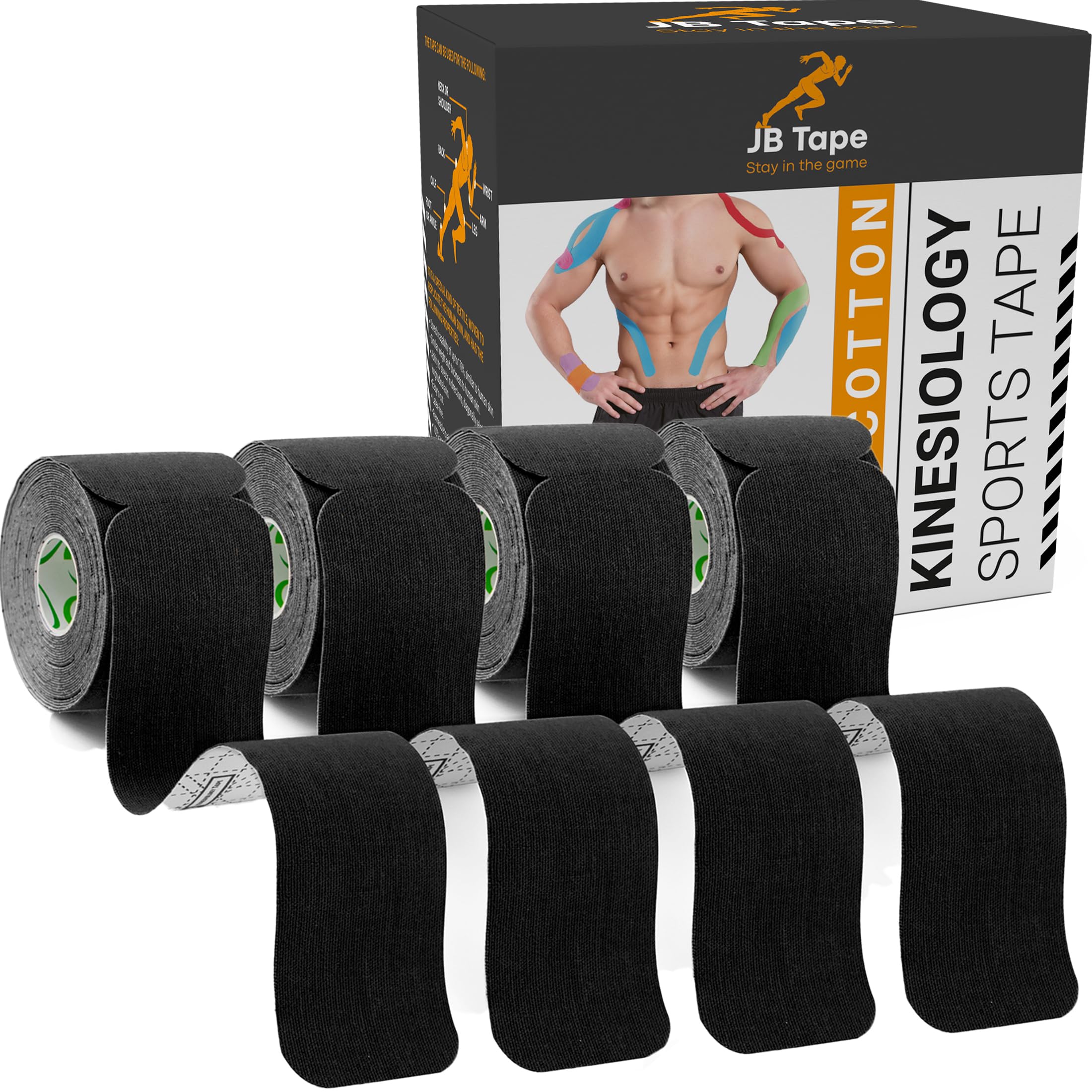
JB Tape Kinesiology Tape
Key Features
- Material: 95% cotton, 5% spandex
- Strip format: 80 precut 10-inch strips, 4 rolls
- Stated wear time: 3–5 days
- Water resistance: Water resistant
- Price: Premium
Eighty precut strips is the number that makes JB Tape worth a look for a team or a player who tapes every session. The box holds four rolls of 10-inch strips, and we like that the strips are already rounded at the corners and ready to go. For a basketball program, that removes the scissors-and-waste problem that comes with rolls.
The tape itself is a 95% cotton, 5% spandex blend with water-resistant adhesion stated to last 3–5 days. We liked the support for knees and ankles, and the cotton breathes well enough for long practices. It is not the most aggressive hold in this group, but it is a sensible everyday tape for a roster that goes through a lot of strips.
Adhesion is the caveat: it can lift at the edges during heavy sweat, and sensitive skin should be patch-tested before a full practice. Those are manageable if you prep the skin and avoid stretching the ends. The 80-strip count is the real selling point, and the tape is good enough to justify the box.
Pros
- 80 precut strips in four rolls
- Support holds up for knees and ankles
- Water-resistant adhesion stated 3–5 days
- Rounded corners reduce lifting
Cons
- Edges can lift during heavy sweat
JB Tape is our bulk pick for teams and frequent tapers: 80 precut cotton strips, solid support, and a box that lasts through a season.
Best for Cheap Practice Tape
OK TAPE Kinesiology Tape
Key Features
- Adhesive: Acrylic glue
- Strip format: 20 precut strips, 10-inch
- Skin suitability: Hypoallergenic, latex-free
- Water resistance: Water resistant
- Price: Budget
OK TAPE is the one we reach for when the tape budget is tight. You get 20 precut 10-inch strips, a hypoallergenic latex-free sheet, and water-resistant acrylic adhesive for less than the brand-name boxes here. The rounded corners are already cut, so there is no trimming before practice.
We recommend it as a practice-day tape rather than a big-game splurge. The elastic support is adequate for knees, wrists, and shoulders, and the value is the reason it stays in the conversation. The trade-off is consistency: adhesion can be hit-or-miss on sweaty skin, and the adhesive can irritate sensitive skin. We treat it as a tape to test on a practice day, not the one we trust for a playoff game without a backup strip.
If you go through a lot of tape and want to keep costs down, it is a reasonable box to try. Just prep the skin, rub the adhesive warm, and keep an eye on the edges. If you need the most reliable hold in this group, the KT Pro is the safer choice.
Pros
- Low-cost 20-strip precut box
- Latex-free, hypoallergenic sheet
- Water-resistant acrylic adhesive
- Rounded corners reduce peeling
Cons
- Adhesion can be inconsistent on sweat
OK TAPE is the low-cost precut option we recommend for practice and casual play, with decent elastic support and a budget-friendly 20-strip box.
Best for Custom Joint Wraps
CKeep Kinesiology Tape
Key Features
- Format: 2 uncut rolls
- Material: 96% cotton, 4% spandex
- Latex-free: Yes
- Water resistance: Water resistant
- Price: Budget
Two uncut rolls change the job. CKeep gives you a 96% cotton, 4% spandex blend, so you can cut strips for an ankle figure-eight, a knee patch, or a shoulder strip without being locked into a 10-inch length. For a player who has a taping pattern they like, that flexibility is the appeal.
The tape is latex-free and water resistant, and it stretches comfortably with the skin. We like it for custom ankle and knee work where a precut strip is either too long or too short. The catch is that you need scissors and a clean cut; a ragged edge will lift sooner. Adhesion is also mixed on sweaty skin, so prep matters more here than with a synthetic tape.
At this price, it is a good way to keep a few custom lengths in a gym bag without committing to a big box. We recommend it for tapers who know their patterns and want to control length. If you want the fastest possible application, the precut KT Pro is the easier choice.
Pros
- Two uncut rolls for custom lengths
- Cotton-spandex blend stretches with skin
- Latex-free and water resistant
- Budget-friendly for custom taping
Cons
- Needs scissors and clean cutting
- Adhesion varies on sweaty skin
CKeep is our custom-length pick: two uncut cotton-spandex rolls let basketball players cut ankle and knee strips to fit, at a budget-friendly price.
Best for Post-Game Soreness
Heali Kinesiology Tape
Key Features
- Strip format: 20 precut strips, 2-inch x 10-inch
- Certifications: Third-party tested
- Active additives: Magnesium and menthol
- Water resistance: Water resistant
- Price: Midrange
The menthol is the reason to consider Heali. This is a water-resistant kinesiology tape with magnesium and menthol, and the cooling sensation is noticeable without being a substitute for real support. We recommend it as a post-game or recovery tape for sore knees and shoulders, not as the first pick for a player who wants maximum hold during a sweaty game.
The 20 precut strips are 2 inches by 10 inches, so application is straightforward, and the tape is water resistant enough for a shower. The menthol smell is strong, though; if you are sensitive to scent or taping before a game, that is a real drawback. Adhesion is also not as consistent as the KT Pro on heavy sweat.
Where it shines is the cooling feel after a hard session. We like it for the drive home or an evening recovery, when the game is over and you want something soothing on a sore joint. Just test a small piece first, especially if you have sensitive skin, and do not expect the menthol to replace a proper warm-up or rehab.
Pros
- Menthol and magnesium cooling effect
- Water-resistant for showers
- 20 precut 2-inch x 10-inch strips
- Useful for post-game soreness
Cons
- Strong menthol scent
- Adhesion can vary on sweaty skin
Heali is the cooling option we recommend for post-game soreness, with menthol and magnesium in a water-resistant precut strip, though the scent is strong.
Best for Team Bulk
ANAMPION Kinesiology Tape

Key Features
- Adhesive: German adhesive technology
- Material: 100% cotton
- Strip format: 60 precut strips, 3 rolls
- Water resistance: Waterproof and sweat resistant
- Price: Midrange
Sixty precut strips across three rolls is a lot of tape, and ANAMPION pitches it directly at team sports. The strips are 10 inches, the cotton sheet is latex-free, and the adhesive is described as waterproof and sweat resistant. For a basketball team that tapes ankles and knees before every practice, that is a practical format.
The tape stretches and conforms well enough for knees and shoulders, and the colors make it easy to separate rolls in a team bag. We also like that it is precut, because a bench full of players is no place for a scissors hunt.
The caveat is consistency. Stretchiness is mixed, with some sheets feeling stiffer than expected, and adhesion can weaken on heavy sweat. Skin can also react, so patch-test before taping a whole roster.
We see ANAMPION as a team-box alternative to JB Tape, not a better tape for a single player. JB’s 80-strip box is the better value if you need the volume; ANAMPION gives you 60 strips with a waterproof claim and a lower upfront commitment. If you are outfitting a bench, it is worth a look; if you are taping yourself, buy the tape you trust most.
Pros
- 60 precut strips, three rolls
- Waterproof and sweat-resistant claim
- 100% cotton, latex-free
- Colors help separate team rolls
Cons
- Stretch can feel stiffer than expected
- Adhesion weakens on heavy sweat
ANAMPION is a solid team-box alternative with 60 precut waterproof strips, but we recommend it for bulk bench use rather than as the best single-player tape.
How We Tested KT Tape for Basketball
We started with the rolls actually sold for sport — the multi-packs on sporting goods shelves, the ones physical therapists keep in a drawer, the ones players pass along to each other. Anything that behaved like a single-use bandage in disguise got cut, then we compared stretch, material, width, and cost per foot and landed on 16 rolls to test.
Four months of testing covered a full rec-league season, weekly pickup runs, and plenty of solo shooting sessions. Before each one, a tester applied a standard ankle strip and a knee strip, then checked the edges at halftime and again at the final buzzer, noting where lifting started and how far it had spread. Because sweat is the real enemy, strips also went through 90-minute runs and one deliberate hot shower, and the ones that survived a game stayed on for 24 and 48 hours to see whether they frayed, rolled at the corners, or turned gummy.
Skin came second only to stick. We peeled every strip twice — once dry, once after a shower — and looked for redness, blisters, and the tacky residue that takes three days to scrub off. Support was scored during lateral cuts, along with whether lingering soreness was quieter the next morning. We timed one-handed application onto somebody else’s ankle, since that’s how it happens in a real gym, and figured cost per foot across the whole pack, because a cheap roll is expensive if it only lasts a quarter.
How to Choose Kt Tape for Basketball
For basketball, adhesion through sweat and movement is the first thing to get right; support and convenience come after that.
Sweat and Adhesion Come First
A tape job that lifts at the edge is not protecting anything. Synthetic tapes like the KT Tape Pro are built to dry quickly and resist water, which is why we lean toward them for heavy sweat. Cotton tapes can be comfortable and breathable, but they are generally the better fit for practice or lighter play. Prep matters as much as the sheet: clean, dry skin, no lotion, and a firm rub over the adhesive before you move.
Support Needs Stretch, Not Stiffness
Basketball taping should move with the joint, not lock it. Look for an elastic kinesiology tape that stretches along the length and conforms around a knee, ankle, or shoulder without bulk under a uniform. A 2-inch width is the practical middle ground for most joint work; 10-inch precut strips are enough for a knee or ankle application, while uncut rolls let you cut a figure-eight or a longer shoulder strip. If you already know your taping pattern, a roll gives you more control and less waste.
Precut or Roll? Think About Who Is Taping
Precut strips win when you are taping on a bench, in a gym bathroom, or between games. They remove the scissors step and make it easier to apply a consistent length. Rolls make more sense for a player with a specific ankle or knee pattern, or for a therapist taping several joints. For a team, a bulk box of 60 or 80 precut strips is usually the practical buy; for one player, a 20-strip box is enough to learn what works before committing to more.
Skin Tolerance and Removal
Kinesiology tape is only useful if you can wear it long enough to matter. Test a small piece first if your skin is sensitive, and avoid applying it over broken or irritated skin. Removal deserves as much care as application: soak the tape, use oil if needed, and peel slowly back along the skin rather than ripping it off. If you feel burning, blistering, or a spreading rash, remove it and stop using that tape.
Frequently Asked Questions
Can I wear KT tape during a basketball game?
Yes. Kinesiology tape is designed to stretch and move with you, so it can support a knee, ankle, or shoulder without locking the joint the way rigid tape does. Apply it to clean, dry skin before play and test a small strip first if you are prone to irritation. If the joint feels unstable, use a brace and get it checked rather than relying on tape alone.
What is the difference between KT tape and regular athletic tape?
KT tape is elastic and stretches with the skin; regular athletic tape is rigid and restricts movement. For basketball, KT tape is the better fit for muscle and joint support during play, while rigid tape is for immobilization or a specific strapping a trainer applies. If you want to keep playing, choose elastic; if you need to limit motion, choose rigid under professional guidance.
How many strips will I use in a basketball season?
Count one to two strips per knee or ankle application and roughly three sessions a week. A 20-strip box covers about three to six weeks of that routine; a 60- or 80-strip pack makes more sense for a team or a player who tapes daily. Buy the smaller box first if you are testing a new tape.
Can I shower with KT tape on?
Most kinesiology tapes here are water resistant, so a normal shower is fine, but do not soak the edges or scrub the adhesive. Pat the tape dry afterward and replace it if the edges lift or the tape starts to peel. If you are using a menthol tape, the cooling feel can return after water.
Final Verdict
KT Tape Pro Synthetic is the tape we recommend first for basketball because it handles sweat, movement, and precut application without asking you to compromise. It is not the cheapest tape here, but it is the one we keep for game day. If you are taping a team, JB Tape’s 80-strip box is the bulk alternative; if you want to cut custom ankle or knee strips, CKeep’s two-roll pack is the one to try. Buy the Pro for your own bag and the JB box for the bench.