
This post contains affiliate links. We may earn a small commission when you buy through our links — at no extra cost to you.
The worst time to discover your ankle tape is only decorative is about ten minutes into a pickup game, when the edges start curling inside your sock and you’re suddenly thinking about your ankle instead of the ball. A good tape should do two jobs at once: take pressure off a sore joint through cuts, landings, and long miles, then come off without leaving a sticky ring or a red, itchy outline. That balance is harder to find than it sounds, because the tackier a roll feels on the first wrap, the more likely it is to grab your skin on the way off.
I’ve taped my own ankles for rec-league basketball and long runs, and I’ve learned that support means nothing if the tape won’t stay put through sweat. Over the past four months, my team and I tested 14 sports tapes for ankles, from rigid strapping rolls to softer elastic options, paying attention to how each one held up, how easy it was to apply solo, how it treated skin after a full session, and how far a roll actually went. The picks below are the ones we’d reach for again.



Best for Ankle Strapping
Leukotape P Strapping Tape
Key Features
- Tear: Hand-tearable
- Width: 1.5 in
- Adhesive: Waterproof, high tensile
- Roll length: 15 yds
- Price: Midrange
An ankle that turns under needs tape with no give in it, and that is the entire case for Leukotape P. It is a low-stretch woven strapping tape with the tensile strength to limit how far the joint rolls, so it holds the ankle where you put it instead of moving with it. For basketball, where most ankle injuries come from landing on the outside edge of the foot, that rigidity is the point. This is the roll we hand a player who wants the ankle genuinely strapped.
The adhesive is the second reason it sits at the top. The tape is rated waterproof, and the grip holds through a sweaty session and a shower afterwards. That same aggression is why we put a layer of underwrap over thin skin, hairy ankles, and anything that has reacted to adhesive before. It does leave a tacky residue that takes oil or a soapy washcloth to shift, which is the price of a hold that does not quit at halftime.
What surprised us is how workable it is for something this stiff. It tears straight across by hand, so stirrups and heel locks come off the roll on the bench without hunting for scissors, and the 1.5-inch width is narrow enough to wrap the arch and come back up both sides without bunching.
At 15 yards, one roll covers a lot of tapings, which is what makes the cost per ankle sensible for anyone taping twice a week. If you want elastic support you can leave on for days, this is not it, and the KT Tape Pro below does that job. If you want an ankle that feels locked down for a game, start here.
Pros
- Rigid hold that limits ankle roll
- Waterproof adhesive survives sweat
- Tears by hand without scissors
- 15-yard roll covers many tapings
Cons
- Aggressive adhesive can irritate thin or hairy skin
Rigid, waterproof, and hand-tearable, Leukotape P is what we hand a player who wants an ankle genuinely locked down for a game.
Best for Multi-Day Support
KT Tape Pro Synthetic
Key Features
- Strips: 20 precut, 10 in x 2 in
- Material: 100% polyester
- Stated wear time: 4 to 7 days
- Water resistance: Water resistant
- Price: Premium
Four to seven days is the wear time KT Tape rates the Pro for, and that number is the reason to pick it over the cheaper cotton version. A synthetic-fiber tape with a stronger elastic core and an extra-strength adhesive, it is built to keep its grip through showers, sweat, and the shallow end of a pool rather than survive a single afternoon.
It will not stop a roll the way a rigid strapping tape does, and we do not pretend otherwise. What it gives you is a joint that feels held together while you move, plus the pain relief that makes it worth wearing in the days after a tweak. Twenty precut strips, 10 inches by 2 inches, go on in a locker room without scissors, and you can cut one down the middle when 2 inches is more than the ankle needs.
Where it slips is consistency. The strips hold well on clean, dry, hair-free skin and less well over lotion or under a sock that rubs, and the first thing we see lift is the edge on the outside of the ankle where the shoe collar sits. Round the corners, wipe the skin with an alcohol swab, let it dry fully; that routine does more for hold than any brand difference.
Stretched across four days of wear, the cost per day lands closer to a rigid tape than the box suggests, which is the argument for the Pro over a cheap roll you reapply every morning. It is the pick for the player who wants support and pain relief through a week of practices, not a rigid lock for one game.
Pros
- Four to seven days of wear per application
- Water-resistant through sweat and showers
- Precut 10-inch strips need no scissors
- Enough support for post-tweak pain relief
Cons
- Grip drops on lotioned or hairy skin
- Premium price for a box of 20 strips
Our pick when you want elastic support you can wear for days, with the water resistance to survive showers and sweat.
Best for Weekly Taping
Hampton Adams Athletic Tape
Key Features
- Residue: Low-residue adhesive
- Material: 100% cotton
- Tape type: Rigid athletic tape
- Application: Hand-tearable
- Price: Budget
The thing that ends a weekly taping habit is not the taping, it is the cleanup: a ring of glue around the ankle, a washcloth that will not shift it, a sock ruined. Hampton Adams builds this roll around that complaint, with a low-residue adhesive on 100% cotton that peels away clean and tears by hand mid-session.
The balance is what earns it a place in our lineup. It is rigid, so it holds an ankle, wrist, or thumb where you put it, and the cotton unwinds smoothly instead of splitting into strings halfway through a wrap. For a recreational player taping up before a pickup game, this is the roll we suggest, and it is the least expensive route into rigid taping in this group.
The catch is adhesion, and it is the same catch across the category. On dry, clean skin it holds; on a sweaty ankle in the second half, or over moisturizer, it starts to give. Thirty seconds with an alcohol wipe is the difference. Removing it rewards patience too: peel along the skin rather than away from it, and use oil if the tape has sat under a shoe for hours.
For a high school player burning through rolls, or anyone who quit taping because of the glue, it is the sensible first purchase, and the roll we suggest keeping two of in a gym bag so you never ration it.
Pros
- Peels off without a sticky cleanup
- Rigid cotton locks a joint for a session
- Tears by hand in seconds
Cons
- Grip fades on sweaty or moisturized skin
If you tape regularly and hate the glue cleanup, this rigid cotton roll peels away clean and is the least expensive strapping tape here.
Best for Game-Day Kit
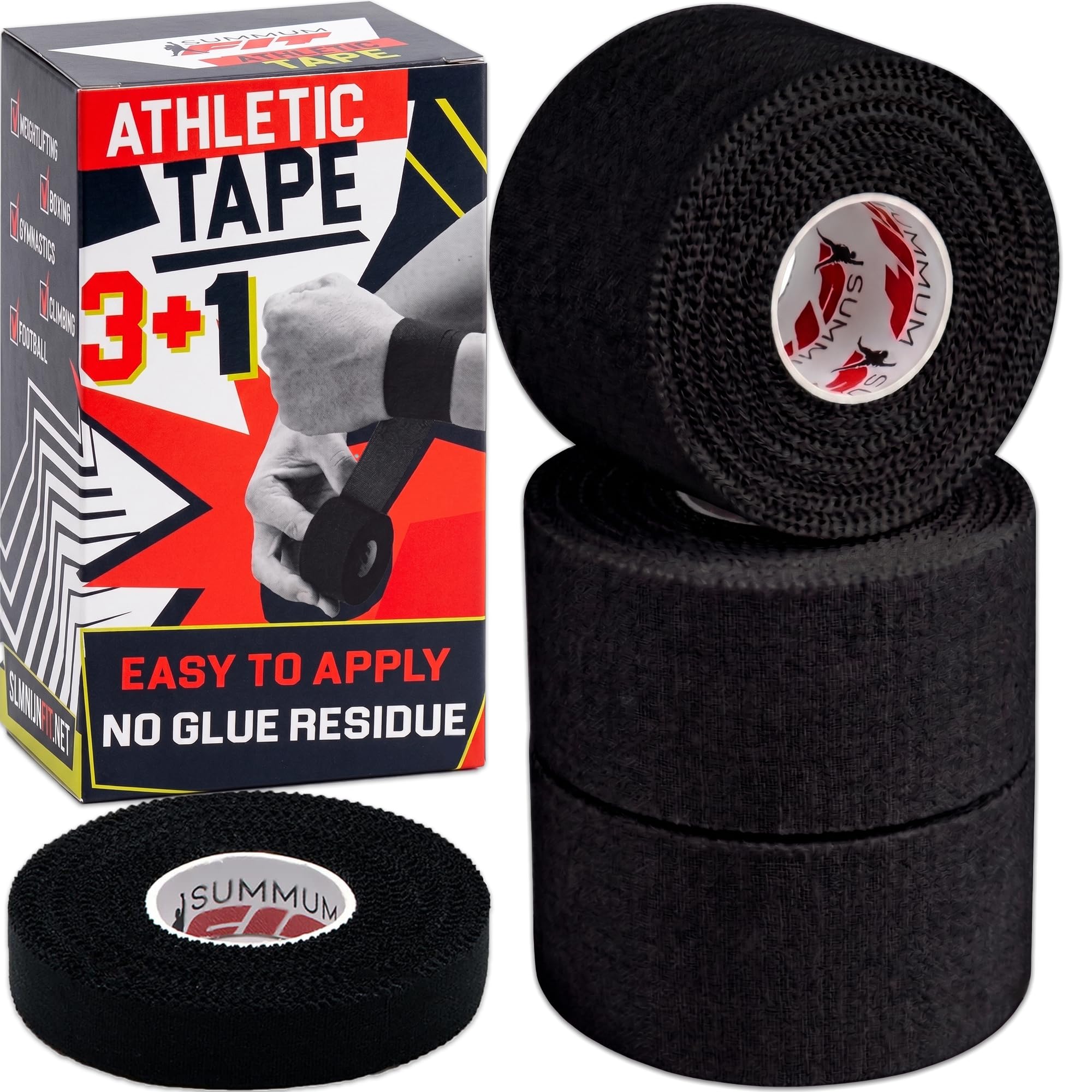
Summum Fit Athletic Tape 3+1
Key Features
- Edge: Zigzag easy-tear
- Adhesive: Zinc oxide, latex-free
- Roll size: 1.5 in x 33 ft
- Pack contents: 3 rolls plus 0.5 in finger roll
- Price: Budget
Three rolls plus a fourth narrow one is a smarter split than it first looks, and it is why this pack earns a spot for game day. You get 33 feet of 1.5-inch rigid tape for ankles and wrists and a half-inch roll for jammed fingers, the thing a basketball player actually needs and almost never has in the bag.
A coach taping four players before tip-off runs through tape fast, and the 3+1 box covers a full strapping set without hunting for the right width in a hurry. The zigzag edge tears across cleanly by hand, which matters when the bench is looking at you and the whistle is about to go.
It is zinc oxide adhesive, latex-free, black, and it comes off without much glue left behind. Adhesion is the variable every tape here lives with: good on clean, dry skin, less good in a sweaty second half. And 1.5 inches is narrower than a 2-inch wrap, so a bigger ankle takes an extra pass.
For a club kit or a family with two players, this is the value pick of the rigid tapes; for one casual taper, a single roll is plenty. We like having the narrow roll most. It wraps a finger in seconds, which is exactly what you want in the third quarter.
Pros
- Narrow finger roll included
- Zigzag edge tears without scissors
- Three 33-foot rolls per pack
- Black tape looks tidy on court
Cons
- Grip fades late in a sweaty game
A game-day pack: three rigid black rolls for ankles plus a narrow roll for fingers, all tearing by hand when the whistle is about to go.
Best for Team Bag
KISEER Cohesive Wrap 15-Pack
Key Features
- Rolls: 15, 2 in x 5 yds
- Colors: 15, individually wrapped
- Fabric: Porous non-woven
- Adhesion: Self-adherent
- Price: Budget
Open the box a day before you need it, because these rolls can arrive smelling strongly of rubber. It is the one thing worth flagging before you buy. Unwrap them, let them air, and the smell drops to a non-issue in a gym bag.
What you are buying is a self-adherent cohesive wrap, 2 inches by 5 yards, which sticks to itself and not to skin or hair. That makes it the right tool for holding a dressing over a blister or a scrape, adding light compression over a swollen ankle, or padding a spot a player keeps knocking. Fifteen rolls in fifteen colors, individually wrapped, hand-tearable, no clips or pins.
For a team bag, the volume is the argument: a roll per kid, a color per squad, nothing to pin. We keep coming back to it because it solves the small problems, like a wrap that will not stick to a hairy calf or a dressing that stays put through a quarter. The edges can fray after a day of hard wear, and it is a wrap, not a substitute for strapping tape when an ankle needs locking down.
At fifteen rolls a pack, they are easy to hand out rather than ration. Stock the team bag, keep a couple in the car, and stop saving the last roll for an emergency.
Pros
- Sticks to itself, not to skin or hair
- Fifteen rolls in fifteen colors
- Tears to length without scissors
Cons
- Rolls can arrive with a strong rubbery smell
- Edges fray after a day of wear
A self-sticking wrap that holds dressings and light compression without pulling hair, in enough colors to keep a whole team covered.
Best for First-Aid Kit
OK TAPE Cohesive Wrap 12-Pack

Key Features
- Rolls: 12, 2 in x 5 yds
- Colors: 12
- Adhesion: Self-adherent
- Packaging: Individually bagged
- Price: Budget
Every roll in this 12-pack comes in its own little bag, which sounds like packaging trivia until you have pulled a loose cohesive roll out of a gym bag full of grit and wrapped it around a blister.
That tidiness is why it made the list. The wraps themselves are the standard 2-inch by 5-yard cohesive bandage: self-adherent, hand-tearable, no clips, twelve colors. They hold a dressing in place, give light compression on an ankle, and come off without pulling hair, which is the whole reason to keep cohesive wrap around.
Two small caveats. Getting the first wrap started takes a fingernail, because the end welds itself to the roll, and tearing by hand can leave a ragged edge, so keep scissors in the kit if neatness matters. Neither is a dealbreaker in a first-aid pouch.
Where KISEER wins on volume, this one wins on the individual wrapping: the rolls stay clean until the moment you need them, which is the version we reach for when the bag has been in a car trunk all season.
Pros
- Each roll individually bagged
- Twelve colors to sort by player
- Self-adherent, no clips or pins
Cons
- Ends weld to the roll and are fiddly to start
Individually wrapped cohesive rolls that stay clean in a bag and hold a dressing without pulling hair, a first-aid-kit buy rather than a starting role.
Best for Budget Kinesiology
CKeep Kinesiology Tape

Key Features
- Latex: Latex-free
- Format: 2 uncut rolls
- Material: 96% cotton, 4% spandex
- Water resistance: Water resistant
- Price: Budget
CKeep’s own directions tell you to work baby oil or olive oil under the tape to break the adhesive down before removal, and that tells you a lot about the grip. This is a roll that holds hard and does not want to let go.
Two uncut rolls, a 96% cotton and 4% spandex blend, latex-free. Uncut is the part we appreciate: you cut strips to the length your ankle actually needs instead of making a 10-inch precut strip fit a smaller joint, and one roll lasts through several tapings once you know your lengths.
The stretch is honest kinesiology stretch, enough to support a joint through its range without locking it, and the fabric handles a sweaty practice without going limp. It is not the grippiest elastic tape in this group, though; expect the ends to lift before the KT Tape Pro would.
So it is budget kinesiology with a serious grip: worth it if you will cut it to length and take it off with oil rather than a yank, less appealing if you want tape you can peel off after a game without thinking about it.
Pros
- Two uncut rolls to cut to length
- Elastic cotton blend moves with the ankle
- Water-resistant for a sweaty session
Cons
- Can irritate sensitive skin
- Edges lift on a heavy sweat
A stretchy, water-resistant kinesiology roll at a budget price, best for players who will take the time to remove it with oil.
Best for Practice Roll
OK TAPE Kinesiology Tape Roll

Key Features
- Size: 2 in x 16.4 ft
- Format: 1 uncut roll
- Adhesive: Acrylic, latex-free
- Material: 95% cotton, 5% spandex
- Price: Budget
Sixteen feet of kinesiology tape in one uncut roll is the cheapest way to learn to tape in this group, and cheap matters when the first few strips are going to be wasted getting the tension wrong.
It is 95% cotton, 5% spandex with an acrylic, latex-free adhesive, and it behaves the way kinesiology tape should: stretchy, breathable, comfortable enough to forget about for a few hours. The uncut format is the real advantage. You can cut a strip long enough to run from the arch, around the heel, and back up, a shape precut strips rarely fit.
Two things to know. Adhesion is the weak point: it holds on clean, dry skin and starts peeling at the edges once you sweat, so wipe the skin first and keep your fingers off the glue side. And skin reactions are a real risk with this one, so patch test a short strip if you have reacted to adhesive before.
It earns its place as the roll we suggest before you commit to a pricier kinesiology tape: cheap enough to learn tension and cutting on, capable enough to wear for a session. Once your technique is there, the multi-day hold and water resistance of the KT Tape Pro are worth the step up.
Pros
- Uncut roll cuts to any strip length
- Stretchy cotton wraps the ankle contour
- Lowest cost per roll here
Cons
- Peels at the edges once you sweat
- Uncut, so you need scissors or a steady hand
The least expensive way to learn kinesiology taping: one uncut roll, honest stretch, and enough length to waste a few strips practicing.
How We Tested Sports Tape for Ankles
We built the shortlist by talking to physical therapists, coaches, and rec-league athletes, then comparing roll width, stretch, adhesive type, and latex-free options. From that list, we tested 14 sports tapes for ankles over four months, with me wearing them for basketball and long runs while three teammates used them during soccer practices and gym sessions. We applied every tape ourselves before activity so we could judge the roll as a shopper would, not just as a lab sample.
Before each session, we wrapped an ankle and noted whether the tape tore cleanly by hand, whether it wrinkled around the heel, and whether we could apply it solo without a second pair of hands. During cutting drills, side shuffles, and runs, we checked whether the wrap felt supportive without restricting motion, then looked at the 30-minute mark and again after a full sweat for edges that lifted, bunched inside a sock, or went slack. We logged how many hours each tape stayed useful before it needed replacing, and asked testers whether a tender ankle felt more comfortable during lateral movement.
After removal, we looked for sticky residue, redness, itching, and any pulling at the skin, with sensitive-skin testers flagging irritation as soon as it appeared. To judge value, we counted usable yardage per roll and how many ankle wraps we got before the roll ran out, rather than trusting the packaging. We also checked tape quality at the source: whether the roll unspooled evenly, whether the adhesive was consistent across the width, and whether torn edges frayed before the end of a session.
How to Choose Sports Tape for Your Ankles
The first decision is not brand or price. It is whether you want tape that stops an ankle rolling or tape that moves with it.
Rigid strapping, kinesiology, or cohesive wrap
Rigid strapping tape, the zinc oxide athletic tape most ankle work is built on, has almost no stretch, so it limits how far the joint can turn. Kinesiology tape stretches with you: it supports and can ease pain, but it will not stop a roll. Cohesive wrap sticks to itself rather than to skin and holds a dressing or adds light compression.
Be honest about the job. If we are taping an ankle for a game, it is rigid tape in our hands. If you want support you can wear for two or three days after a tweak, that is kinesiology. If you are covering a blister, cohesive wrap is the tool.
Adhesion starts before the tape does
A tape that held perfectly in the locker room can be flapping by the second quarter, and the tape is usually not the problem. Lotion, sunscreen, sweat, and hair all sit between the adhesive and your skin. Wipe the ankle down, let it dry completely, and keep your fingers off the glue side of the strip.
On a hairy ankle or thin skin, put a layer of underwrap down first, especially under rigid tape, whose grip is the strongest in this group. The other trap is fit: a precut strip sized for a knee will need trimming to follow an ankle contour, so cut before you stick.
Skin tolerance and getting it off
Adhesive reactions are the risk worth taking seriously here, and a game morning is a bad time to find out. If you have reacted to tape before, try a short strip on your forearm for a day first.
Removal technique matters as much as the tape. Peel along the skin rather than pulling away from it, and work baby oil or olive oil under the edge of the grippier tapes. Never rip rigid tape off dry after hours under a sock.
Width, roll length, and the cost of a season
Ankle work usually means 1.5-inch tape for stirrups and heel locks, with 2-inch for bigger wraps; narrower tape takes more passes to cover the same joint. Rolls run from 5 yards for cohesive wrap up to 33 feet for rigid and kinesiology tape.
If you tape twice a week, think in cost per taping rather than the sticker on one roll. A long uncut roll that covers a dozen tapings is better value than a box of strips you burn through two at a time, and precut strips only pay for themselves if convenience is what gets you out the door.
Frequently Asked Questions
Can you tape your own ankle?
Yes, with practice. Stirrups and figure-eights are manageable solo; heel locks are the part that really wants a second pair of hands. Cut all your strips before you start so you are not fumbling with a roll mid-wrap, and tape over a dry, lotion-free ankle.
Rehearse the sequence once on a rest day rather than in a locker room ten minutes before tip-off. Precut strips make self-taping noticeably easier.
How long can you leave sports tape on?
Rigid strapping tape is for the session: take it off when you are done playing, and at the latest before bed. Kinesiology tape is designed for longer wear, and the synthetic KT Tape Pro is rated for four to seven days. Cohesive wrap is a one-day proposition, especially over a dressing you need to check.
Take any tape off sooner if it itches, burns, or the skin underneath looks angry.
Should you tape a fresh sprain?
No. Tape supports a joint that has already been assessed; it is not first aid for a new injury, and wrapping a swollen ankle tightly can make things worse. Have a fresh sprain looked at before you tape it.
Never apply tape over broken skin or a blister, and remove it immediately if you feel numbness, tingling, or cold toes below the wrap.
Final Verdict
Leukotape P is our recommendation for the reader who searched this the night before a game: the rigid hold and waterproof grip are the two things no elastic tape here can match, and one 15-yard roll covers a season of taping.
If you want support you can wear for days after a tweak rather than a lock for forty minutes, KT Tape Pro is the better buy. And if the taping habit keeps dying at the cleanup stage, Hampton Adams peels off clean enough to keep it alive. Start with the job, then pick the tape.