
This post contains affiliate links. We may earn a small commission when you buy through our links — at no extra cost to you.
Kinesiology tape is supposed to keep you on the court, but anyone who has taped up before a pickup game knows the two ways it goes wrong: it rolls off by the second quarter, or it hangs on so hard you leave a patch of skin behind. That tension is the whole game—a roll that survives sweat usually needs to be coaxed off in the shower, and one that lifts painlessly at the final buzzer probably will not survive a landing on somebody’s foot. Get it right, though, and it supports a cranky knee or shoulder without changing how you move.
For three months, my team and I taped up with 14 different rolls—rec-league games, weekend pickup runs, the ugly warmups in between—and the differences show up hours after tip-off. One thing worth knowing before you spend: how a roll is cut matters as much as the fabric, since pre-cut strips are quick on an ankle but only a full roll gives you the length a knee pattern needs. The picks below are the ones that held.



Best for All-Around Basketball Use
KT Tape Pro Synthetic
Key Features
- Format: 20 precut strips, 10 x 2 in
- Material: 100% polyester
- Adhesive hold: 4-7 days
- Water resistance: Water resistant
- Price: Midrange
The first thing we look for in basketball tape is whether it survives the second half. KT Tape Pro Synthetic is the one we kept reaching for: the 100% polyester fibers dry fast, the adhesive is water-resistant, and the 10-inch precut strips are ready for a knee, shoulder, or ankle without scissors. The listed hold is 4-7 days, longer than most of this set, and the rounded corners are the detail we noticed most—they stop the tape catching on a jersey.
What sold us was the balance of support and low bulk. The elastic core gives a firm pull without the stiffness of a rigid brace, and the synthetic face stays light when you sweat. We also liked that the strips are wide enough to cover a knee without doubling up, but you can cut them narrower for a wrist or elbow.
It is not magic. The adhesive can lift at the edges on a hot day, especially if you rush the application or the skin is damp. Clean, dry skin and a few seconds of friction on the tape make a visible difference. The Pro also costs more than the budget precut packs, and the synthetic feel is less soft than cotton. For most basketball players, that is a fair trade for the best mix of sweat resistance, hold, and convenience here.
Pros
- Synthetic fibers dry fast and resist water
- 4-7 day adhesive hold
- Precut strips with rounded corners
Cons
- Edge lift on hot, sweaty days
- Costs more than budget precut packs
We recommend KT Tape Pro Synthetic for most basketball players because its synthetic fibers, water-resistant adhesive, and 4-7 day hold handle sweat and repeated sessions better than the rest of this set.
Best for Team Seasons
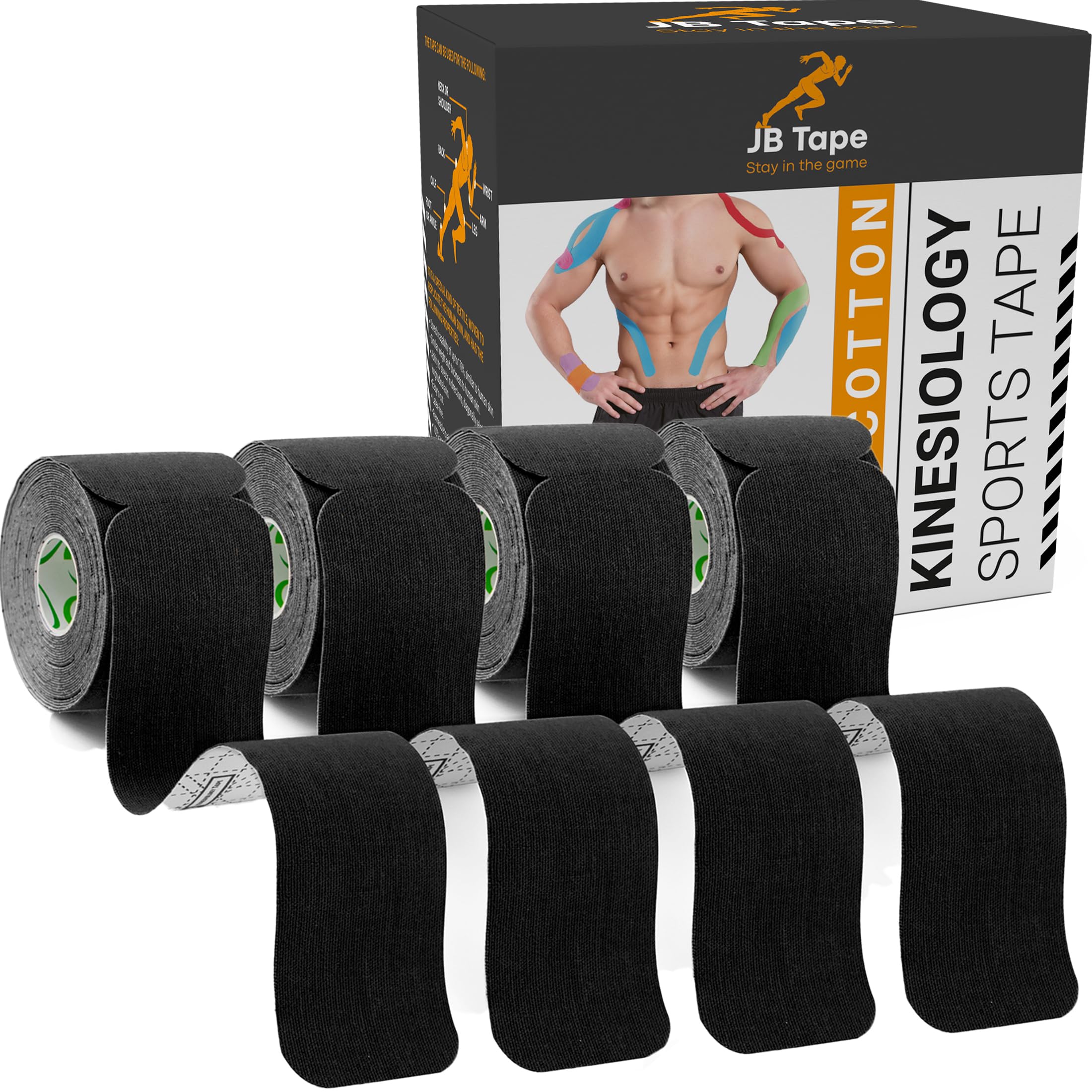
JB Tape 80-Strip
Key Features
- Format: 80 precut strips
- Material: 95% cotton, 5% spandex
- Adhesive hold: 3-5 days
- Water resistance: Water resistant
- Price: Premium
A 20-strip pack disappears fast when you are taping two knees before every practice. JB Tape’s 80 precut strips across four rolls solve the supply problem first: you get four times the strips of the top pick, and the 10-inch length covers most knee, shoulder, and ankle applications without scissors. Four rolls also let you leave one in the team bag, one in the car, and still have a spare.
We also liked that it is not just a bulk bin special. The cotton-spandex blend stretches enough to move with a joint, the adhesive is water-resistant, and the rounded corners resist the curl that starts at a square edge. The listed hold is 3-5 days, which is realistic when the skin is clean and dry. For a team manager or a player who tapes daily, that is the value case.
The trade-off is the fixed 10-inch strip. For a long shoulder or a high arch, you may need two, which eats into the bulk advantage. The adhesive is competent but not the most aggressive here; on a very sweaty player, the top pick still has the edge. Those are easy compromises for a team that goes through tape quickly.
Pros
- 80 strips across four rolls
- Water-resistant 3-5 day hold
- Rounded corners reduce lifting
- Cotton-spandex stretches with joints
Cons
- Fixed 10-inch strips may need doubling
- Adhesive less aggressive than top pick
JB Tape’s 80-strip, four-roll pack is the one we hand to a team manager or a player who tapes daily and does not want to run out midseason.
Best for Custom Joint Taping
RockTape Extra Sticky
Key Features
- Format: Uncut roll, 2 in wide
- Stretch: 180-degree stretch
- Adhesive hold: 5-7 days
- Water resistance: Water resistant
- Price: Premium
RockTape is the one we reach for when a joint needs a shape rather than a rectangle. The 2-inch uncut roll lets you cut a Y-strip for a shoulder or a longer piece for a thigh, and the 180-degree stretch gives you more range than the precut strips here. That extra stretch is the point: you can load the tape for support without turning it into a rigid wrap.
The extra-sticky label is backed by a 5-7 day hold and a water-resistant finish, and the 97% cotton/3% nylon blend feels more like cloth than the synthetic top pick. We liked that for contours and for areas where a slicker tape feels intrusive. It also handled a sweaty session better than we expected from a cotton-heavy roll, though the edges eventually lifted.
The cost is the obvious hurdle: this is the most expensive roll in this set, and you get one roll rather than a pack of precut strips. Adhesion is also not universal—some rolls grip for days, others let go early. If you only tape standard knee and ankle shapes, a precut pack is easier and cheaper. For custom work, the stretch and cloth feel justify the premium.
Pros
- 180-degree stretch for custom shapes
- Extra-sticky 5-7 day hold
- Water-resistant cotton-nylon blend
Cons
- Premium price for a single roll
- Adhesion can vary from roll to roll
RockTape Extra Sticky is the custom-taping pick: the uncut roll and 180-degree stretch shape a shoulder or arch in a way precut strips cannot.
Best for Precut Value
GJUMP Precut 2-Pack
Key Features
- Format: 40 precut strips, 2 rolls
- Material: Cotton
- Adhesive hold: 3-5 days
- Water resistance: Water resistant
- Price: Midrange
Forty precut strips is a useful middle ground: enough for a couple of weeks of practice, not so many that you are storing a team’s worth. GJUMP splits them across two rolls, and the strips have rounded corners and a printed arrow to help you keep the stretch direction consistent. That arrow is a small thing, but it matters when you are taping in a hurry.
We found the 10-inch strips easy to place on knees and shoulders, and the water-resistant finish handled a normal practice session without turning gummy. The 3-5 day hold is typical for this group rather than exceptional, but the cost per strip is one of the better ones here. For a high-school player taping two spots, that math matters.
The catch is that this is a newer product with a shorter track record than the KT and RockTape rolls. The adhesive is competent but not the strongest in this set, and on a very sweaty player we still choose the top pick for a joint that needs to stay put. If you want a low-cost precut pack for routine sessions and do not need the longest hold, it earns its place.
Pros
- 40 precut strips in two rolls
- Water-resistant 3-5 day hold
- Rounded corners and guide arrow
Cons
- Adhesive not as strong as top pick
- Shorter track record than established brands
GJUMP’s 40 precut strips in two rolls are the sensible middle pack for a player who tapes two spots and wants water resistance without paying for the top pick.
Best for Budget Cotton
KT Tape Original Cotton
Key Features
- Skin: Hypoallergenic, latex-free
- Format: 20 precut strips, 10 in
- Material: Cotton
- Water resistance: Water resistant
- Price: Budget
If you do not like the slick feel of synthetic tape, the original cotton KT Tape is the familiar alternative. It is a 20-strip precut pack with a breathable cotton face, a water-resistant adhesive, and the same 10-inch strip length as the Pro. On a knee or shoulder, it feels softer against the skin and less like a plastic film.
We noticed the cotton version is more forgiving on application: it conforms to curves easily, and the beige color disappears under a uniform. The trade-off is that it does not dry as fast as the synthetic Pro, so a heavy sweat session can leave it feeling damp. The adhesive is long-lasting, but the hold is not in the same class as the Pro’s 4-7 days.
The bigger caveat is skin sensitivity. This is the tape in the set with the highest irritation risk, and rash or blisters are real possibilities for some players. Patch-test a short strip before taping a large area, or spend more on the synthetic version if you have reacted before. For everyone else, it is a comfortable, budget-friendly precut that works for practice and games.
Pros
- Soft breathable cotton
- 20 precut strips
- Costs less than the Pro
Cons
- Can irritate sensitive skin
- Less sweat-resistant than synthetic Pro
KT Tape Original Cotton is for the player who prefers a soft cotton feel and a lower-cost precut pack, provided they patch-test for skin sensitivity first.
Best for Cheapest Precut
OK TAPE Precut

Key Features
- Skin: Hypoallergenic, latex-free
- Format: 20 precut strips, 2 in x 16 ft
- Corners: Rounded
- Water resistance: Water resistant
- Price: Budget
OK TAPE is the pack we kept as a spare in the gym bag. You get 20 precut 10-inch strips, rounded corners, and a water-resistant finish for less than most of the competition. That makes it an easy yes for practice days when you are taping a knee or a wrist and do not want to open the good roll.
The tape applies cleanly and stretches enough to follow a joint, and the acrylic adhesive is fine for a normal session. But it is not the most secure here: on a sweaty player, the edges started to lift sooner than they did on the KT Pro. The bigger issue is skin comfort—the adhesive is strong enough to irritate sensitive skin, and removal can sting if you rush it.
For a budget pack, it is still a useful buy, especially for a player who tapes often and replaces strips often. Just do not expect it to be the gentlest tape in this set, and do not put it on broken skin. If you need the most reliable hold for a game, spend up.
Pros
- Low-cost 20-strip precut pack
- Water-resistant
- Rounded corners
Cons
- Adhesive can lift early on sweaty skin
- Can irritate sensitive skin
OK TAPE is the budget spare to keep in the gym bag: 20 precut, water-resistant strips for practice days when you do not want to use the good roll.
Best for Budget Uncut
Hampton Adams 2-Pack

Key Features
- Format: 2 uncut rolls
- Adhesive: Latex-free
- Material: Cotton blend
- Water resistance: Water resistant
- Price: Budget
Two uncut rolls for the price of one precut pack is the appeal here. Hampton Adams gives you 2-inch rolls that you can cut to the length you need, which is useful for long thigh strips or a shoulder pattern that does not fit a 10-inch precut.
The cotton blend is breathable and stretches well, and the water-resistant finish held through a shower in our testing. We also appreciated the flexibility of cutting a short strip for a small joint without wasting a full precut piece. The adhesive is not the strongest here, though: on a heavy sweat, the edges can roll, and removal can leave a sticky residue.
The skin reaction risk is the part that gives us pause. This is a tape to patch-test, especially if you have sensitive skin, and it is not the one we choose for a player who already knows adhesive rashes. The residue also means you need oil or warm water for cleanup, not a quick peel.
If you cut custom shapes regularly and want a cheap two-roll supply, it is a practical option. If you want the most dependable hold for a game, the top pick is safer. The two-roll format is the reason to consider it, not the adhesive.
Pros
- Two uncut rolls
- Water-resistant cotton blend
- Custom lengths without waste
Cons
- Can irritate sensitive skin
- Leaves sticky residue
Hampton Adams is the cheap uncut two-roll pick for players who cut custom shapes, as long as they patch-test and accept a weaker hold in heavy sweat.
Best for Precise Custom Cuts
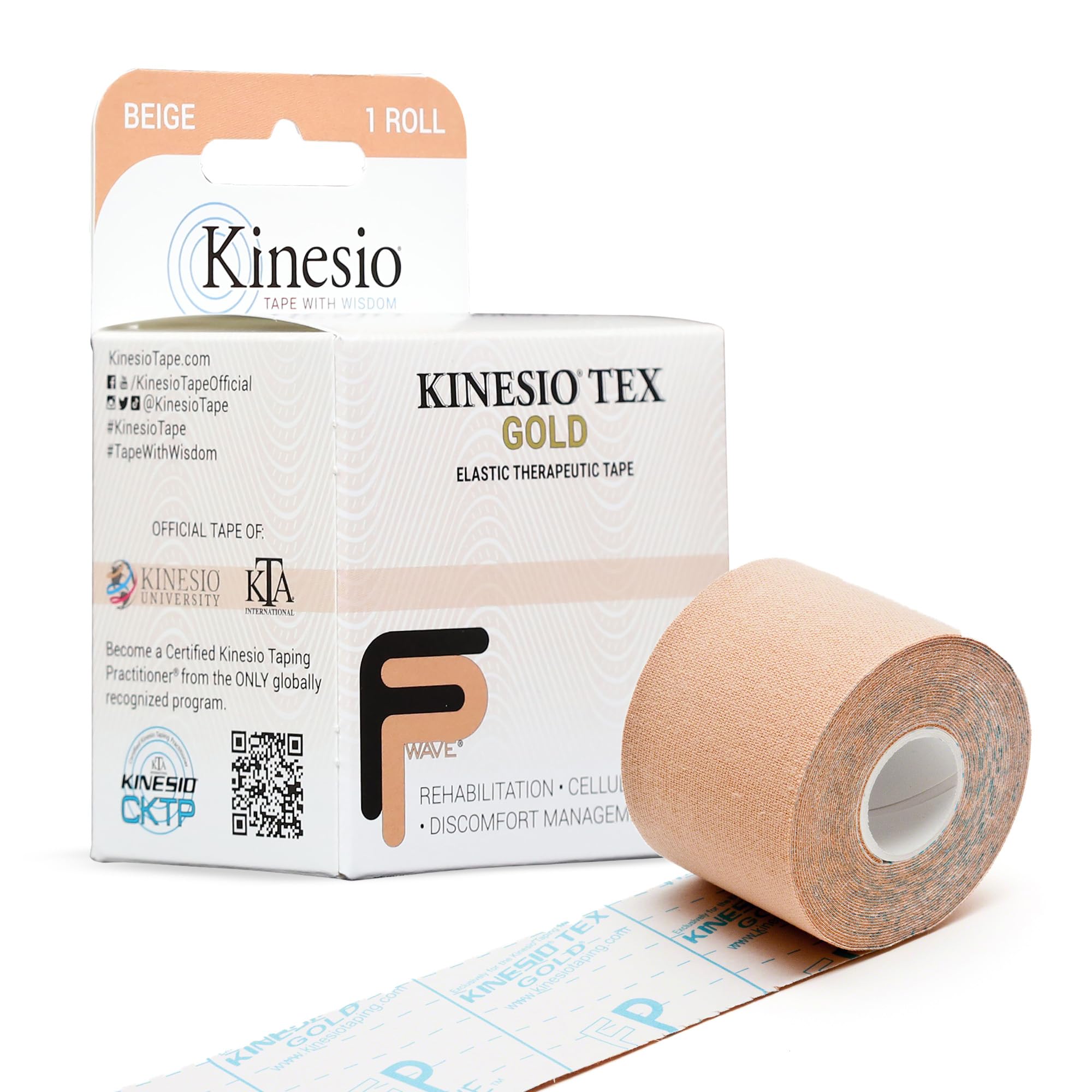
Kinesio Tex Gold FP
Key Features
- Format: Uncut roll
- Material: 100% polyester
- Roll size: 2 in x 16.4 ft
- Price: Midrange
Kinesio Tex Gold FP is the tape that started the category, and the roll feels different from the budget stuff: a 2-inch by 16.4-foot uncut length of 100% polyester that cuts cleanly and stretches evenly. If you follow a specific taping method and need precise strips, this is the roll to learn on.
We liked the controlled stretch and the way the tape follows a contour without bunching. It is also the most clinical-feeling tape here—thin, light, and unobtrusive under a jersey. But Kinesio does not claim water resistance, and our sweaty sessions showed why that matters: without a water-resistant adhesive, edges can loosen faster than they do on the KT Pro or RockTape.
The price is reasonable for a long roll, but you pay in time: you have to cut every strip, and the adhesive is not as forgiving if you get the application wrong. The skin comfort is also mixed, so patch-test. It is a specialist’s tape for custom work, not the simplest choice for a player who wants to slap on a knee strip before practice.
We keep it for the sessions where a precise shape matters more than speed. For everything else, the precut picks are easier and more secure in sweat. That is a narrow role, but it is a real one.
Pros
- Long 16.4-foot uncut roll
- 100% polyester with even stretch
- Precise custom shapes
Cons
- No water-resistance claim
- Requires cutting every strip
- Can irritate sensitive skin
Kinesio Tex Gold FP is a specialist’s uncut roll for precise custom taping, not the simplest or most sweat-secure choice for a standard knee or ankle strip.
How We Tested Kinesiology Tape on the Court
Every roll that made the shortlist started with the same research pass: what basketball players actually re-order, how the tape is woven (cotton versus a nylon blend changes how it stretches and how it breathes), what adhesive it uses, whether it comes pre-cut or as a full roll, and the real cost per application rather than the sticker price. Anything that listed no ingredients, or claimed a medical-grade adhesive without saying what it was, did not make the cut.
Fourteen rolls went through three months of rec-league games, weekend pickup runs, and practice-night warmups. I taped ankles, knees, calves, and a couple of shoulders, timing applications with a full roll versus a pre-cut strip, then wore each through a 40-minute game and checked the edges at halftime and again in the locker room. How much the tape stretched mattered as much as how well it stuck—the low-stretch rolls gave firmer support on an ankle, while the stretchier ones felt better on a sore knee and, an hour in, were the ones that actually dulled the ache. Adhesion got the closest look: where edges lifted, how far they curled after a hard cut, and whether pressing them back down bought another quarter or was purely cosmetic.
Removal told the other half of the story. I peeled each one slowly, after sweats and after showers, and noted redness, itching, and whether the tape took hair with it. A couple of rolls left angry red rectangles that lasted an hour; two left nothing at all. Durability and value came last: how many ankle jobs a single roll covered, whether the tail end frayed before it was used up, and what each application actually cost.
How to Choose Kinesiology Tape for Basketball
The right basketball tape is the one that survives sweat, stays put through a game, and comes in a format you will actually use before practice.
Precut strips or an uncut roll?
Precut 10-inch strips are the locker-room choice: no scissors, consistent length, and fast application on knees and ankles. A 20-strip pack suits one player for a few weeks; 40 to 80 strips makes more sense for a team or a daily taper. Uncut rolls are for custom work—shoulders, arches, and long thigh strips—and they reward practice. If you tape the same two spots before every session, precut saves time. If you follow a specific method and need Y-strips or longer pieces, an uncut roll is worth the extra minute.
Sweat and adhesion decide the purchase
Basketball is hard on tape: sweat, contact, and jersey friction all work on the edges. Look for a water-resistant adhesive and a stated hold of several days, but do not treat waterproof as a guarantee. Adhesion depends as much on prep as on the tape. Clean, dry skin; no lotion or sunscreen under the strip; and a few seconds of rubbing the adhesive after application make a bigger difference than most labels admit. Round the corners or buy tape that already has them, and avoid stretching the ends, which pulls them up.
We prioritize a water-resistant adhesive over color every time. The synthetic KT Tape Pro is our default here because its 4-7 day hold and fast-drying fibers suit repeated sessions. A cotton tape can work, but it needs more attention to drying.
Material, breathability, and skin
Synthetic fibers dry fast and resist moisture; cotton feels softer and breathes well but can hold sweat longer. Neither is automatically gentler. Hypoallergenic and latex-free claims reduce one risk, not all of them. If you have reacted to adhesives before, patch-test a short strip on your forearm for a day before taping a knee. A tape that irritates your skin is not a bargain, however well it sticks.
Stretch and support
Kinesiology tape is elastic, not a rigid brace. It gives light support and keeps a joint in mind without locking it. A 180-degree stretch, like RockTape’s, is useful for custom shapes and loaded positions; a standard precut strip is easier for straight knee and ankle runs. For an unstable ankle or a fresh injury, use a brace or get medical advice—tape is not a substitute for either. Choose the stretch that matches your taping method, not the biggest number on the label.
How much tape do you need?
A 20-strip pack is a personal supply; a 40-strip pack covers two areas for a few weeks; 80 strips is team territory. Uncut rolls go further per strip if you cut carefully, but mistakes waste length. If you tape before every practice, cost per strip matters more than the pack price. If you tape only on game day, a smaller precut pack stays fresher and is easier to carry. Match the format to your routine before you chase a lower shelf price.
Frequently Asked Questions
Can I shower with kinesiology tape on?
Usually yes, if the tape is water-resistant. Pat it dry rather than rubbing, and keep soap off the edges, which is where lifting starts. If the tape feels soggy or the edges curl after a shower, replace the strip before practice. A towel pat is enough; you do not need to avoid water altogether.
How do I remove kinesiology tape without hurting my skin?
Go slowly and peel along the skin, not upward. Warm water or a little baby oil or olive oil can soften the adhesive. Never rip a dry strip off after a sweaty session. If removal pulls skin or leaves a rash, stop and treat the area before taping again.
Can I reuse a strip of kinesiology tape?
No. Once a strip comes off, the adhesive has picked up skin oils, lint, and sweat, and it will not hold reliably again. Reusing it also raises the chance of irritation. Cut a fresh strip, and keep spare precut strips in your gym bag for mid-game repairs.
Final Verdict
For most basketball players, KT Tape Pro Synthetic is the tape to buy: the synthetic fibers and water-resistant adhesive handle sweat, the 4-7 day hold keeps it on between sessions, and the precut strips make game-day application quick.
If you are taping a team, JB Tape’s 80-strip pack is the better value. If you cut custom shoulder or arch shapes, RockTape’s uncut roll and 180-degree stretch earn the premium. The rest are niche or budget backups.