
This post contains affiliate links. We may earn a small commission when you buy through our links — at no extra cost to you.
The insole that comes in a basketball shoe is there to fill space, not to support you — a thin sheet of foam that flattens out somewhere around week three. The shoe itself is probably fine. It’s that liner that lets your arch collapse on a hard cut and sends a dull ache up your shin by the fourth quarter. A better pair puts real structure under your foot: arch support that actually holds, cushioning that absorbs landings without turning the shoe into a marshmallow, and a price that’s a fraction of a new sneaker.
I’ve been swapping insoles in and out of my own rotation for years, and my team has now spent six months in 12 different pairs, running them through pickup games, league nights, and a lot of driveway shooting. The ones that earned a spot share one thing: they fit the shoe they’re going into. Too thick and your heel lifts with every step; too thin and there’s no point. What’s below is sorted by what each pair is actually good at.
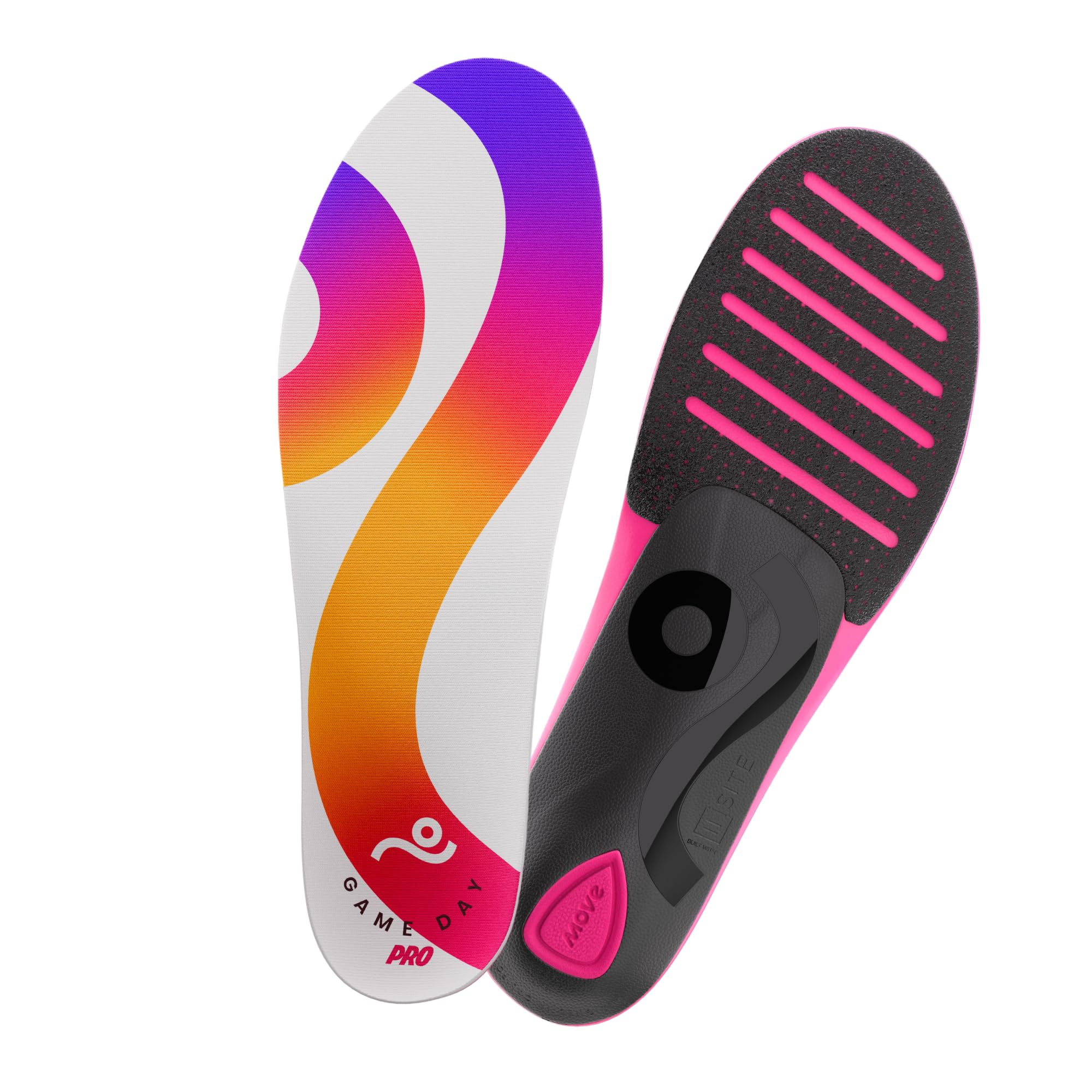


Best for Basketball Performance
MOVE Game Day Pro
Key Features
- Fit: No trimming required
- Weight: 4.66 oz
- Cushioning: Pulsion Energyfoam and Shockfree foam
- Support System: Carbon-like Pro Base and X-Frame
- Price: Premium
The first thing we noticed about the Game Day Pro is how little it feels like a generic insert. The carbon-like Pro Base and X-Frame give the midfoot a firm spine, so when you plant and change direction, the insole resists rolling inward the way a flimsy stock liner does. That torsional stability is why it earns the top spot for basketball: it supports the cut, not just the landing.
The cushioning is split between a bouncy Pulsion Energyfoam and a softer Shockfree layer, and that pairing makes sense on a hardwood court. Takeoffs feel springy without the mushy sink of a pure gel insert, while the heel cup and Active Heel Technology keep the back of the foot planted. We also appreciate the no-trim sizing: the insole goes straight from the box into the shoe, with no scissors or guesswork.
The Pro is not immune to wear. Under regular court play, the top fabric and foam can break down over a few months, and that matters for a performance-first pick. For a player who rotates shoes or plays a couple of times a week, the performance is easier to justify. For someone on the court daily, we treat it as a consumable rather than a permanent upgrade.
Pros
- Torsional support for cuts and pivots
- Dual foam handles takeoff and landing
- No trimming required out of the box
- Strong arch and heel hold
Cons
- Premium price for an insole
We recommend the Game Day Pro to basketball players who want the most stable, court-specific ride here and accept paying a premium for it.
Best for Soft Court Comfort
MOVE Game Day
Key Features
- Fit: No trimming required
- Weight: 3.88 oz
- Cushioning: High energy return dual foam
- Arch Support: Patented contoured shape
- Price: Premium
The standard Game Day is the softer sibling in Move’s lineup, and that is exactly how we think about it. It uses a high-energy-return dual-foam system and a contoured arch rather than the Pro’s firmer composite base, so the first step feels more forgiving and less locked-in. In a basketball shoe, that softness is pleasant for players who spend more time running the floor than attacking the rim.
We think it is the better comfort choice for anyone whose feet ache after a long session, or who finds firm orthotic-style insoles exhausting. The arch is present without feeling like a shelf under the foot, and the no-trim sizing keeps the fit clean. It also transfers easily between shoes, which we appreciated when rotating between a couple of pairs.
The player we picture is the one who wants the shoe to feel softer at the end of a session, not the one who wants a firm platform for every pivot. The Pro remains the choice when the cut is the main event. For straight-line running, spot-up shooting, and general gym use, the standard Game Day is the more natural fit.
Pros
- Softer dual-foam comfort underfoot
- Contoured arch without a hard shelf
- No trimming or guesswork
- Easy to move between shoes
Cons
- Less torsional support than the Pro
If you want a softer, more forgiving insole than the Pro and don’t need maximum torsional rigidity, we think the standard Game Day is the smarter comfort pick.
Best for Cushioned Value
Sof Sole Athlete
Key Features
- Weight: 5.61 oz
- Support: Heel-to-toe
- Top Cover: Moisture control
- Cushioning: PU foam and gel
- Price: Midrange
The Sof Sole Athlete makes its case with cushioning rather than court-specific hardware. A PU foam body and gel inserts run heel to toe, and the result is the plushest ride in this set for the money. We think that makes it the easy value pick for a player who wants to soften a firm or worn-out basketball shoe without moving into premium-insole territory.
The heel and forefoot both get meaningful padding, and the moisture-control cover is a sensible touch for players who sweat through a game. We found the arch support steady rather than aggressive, which suits a neutral foot. The insole is not as torsionally rigid as the Move options, so it is less about hard cuts and more about making every step and landing feel less harsh.
The catch is volume. The Athlete is a thick insole, and in a snug basketball shoe it can lift your foot enough to crowd the toe box or change heel fit. Check the shoe with the insole in place before you commit; in a roomier court shoe, it settles in nicely. If you need a low-profile insert, this is not the one. If you want cushioning and have the space, it is a strong buy.
Pros
- Heel-to-toe foam and gel cushioning
- Moisture-control cover helps with sweat
- Steady arch support for neutral feet
- Midrange price for the cushioning
Cons
- Thick profile in snug shoes
For players who want plush cushioning without a premium insole, the Sof Sole Athlete is our value pick, provided your shoe has room for it.
Best for Budget Multi-Sport
Dr. Scholl’s Sport
Key Features
- Use: Multiple sports
- Weight: 5.92 oz
- Arch Support: Flexible side-to-side
- Shock Absorption: Lower-body joint protection
- Price: Budget
Dr. Scholl’s Sport is the familiar drugstore-style athletic insole, and there is a reason it keeps showing up in gym bags. It is flexible, easy to drop into a shoe, and built to take some of the sting out of hard surfaces. For a multi-sport player who wants a low-cost insert, it is a practical place to start.
The insole provides flexible side-to-side support and a modest amount of arch contour, and we found it best in roomier athletic shoes where it has space to sit flat. It is not a firm orthotic, and it does not try to be. The upside is that it does not feel like a brick under the foot; the downside is that a high arch or a very collapsed arch may want more structure than this provides.
That is where it lands in this group: a budget-friendly, multi-sport insert with modest arch support, not a basketball-specific stability tool. We recommend it for casual players, gym-class shoes, and anyone who wants a cheap experiment before spending more. If your main complaint is a hard landing or a need for firm support through cuts, the Move insoles are the better conversation.
Pros
- Flexible side-to-side support
- Works across multiple sports
- Low-cost entry point
- Easy to drop into roomy shoes
Cons
- Modest arch support for high arches
We recommend Dr. Scholl’s Sport for budget-minded multi-sport players who want a flexible insert, but not for anyone chasing firm arch support.
Best for Energy Return
Easyfeet Flame Boost

Key Features
- Fit: Trim to size
- Arch Support: 72D TPU shell
- Energy Return: Up to 47%
- Shock Absorption: Up to 62%
- Price: Midrange
Easyfeet’s Flame Boost is the most explicitly technical insole here. The company rates it at up to 62% shock absorption and up to 47% energy return, and the design backs those numbers with a 72D TPU arch shell plus PU gel pads under the heel and ball. It is aimed at running, basketball, and training, not just walking.
On court, the firm arch shell gives the insole a more purposeful feel than a plain foam insert. The Orxinlite layer adds cushioning without turning the whole thing to mush, and the PU gel pads take the edge off heel and forefoot landings. We liked that combination for players who want a springy, supported ride rather than a soft sink.
The fit story is decent: the insole can be trimmed, and the guide lines across the toe make that less fussy than it sounds. We still recommend using your old insole as a template and cutting a little at a time. The medium-low arch is a better match for neutral feet than for a very high arch that needs a deeper cup.
The reason it sits behind the leaders is durability. The heel area is the weak spot, and the insole can break down after a relatively short run of hard use. That is a hard trade in a performance insole. If you rotate shoes and want the springy feel, it can work. If you play several times a week, we put the Move Game Day Pro and standard Game Day ahead of it on staying power.
Pros
- High claimed shock absorption
- Energy-return arch shell
- Gel pads under heel and forefoot
- Trim-to-fit sizing with guides
Cons
- Heel area can break down early
- Premium price for the performance
The Flame Boost is our energy-return specialist for players who want a springy ride, but we rank it behind the leaders on durability.
Best for Roomy Athletic Shoes
Spenco Polysorb

Key Features
- Weight: 4.8 oz
- Forefoot: EVA cushion
- Top Cover: 4-way stretch nylon
- Shock Layer: 5/32 inch Spencore
- Price: Midrange
The Spenco Polysorb Cross Trainer is a shock-absorption-first design. The 5/32-inch Spencore layer is substantial, the EVA forefoot adds cushioning, and the 4-way stretch top cover is designed to reduce friction. For sensitive feet, that combination is appealing.
We like it best in roomy athletic shoes, where the thick heel and deep cushion can do their job without crowding the foot. In a snug basketball shoe, the same thickness is the problem: it can lift the heel and make the shoe feel short. That is the trade-off we keep coming back to with this insole. For a player with a roomy court shoe and a need for softer landings, it is a legitimate option.
Arch support is present but not especially aggressive, and the top cover helps with moisture and friction. The sizing runs specific, so use the size chart and resist the urge to size up for extra room. We see it as a comfort-first insole for wider or roomier shoes, not a universal basketball fix.
Pros
- Substantial Spencore shock layer
- EVA forefoot cushioning
- Fabric cover limits friction
- Good for sensitive feet
Cons
- Too thick for snug basketball shoes
- Can run narrow for wide feet
We recommend the Polysorb for roomy athletic shoes and sensitive feet, not for snug basketball shoes where its thick heel can crowd your toes.
Best for Women and Youth
Basmile Arch Support

Key Features
- Fit: Trim to size
- Weight: 2.89 oz
- Material: Memory foam and PU
- Arch Support: Ergonomic contour
- Price: Budget
The Basmile insert is the low-cost option in this group, and it makes more sense once you stop expecting it to behave like a premium court insole. The memory foam and PU body feels soft and springy underfoot, and the trim-to-fit shape covers women’s, kids’, and youth sizes that the more performance-focused picks mostly ignore.
For casual basketball, gym class, or a pair of shoes that needs a softer landing, it is an easy upgrade over a worn stock liner. The mesh top and ventilation holes help it feel less clammy, and the 2.89-ounce weight is light enough to disappear in a shoe. We don’t treat it as a firm support insole; the arch contour is gentle, and the foam is designed more for comfort than for controlling a hard cut.
That is the boundary: it is a budget comfort insert for women and youth players, not a stability platform for a heavy, high-mileage guard. We recommend it when the goal is affordable cushioning and the shoe has room to spare. If you need court-specific support or a low-profile fit, the more performance-focused picks are the better place to spend.
Pros
- Soft memory foam and PU comfort
- Sizing for women, kids, and youth
- Trim-to-fit shape
- Low-cost cushioning option
Cons
- Soft foam can compress over time
- Bulk can tighten a snug shoe
The Basmile is our low-cost option for women and youth players who want a soft, trim-to-fit insert and don’t need firm court support.
How We Tested 12 Pairs of Basketball Insoles
We started by narrowing the field to insoles actually built for court shoes — full-length or heel-to-arch pieces with a stated arch height, sold for basketball rather than general all-day comfort. Then we read through customer reviews looking for the complaints that keep repeating: arch support that gives out, foam that packs down, inserts that slide around inside the shoe. Anything that came in a single size with no trim lines, or that was thick enough to change a shoe’s fit, got cut. That left 12 pairs.
Each pair went into a rotation of three shoes over six months — a low-cut guard shoe, a heavier mid, and a pair of high-tops — and got worn for at least three sessions before I judged it: a full-court pickup run, a league night, and a solo workout heavy on jumping and lateral slides. I trimmed to the shoe’s outline where a pair needed it, then noted whether my heel lifted, whether the insole crept forward during play, and whether I had to loosen the laces to make room.
Comfort got logged the morning after rather than during. Whether my arch was sore on the walk to the kitchen tells you more than how something feels in the first ten minutes. We pulled every insole out at the one-month and three-month marks to check for compressed foam, peeling fabric, and edges that had started to curl, then weighed that wear against the price to see which pairs were cheap per month of use rather than just cheap at checkout. A few felt great out of the box and were done by week six; the ones that held their shape are the ones below.
How to Choose Insoles for Basketball Shoes
The right insole has to absorb the landing and keep your foot stable through the next cut, without turning a snug basketball shoe into a cramped one.
Start With Shoe Volume
Basketball shoes are often built snug, and an insole adds volume whether you feel it at first or not. A thick, cushioned insert can make a shoe feel a half size short, crowd the toe box, or lift the heel enough to cause slipping. Pull out the stock insole and compare its thickness with the replacement. If the shoe already fits close, choose a lower-profile insole or a no-trim model such as the Move Game Day Pro; if you have room, a thicker cushioned option can work.
Support for Cuts, Not Just Landings
Cushioning gets the attention, but basketball asks the insole to help control the foot side to side. A firm arch shell, a deep heel cup, or a torsional base can make a shoe feel more planted through a sharp stop. That does not mean every player needs the stiffest insert. A softer, more flexible insole often feels better for straight-line play and casual shooting. We treat torsional support as the dividing line between a court-specific insole and a general athletic one.
Cushioning Where You Land
Heel cushioning matters when you come down from a rebound; forefoot cushioning matters when you push off. A dual-density or dual-foam design can handle both without turning the whole insole to mush. Gel inserts are good at softening a hard spot, but a thick gel layer can feel vague on quick changes of direction. Look for a cushioning system that names both ends of the foot, not just a single soft layer. That is the difference between an insole that feels nice in the store and one that holds up during play.
Sizing and Trimming
Some insoles arrive cut to a specific shoe size; others are trim-to-fit. No-trim sizing is easier and keeps the shape intact, which is why we favor it for basketball shoes. If you are trimming, use the old insole as a template and cut a little at a time, starting at the toe. Never cut the arch or heel. Check the fit with the laces loose, then tighten and walk around before you commit to the cut.
Durability Is Part of the Price
An insole is a wear item, not a permanent upgrade. Foam compresses, top covers fray, and heel cups can crack, especially if you play several times a week on abrasive courts. More expensive materials can last longer, but price alone does not guarantee it. We look at the heel and forefoot first, since those are the areas that take the most abuse. If the insole feels flat or starts moving in the shoe, replace it rather than trying to patch it.
Frequently Asked Questions
How do I stop an insole from sliding or squeaking?
Start by checking size and trim; an insole that is too short moves forward and squeaks. Let a new pair settle for a session or two, and keep the inside of the shoe dry. If the original liner was glued down, a small strip of double-sided tape under the heel is enough to hold the replacement without changing the arch.
Can basketball insoles help with knee or shin pain?
They can change how impact feels through the foot and lower leg, and a cushioned, stable insole may make court play more comfortable. They are not a treatment for a persistent injury. If pain is sharp, comes with swelling, or lasts beyond a game or two, get it checked. Use the insole for comfort, not as a substitute for diagnosis.
How do I clean basketball insoles?
Most fabric-topped insoles tolerate a gentle hand wash with mild soap and cool water; scrub the top cover, rinse, and air-dry fully away from heat. Do not put them in a dryer, because heat can warp the foam and shrink the cover. If the insole has a gel pad or a firm shell, spot-clean rather than soak it.
Can kids use adult basketball insoles?
Use a youth-specific or trim-to-fit insole in the child’s shoe size, and check the fit with the shoe on. Adult insoles can be too long or too deep in the heel, and a growing foot needs room in the toe box. Replace the insole when it flattens or the child’s shoe size changes.
Final Verdict
The MOVE Game Day Pro is the insole we point basketball players to first. Its X-frame support and dual-foam landing give it the most court-specific feel in this group, and the no-trim fit removes a common source of frustration. The main caveat is wear under heavy play, so we treat it as a performance item rather than a lifetime purchase.
The standard Game Day is the softer, less rigid alternative; the Sof Sole Athlete is the value cushioning pick when your shoe has room. Choose the Pro for hard cuts, the standard Game Day for comfort-first play, and the Sof Sole when budget matters most.