
This post contains affiliate links. We may earn a small commission when you buy through our links — at no extra cost to you.
Budget basketball shoes have a reputation problem, and it isn’t entirely undeserved: something has to give when a pair costs a fraction of a flagship, and it’s usually the outsole rubber or the foam under your forefoot. The good news is that the gap has narrowed a lot. Over the past six months my team and I put 14 pairs through weekly gym runs, blacktop pickup games, and a lot of solo shooting drills, and the best of them held up in ways that would have surprised me a few years ago.
What separates a smart buy from a waste of money comes down to a few unglamorous details. Traction is the one I’d protect first — a simple herringbone pattern in softer rubber grips a dusty floor in a way a pretty molded sole won’t. Then fit: budget pairs often run a half size off or pinch across the forefoot, so measure your foot before you trust the size chart. Comfort and support matter more than looks, but if a shoe looks like a brick, you’ll wear it less. The picks below got that balance right without charging flagship money.



Best for All-Court Play
adidas Own The Game 3.0
There’s a version of this guide where the top pick is the flashiest shoe on the page. This isn’t it. The Own The Game 3.0 sits near the bottom of the price range here, and it’s still the first pair we hand anyone who asks what to buy, because it gets the three things that decide a budget court shoe right: the toe box leaves room for a wide forefoot, the mid-top collar steadies the ankle without fighting it, and the outsole grips a clean floor.
The fit is the detail we keep coming back to. Among these picks it is the friendliest for wide feet by a clear margin — most of the others are cut close through the forefoot or run small. The upper starts firm and softens after a session or two, and the collar sits high enough to feel supported without limiting how far you can point your toe. Comfort holds up over a long session, too, which is not a given at this price.
Grip has held on indoor courts, including the dusty stretches where cheap outsoles skate, and the build looks sturdier than the money suggests. What you give up is subtlety. This is a support-first mid-top rather than a fast, low ride, and the colorways are loud enough to announce themselves before you do. If you want a quicker, closer-cut shoe, the Nike Precision 7 is the better fit. Everyone else can stop shopping.
Pros
- Roomiest toe box in this set
- Mid-top collar steadies landings
- Non-slip outsole grips clean courts
Cons
- Too roomy for narrow-footed players
The pair we recommend first: roomy enough for wide feet, steady in the collar, and grippy, for less than most of the field.
Best for Outdoor Courts
PEAK Streetball Master
Key Features
- Upper: Breathable
- Collar: High top
- Surface: Outdoor courts
- Cushioning: Cushioned midsole
- Price: Midrange
A high collar, a cushioned midsole and an upper that breathes: on the shelf, the Streetball Master looks like a shoe from a different price bracket. It’s the outdoor specialist of this group, the model PEAK names for streetball, with the taller collar and the extra coverage that go with that job.
We take it to blacktop ahead of anything else here. The collar sits above the ankle bone, the lacing pulls the midfoot down snugly, and the shoe feels planted when you stop and pivot. Grip holds on surfaces where the gym shoes in this set get loose, and there’s enough cushioning underfoot that a two-hour session doesn’t leave your legs complaining. It breathes well, too, which matters more outdoors in July than anything on a spec line.
The catch is longevity. The upper is where these go — splitting within a month is the failure to watch for, and asphalt makes it more likely. We treat the Streetball Master as a shoe you buy knowing it may not see a second season. For an outdoor player who wants to spend little and replace without regret, that’s a fair trade. For anyone who needs one pair to last a league season, it isn’t.
Pros
- High collar covers the ankle
- Grip holds on slick outdoor surfaces
- Breathable upper for hot weather
- Cushioned enough for long sessions
Cons
- Sizing is inconsistent between pairs
Our outdoor pick: a high collar, real grip and a breathable upper, with the understanding that the upper may not last a season.
Best for Tightest Budget
PUMA All-Pro Nitro
Key Features
- Fit: Narrow
- Use: Court and everyday
- Weight: 2.43 lb
- Price: Budget
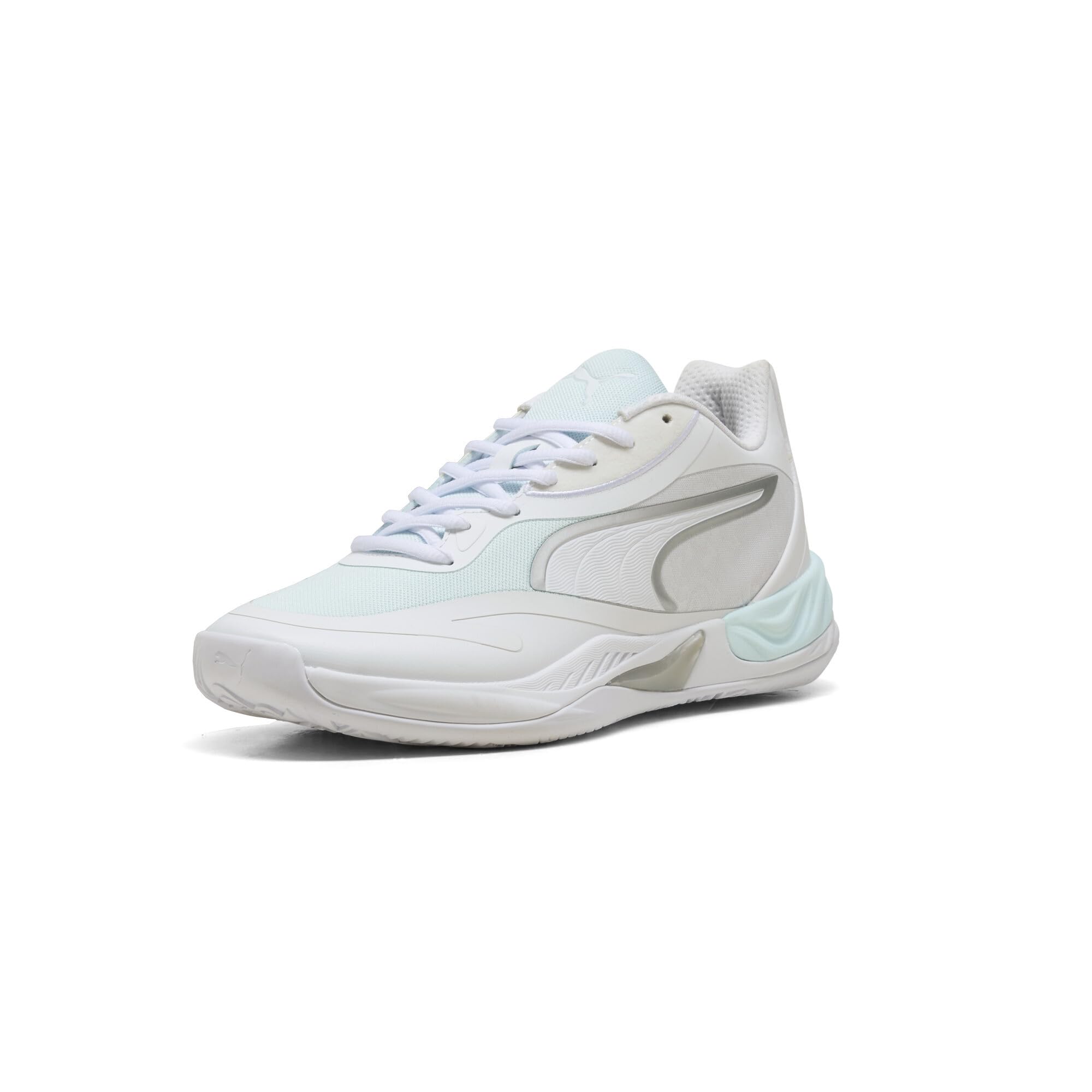
The least expensive shoe here is also the one that looks least like a budget buy. PUMA’s All-Pro Nitro has the low, sleek profile of a performance model, and it sells for a fraction of what it originally listed at — the kind of gap that usually means a colorway nobody wanted. Whatever the reason, the shoe underneath is a real basketball shoe.
It’s comfortable right away, with cushioning that feels softer underfoot than the money suggests, and the look carries off the court as easily as on it. For a pickup game and the walk home afterward, there’s nothing here that feels like a compromise.
The reason it isn’t our top pick is fit. The forefoot is cut narrow, and wide-footed players will feel the squeeze; if that’s you, skip it. If it isn’t, this is the best value in the guide by a distance — a second pair for what most shoes here ask for one, and the pair we reach for when we don’t want to think about what’s on our feet. What we can’t vouch for is how it looks after a full season of outdoor use, though the price makes that gamble easier to take.
Pros
- Least expensive pair in this guide
- Cushioning feels softer than the price
- Sleek enough for everyday wear
Cons
- Narrow forefoot rules out wide feet
We keep the All-Pro Nitro on the list as the cheapest real basketball shoe here — a genuine bargain unless your feet are wide.
Best for Fast Guards
Nike Precision 7
Key Features
- Fit: Runs narrow
- Build: Lightweight
- Sizing: Unisex
- Price: Midrange
Pick up the Precision 7 and the first thing you notice is how little there is to it. It’s the lightest-feeling shoe in this set, and on court that shows up as quickness — you get from a defensive stance into a sprint without the shoe dragging behind you.
For a guard, this is the one. The forefoot sits low and close to the floor, the collar holds the heel without a bulky wrap, and the grip bites on clean hardwood, the tacky kind of traction that makes a hard cut feel safe. We take it over the top pick for a fast, slashing player, and over the PEAK for anyone whose basketball happens indoors.
What it doesn’t give you is much shoe. Cushioning is present but modest — this is a court-feel design, not a soft landing — and the upper is thin enough that we keep it for gyms. On hardwood it is the quickest thing in the guide; on asphalt we prefer the PEAK or the Under Armour, both of which put more shoe around the foot. The look is clean and understated, which suits a shoe that does its best work indoors.
Pros
- Lightest feel in this set
- Grip bites on clean hardwood
- Stable, supportive collar
Cons
- Runs narrow and small; wide feet are out
We point fast, narrow-footed guards to the Precision 7: light, grippy on clean hardwood and stable in the collar.
Best for Supportive Fit
Under Armour Lockdown 7

Leather is the detail that sets the Lockdown 7 apart from everything else here. In a set full of mesh and knit uppers, this one is solid and structured, holds its shape rather than collapsing around the foot, and shrugs off scuffs that mark softer shoes. It won’t turn heads, and it isn’t trying to.
It’s snug through the midfoot, with ankle and arch support that feels more secure than the money implies, and the heel sits deep in the collar, so the shoe stays put when you cut. There’s plenty of structure underfoot as well; this is not a shoe that folds when you push off.
The catch is comfort versus structure. The leather that makes this shoe last is the same leather that takes breaking in, and on some feet it raises blisters before it softens — a few evenings around the house before game day mostly settles it. What we keep coming back to is how long it holds up: this is the pair here we trust for a full rec season and the walk home after.
Pros
- Leather upper resists scuffs
- Solid ankle and arch support
- Built to last a full season
Cons
- Sizing runs small for some players
We trust the Lockdown 7 to last a season: leather that resists scuffs and a snug, supportive fit, once you have broken it in.
Best for Standout Colorways
PUMA Dagger

Buy the Dagger for the colorway and you get a good shoe thrown in. These are the loudest pairs in the guide, and PUMA has done the job properly — vibrant panels, clean shapes, and a finish that doesn’t read as budget in daylight. On looks alone it’s the pair we pick to be noticed in.
Underneath the paint job it’s a competent court shoe: comfortable enough for a full session, decently cushioned, and put together well enough that the price doesn’t show in the seams. It works as an everyday sneaker too, which is more than several shoes here can claim.
Where the Dagger earns its place is value. It looks and feels like more than it costs, the build has enough substance to survive being worn daily, and nothing about it feels disposable. It isn’t a performance shoe the way the Precision 7 or the top pick are — the cushioning is simple and the support is basic — but as a cheap pair that looks good and plays fine, it does the job.
Pros
- Vibrant colorways that stand out
- Solid build for the money
- Comfortable on and off court
Cons
- Runs small, so ordering up is safer
The Dagger is the pair we reach for when the colorway matters: well built for the money, comfortable, and it runs small.
Best for Retro Looks
Ewing 33 HI

The 33 HI is the only shoe in this guide with a lineage. Patrick Ewing’s name is on the box, the silhouette is unapologetically retro, and the suede panels give it a texture that none of the mesh shoes here can match. If you grew up watching him, half the pitch is already made.
It’s also a usable basketball shoe. The fit runs true, the collar supports the ankle, and the build feels substantial — closer to the leather-and-suede shoes of the nineties than to the lightweight knits in the rest of this list. It doesn’t ask for much of a break-in either.
Where it gives ground is court feel. There’s more shoe around your foot than in the Nike or the PUMA, so you feel a little less of the floor, and a quick guard will notice. That bulk is the point of a retro shoe, and it’s why the 33 HI doubles as a lifestyle sneaker better than anything else here.
So this is the one we buy for the look and the story, and it plays well enough that the choice doesn’t feel purely decorative. It’s a second pair, a league-night shoe when the game matters less than the outfit, or a gift for a Knicks fan. As an only pair for a competitive season, the adidas or the Precision 7 come first.
Pros
- Retro silhouette with real texture
- True-to-size fit
- Substantial, well-made build
Cons
- Suede upper needs more care than mesh
We buy the 33 HI for the lineage and the suede, not for a competitive season — true to size, well made and unmistakably Ewing.
How We Tested 14 Pairs of Budget Basketball Shoes
We started by pulling every basketball shoe under a set price ceiling, then cut anything with a paper-thin outsole, a molded tread that clearly wouldn’t grip, or a return window too short to test properly. That left 14 pairs, all bought at retail rather than sent to us. Each went through two indoor sessions a week plus a weekly outdoor run on blacktop for six months — the outdoor days are what separate the durable pairs from the ones that bald at the pivot point.
Traction got tested first, on a high school floor that hadn’t been swept since warmups. We ran defensive slides and hard stops, noted who slid and who bit, then repeated the whole thing after wiping the floor down to see how the rubber handled dust on a clean surface.
For comfort and fit, I wore each pair straight out of the box for a full session before breaking anything in, which told us fast who needed a week of grace and who never stopped rubbing. We measured feet on a Brannock device and tried half sizes in both directions; several pairs ran a full size off, and a few pinched hard for anyone with wide feet. Support was judged in lateral cut drills, watching whether the foot rolled over the edge of the footbed, plus a simple twist test on the bench.
Appearance and value came last: we photographed each pair after a month of play to see how badly they scuffed, and kept asking whether the shoe delivered anything a flagship at twice the price actually would. None of the 14 was perfect — the ones below are the pairs whose compromises we could live with.
How to Choose Budget Basketball Shoes
A budget basketball shoe is a set of compromises, and the useful question is which ones you feel on court. Fit and grip change how you play; almost everything else is comfort.
Fit Comes Before Everything Else
A cheap shoe that fits beats an expensive one that doesn’t, and sizing is the complaint we flag most in this category — several pairs here run small or narrow through the forefoot. Measure your foot late in the day, leave a thumb’s width between your longest toe and the end of the shoe, and try them with the socks you actually play in.
If your forefoot is wide, start with the Own The Game 3.0, which has the roomiest toe box in this set, rather than the closer-cut performance shoes. The exception is a player who wants a locked-down, low ride: for that, a snug shoe is the point, and you should treat the sizing chart as a starting point rather than an answer.
Match the Outsole to the Floor You Play On
Indoor gyms and outdoor blacktop want different rubber. Soft, tacky compounds bite hardwood and wear away fast on asphalt; a firmer outsole survives the driveway but feels slick on a polished floor. We decide this before anything else, because it narrows the list faster than any other choice.
The Streetball Master is the one here built around outdoor play, while the Precision 7 is happiest indoors. Playing most of your basketball outside in a shoe meant for gyms is the classic budget mistake: the tread goes smooth long before the upper does.
Decide How Much Collar You Want
Collar height is a preference as much as a protection feature. A high top like the Streetball Master feels secure when you land awkwardly; a low, close-cut shoe feels quicker and frees the ankle to move. Neither prevents a roll on its own — the fit through the heel and midfoot does more of that work than the collar does.
For most rec players, a mid-top like the Own The Game 3.0 is the compromise we recommend. If you have rolled an ankle more than once, a high collar is worth the lost freedom of movement.
Plan for Cushioning and Wear
Budget shoes use simpler foams, and there is usually less of it. Expect the midsole to pack out before the upper gives way: once the shoe feels flat under the ball of your foot, the cushioning has done its work, whatever the tread still looks like.
Watch the outsole at the pivot point and under the toes, where cheap pairs wear through first. Rotating two cheaper pairs spreads the load and often outlasts one expensive pair, which is worth considering if you play several times a week.
Frequently Asked Questions
Are budget basketball shoes good enough for league play?
For most rec players, yes. The gap between a budget pair and a premium one shows up in how long the cushioning lasts and in the upper materials rather than in whether you can play in them.
If you are on court three or more times a week, the more expensive foam can work out cheaper over a season. If you play once or twice a week, put the money into fit instead.
Can I use basketball shoes for volleyball or pickleball?
Yes, on indoor courts. Basketball shoes are built for lateral cuts and landings, which is exactly what volleyball and pickleball ask for, and the grip translates straight across.
Volleyball players usually want a bit more forefoot cushioning; pickleball players often prefer something lighter and lower. The Streetball Master is even sold as a pickleball shoe. Keep them off sand and grass.
Is an aftermarket insole worth adding to a budget pair?
Only if the original footbed lifts out. When it is removable, a better insole is the cheapest upgrade a budget basketball shoe can take, and it can add the cushioning the stock foam lacks.
If the footbed is glued in, an insole on top steals volume from the shoe and can turn a snug fit into an uncomfortable one. Check before you buy the insole.
Final Verdict
If you want one pair for this season, the adidas Own The Game 3.0 is our pick: a roomy toe box for wide feet, a mid-top collar that steadies you on landings, and an outsole that grips a clean floor, for less than most of this group. Play outdoors and the PEAK Streetball Master’s higher collar and street-ready grip make more sense.
If the budget is the whole story, the PUMA All-Pro Nitro is the cheapest real basketball shoe here — just not for wide feet.