
This post contains affiliate links. We may earn a small commission when you buy through our links — at no extra cost to you.
Every shot trainer promises improvement, but the real battle is finding one that matches your game and doesn’t come with hidden headaches. Whether it’s a smart ball that drops connection mid-session or a hand-placement ball that needs pumping before every use, the market is full of tools that work great – for the right player.
The choice ultimately comes down to what you want to fix: your form, your strength, or your volume. A data‑driven smart ball gives you shot‑by‑shot feedback but ties you to an app and subscription. A rebounder lets you crank out hundreds of reps but doesn’t analyze your mechanics. Weighted balls build power but can mask form flaws if used alone.
This guide helps you pick the tool that fits your specific goal – so your training time actually transfers to the court.


Best for Data-Driven Analysis
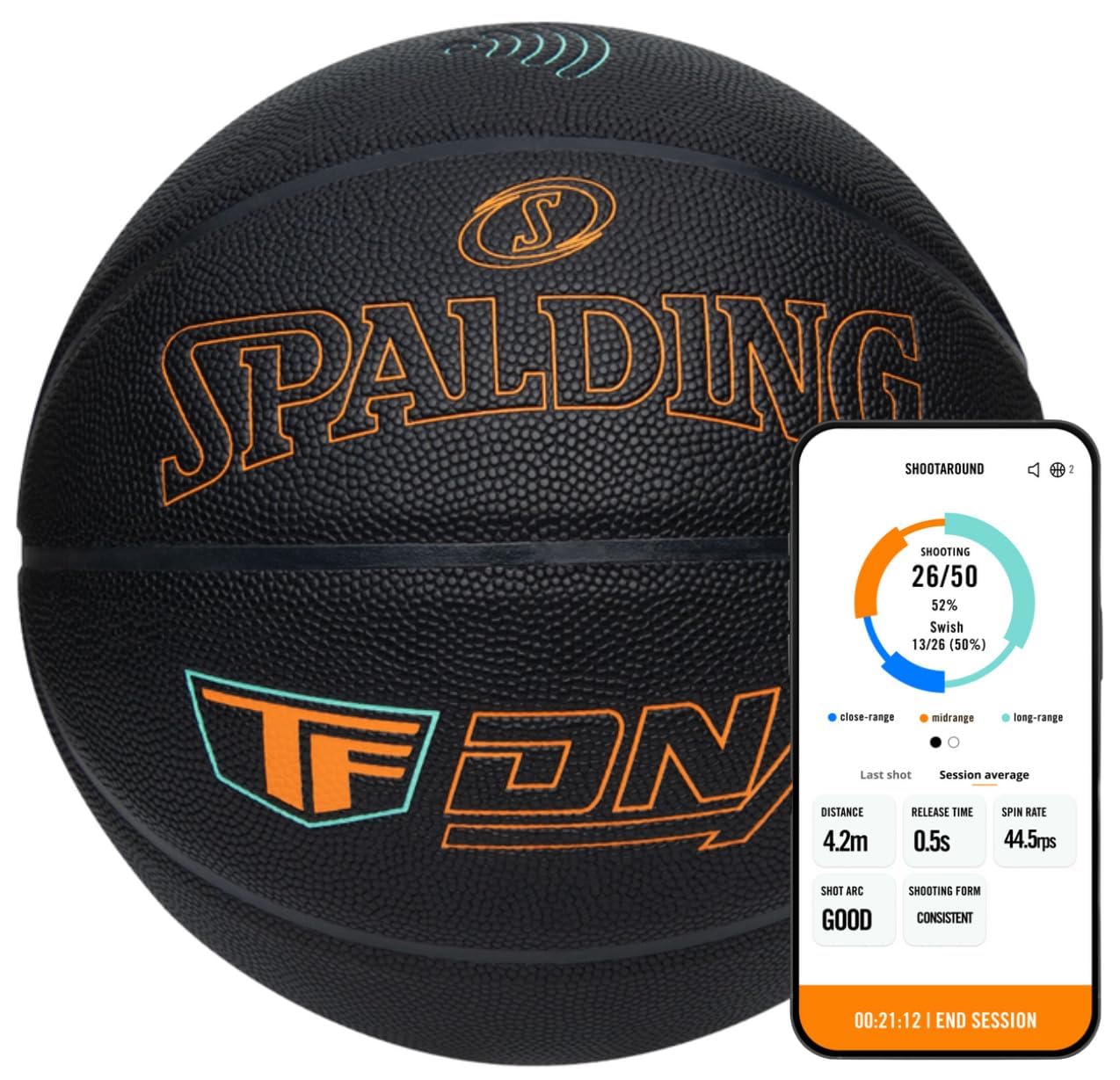
Spalding TF DNA Smart Ball
Key Features
- Training Type: Smart tracking
- Ball Size & Weight: 29.5 inch
- Durability & Air Retention: Composite leather, Bluetooth issues
- Price: $$$
The Spalding TF DNA Smart Ball embeds sensors in a composite leather regulation-size ball to track shot arc, rotation speed, release angle, and release time after every attempt. That data appears on your iPhone immediately, letting you see whether each shot was flat, short, or off-axis without replaying video. The ball itself feels like a standard Spalding game ball – good grip, solid bounce, and suitable for both indoor and outdoor courts.
Bluetooth connectivity can be inconsistent: the ball may drop the connection mid-session, especially when the phone is more than ten feet away or behind obstacles, requiring a pause to re-pair. This doesn’t derail solo drills but can disrupt timed challenges. The ball also occasionally misreads makes as misses – expect a roughly 4% error rate on close-range shots where net tension is high. These are limitations worth knowing, not dealbreakers for focused players.
This bundle is built for serious players who own an iPhone and want objective metrics on their shooting mechanics. The $10/month subscription kicks in after the first year, adding ongoing cost. Android users should note the app has not been released despite the product listing stating compatibility – an iOS device is required. If your priority is high-rep volume, a standalone rebounder like the Dr. Dish serves that need better. But for data-driven form improvement, this is the only product that combines analytics with a game-ready ball.
Pros
- Composite leather cover with an authentic Spalding feel that holds up on indoor and outdoor courts.
- Live shot metrics (arc, rotation, release angle) after every attempt – no video replay needed.
- Immediate audio and visual feedback helps correct form in the moment.
- Trackable improvement over time with gamified challenges for consistent practice.
Cons
- Bluetooth connection can drop during use, especially when the phone is more than 10 feet away or behind obstacles.
- Android app has not been released despite product listing promising compatibility – requires an iPhone to access all features.
For iOS users who want to quantify their shooting form and track progress, this smart ball delivers insights no other training tool provides – just be prepared for occasional Bluetooth hiccups and the ongoing subscription fee.
Best for High-Volume Reps
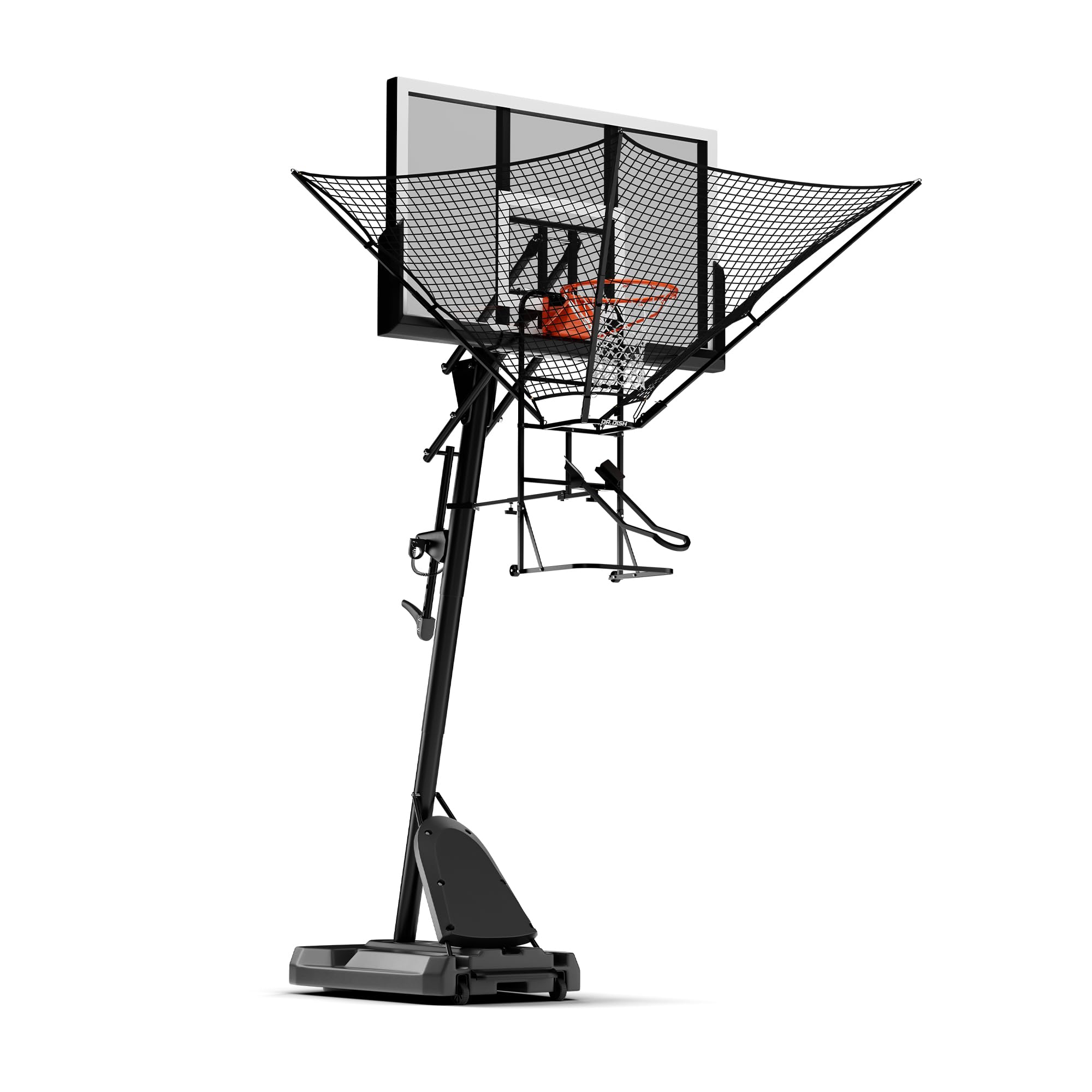
Dr. Dish IC3 Rebounder
Key Features
- Training Type: Rebound net
- Durability & Air Retention: Steel frame, net jams
- Price: $$$
The Dr. Dish IC3 rebounder pairs a heavy-duty steel frame with a foldable design and a ball return that works on any standard rim, enabling players to get up to 800 reps per hour without chasing loose balls. This makes it a practical alternative to a ball machine—no ongoing costs, no power cord, just consistent ball return for high-volume shooting practice.
This setup suits high school and college players who want to cram 500+ reps daily, or parents who want to maximize practice efficiency for multiple kids. However, the ball can occasionally get stuck between the net and rim, requiring tension adjustments or a second ball to dislodge it—a manageable tradeoff for the rep counts. The assembly instructions are also confusing, so set aside extra time for setup.
Pros
- Heavy-duty steel frame built to withstand frequent use.
- Delivers 2–3x more reps per practice compared to standard shooting drills.
- Encourages proper shot arc by forcing the ball over the net on each return.
Cons
- Assembly instructions can be confusing, making initial setup time-consuming.
- Ball can get stuck between the net and rim, requiring tension adjustments or a second ball to free it.
For serious players seeking high-volume shooting without the cost or complexity of a ball machine, the Dr. Dish IC3 is a durable, effective tool that delivers consistent reps.
Best for Strength & Conditioning
SKLZ Weighted 3lb
Key Features
- Training Type: Weighted resistance
- Ball Size & Weight: 29.5", 3 lb
- Durability & Air Retention: Synthetic leather, occasional imbalance
- Price: $$
The SKLZ Weighted Training Basketball packs a 3-lb weight into a full 29.5-inch ball that feels like a standard game ball once inflated. Where the top pick tracks shot arc and rotation, this ball focuses on the physical side: strengthening the arms, wrists, and fingers needed for consistent shooting and passing. The synthetic leather cover and built-in weight make it a practical tool for players who want to increase range without changing their shooting motion.
This ball suits players who want to add strength and control to their training routine, whether for dribble drills, warm-ups, or shooting practice. A small number of units may have unbalanced weight distribution, which can cause erratic bounce – something to check on arrival. The synthetic leather can also feel slightly slick compared to composite game balls, a minor difference that most adjust to quickly.
Pros
- Builds arm, wrist, and finger strength effectively.
- Improves ball handling and dribbling control.
- High-quality construction with a premium feel.
Cons
- Some units may have unbalanced weight distribution causing inconsistent bounce.
- Synthetic leather can feel slightly slick compared to composite game balls.
A straightforward strength-training ball that delivers results for players willing to check for balance on arrival.
Best for Kids & Beginners
Baden SkilCoach 27.5"
Key Features
- Training Type: Hand placement
- Ball Size & Weight: 27.5", 16 oz
- Durability & Air Retention: Rubber, frequent air loss
- Price: $
Color‑coded hand graphics on a 27.5‑inch rubber ball give young players a visual guide for where to place each hand – left‑handed shooters see one set of markers, right‑handed shooters another. The reduced size fits small hands comfortably, making it easier to practice correct form without the ball feeling oversized.
This ball is designed for children ages 4 to 10 and the coaches or parents teaching them. The valve seal can be inconsistent, so you may need to pump it up before each practice session. If you’re looking for a regulation‑sized ball or something that holds air for days, this one isn’t the right fit – it’s a teaching tool that requires a bit of maintenance. The hand guides are its main advantage; for strength training or durability, consider the Baden Heavy Trainer instead.
Pros
- Color‑coded hand graphics for left- and right-handed shooters provide clear visual guidance.
- Junior 27.5" size is ideal for young beginners learning proper hand placement.
- Effective at building muscle memory through repeated correct form.
Cons
- Decals may wear off after a few months of regular use.
- Air may escape between sessions, requiring inflation before each use.
Best for parents and coaches who want a dedicated hand‑placement trainer for young kids and are willing to keep a pump nearby.
Best for Team Strength Drills
Baden Heavy Trainern
Key Features
- Training Type: Weighted resistance
- Ball Size & Weight: 29.5", 44 oz
- Durability & Air Retention: Rubber, some warping
- Price: $
At 44 ounces and under $20, this rubber ball focuses on building hand strength and passing velocity without a premium price tag. It’s a straightforward tool for coaches and players who prioritize repetitive drills over digital feedback.
This ball suits youth coaches buying in bulk for team drills, or players looking to improve hand strength without spending much. The rubber cover holds up to indoor/outdoor use, though it can feel abrasive for younger children. A portion of units may deform over extended use, so it’s a practical choice for short-term training cycles rather than long-term game use.
Pros
- Effective for strength training, especially passing and dribbling drills.
- Well-made and durable under heavy use.
- Great value – one of the most affordable heavy training balls available.
Cons
- In some units, the ball may lose perfect roundness after months of use – a tradeoff for the low price.
- Markings and logo can wear off quickly, but that doesn’t affect performance.
For teams and individual players on a budget, this weighted ball delivers the strength-building workout without the premium cost – just be aware of potential shape changes over time.
Best for Cost-Conscious Players
KUYOTQ Weighted Ball

Key Features
- Training Type: Weighted resistance
- Ball Size & Weight: 29.5", 3.3 lb
- Durability & Air Retention: PU leather, temporary oval
- Price: $
This weighted ball offers 3.3 lbs of training weight in a regulation 29.5″ size, with a PU leather surface that provides good grip. The price is roughly half of what premium brands charge, and the build quality is close to theirs. One quirk: the ball may appear oval for 30-60 minutes after inflation before rounding out – this is normal but can be puzzling. The SKLZ and Baden Heavy have longer track records and larger user feedback, making them safer bets for those who prioritize consistency over budget.
Pros
- Build quality and materials are comparable to premium weighted balls at a much lower price.
- Offers substantial savings compared to established brands while delivering similar training benefits.
Cons
- The ball may feel slightly heavier than its advertised weight, which can affect shooting rhythm for some players.
Best for budget-focused players who can accept the initial shaping quirk and want heavy ball training without paying premium prices.
Best for Young Shooters
HOOPSKING Skill Shooter

Key Features
- Training Type: Hand placement
- Ball Size & Weight: 28.5"
- Durability & Air Retention: Rubber, poor air retention
- Price: $
The HOOPSKING Skill Shooter provides clear color-coded hand placement guides and an online training video, making it a functional tool for teaching young players proper shooting form. Air retention can be inconsistent, with some units requiring weekly inflation, and the hand markings may fade after a few weeks of indoor use. For a more durable option, the Baden SkilCoach is a better choice for consistent practice.
Pros
- Helps young shooters develop proper hand placement with lefty-friendly yellow markings
- Appropriate size and material for beginners learning the game
Cons
- Hand markings may fade after a few weeks of indoor use, reducing visual guidance
- Air retention can drop noticeably within a month due to valve seal inconsistencies
Works as a low-cost visual training tool for casual home practice, especially for left-handed shooters, if you’re prepared to top up the air regularly.
Best for Follow-Through Aid
FNBX FlickGlove

Key Features
- Training Type: Resistance trainer
- Durability & Air Retention: Silicone, tears easily
- Price: $
The FlickGlove uses three silicone straps to reinforce shooting follow-through and add spin, and it feels comfortable during play. For the price, it works well initially. However, the silicone material may tear at the finger tips after a few sessions, and the snap buttons can come loose mid-practice. This makes it a short-term tool best used as a supplement to other training equipment rather than a daily go-to.
Pros
- Helps reinforce follow-through and adds spin to shots.
- Comfortable to wear during practice without getting in the way.
Cons
- Silicone material may tear at the finger tips after a few uses.
- Snap buttons can come undone during practice.
A budget-friendly option for players who want to test follow-through training without a long-term commitment – expect to replace it after a few sessions.
Best for Youth Beginners
BALSMART Hand Position Ball

Key Features
- Training Type: Hand placement
- Ball Size & Weight: 28.5"
- Durability & Air Retention: Foam rubber, no data
- Price: $
The BALSMART hand position ball offers clear left/right hand graphics on a soft foam surface, making it easy for very young shooters to place their hands correctly. At under $20, it’s a low-cost introduction to proper form. However, the size 6 (28.5") is best suited for kids ages 5–10 – older children or teens will outgrow it quickly. With limited user feedback, it’s less established than alternatives like the Baden SkilCoach. This ball works for the absolute beginner, but if you want a more widely tested youth trainer, that other option is a safer choice.
Pros
- Affordable foam rubber ball with clear hand guides for young beginners.
- Teaches correct hand placement without overwhelming features.
Cons
- Only suitable for children ages 5–10 due to small size.
Best for parents on a tight budget teaching their youngest players (ages 5–10) basic shooting form. If you need a more established youth ball, consider the Baden SkilCoach.
Best for Right-Handed Form
Shot Coach Form Brace

Key Features
- Training Type: Form correction
- Durability & Air Retention: Plastic, durable
- Price: $
Shot Coach Form Brace physically keeps the shooting elbow tucked in, helping right-handed beginners build proper muscle memory. The durable plastic construction holds up to regular use. However, the same elbow restriction can be achieved with a simple household item like rope, making the price feel high for what is essentially a plastic angle guide. It only works for right-handed shooters, so left-handed players should look elsewhere. This is a basic tool for coaches who want a visible form cue during group drills, but not a complete training solution.
Pros
- Physically prevents the shooting elbow from flaring out, building proper form over time.
- Sturdy plastic build that withstands frequent practice sessions.
Cons
- Only designed for right-handed players – left-handed shooters cannot use it.
- The same form restriction can be achieved with household items like rope – the tool adds convenience but not unique value.
Best suited for right-handed beginners who want a physical reminder without needing analytics, and for coaches who need a visual cue during team sessions.
Best for Budget Off-Hand
Crown x Starr Off-Hand Kit

Key Features
- Training Type: Off-hand kit
- Durability & Air Retention: Plastic, limited data
- Price: $
This kit includes both an off-hand shooting pad and a pair of dribbling goggles for a low price, making it an affordable experiment for breaking the guide-hand habit. Its real-world impact on shooting consistency hasn’t been thoroughly validated — treat it as a low-cost trial rather than a proven training tool. Players with larger hands may find the pad undersized, so it suits average hand sizes best.
Pros
- Helps correct guide-hand interference without a large investment.
- Combines a shooting aid and dribbling goggles in one purchase, saving money over buying separately.
Cons
- The off-hand pad may be too small for players with larger hands, limiting its fit.
This kit is a reasonable low-cost trial for those curious about off-hand training and need basic goggles — but don’t expect it to replace dedicated training tools.
How to Choose
The best shot trainer fixes a specific weakness – form, power, or volume – so knowing which one you need is half the battle.
Training Type
Shot trainers fall into four categories: smart balls that track arc and rotation, weighted balls for strength, hand‑placement balls for beginners, and rebounders for high‑volume reps. Each targets a different aspect of your shot, so matching the type to your primary goal is critical.
Smart balls provide immediate feedback on mechanics but lock advanced features behind an app subscription. Weighted balls build muscle but can ingrain poor form if used without conscious technique work. Hand‑placement balls teach hand positioning but often suffer from air‑retention issues. Rebounders maximize reps but don’t analyze your form.
Ball Size and Weight
Official men’s balls are 29.5 inches (size 7), while youth sizes (28.5, 27.5) match smaller hands. Weighted balls range from 2.75 to 3.3 pounds – enough to build strength without overloading the wrist. Using the wrong size or weight can frustrate a young player or fail to challenge an adult.
A heavier ball (3+ lbs) builds passing power and dribble control, but switching back to a regulation ball requires a brief adjustment period. For kids, a junior size with hand guides teaches proper placement without overwhelming them.
Durability and Air Retention
Rubber training balls are affordable but a common weak point is the valve seal. Many need pumping before every session, and some lose shape over time. Composite leather or PU holds air better but costs more. If you train outdoors, rubber handles abrasion better, but the trade‑off is air retention.
For heavy‑duse rebounders, look for welded steel frames and adjustable net tension. Plastic clips on rim‑attached targets break quickly – this is why many buyers return them within days. Prioritize products with metal components or reinforced plastic where the part sees stress.
Additional Costs
Smart basketballs require a monthly or yearly subscription for full analytics – typically $10/month. Without it, the ball is just a regular ball with basic tracking. Rebounders and weighted balls have no ongoing costs. Hand‑placement balls may need frequent replacement if the valve fails.
Factor in the total cost of ownership: a $150 smart ball plus $120/year for the app costs more over two years than a $500 rebounder that lasts a decade. Set your budget not just on the sticker price but on how long you plan to use the tool.
FAQ
Do weighted basketballs actually improve shooting accuracy or just build arm strength?
Weighted balls build arm, wrist, and finger strength, which can translate to better range and endurance, but they don’t correct form by themselves. You need to pair them with form drills (using a smart ball or a hand‑placement guide) to see accuracy gains. Think of them as a strength tool, not a form fix.
Why does my smart basketball keep disconnecting from the app?
Bluetooth connectivity is the most common complaint with smart balls like the Spalding TF DNA. Interference from other devices, distance from the phone, or unit variance can cause frequent drops. Keep your phone within 10 feet and try resetting the ball. If it persists, you may have a defective unit – the problem isn’t universal.
How often do hand‑placement training balls need to be re‑inflated?
It depends on the brand, but many rubber hand‑placement balls (like the Baden SkilCoach or Hoopsking) have unreliable valve seals that lose air after a few days. Some users report needing to pump before every session. If you hate constant maintenance, look for a composite leather option or be ready with a pump.
Can a basketball shot trainer rebounder work with any outdoor hoop?
Most rebounders attach to standard 18‑inch rims with hooks, regardless of pole type. The Dr. Dish IC3 fits both indoor and outdoor hoops, but make sure your rim doesn’t have a thick padding that blocks the clips. Outdoor hoops with chain nets may cause more ball‑sticking issues than nylon nets.