
This post contains affiliate links. We may earn a small commission when you buy through our links — at no extra cost to you.
A kid-sized basketball hoop can turn a driveway, basement, or hallway into a court, but only if it stays upright after the first missed dunk. I’ve watched a flimsy rim wobble once and send a kid back inside, which is why I care less about flashy packaging and more about whether the toy keeps them shooting. The best basketball toys for kids make play easy: the ball bounces true, setup doesn’t eat an afternoon, and the whole thing looks cheerful enough to leave out. It gets them moving without a screen.
Over the past six months, my team and I tested 12 basketball toys for kids—mini hoops, oversize bouncers, and play sets—in driveways, basements, and living rooms. We wanted to know which were genuinely fun, which held their air and shape, and which stayed steady when a 7-year-old went for a layup. Assembly mattered, too; if a grown-up needs a power drill and a prayer before the first bounce, the toy loses its appeal. The picks below survived daily play and still felt worth the space.
Our Top Picks


The Best Basketball Toys for Kids, Reviewed
GMAOPHY Toddler Hoop – Best Overall
Key Features
- Age range: 18 months and up
- Adjustment: 5 height slots
- Height range: 29.5 to 41.3 inches
- Included balls: 3 soft balls and pump
- Price: Midrange
The five height settings on GMAOPHY’s toddler hoop run from 29.5 to 41.3 inches, and that range is why it’s the first one we hand to most families. A one-year-old can shoot at the low setting without the rim towering over them; by the time they’re three or four, you can raise it a notch and get another season or two. The box includes three soft inflatable balls and a pump, so the first game doesn’t depend on finding a spare ball.
We like how little ceremony the setup takes. The plastic frame is light, the pieces go together without a toolbox, and the whole thing moves from the playroom to the patio without becoming a project. The three balls are soft enough for indoor play and small enough for little hands, and having spares matters more than it sounds: one can disappear under a sofa and the game keeps going. The five slots are easy to find and lock, which makes raising the rim a one-person job.
The base is the part to watch. Empty, it’s light; filled, it behaves much better when a child runs into it or hangs on the rim. We kept ours on a flat surface and gave it a few minutes to settle before play. The hoop is sized for the included mini balls, so a full-size basketball is the wrong partner. For the toddler years, that’s the right scope: a real target, a soft ball, and no trip to a gym.
Pros
- Five height settings from 29.5 to 41.3 inches
- Three soft balls and a pump included
- Light enough to move between rooms
- Simple assembly without extra tools
Cons
- Top height suits toddlers, not tall preschoolers
For most families with a toddler, this is the hoop we recommend: the five height settings stretch from first steps to preschool, and the three soft balls are ready to play.
SUPER JOY Toddler Hoop – Best for Pool Play
Key Features
- Adjustment: 5 height slots
- Play modes: Poolside or freestanding
- Height range: 2.3 to 4.5 feet
- Included balls: 4 mini balls and pump
- Price: Midrange
The reason to choose SUPER JOY’s toddler hoop over the more compact picks is written into its pole: it reaches 4.5 feet, and the same frame can be broken down into a poolside hoop. We think that makes it the better buy for a taller preschooler or a family with a pool, even though it takes up more room than a first hoop needs.
The five height slots start at 2.3 feet, so it still works for a small child; the difference is the headroom at the top. The set arrives with four mini soft balls and a pump, and the two-mode design is genuinely useful: with the bent pole alone, it sits at the pool edge; with the straight sections added, it becomes a freestanding hoop for the yard or playroom. The extra balls are handy for playdates, and the pump means it’s usable the day it arrives.
The trade is the setup. Converting between pool and floor mode means adding or removing poles, and the taller the hoop, the more carefully you need to site it. We kept ours on a flat patio and re-tightened the joints after the first day. It’s not a leave-out-all-winter toy; bring it in when the weather turns. If you have the floor space and a child who has outgrown the low rims, the extra height is worth the fuss.
Pros
- Reaches 4.5 feet for taller preschoolers
- Converts to a poolside hoop
- Four mini balls and a pump included
- Five height slots
Cons
- Wobbles when a child hangs on the rim
- Pool mode needs a pole swap
We reach for this one when the hoop has to move between the driveway and the pool; its taller range and four balls suit bigger preschoolers better than the compact toddler hoops.
HopeRock Indoor Hoop – Best Indoor Hoop for Older Kids
Key Features
- Rim: Spring-loaded steel
- Mount: Over the door
- Scoring: LED scoreboard and cheers
- Age range: 5 to 12 years
- Price: Midrange
HopeRock’s indoor hoop hangs over a door and turns every shot into a small event: the backboard lights up, a scoreboard counts baskets, and a cheer sound fires when the ball goes through. For a grade-schooler who wants a bedroom court, that feedback is the whole appeal.
The spring-loaded rim gives a little when a kid hangs on it, and the steel rim and thick backboard are meant to take repeated shots. We like that it installs without drilling; the hook design relies on the door, so the fit is the first thing to check. The set includes a ball and pump, and the whole thing is small enough to leave up between sessions.
The mini ball and small rim keep it in toy territory. This is a bedroom diversion, not a training tool, and that’s fine: the lights and score give it more staying power than a plain backboard, especially for a kid playing alone. We treat the electronic part as the fun layer, not the reason the hoop works.
Pros
- Over-the-door mount needs no drilling
- Spring-loaded steel rim
- Lights and electronic scoring
- Easy assembly
Cons
- Scoreboard can miss baskets
If your kid wants a scoreboard and a door-mounted hoop, this is our indoor pick, though we treat the scoring as a bonus rather than the reason to buy.
GMAOPHY Baby Sports Toy – Best for 1-Year-Olds
Key Features
- Age range: 12 months and up
- Batteries: 1 AA required, not included
- Activities: Basketball, soccer, lights and songs
- Dimensions: 19.69 x 15.75 x 23.62 inches
- Price: Midrange
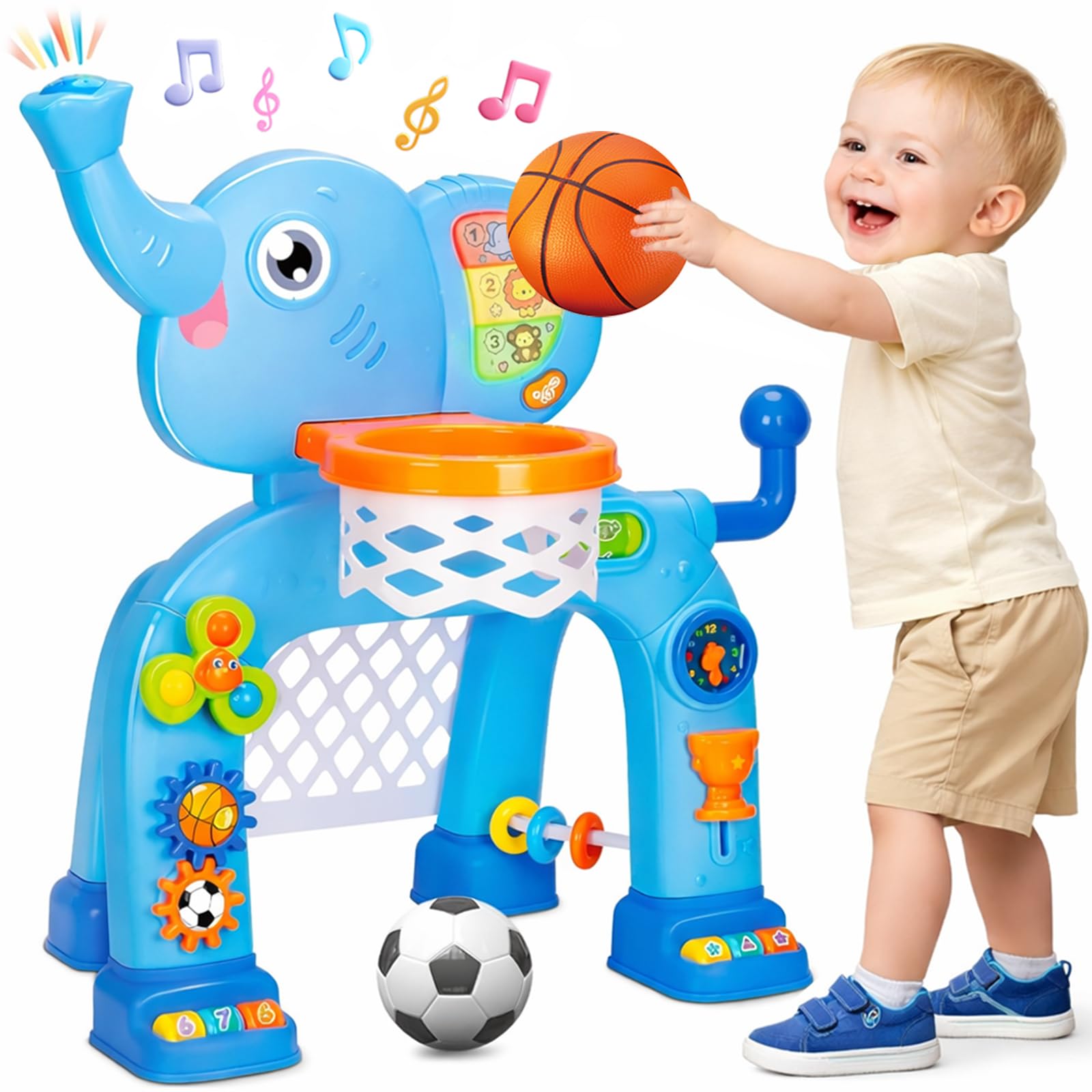
The GMAOPHY baby set is less a basketball hoop than a tiny activity center: a low hoop, a soccer goal, lights, more than 30 sounds and songs, buttons, gears and a spinning trophy. For a one-year-old, that’s the right ratio of cause and effect to actual shooting.
We like it for the 12-to-18-month stage, when a child is more interested in making something happen than in scoring. The balls are small enough for little hands, the hoop is low, and the lights and songs reward a shot without needing a scoreboard. It also gives a second sport to grow into, which stretches the toy past the first week.
The included pump and screwdriver mean it’s ready to assemble, and the plastic is rounded and light. The toy is best kept on the floor, where a baby can crawl up to it. The sound bank is big enough to keep a baby coming back, and the buttons are easy to hit during floor play.
Pros
- Basketball and soccer goal in one toy
- Lights and more than 30 sounds and songs
- Soft balls sized for little hands
- Easy assembly with pump included
Cons
- Needs one AA battery, not included
- Not for older preschoolers
This is the one we hand to a one-year-old: the low hoop, soft balls, lights and songs turn first shots into a cause-and-effect game.
Iyoyo Mini Basketballs – Best for Replacement Mini Balls

Key Features
- Colors: Five assorted colors
- Included: Pump and needle
- Ball size: 6 inches
- Pack size: 5 balls
- Price: Budget
A five-pack of six-inch mini basketballs with a pump is a small thing to get right, but it solves a real problem: the ball that came with the hoop is always the first piece to vanish. Iyoyo’s set gives you five colors, a pump and a needle, and enough balls to keep a playdate moving.
We like the six-inch size for toddler hands and for over-the-door hoops; it’s big enough to grip and soft enough that an indoor miss doesn’t rattle the room. The colors make it easy to hand out one per child, and the pump means you can top them up without hunting for a needle. They work for pool play too, which is more than most mini balls manage.
The pump is the weak link; the handle on small included pumps can feel flimsy, so we keep a better pump nearby. The balls also arrive deflated and vary slightly in size, which matters if your hoop has a tight rim. Check the first ball against the rim before inflating the rest; if it binds, size down to a five-inch set.
Pros
- Five six-inch balls in bright colors
- Pump and needle included
- Easy for toddler hands to grip
- Works with popular mini hoops
Cons
- Air retention varies between balls
We keep this five-pack around for the day the original mini balls disappear under the sofa; five colors and a pump make it the practical restock.
ABAJI Mini Basketballs – Spare-Ball Value

Key Features
- Included: Pump and needle
- Material: PVC
- Ball size: 5 inches
- Pack size: 2 balls
- Price: Budget
Two five-inch balls and a pump won’t rescue a broken hoop, but they will rescue the afternoon when the original mini ball has rolled under the car. ABAJI’s pair is the spare-ball answer: small, soft, and cheap enough to keep a couple in the toy bin.
We like the five-inch size for tight over-the-door rims and for kids who are ready for a slightly smaller ball than the six-inch toddler size. The PVC surface has enough grip for indoor shooting, and the pair plus pump is a sensible car or grandma’s-house kit. It’s also the least expensive way here to get a playable ball back into rotation.
The balls are inflatable, so they need a few minutes with the pump before play. Inflate one slowly and check the bounce before the second; the pair is best treated as spares, not as the main gift. If you’re replacing the only ball for a hoop, buy a five-pack instead and keep the extras in the box.
Pros
- Two five-inch balls and a pump
- Soft PVC surface for indoor play
- Budget-friendly spare set
- Works with mini hoops
Cons
- Five-inch size is smaller than expected
- Air retention varies
A spare-ball buy for tight budgets: two small balls and a pump get an over-the-door hoop back in play without replacing the whole set.
How We Chose and Tested Kids’ Basketball Toys
We started by pulling together a shortlist of 12 basketball toys sold for kids, filtering out anything with vague size specs, missing age recommendations, thin replacement-part support, or a price that felt out of step with what came in the box. We included mini hoops, oversize bouncers, and toddler-friendly play sets, then set them up in the places kids actually use them: driveways, basements, living rooms, and one park court.
During setup, I timed how long assembly took solo and noted whether the instructions matched the hardware; I also checked finished height and footprint against the listed size. Kids in the house and a few visiting friends gave each toy a workout over six months. We watched whether they kept coming back to it, whether the ball bounced predictably, and whether the colors held up after being left outside or wiped down.
Every couple of weeks, we checked air retention by pressing the ball and bouncing it beside a fresh one, and inspected seams, rims, and backboards for cracks, warping, or wobble—the build quality tells you quickly whether a toy will last past the novelty phase. For stability, we nudged each hoop during normal layup attempts and recorded whether it tipped, slid, or needed sand weighting. Functionality meant the toy did what it promised without extra fuss: adjustable rims actually adjusted, bouncers bounced straight, and storage didn’t require a dedicated closet. At the end, we compared price against how often each toy got used and how well it still worked, because value isn’t the sticker price—it’s the cost per week of real play.
How to Choose Basketball Toys for Kids
The right basketball toy is less about official specs than about matching the rim height, ball size, and setup to the child in front of you.
Match the rim to the child
A toddler hoop and a grade-school hoop are different purchases. The toddler sets here start around 2.3 to 2.5 feet and top out between 3.4 and 4.5 feet, which is enough for a first shot but not for a tall 6-year-old. We look for a low setting a small child can reach without a step and a top setting that buys at least a couple of years. If your child is already tall for their age, choose the taller 4.5-foot range; if you’re buying for a 1-year-old, a floor-level baby toy is the better first step.
Stability is the feature you feel first
A freestanding hoop is only as good as its base. The plastic poles and backboards are light, so the base needs water or sand before play, and the hoop needs a flat surface. Even then, a child hanging on the rim can pull a tall setting over. We check the base first, then the joints, then the rim height. Over-the-door hoops avoid the tipping problem but depend on a solid door and a clean fit; foam pads protect the frame, and a hollow-core door is not the place for hard dunking.
Ball size and the spare-ball math
Mini hoops use mini balls, usually five or six inches across. Six-inch balls are easier for toddler hands and more forgiving on a small rim; five-inch balls suit tight over-the-door rims and older kids who want a smaller target. A full-size 29.5-inch basketball is not the partner for these toys. Balls arrive deflated, so a pump and needle are part of the purchase. We like a multi-pack because the ball is the first thing to disappear, and matching the replacement size to the rim matters more than the color.
Lights, sounds, and electronics
Lights and scoreboards add excitement, especially for a kid who is playing alone. They also add the parts most likely to stop working first. We treat electronic scoring as a bonus and buy the hoop for its rim, mount, and height range. For a baby, lights and songs can be the main attraction; for an older child, a spring rim and a backboard that survives repeated shots matter more. Check the battery situation before gifting, and keep the toy where it can be supervised rather than in a damp backyard.
Frequently Asked Questions
Are basketball toys safe for a 1-year-old?
Follow the age grading. The baby activity set here is rated for 12 months and up; the toddler hoops are generally 18 months or 3 years and up. Soft inflatable balls are the right choice, but keep the pump needle and any small parts out of reach, and supervise floor-level play. If a ball fits entirely inside a child’s mouth, it is not a safe unsupervised toy.
Can I mount a mini hoop on a wall instead of a door?
The over-the-door hoops here are designed to hang from a door frame, not to be screwed to a wall. Use the door hardware as intended, check that the door closes without binding, and add foam pads if the frame is getting marked. If you need a wall mount, buy a purpose-built wall hoop rather than adapting a door set.
How should I store a toddler hoop between uses?
Move freestanding hoops against a wall or break them down if the base is empty; a loaded base is heavy and not meant to be dragged. Keep the balls and pump in one bin so the set stays usable, and bring plastic hoops indoors in freezing weather. If a pole joint starts to crack, stop using that height setting rather than taping it.
Final Verdict
GMAOPHY’s toddler hoop is the one we point most families to first. The height range covers the toddler years, the three soft balls make it playable indoors, and the setup is simple enough that it actually gets used. For a taller preschooler or a poolside setup, SUPER JOY’s 4.5-foot range is the better buy; for a grade-schooler who wants a scoreboard, HopeRock is the indoor alternative.
The mini-ball packs are not the main gift. They’re the insurance policy: buy them when the original ball disappears or when you need a five-inch ball for a tight rim.