
This post contains affiliate links. We may earn a small commission when you buy through our links — at no extra cost to you.
Basketball training gear often splits into two camps: do-everything bundles that impress at first glance, and single-purpose tools that quietly deliver. The problem? Many kits load up on flimsy hurdles and parachutes that break within weeks, making the whole package less valuable than a couple of high-quality pieces. Knowing which one to pick isn’t about brand names—it’s about matching what you actually practice with what the gear was engineered to withstand.
That’s why this guide doesn’t just list products. It breaks down which training aids build real, transferable skills—whether you’re working on finishing through contact, keeping your eyes up on the dribble, or tightening your footwork. Every recommendation is tied to a specific drill scenario, so you can cut past the marketing and pick the equipment that fits your court, your intensity, and your goals.



Best for Contact Training
GoSports Premium Blocking Pad
With five reinforced handles and a dense 4-inch foam core wrapped in composite leather, this pad handles repeated basketball drives without losing shape. The grip positions let the holder absorb contact from any angle while keeping control, making it practical for defensive drills, finishing through traffic, and rebounding contests.
It suits basketball players training for contact, coaches setting up drill stations, and parents working with kids across multiple sports. A few users note the foam is firmer than expected or detect a minor chemical smell when new, but these don’t affect the pad’s core job of absorbing impact.
Pros
- Build that stands up to daily aggressive use without tearing or compressing.
- Five well-placed handles give the holder plenty of control during fast-paced drills.
- Works for basketball, football, lacrosse, and martial arts – one pad covers multiple sports.
Cons
- A slight chemical odor may be noticeable out of the box, but it fades with use.
- The foam’s firmness is a personal preference: some find it too hard for light tapping, others too soft for heavy strikes.
For basketball players who want to practice finishing through contact, this pad provides the durability and grip positions to make that work session after session.
Best for Handles & Passing
SKLZ Weighted Basketball
The SKLZ Weighted Basketball overloads dribbling and passing muscles to build that snappy, controlled handle feel. Unlike foam reaction trainers that sharpen hand-eye coordination, this ball adds genuine resistance. It’s not for shooting — form disruption is a real risk — so stick to stationary dribbling and chest-pass work. The ball often measures closer to 2.14 lb than the advertised 3 lb, which may disappoint those expecting extreme overload. Serious players doing indoor drill work who accept the lighter actual weight will notice the carryover to a standard ball.
Pros
- Builds noticeable arm, wrist, and finger strength, making a regular ball feel lighter.
- Quality synthetic leather feel that holds up to regular drill use.
- Dramatically improves ball-handling speed and control after drills.
Cons
- Shooting with this ball can alter your mechanics — limit it to dribbling and passing only.
- Actual weight has been measured around 2.14 lb, falling short of the claimed 3 lb.
For dedicated players who prioritize handle and wrist development over brute resistance, this ball delivers — accept the spec shortfall and keep it out of shooting drills.
Best for Solo Shooting
GoSports XTRAMAN Defender
The GoSports XTRAMAN Defender fills a unique gap among solo training tools: a 7-foot mesh screen that simulates a defender’s height and reach for shooting and driving drills, without needing a practice partner. Unlike a contact blocking pad, this is purely a visual and spatial obstacle — players learn to elevate their shot over outstretched arms or attack off the dribble around a static help defender. Assembly is fast, and the whole unit packs into a carry bag.
The XTRAMAN suits solo players and coaches who want to ingrain proper arc on jumpers or rehearse driving past a screen. Keep in mind: on outdoor courts in any wind, the lightweight base needs sandbags or water jugs to stay upright. It is a mesh net screen, not a physical block, so drills requiring contact resistance won’t translate.
Pros
- Simulates a defender’s presence for shooting and driving drills, forcing higher release points and better shot arc.
- Quick to assemble and break down, with included carry bag for easy transport to the gym or park.
- Mid-range price delivers a life-sized obstacle that adds realism to solo workouts.
Cons
- Does not provide physical contact or resistance — it’s a mesh screen, so drills requiring a pad or blocker won’t translate.
For solo shooters who need a visual defender to arc over, the XTRAMAN is a smart investment — as long as you weight the base outdoors.
Best for Strength Building
Baden Heavy Trainer 29.5"
Unlike visual training balls that teach hand placement, the Baden Heavy Trainer adds 18-22 ounces to an official 29.5-inch ball, turning each pass and dribble into a strength drill. Youth players around middle school age gain arm power for longer passes and tighter handles, with improvements often noticeable after a few sessions. The rubber shell keeps the price low, though the texture can be abrasive on small hands during extended use. Over a season of heavy training, the ball may warp or lose its perfect roundness; it’s a training tool, not a forever game ball. At a budget-friendly price, it offers targeted resistance work that heavier, more expensive weighted balls provide.
Pros
- Builds passing power and dribbling strength noticeably after just a few sessions.
- Heavy-duty rubber build feels durable yet costs less than many weighted trainers.
- Official 29.5-inch size translates strength gains directly to a standard game ball.
Cons
- May lose roundness and develop flat spots after a season of frequent use.
- Rubber texture feels abrasive on small children’s hands during extended drills.
For coaches and parents who want a low-cost way to add resistance to youth basketball drills, this heavy ball does the job — just treat it as a seasonal tool, not an heirloom.
Best for Eyes-Up Dribbling
Dribble Specs Glasses
The soft plastic shield naturally blocks sight of the ball without pinching, forcing players to keep their head up during dribble drills. Regular use builds off-hand control and overall feel—coaches can toss a pair into gym bags without worrying about breakage, since the flexible frame survives daily wear.
These blinders work best for older kids, teens, and adults focused on breaking the habit of looking down. For very young children with smaller heads the fit can feel loose and annoying, and players who need corrective glasses may find the bridge doesn’t sit right. If your player falls into either group, it’s worth verifying the fit before committing.
Pros
- Forces eyes-up dribbling without complex setup
- Noticeably sharpens off-hand control with regular use
- Stands up to team practices and being tossed in a gym bag
Cons
- May fit too large for young kids, causing discomfort and distraction
- Not designed for simultaneous use with glasses; may pinch around the bridge for some face shapes
A focused, affordable tool for players who can wear them comfortably—older kids through adults will see quick payoff in habits. Young children and glasses-wearers may need to test the fit before buying.
Best for Contact Drills
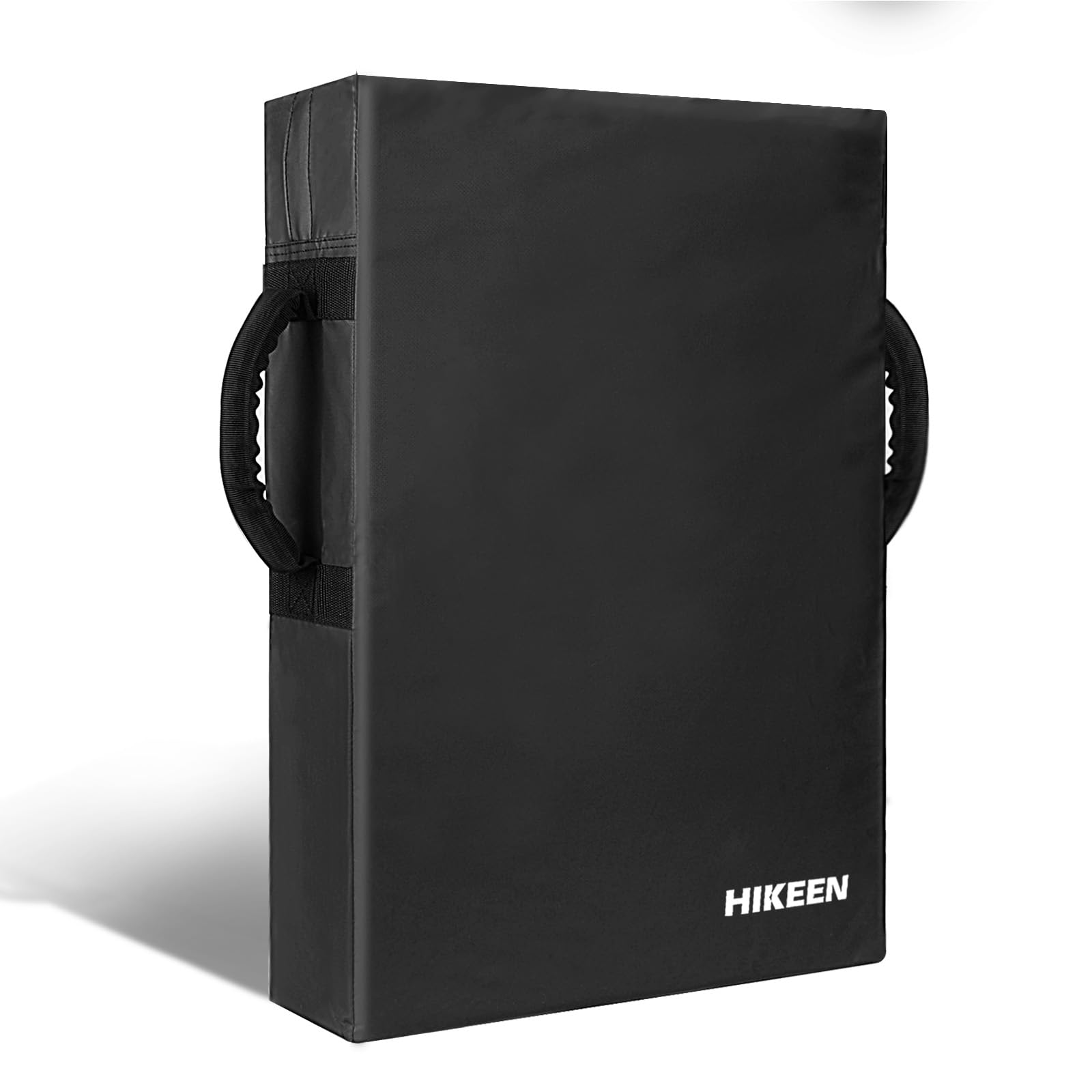
Hikeen Blocking Pad
Leather construction and five grab handles provide a stable platform for basketball defensive and contact drills at a lower price than many name-brand pads. The dense foam absorbs impact during body contact and finishing work, though some holders may find it too firm during full-force strikes. Parents training young players on driving through fouls and multi-sport households get a durable, value-focused tool that handles high-repetition use.
Pros
- Thick, dense foam absorbs impact well for basketball and football contact drills.
- Multi-sport design helps improve hand placement and explosiveness in basketball finishing.
- Mid-range price delivers performance comparable to pricier name-brand pads.
Cons
- During heavy strikes, the dense foam can feel too firm for the holder, causing discomfort for some.
For parents and multi-sport households wanting a durable, affordable blocking pad for basketball contact drills, the Hikeen holds up well. Holders sensitive to firm padding may want to add a layer of cushioning for high-impact sessions.
Best for Youth Agility
X-UMEUS Agility Set
With ladder, 12 cones, 4 adjustable hurdles, a jump rope, and running parachute, the X-UMEUS kit gives families and young athletes multiple ways to work on footwork, speed, and coordination without buying separate tools. The parachute and hurdles are best treated as introductory accessories — they may tear or snap under heavier, repeated use.
This fits households looking for a fun backyard setup where equipment failure means a pause, not a season-ending problem. Coaches who primarily want the ladder and cones will find the most value here, while serious players needing consistent intensity should consider replacing the fragile pieces.
Pros
- Complete agility set with ladder, cones, hurdles, parachute, and jump rope — covers speed, footwork, and coordination drills.
- Family-friendly value that stores and transports easily in the included carry bag.
- Adjustable ladder rung spacing adapts to different skill levels and drill variations.
Cons
- Hurdles may snap at the base after limited use, and the parachute can tear, making those parts short-lived in active training.
The X-UMEUS set delivers a broad starter kit for footwork and agility drills, but plan on the parachute and hurdles being disposable — the ladder and cones carry the real value.
Best for Footwork Drills
GHB 20ft Agility Ladder

The GHB ladder provides effective footwork training for basketball agility at a very low cost. The 20-foot length and rungs that adjust up to 15 inches apart work well for speed ladder drills. The included carry bag keeps storage compact, but pulling the ladder out often reveals a tangled knot that needs patient unraveling — a time sink before practice can start. It’s a functional choice for budget-minded coaches or parents who don’t mind the setup ritual for occasional home use.
Pros
- Effective for developing basketball footwork quickness and agility
- Comes with a carry bag and drill guide for organized storage
Cons
- Straps can tangle into a tight knot after storage, making setup frustrating and time-consuming
If you need an occasional agility ladder for basketball footwork drills, can tolerate untangling, and prioritize a low price, this ladder delivers solid training value.
Best for Drill Marking
FGBNM 25-Pack Disc Cones

A budget-friendly 25-pack with a carry bag offers ample disc markers for indoor agility, boundary, and footwork drills. The thin plastic cones are lightweight enough to pack away easily, but that flimsiness comes with a clear limit: they can blow away in even a gentle breeze and may crack when stepped on, so they are best kept to calm indoor practices.
Pros
- Provides abundant markers for agility ladders, boundary lines, and footwork patterns.
- Carry bag and holder keep the 25 cones organized and portable at a budget-friendly price.
Cons
- Thin plastic construction means cones can blow away in a breeze and may crack when stepped on during drills.
For coaches running indoor footwork and agility drills who need a large set of markers on a tight budget, this 25-pack works — as long as the gym doors stay closed and no one steps on them.
Best for Reaction Training
Champro Reaction Ball

For basketball players wanting quicker hands and reaction speed, the Champro Reaction Ball adds chaotic bounces to wall-drill sessions. It’s durable and fun, but erratic rebounds can frustrate beginners, and the ball is essentially dead on grass. That keeps it a niche agility supplement, not a mainstay training tool.
Pros
- Unpredictable bounces sharpen reaction time and hand-eye coordination for defensive drills.
- Tough molded rubber withstands daily wall throws and even rough dog play.
Cons
- Grass renders the ball nearly useless, and on pavement the erratic bounces can overwhelm beginners.
If you have access to a hard surface and want a cheap, durable way to add unpredictable bounces to reaction drills, this ball fits—just don’t expect grass training or beginner-friendly consistency.
Best for Beginners’ Form
Baden SkilCoach 27.5"

The handprint graphics give absolute beginners an instant visual guide for correct hand placement, and the left-handed option is a rarity in training balls. Markings may fade after a few months, and the ball demands constant attention to stay playable, making it a short-term teaching aid rather than a season-long tool.
Pros
- Effective visual guide for correct hand placement on the ball.
- Builds muscle memory quickly for young shooters.
Cons
- Ball may lose air between uses, requiring reinflation before practice.
For a coach introducing shooting form to a young team or a left-handed beginner needing a visual guide, this ball delivers a low-cost, effective start — provided you keep a pump nearby.
Best for Light Agility
HLYWEI Agility Set

For basketball players needing budget-friendly footwork drills, this set covers the basics with a ladder, cones, and jump rope. Build quality is solid for the price, but it isn’t designed for frequent team practices, and lacks the parachute and hurdles some athletes want. It’s a practical starter kit for occasional at-home training.
Pros
- Decent build quality for an entry-level price, suitable for youth basketball agility work.
- Improves speed, coordination, and on-court footwork through varied drills.
Cons
Ideal for parents buying a first agility kit for a young basketball player’s at-home workouts, not for daily team use.
Best for Youth Kit
MUROZA Agility Set

The MUROZA set bundles multiple training tools at a reasonable price, suitable for youth basketball players improving agility and footwork. However, the plastic hurdles and bag zipper can show wear with frequent use, making it a better fit for casual practice rather than intense daily training.
Pros
- Complete set includes ladder, cones, hurdles, parachute, and jump rope for varied drills.
- Compact carry bag keeps all items organized and portable for court or field.
Cons
- Flat cones can crack under foot traffic and the lightweight ladder may shift during drills — acceptable for grass but not hard courts.
A practical pick for families or coaches who need a budget-friendly agility set for occasional youth basketball footwork sessions.
Best for Hand-Eye Coordination
SKLZ Reactive Catch

The SKLZ Reactive Catch uses a three-pointed foam design with color cues to train reaction and catching reflexes. It’s soft and safe for kids ages 6-12, making it a fun addition to baseball or basketball warm-ups. However, the foam arms can tear under aggressive use, limiting its lifespan if thrown hard. At a mid-range price, it feels expensive for the materials – a basic rubber reaction ball offers similar benefits for less.
Pros
- Engaging training tool that improves hand-eye coordination and reaction speed.
- Soft foam construction makes it safe for indoor use and young players.
Cons
- Foam arms can tear when used with aggressive throws or by older players.
This works best as a low-stakes training toy for kids who need gentle reaction practice – not for competitive athletes or those looking for durable gear.
How to Choose
The most effective basketball training gear isn’t the one with the most accessories—it’s the one that matches the specific skill you’re trying to build and the environment you train in.
Weight and Heaviness Accuracy
Weighted basketballs promise overload resistance, but actual weight often drifts from the stated spec—some come in nearly a pound light. A lighter-than-advertised ball still provides resistance, but if you’re counting on a specific load for a periodized program, the mismatch undermines your plan.
Always check measured weight when training goals hinge on exact overload. If a ball’s primary job is to make a standard ball feel featherlight, a few ounces off may not matter; if you’re targeting a precise strength stimulus, look for brands with consistently accurate manufacturing.
Sturdiness Under Outdoor Conditions
Defender mannequins and cheap cones share a hidden vulnerability: lightweight construction that can’t handle wind or foot traffic. A 7-foot mesh screen with a narrow plastic base turns into a sail in a breeze, while paper-thin disc cones scatter or crack on asphalt.
The fix for mannequins is simple—add sandbags or filled water jugs over the base pegs—but it’s an extra step many buyers discover only after the first gust. For cones, thicker rubber or weighted bases survive outdoor team use; the budget ultra-thin versions are best reserved for indoor gym floors.
Tangling Resistance and Ladder Storage
Nylon-strap agility ladders with loose plastic rungs twist into a frustrating knot the moment you fold them tightly into a bag. The mechanism is simple: flexible materials rotate freely under tension, and once tangled, separating rungs eats up practice time.
To prevent tangling, roll the ladder flat from one end and store it inside its bag without compacting. If you value zero setup time, consider ladders with stiffer, tangle-resistant construction—though they tend to cost more, they deploy in seconds with no detangling required.
Handle Design and Padding Thickness for Blocking Pads
Blocking pads rely on two ergonomic details: handle placement and foam density. Multiple reinforced handles let the holder angle the pad naturally during drives or post-ups, while foam thickness determines how much force reaches the holder’s arms.
Firmer foam transmits more shock to the holder but lasts longer and resists collapsing; softer foam cushions better at the expense of quicker breakdown. The sweet spot for basketball contact is a dense 4-inch foam that balances protection with the feedback needed to simulate real defensive resistance.
Air Retention Consistency
Training balls with poor air retention deflate overnight, forcing you to find a pump before every session. This happens when internal bladders or valves develop micro-leaks, common in budget rubber balls used heavily.
A ball that won’t hold air disrupts drill rhythm and erodes trust in the equipment. If a ball is primarily a teaching tool—like one with handprint graphics—constant reinflation adds frustration for young beginners; for those, it’s worth verifying air retention in early use or choosing a ball known for reliable bladder integrity.
FAQ
Why does my agility ladder get tangled so easily and how can I prevent it?
Most budget ladders use flexible nylon straps and loose plastic rungs that twist during storage. To prevent tangles, always roll the ladder from one end while keeping it flat, or hang it unfolded. For frequent use, a ladder with stiffer, tangle-resistant design may save you the untangling time.
Can I use a blocking pad for basketball shooting and driving drills?
Blocking pads are excellent for basketball drills that require body contact—think driving to the hoop, finishing through fouls, or boxing out. They’re less suited for shooting form practice unless you’re working on shooting with a defender in your face. Coaches use them as a physical obstacle to train hand placement and explosiveness.
Does a weighted basketball really improve handles without messing up my shot?
A properly used weighted basketball forces your wrist, fingers, and forearms to work harder during dribbling and passing, which translates to quicker handles with a standard ball. Because the extra weight can alter your release point, save shooting reps for your regular ball to prevent form breakdown.
How do I keep a basketball defender dummy from falling over outside?
Portable defender mannequins tend to tip in wind because the base is lightweight for portability. The fix is simple: place sandbags or filled gallon jugs over the base pegs. Indoor use on a smooth floor often eliminates the problem entirely.