
This post contains affiliate links. We may earn a small commission when you buy through our links — at no extra cost to you.
Every basketball player knows the drill: shoot, chase the ball, dribble back, repeat. A shooting rebounder cuts that cycle, but the category is full of shortcuts. Many budget models use thin plastic that cracks after a few weeks of sun or cold, while others are just backstop nets that don’t return the ball at all.
The real trade-off isn’t price versus features—it’s matching the return mechanism to how you actually practice. A rim-attached chute only returns made shots, making it ideal for form work. A freestanding rebounder lets you simulate catch-and-shoot but doesn’t send the ball back after a miss. A net system keeps balls contained but never hands one to you.
This guide breaks down each type by its physical behavior—what returns, what wears out, and what fits your hoop. The goal is to help you buy once for your skill level and setting, not gamble on marketing claims.


Best for Serious Players
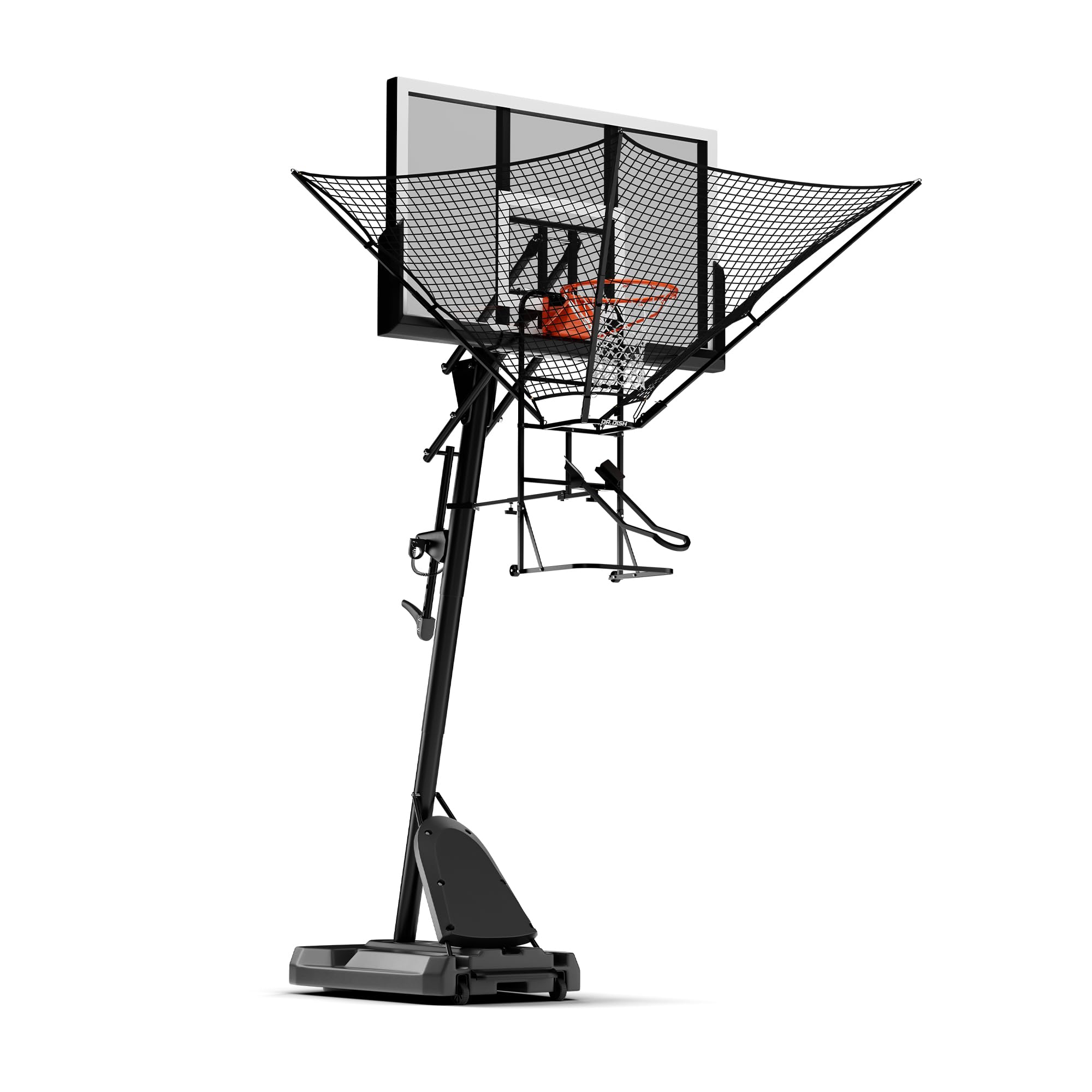
Dr. Dish IC3 Rebounder
Key Features
- Type: Rim-attached net+ramp
- Return Consistency: Returns made & some misses
- Durability: Steel frame, heavy-duty
- Fit: Standard rims
- Assembly: Moderate
- Price: Premium
With a welded steel frame and a net-and-ramp return, the IC3 delivers shot volumes that plastic alternatives can’t match. Players consistently get 2–3 times more attempts per session, and the net height naturally encourages a proper arc. The unit folds to 22 x 22 x 59 inches for storage, weighs 35 lbs, and comes with a 1-year warranty — all marks of professional-grade gear.
This rebounder suits serious players, coaches, and teams who want a long-lasting tool for volume shooting. The ball can occasionally get stuck between the return net and rim net; adjusting tension usually resolves it. Assembly instructions may require patience — a tradeoff for the sturdy build.
Pros
- Durable steel construction outlasts most competitors
- Dramatically increases shot volume during practice
- Effective at developing proper shot arc
Cons
- Assembly instructions may be unclear for some users
For committed players who shoot hundreds of reps per session, the IC3 is a premium-priced training tool that outperforms lighter-built alternatives.
Best for Casual, Kids
Spalding Back Atcha
Key Features
- Type: Rim-attached plastic chute
- Return Consistency: Returns made shots only
- Durability: Plastic cracks in sun/cold
- Fit: Most rims, not breakaway
- Assembly: Tool-free, easy
- Price: Budget
The Spalding Back Atcha attaches to most standard rims in seconds without tools and returns made shots on a gentle arc. It undercuts even the 360° rotating budget chute on price, but trades adjustable rotation for simplicity.
This is a fit for casual players and young kids shooting close to the rim on a permanent hoop, ideally under covered shelter. The plastic chute can become brittle in direct sun or freezing temperatures, so it’s best stored indoors when not in use. It also won’t work with breakaway or non-standard rims without modification.
Pros
- Snaps onto the rim in seconds — no tools needed.
- Returns made shots from close range at a price that’s hard to beat.
Cons
- Plastic can become brittle and crack if left in extreme sun or cold.
- Does not fit breakaway or non-standard rims without modification.
A smart, cheap option for light, occasional use on a standard rim — but expect it to be a seasonal purchase if left outdoors.
Best for Catch-And-Shoot
GoSports Passback
Key Features
- Type: Freestanding adjustable rebounder
- Return Consistency: Pass-back only
- Durability: Bungee/net may wear
- Fit: No rim needed
- Assembly: Tight, needs 2 people
- Price: Mid-Range
Adjustable frame angle lets you run catch-and-shoot drills, pass-back for soccer, or hit grounders for softball — all without a partner. The nylon net and bungee cords return passes at a moderate pace, but wear can become an issue with heavy daily use. Assembly requires strong hands or a second person; sandbags (not included) improve stability. This rebounder fits athletes who want a single training aid for multiple sports, not a dedicated high-repetition basketball shooter.
Pros
- Adjustable angle supports catch-and-shoot drills, pass-back, and multi-sport use (basketball, soccer, softball).
- Freestanding with rubber feet and sandbag compatibility for moderate-intensity passes.
Cons
- Net installation is very tight — best tackled with two people or strong hands.
- Bungee cords and net stitching may loosen over time with frequent use.
A capable multi-sport trainer for moderate weekly practice, but expect some wear — not for daily heavy training.
Best for Backyard Protection
Hathaway Net System
Key Features
- Type: Freestanding backstop net
- Return Consistency: Captures only
- Durability: Anchor bags may tear
- Fit: Any hoop
- Assembly: Minimal instructions
- Price: Mid-Range
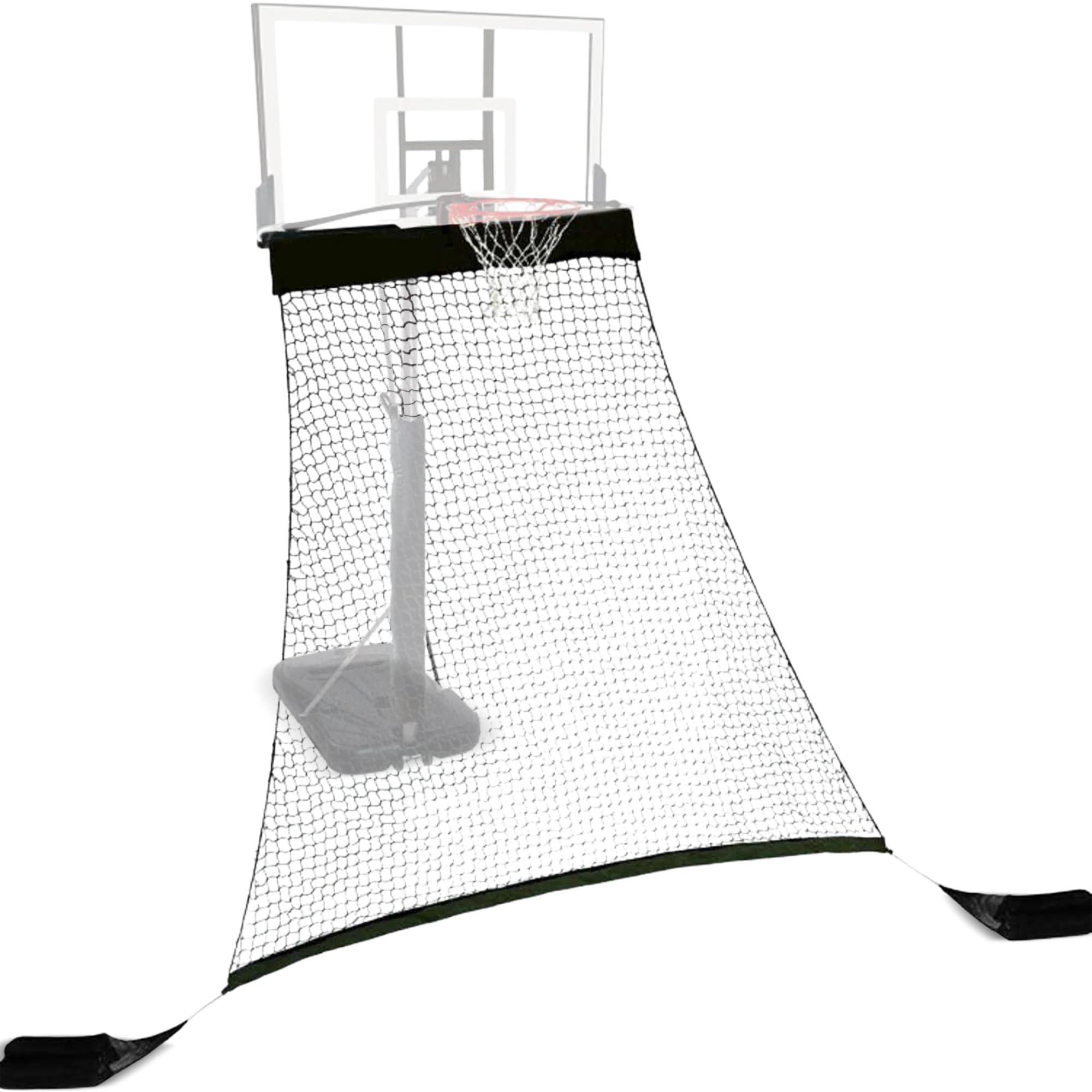
The Hathaway Rebounder uses a 10x9x5 ft fade-resistant net to catch roughly 80% of missed shots, protecting plants, windows, and bystanders in backyard practice areas. Unlike active return systems, it only holds balls — no pass-back mechanism. This makes it a practical fit for multi-player sessions where balls scatter or for courts with obstructions, rather than solo repetition drills.
Pros
- Captures roughly 80% of missed shots, keeping the playing area tidy.
- Good value for a large protective net — covers a wide area without a premium price.
Cons
- Anchor bags can tear after repeated outdoor use, reducing portability.
Best as a backyard containment net for families or group play rather than a solo shooting trainer.
Best for Prevent Rolling
Franklin Pass Back Net

Key Features
- Type: Pole-mounted backstop net
- Return Consistency: Only catches
- Durability: Inconsistent net quality
- Fit: Requires poles
- Assembly: Easy
- Price: Mid-Range
This pole-mounted net covers a wide area to catch wild shots and keep balls from scattering. It’s a solid backstop for backyard practice where retrieval is the main hassle. However, it does not return balls to the shooter – it’s a catch net, not a rebounder. Anyone needing automated ball return for solo drills should look at rim-attached options instead.
Pros
- Large coverage area catches wild misses and contains balls effectively
- Relatively easy to set up for a backstop net
Cons
- Net durability can vary between units – some may need replacement sooner than expected
Best for backyard practice where ball retrieval is the main problem and you don’t need automatic ball return for shooting drills.
Best for Occasional Practice
SKLZ Kick-Out

Key Features
- Type: Rim-attached rotating chute
- Return Consistency: Returns made shots
- Durability: Plastic clips break
- Fit: Standard 18" rim
- Assembly: Easy
- Price: Budget
This chute returns made shots effectively and rotates 360° for practice from any court angle. However, plastic clips and straps can wear out over time, and the chute may rotate out of position during use. These tradeoffs limit it to occasional practice for beginners—not high-volume training.
Pros
- Returns made shots effectively, improving practice flow
- 360° rotation allows practice from any court angle
Cons
- Plastic clips and straps can wear out over time, requiring replacement
Best for beginners shooting occasional hoops who want a low-cost return without long-term expectations.
Best for Indoor or Covered
GADFISH Metal Return

Key Features
- Type: Rim-attached metal chute
- Return Consistency: Returns made shots
- Durability: Weld/rust failures
- Fit: Standard rims
- Assembly: Tool-free, easy
- Price: Budget
The GADFISH Metal Return attaches to an 18" rim with three rubber-coated hooks and a metal chute — no tools needed. It feels sturdier than plastic alternatives right out of the box. However, the welds and black coating may deteriorate within weeks, and the hooks can loosen over time, creating wobble. This works best for indoor or covered outdoor practice where weather won’t accelerate wear, and the claimed lifetime warranty can help if you’re willing to follow up on it.
Pros
- Tool-free setup in minutes
- Metal construction feels more solid than plastic options
Cons
- Welds and coating may show rust or breakage within weeks of use
Good for a covered driveway or indoor hoop where you want a metal feel on a tight budget, but not for outdoor exposure or buyers who prefer not to deal with warranty claims.
Best for Light Solo Use
SKLZ Solo Assist

Key Features
- Type: Freestanding portable rebounder
- Return Consistency: Pass-back only
- Durability: Net/bungee rip
- Fit: No rim needed
- Assembly: Easy
- Price: Premium
The SKLZ Solo Assist folds flat for easy storage and provides a surface for solo passing and shooting off a pass. The net and bungee cords can wear with moderate use, and the frame may tip on harder passes — making it best for casual practice by younger players who prioritize compact portability over durability.
Pros
- Useful for solo passing and shooting drills off a pass
- Folds flat for compact storage and portability
Cons
- Net and bungee cords can wear with moderate use, and frame may tip on hard passes
Best for younger players or those needing a portable rebounder for light, occasional use — not suited for regular training or hard passes.
Best for —
ProSlam 4-Hook Return

Key Features
- Type: Rim-attached metal chute
- Return Consistency: Returns made shots
- Durability: Weld breaks weeks
- Fit: Standard rims
- Assembly: Tool-free, easy
- Price: Premium
The ProSlam attaches without tools and stays steady when secured, making setup quick for indoor or covered outdoor use. However, weld integrity can be a concern in some units — early reports note separation within weeks, so this suits occasional light practice rather than daily shooting sessions.
Pros
- Attaches to the rim without tools in minutes.
- Stays steady against the rim with minimal wobble when properly secured.
Cons
- Weld integrity can weaken in some units, limiting long-term use for regular practice.
This works for occasional indoor use where quick setup matters, but it’s not built for consistent training sessions.
How to Choose
The most important decision isn’t how much to spend—it’s whether you need a rim-attached chute, a freestanding rebounder, or a backstop net, because each returns the ball in a fundamentally different way.
Type: Rim-Attached vs Freestanding vs Backstop
Rim-attached chutes hang from the hoop and return only made shots. They force you to chase misses but give you instant feedback on makes. Freestanding rebounders (like the GoSports) are independent of the hoop and return the ball to you after a pass or a shot off the rebound net—great for catch-and-shoot drills but they don’t return missed field goals.
Backstop nets do not return the ball at all; they simply stop it from rolling away. If your main frustration is chasing balls into the street or bushes, a backstop net solves that. But if you want to increase shot volume, you need a system that actively sends the ball back to your hands.
Return Consistency
Not all returners return the same way. Rim-attached chutes rely on gravity and the angle of the chute; made shots roll down and out. Some models, like the Dr. Dish IC3, use a ramp and net combo that also catches certain misses. Others only return from the net if the ball hits the back of the rim and falls through—so your practice flow depends on your shooting accuracy.
Freestanding rebounders return the ball at a set angle based on how you tension the net. If the net or bungees lose elasticity, the return becomes weak. Test the tension before each session—loose net means the ball drops at your feet instead of popping back to your chest.
Durability
Durability is where the category splits into two camps: metal-framed systems that survive years of use, and plastic or polyester alternatives that degrade quickly. Steel frames (Dr. Dish) and powder-coated metal chutes (GADFISH) resist impact but may rust if the coating chips. Plastic chutes (Spalding, SKLZ) crack under UV or freezing temps—expect a single season outdoors.
For backstop nets, the weak point is often the anchor bags (sand or water) that can tear, or the bungee cords that snap. If you practice daily, budget for replacing cordage or buying a heavier-duty net within a year. The material weight (denier) matters; 300-denier polyester is stronger than 150-denier.
Fit
Rim-attached products are designed for standard 18-inch steel rims. Breakaway rims, adjustable hoops, or rims with thick padding often block the hooks or chute. The Spalding Back Atcha explicitly excludes many breakaway models; the SKLZ Kick-Out fits many but reviewers report it slipping on non-standard hoops. Measure your rim’s inner diameter and the space between the rim and backboard before buying.
Freestanding rebounders and backstop nets bypass fit issues entirely—they just need a flat surface. But they require ground clearance and won’t work inside a small garage. Check the footprint: a 10×9 foot net like Hathaway’s needs a 10-foot diameter circle of free space.
Assembly
Assembly difficulty varies more than you’d expect. Tool-free clip-on chutes (Spalding, GADFISH) take under 5 minutes. The Dr. Dish IC3 requires assembly of the frame and net, which can take 30–60 minutes and may need tension adjustments. Freestanding rebounders like the GoSports demand stretching the net over a tight frame—best done with a partner to avoid frustration.
Budget on assembly time: a fast install often correlates with weaker attachments. The easier it is to put on, the less secure it may be during hard use. Products with multiple hooks or straps (like the ProSlam) wobble less but take longer to align. If you’re assembling outdoors in cold weather, plastic parts become brittle and may crack when you tug them.
FAQ
Why does my basketball return attachment keep rotating to the side when I shoot?
This happens with rim-attached chutes that use a single pivot or friction fit. The force of the ball hitting the chute gradually rotates it. Tighten any adjustment knobs and check that the hooks are fully seated on the rim. On models like the SKLZ Kick-Out, adding a rubber band or zip tie to the hook prevents creep. If rotation persists, choose a model with a locking mechanism.
Can a plastic ball return hold up in hot sun or freezing weather?
No. Plastic returns (Spalding, SKLZ) are designed for mild, covered conditions. Direct sun causes UV embrittlement; freezing temperatures make the plastic brittle and prone to cracking on impact. Expect failure within a few months of outdoor exposure. For year-round outdoor use, look for a metal-framed return or a steel-reinforced net system.
How do I stop the ball from getting stuck between the return net and the rim net?
This sticking is common on cloth-based return systems like the Dr. Dish IC3. It happens when the return net is too loose or the angle is too flat. Tighten the tension straps on the return net so it slopes steeply downward. If the ball still wedges, adjust the angle of the ramp—a steeper drop reduces friction. Regular tension checks keep the return smooth.
Is a freestanding rebounder better than a rim-attached return for shooting practice?
It depends on what kind of shooting you’re practicing. Rim-attached returns are best for repetition of catch-and-shoot from the same spot, because they return only made shots. Freestanding rebounders let you simulate passing to yourself and shooting off the move, but they don’t return your misses. If you want to work on form from a set position, go rim-attached. If you want to practice moving into a shot, go freestanding.