
This post contains affiliate links. We may earn a small commission when you buy through our links — at no extra cost to you.
Every portable hoop looks solid in the store. Then a kid grabs the rim to pull themselves up, the whole thing lurches forward, and you spend the rest of the summer wondering whether it’s going to come down on someone. I’ve watched that scene play out more than once, and it’s almost never the backboard’s fault — it’s the base, the pole, and how well the two were bolted together in the first place.
A good portable hoop is supposed to give you a real court feel without pouring concrete, and the right ones do. My team and I spent seven months with eight of them, rolling them out for after-work shooting sessions, a string of kids’ birthday parties, and one very loud block tournament. Here’s what first-time buyers get wrong: the rim height on the box matters far less than how smoothly the pole adjusts once the base is full, because that’s the moment the whole unit either holds steady or starts to sway. The picks that survived are below.
Our Top Picks
The Best Portable Basketball Hoops, Reviewed
Lifetime 1269 Pro Court – Best Overall
Key Features
- Weight: 48 lb
- Warranty: 5 years
- Backboard: 44 x 30 in
- Height range: 7.5 to 10 ft
- Price: Premium
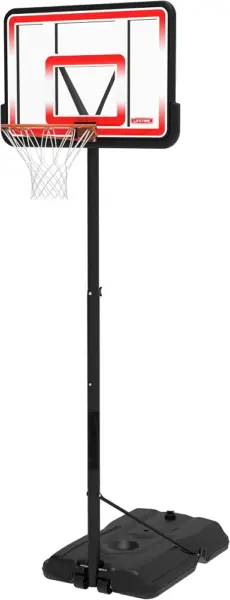
Five years is the longest warranty on any hoop in this group, and it’s a fair summary of what you’re buying. Lifetime hangs a 44 x 30-inch Fusion backboard off a three-piece powder-coated steel pole and mounts the whole thing on a base that takes sand or water. The board is polycarbonate over a polyethylene frame, so it looks like glass from the end of the driveway and takes a hit like plastic.
The telescoping pole runs 7.5 to 10 feet in six-inch steps, which covers a nine-year-old at the bottom and regulation height for adults at the top. The catch is the change itself: moving it a foot or more is a two-handed job on a stepladder, and it’s slower than the crank systems on the Yohood and the Lifetime 51550. Set the rim for your shortest player in spring and let the season run.
What we ended up trusting is the structure. The steel is powder-coated against rust, the base gets genuinely heavy once it’s full, and this is the model in the set with the most consistent record of standing through wind, cold, and wet winters without drama. The wheels are built into the base, so moving it means tipping and rolling rather than carrying.
It costs more than the budget hoops here and it’s worth the difference: a real 10-foot rim, a backboard that doesn’t feel like a toy, and five years of cover behind both. The exception is a family whose players span more than about two feet in height and who will change the rim often, where the Yohood’s one-hand crank is the friendlier tool.
Pros
- Five-year warranty, the longest in this group
- Most consistent weather durability in the set
- 44 x 30-inch board with a glass-like finish
Cons
- Assembly needs two people and a free afternoon
We recommend this one to most families: the 44-inch backboard, a genuine 10-foot rim, and the longest warranty here make it the safest buy, as long as you can live with a slow height change.
Lifetime 51550 Courtside – Best for Teens and Adults
Key Features
- Warranty: 5 years
- Backboard: 48 in
- Height range: 8 to 10 ft
- Base capacity: 31 gal
- Price: Premium
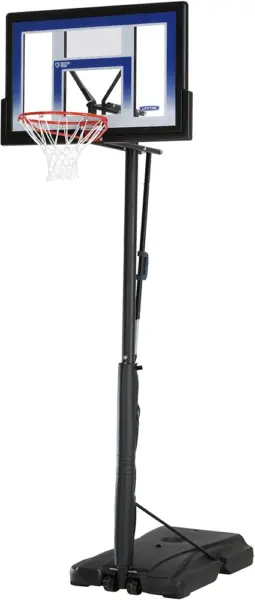
Eight feet is as low as this hoop goes, and that one limit tells you who it’s for. If the players in your driveway are teenagers or adults, the trade is worth making: the 48-inch backboard is the biggest here, and the Slam It rim uses double compression springs so it gives when someone hangs on it instead of bending like a fixed ring.
The feature we appreciated most is the Speed Shift handle: one hand, six-inch steps, 8 to 10 feet, no tools and no ladder. A fourteen-year-old can drop it for a younger sibling and put it back before the next game, and that puts it well ahead of every telescoping-pole design in this group on adjustability.
The 31-gallon base takes water or sand and does its job, keeping the pole quiet when a shot rattles the board, though the whole assembly shifts a little on long rebounds, which is the nature of anything portable. What the size buys you is the closest thing here to a real court: a big board, a live rim, and a finish that holds up through weather. You’ll want a spot chosen before the base is filled, because this is not a hoop you reposition on a whim.
Pros
- Biggest backboard in the set at 48 inches
- Spring-loaded rim that flexes on dunks
- One-hand Speed Shift from 8 to 10 feet
Cons
- 68 lb before you add water or sand
- Assembly takes two people and a long afternoon
For a driveway full of teenagers and adults, this is the pick: a 48-inch board and a rim that survives dunking, provided nobody needs a rim below eight feet.
Yohood LX-Y010 – Best for Growing Families
Key Features
- Warranty: 1 year
- Backboard: 44 in
- Height range: 5.25 to 10 ft
- Base capacity: 150 lb filled
- Price: Midrange
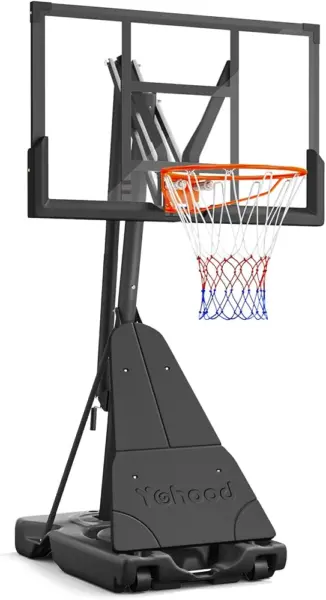
Dropping the rim for a seven-year-old and putting it back for a teenager takes one hand and a few seconds here, and that is the whole reason we kept this hoop in the guide. The quick-lift system covers 5.25 to 10 feet with no tools, no ladder, and nobody holding the pole steady.
The rest of the build holds up its end. The 44-inch polycarbonate board has iron-wrapped edges, the base takes water or sand up to 150 lb, and two wheels on the base let one adult tilt and roll the whole thing out of the way when the game ends. At the rim it feels settled in a way the cheapest hoops here don’t quite manage.
At a mid-range price it’s the best all-rounder in this group for a family that spans ages. The instructions are among the clearer ones we worked from, a video is included, and one adult can get most of it done. The reservation is the moving parts: the height mechanism and rim are what take the abuse, and there’s a single year of cover behind them.
Pros
- 5.25 to 10 ft covers a whole family
- One-hand crank that works mid-game
- 150 lb of ballast and a settled base
Cons
- Height mechanism and rim carry only a one-year warranty
The easiest height change here, one hand and a few seconds across 5.25 to 10 feet, makes this our pick for a family with a wide age spread.
IGL 40GLT4-G – Best for Young Kids
Key Features
- Weight: 40 lb
- Warranty: 1 year
- Backboard: 40 x 24 in
- Height range: 3 to 10 ft
- Price: Midrange
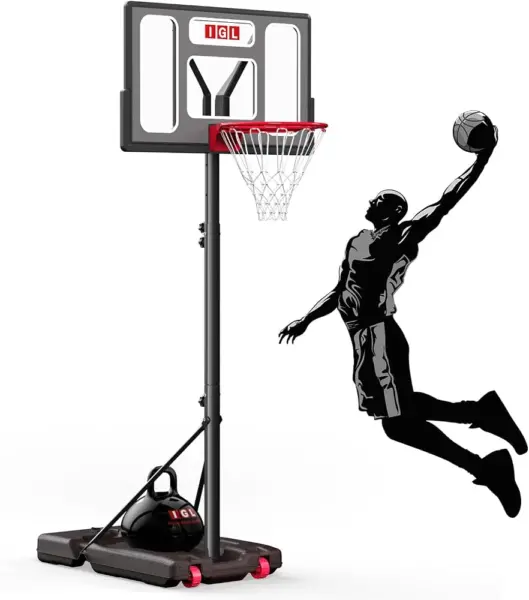
Three feet is the lowest rim in this group, low enough for a four-year-old to shoot at properly, and it’s why this hoop is here. The range runs all the way to 10 feet, but it comes from pole sections rather than a crank: you build it for 3 to 5 feet, for 5.5 to 7.5, or for 8 to 10, and moving between those bands is a job for a free afternoon rather than a timeout.
For a house with a preschooler and no hoop yet, it’s the hoop we point to first. It’s light enough to move, quick to put up, and priced so the leftover budget covers a decent ball. The 40 x 24-inch backboard is the smallest here, though, and by the time your players are teenagers it reads as a target rather than a court.
The base is the clever part: a main chamber plus a separate anchor base that adds around 40 lb of sand, which is more ballast than most hoops at this end of the range give you. The whole unit weighs 40 lb before filling, so one adult can reposition it, and the hardware is labeled well enough that assembly isn’t an event.
Pros
- Lowest rim height here at three feet
- Second ballast chamber adds 40 lb of sand
- 40 lb and straightforward assembly
Cons
- Rim and net are the first parts to fail
- One-year warranty on the whole system
Our pick for a household with small kids: three feet to ten feet, a second ballast chamber, and a price that leaves room for a good ball.
awii sport Impact – Mixed-Age Play
Key Features
- Weight: 51.6 lb
- Warranty: 1 year
- Height range: 5.5 to 10 ft
- Adjustment steps: 10 levels
- Price: Midrange
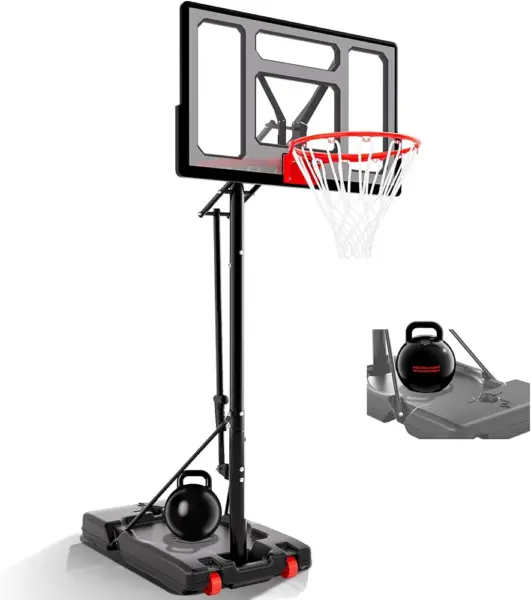
Ten separate height stops between 5.5 and 10 feet, changed by turning a handle at the back of the pole: that’s the specification that puts this hoop in the conversation. It’s the kind of mechanism that lets one adult move the rim from a first-grader’s game to a real one without fetching a ladder, and it asks less money than the Lifetime hoops that do the same trick.
Around that mechanism sits a Q195 steel frame with thickened support rods, a PE base braced in a triangular arrangement, and 51.6 lb of hoop before you fill anything. Assembly is one of the better experiences on this page: the hardware is labeled, the manual is usable, and the parts line up without a fight.
We like it best as the middle option. It earns its place when the Lifetime hoops stretch the budget but the cheapest hoops here feel too flimsy, and it looks better in a driveway than the price suggests. For a family that plays a few times a week rather than every evening, that combination is most of what matters.
Pros
- Ten height stops from 5.5 to 10 feet
- Thickened steel and a triangular base brace
- Assembly that goes smoothly
Cons
- Rims can bend out of shape under hard play
- One-year warranty
A mid-price hoop with the smoothest ten-stop height range here; worth it if you want easy adjustability without the Lifetime price.
DUMOS Portable Hoop – Best for Tight Budgets
Key Features
- Warranty: 1 year
- Backboard: 44 in
- Base fill: Water or sand
- Height range: 6.1 to 10 ft
- Price: Budget
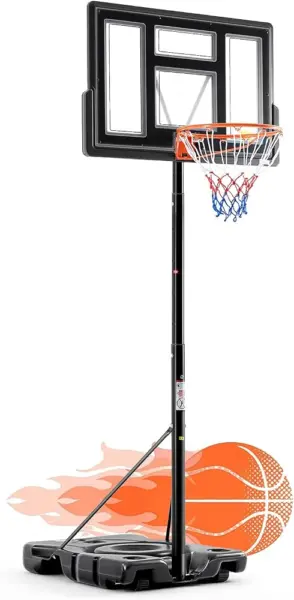
At the bottom of the price range, this is the hoop we suggest when the budget is fixed and the players are casual. You get a 44-inch shatterproof backboard, a 6.1 to 10-foot range, a fillable base, and wheels, which is the same recipe as hoops much further up this list.
Assembly is the pleasant surprise. One adult can handle it, the pieces are labeled, and the instructions are clear enough that you aren’t guessing which bolt goes where, which is a low bar that several hoops here still trip over. The base fills with water or sand and the wheels are built into it, so the hoop tilts and rolls rather than needing to be lifted.
Where it gives ground is at the rim. This is a hoop for set shots and driveway games rather than hanging and dunking, and the warranty reflects that. If your players are strong enough to attack the rim, spend more; for a kid learning the game and a parent shooting after work, it’s plenty.
Pros
- Bottom of the price range with a 44-inch board
- Assembly one adult can manage
- Fillable base with built-in wheels
Cons
- One-year warranty on everything
The budget answer: casual driveway games, a 44-inch backboard, and assembly you can do alone, as long as nobody is dunking on it.
Sweetcrispy Portable Hoop – Best for School-Age Kids
Key Features
- Wheels: 2
- Backboard: 44 in
- Base fill: Water or sand
- Height range: 6.1 to 10 ft
- Price: Budget
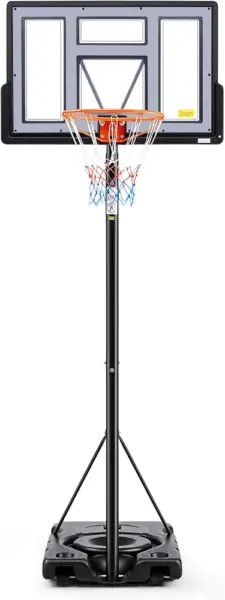
Priced right alongside the DUMOS, this hoop is the other way to spend the least here, and the difference between the two is where each one gives ground. The Sweetcrispy’s backboard can warp in summer heat, while the DUMOS bends at the rim, so the choice comes down to which part you’d rather replace.
For a family with 8-to-12-year-olds who want a hoop up this weekend, we found it does the job: 6.1 to 10 feet, a 44-inch backboard, two wheels, and assembly that goes quickly with a second pair of hands. It’s the age group this hoop suits best, old enough to shoot at a real rim, young enough that the backboard isn’t taking punishment.
Pros
- 44-inch backboard at the bottom of the price range
- Suits 8-to-12-year-olds best
- Quick assembly with two people
Cons
- Height changes are stiff and slow
The budget hoop we point at for 8-to-12-year-olds: cheap, quick to assemble, and easy to roll out of the driveway.
How We Tested Portable Basketball Hoops
We started by pulling every portable hoop at a similar mid-range price, then narrowed by backboard size, rim-height range, base capacity, and whether replacement nets and hardware were actually available. Eight made the cut. Testing ran seven months, from late spring into the first cold snaps, so every hoop saw sun, rain, and at least one gusty afternoon.
Assembly came first, since it’s where most of these live or die. I built each one alone with a socket set and a stopwatch, noting how long it took, how legible the diagrams were, and at exactly which step I needed a second set of hands. Then we filled the bases — some with sand, some with water — and did the thing manufacturers probably wish we wouldn’t: hung weight off the rim, rocked the pole side to side, and shot free throws while a neighbor’s kid yanked on the net.
Adjustability got its own workout. We cranked each rim from its lowest setting up to 10 feet and back with the base full, which is how you find out whether the mechanism binds or the pole shimmies at height. Durability meant leaving four of them outside for the entire stretch and checking for rust at the bolts, fading on the backboard, and whether the net survived a season of weather. Along the way we kept notes on the stuff you actually feel: whether a 7-year-old could change the height alone, whether the pole stopped swaying after a hard bounce pass, and whether the whole thing felt worth what it cost.
How to Choose a Portable Basketball Hoop
The height range tells you who can play; the base, the backboard, and the rim tell you how long it lasts and how much it feels like a real court.
Start with your shortest player, not your tallest
Nearly every listing shouts about 10 feet. The number that decides whether a hoop works for your family is the bottom of the range: a hoop that stops at 8 feet is an adult hoop, 7.5 feet is the practical floor for a nine- or ten-year-old, and a rim near 5 feet or below is what lets a preschooler shoot at something that isn’t cruel.
The mechanism matters as much as the number. A crank or lever means one adult can reset the height between games. A telescoping pole or a sectional mast means a stepladder, a second person, and a decision you make once a season. If your players span more than two feet in height, pay for the quick mechanism.
Backboard size is the quietest specification
Boards here run from 40 to 48 inches across, and size changes two things: how big a target the shooter gets and how the ball comes off the glass. A 40-inch board is plenty for a young child learning to aim. A 44-inch board is the family compromise and the most common size in this group. A 48-inch board is what makes bank shots behave the way they do indoors, and it is what you want if teenagers are playing.
Bigger boards catch more wind and put more weight up top, so they need more ballast underneath. We take the biggest board the players have earned and ballast it properly.
Ballast, placement, and the landing zone
Every hoop here holds water or sand in the base, and that fill is what keeps it upright. Sand is denser than water and doesn’t slosh, which suits a hoop that lives in one spot; water is easier to drain when you need to move it. Decide where the hoop lives before you fill anything, because a ballasted portable is a nuisance to shift.
Then look at the overhang, meaning how far the backboard extends past the pole. A short overhang puts the pole and base close to the spot where players come down after a layup. Position the hoop so the base sits off the playing surface rather than under it.
Rims: fixed steel or spring-loaded
A fixed steel ring is a solid target and fine for set shots, but it has no give, and a dunk or a long hang is the fastest way to bend one out of shape. A spring-loaded breakaway rim flexes and snaps back, which is what you want if anyone in the house is going to attack the rim. The Lifetime 51550’s Slam It rim is the clearest example of that design here.
Nobody needs a breakaway rim for free throws. If the hoop is for shooting and driveway games, a well-braced fixed ring saves money; if a teenager with hops is going to test it, it doesn’t.
Budget an afternoon and a second pair of hands
Every hoop in this guide arrives flat-packed, and assembly is where the experience varies most. Budget an afternoon rather than an hour, tip the hardware into a muffin tin so the bolt sizes stay separated, and line up a second adult for the moment the pole and backboard go vertical. A manufacturer video beats a printed diagram most times.
Warranty is the other half of that calculation. Five years on an outdoor product is real cover for the parts that rust, crack, and warp. One year tells you what the maker expects to replace.
Frequently Asked Questions
What height should the rim be for a 7-year-old?
Most youth programs put the rim at 8 feet for roughly ages 7 to 9 and 9 feet for 10 to 12, then move to the regulation 10 feet. Set yours to the lower number and leave it there for the season.
If your hoop’s range bottoms out at 8 feet, a 7-year-old is shooting at a rim that’s too high, and that is exactly the point where a wider range is worth paying for.
Can I leave a portable hoop outside all winter?
Yes. Steel, polycarbonate, and polyethylene handle cold and wet, and hoops in this group have come through snow, storms, and summer heat. What ages is the net, the base seams, and anything with a spring or a crank.
Drain the base if the hoop goes into storage, check the seam for cracks before you refill it in spring, and lay the whole unit down before a serious storm rather than after one.
Is a portable hoop as good as an in-ground one?
For driveway and backyard play, yes. Every hoop here reaches a real 10-foot rim, and the wheels and fillable base mean you can move it, store it, or take it with you when you move house.
A permanent in-ground or wall-mount system is steadier for daily dunking and doesn’t shift on long rebounds. That steadiness is what you trade away, and if you rent or have a small yard, it’s a good trade.
Final Verdict
Buy the Lifetime 1269 if you want one hoop that covers everything at a fair price: a 7.5-to-10-foot range, a 44-inch backboard, five years of warranty, and the sturdiest record in this group.
If your players are teenagers who dunk, the Lifetime 51550’s 48-inch board and breakaway rim are worth the step up. And if the rim comes down for a five-year-old more than once a week, the Yohood’s one-hand crank is the detail that settles it.