
This post contains affiliate links. We may earn a small commission when you buy through our links — at no extra cost to you.
A driveway hoop looks like a simple purchase until you’re the one sorting 200 bolts on the garage floor. The right one turns a slab of concrete into the busiest spot on the block—kids shooting before dinner, adults sneaking in free throws after work—but a wobbly rim, a height collar that sticks, or a backboard that never sits level can kill the fun fast. What you’re really buying is sturdiness you don’t have to think about, assembly instructions that make sense, and a rim that stays true season after season.
We’ve spent the past six months living with six different driveway hoops, from adjustable family models to heavier-duty units, and the differences in quality and value showed up quickly. My advice: don’t shop by backboard size alone—check how the pole is anchored and whether the height mechanism feels smooth before you commit. The picks below are the ones that survived daily play, weather, and a few overly enthusiastic dunk attempts.



Best for Family Driveways
Lifetime NBA League Edition
Key Features
- Warranty: 5 years limited
- Item weight: 50 lb
- Height range: 7.5 to 10 feet
- Backboard size: 44 inches
- Price: Premium
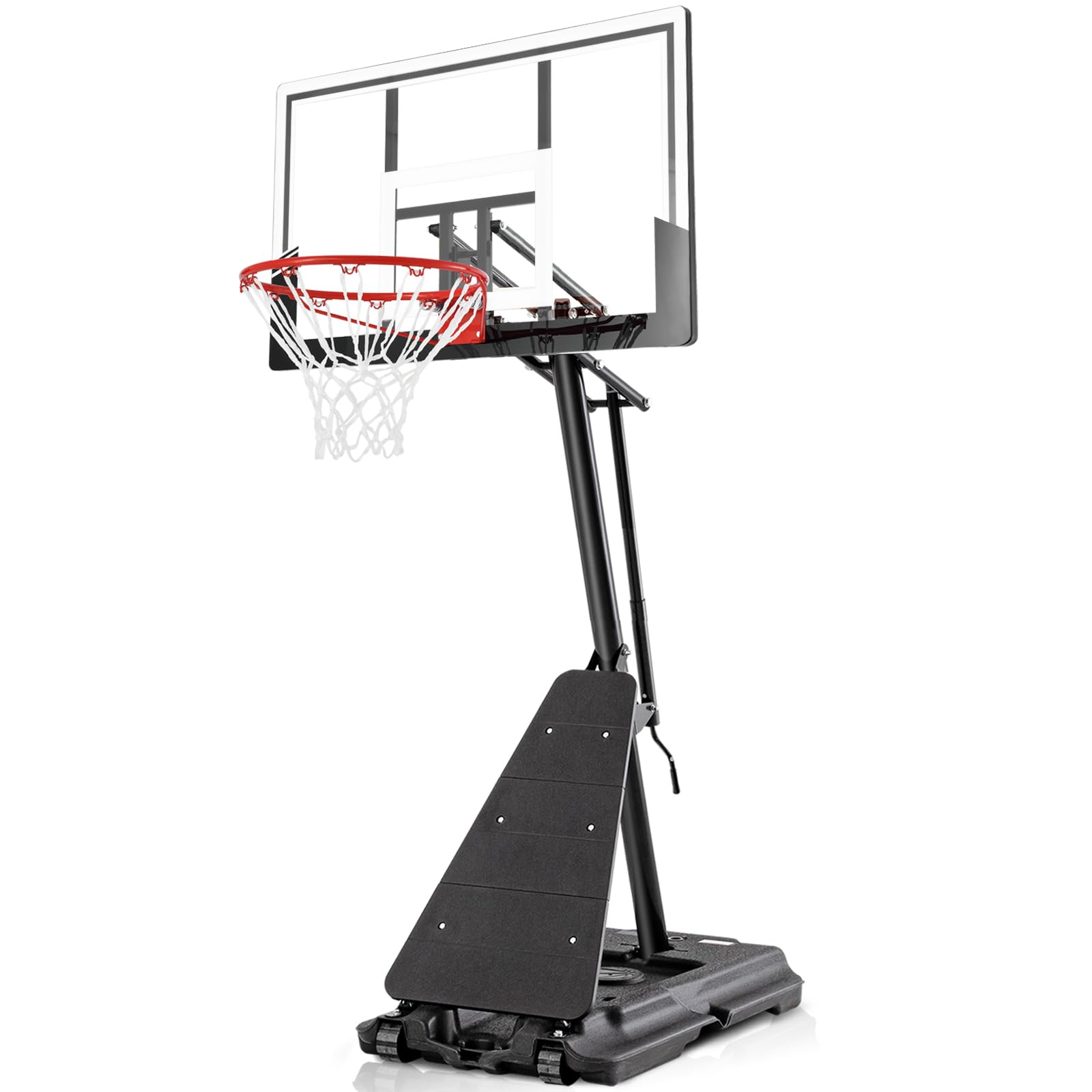
The five-year limited warranty is what decided this one for us. Every other portable hoop here is backed for a single year, which on a driveway is a short promise: the thing sits through sun, rain and freeze-thaw and takes whatever the neighborhood throws at the rim. Lifetime is the only maker in this group standing behind the pole, base and board for five years, and for a product that never comes indoors, that is the most useful thing a buyer can know.
The rest of the package holds up. The backboard is 44 inches of shatterproof polycarbonate, the Classic rim is 5/8-inch powder-coated steel rather than the thin tube you find further down this list, and the frame weighs 50 pounds — light enough for one person to tip onto its wheels, solid enough that it doesn’t read as a toy when you walk up to it. Sturdiness is the dimension where this hoop separates most clearly from the cheaper picks.
The telescoping height collar is the fussy part. It runs 7.5 to 10 feet, which covers teens and adults and nothing younger, and moving it takes a second person and a bit of muscle. A household that drops the rim every week for a six-year-old should look at the Backyard Blitz or the Seray instead; a household that sets it once in spring and leaves it will never notice.
Setup is an afternoon rather than half an hour: two adults, a couple of hours, and the video walkthrough if the printed steps get thin. What you end up with is the most convincing long-term bet in this group — and the NBA graphics look better at the end of a driveway than a plain white rectangle has any right to.
Pros
- Five-year warranty, the longest here
- Steel rim and 50-pound frame feel planted
- Shatterproof 44-inch board with NBA graphics
- Rolls on its own wheels
Cons
- Height range starts at 7.5 feet
We recommend it as the default driveway hoop: the sturdiest portable in this group and the only one backed for five years.
Best for Frequent Height Changes
Backyard Blitz 44-Inch
Key Features
- Base fill: 154 lbs sand
- Height range: 5.3 to 10 feet
- Backboard size: 44 inches
- Height adjustment: Hand crank
- Price: Premium
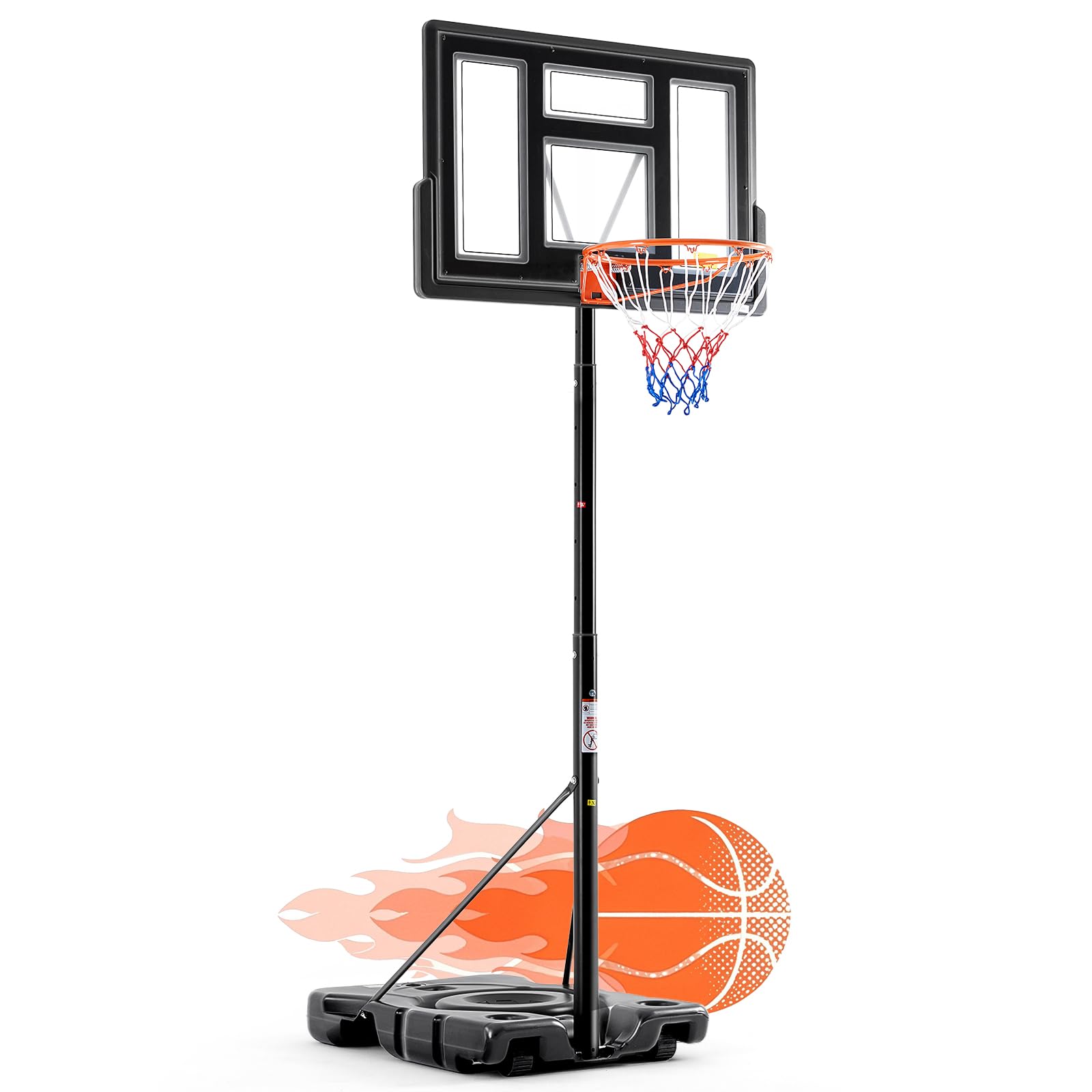
A crank handle changes how a hoop gets used. Turn the screw-type handle on the Backyard Blitz and the rim travels anywhere between 5.3 and 10 feet — no pins to pull, no pole sections to add or remove, no second person holding the board while you work. That is the whole argument for this one, and if there are kids of different heights in the house, it is a strong argument.
We rate its crank the most useful height mechanism in this set, for one reason: it covers 5.3 to 10 feet, where the Spalding’s lever covers only 8 to 10. The board is 44 inches of shatterproof polycarbonate, bonded rather than taped so there is no edge to lift, and the double rim takes contact better than the single-wall rims on the budget hoops.
Stability comes from ballast. The base takes 154 pounds of sand, which the maker recommends over water, and the triangular brace tying base to pole is why a hoop this tall doesn’t skate when a shot clangs off the rim. Filling it is a job — 154 pounds of sand means a hardware-store run and a funnel — but it is a one-time cost you feel every time the ball comes off the board.
What holds us back is history. This hoop has far less of it than the Lifetime, which is why a five-year warranty still counts for more than a clever handle, and assembly runs about two hours with the instructions in front of you. The hardware comes labeled and the box includes everything except the sand.
Pros
- Crank adjust from 5.3 to 10 feet
- 154-pound sand base steadies the pole
- Bonded shatterproof backboard
- Double rim handles contact
Cons
- Long-term durability less proven than the top pick
Its crank takes the rim from 5.3 to 10 feet with one hand and no tools, which makes it the family choice for households that adjust often.
Best for Serious Shooters
Spalding Momentous EZ
Key Features
- Rim: Pro Slam breakaway
- Height range: 8 to 10 feet
- Assembly time: 30 minutes or less
- Backboard size: 54-inch acrylic
- Price: Premium
There is a reason we keep this one at the top of the price range: the 54-inch acrylic board is the only one here that plays like a gym. Acrylic is stiffer than the polycarbonate sheets on everything else in this group, so the ball comes off it with a firm, honest bounce, and the arena-style padding around the frame is the detail you notice when someone drives the lane and lands on the pole.
The rest is built to match. The Pro Slam breakaway rim gives under a hard dunk instead of taking a set, the steel frame behind the board keeps the acrylic flat, and the height lever runs 8 to 10 feet with so little effort that a child can work it — a genuine contrast with the two-person wrestling match of our top pick’s telescoping collar.
Assembly is the claim the box leads with, and it is the one place this hoop is easier than everything else here: 30 minutes or less, with pole sections designed to slot together instead of being fished into place. Even if it takes you double, it is the simplest build in the group.
One number that doesn’t get enough attention is the 18-inch overhang. The rim sits closer to the pole than on most hoops here, so the whole system tucks into a shorter driveway without the board hanging over the walk. For a tight lot, that single figure can matter more than the board.
Pros
- 54-inch acrylic board with arena padding
- Pro Slam breakaway rim
- Assembly promised in 30 minutes or less
- Height lever light enough for a kid
Cons
- Height range only 8 to 10 feet
- 117 pounds empty is a two-person job
Our choice when the board matters most: 54 inches of acrylic and a breakaway rim are worth the step up in price.
Best for Young Families
Seray 40-Inch Rebounder Hoop
Key Features
- Height range: 3.4 to 10 feet
- Certification: ASTM approved, CPC certified
- Backboard size: 40-inch PET
- Height settings: 18 levels
- Price: Midrange
The rebounder is the detail that makes this hoop different. A return frame sits under the rim and feeds missed shots back toward the shooter, so a kid practicing alone spends the time shooting instead of jogging after the ball. It sounds like a gimmick until you watch a nine-year-old use it for twenty minutes without wandering off.
The spec sheet suits that family pitch. Height runs from 3.4 to 10 feet across 18 settings — the widest range in this group, low enough for a toddler and high enough for an adult — and the 18-inch metal rim and rust-resistant finish mean it can live beside a pool without turning orange. It is also the only hoop here whose maker states ASTM and CPC certification, which counts for something on a product kids hang from.
We think it is the right first hoop for a family that intends to grow into it. The low settings do the real work: drop it for a five-year-old after school, put it back at 10 feet for your own shots, and the change takes less time than finding the ball did.
Setup is the tax. The parts are numbered and the illustrations are decent, but the build wants two people and the instructions get thin in places, so set aside an evening rather than twenty minutes. Once it is up, 60 pounds is light enough for one adult to wheel out of the way — more than the heavier hoops here can say.
Pros
- Rebounder returns missed shots
- 3.4 to 10 feet across 18 settings
- ASTM approved and CPC certified
- 60 pounds rolls easily
Cons
- 40-inch board is the smallest here
For a family with small kids this is the one we point to: it drops to 3.4 feet and the rebounder keeps a solo practice moving.
Best for Crank Adjust Value
Skytime 44-Inch Crank Hoop
Key Features
- Rim: 18-inch breakaway
- Item weight: 75 lb
- Height range: 5.3 to 10 feet
- Backboard size: 44-inch polycarbonate
- Price: Midrange
Seventy-five pounds is heavy for a portable hoop, and that is the point. The Skytime’s mass sits in an oversized HDPE base and a steel pole, so once it is filled and parked it stays where you put it; the wheels are for the twice-a-year move, not the daily one. If you want a hoop you can shift around the driveway every afternoon, look at something lighter.
We think this is the best value in the crank-adjust group. The crank is stepless, so the rim locks wherever you leave it rather than at preset notches, and the range runs 5.3 to 10 feet — enough for a seven-year-old and a dunk attempt in the same evening. Add a breakaway rim and an 18-inch metal hoop, and the midrange money starts to look like the smart spend.
Two details worth knowing. The guard plate behind the board is there so a player who hangs in the air doesn’t sail into the pole, a piece of safety design the cheaper hoops here skip. And the rim is the part to protect: a hoop this heavy doesn’t usually go over, but if it does in a wind storm, the rim can take the damage and it doesn’t straighten.
Assembly is a two-hour job for two people, and the board is a 44-inch polycarbonate sheet — standard for the money and a step behind the acrylic on the Spalding. At this price we would rather have the crank and the heavy base than a stiffer board.
Pros
- Stepless crank from 5.3 to 10 feet
- Breakaway rim and 18-inch metal hoop
- Heavy base stays put
- Guard plate behind the board
Cons
- 75 pounds is a lot to move and fill
We think this is the best value in the crank-adjust group, with a stepless rim and enough mass to stay where you park it.
Best for Tight Budgets
DUMOS 44-Inch Portable
Key Features
- Rim: Shock-absorbent
- Warranty: 1 year
- Height range: 6.1 to 10 feet
- Backboard size: 44 inches
- Price: Budget
There is no cheaper way into a full-height hoop in this group, and the spec sheet doesn’t embarrass itself: 44 inches of shatterproof backboard, 10 feet at the top, a shock-absorbent rim, and two wheels on the base. For a driveway where the players are teenagers who leave it at one height, that covers most of what matters.
The savings show up in two places. The height range stops at 6.1 feet, the highest floor in this group, so it is not a hoop for a five-year-old. And the rim is the part that gives out first — a bent rim is what ends these hoops, and it happens on this one more than on the picks above it.
We still recommend it, with the caveat stated plainly: it is the right buy when the budget is fixed and the hoop will live at one height. Assembly is genuinely straightforward, the base takes sand or water, and the money you keep is real.
Two practical notes. Fill the base with sand rather than water if it is staying put; water is for a hoop you move every week, sand is for one that lives at the end of the driveway. And check the rim before you assemble anything — a hoop that arrives with a bent rim is worth catching before you have a pole full of bolts.
Pros
- Cheapest full-height hoop in this group
- Assembly is straightforward
- 44-inch board and shock-absorbent rim
Cons
- Height floor of 6.1 feet
- Rim is the first thing to fail
Spend the least without giving up a 44-inch board or 10 feet of height; just know the rim and base are built to a price.
Best for Windy Driveways
Asbest Crank Hoop

Key Features
- Pole: 66 mm steel
- Base fill: 225 lbs sand
- Height range: 5.25 to 10 feet
- Backboard size: 44-inch polycarbonate
- Price: Midrange
Two hundred and twenty-five pounds of sand. That is what the base takes, and it is the largest fill capacity in this group by a wide margin — 150 pounds if you use water. On a driveway that catches the wind, ballast is the whole game; a tall hoop with a half-full base is the one that ends up on its side with a bent rim.
The hardware backs it up. The steel pole is 66 mm thick, four support rods tie the base to the frame, and the single crank runs the rim from a bit over five feet to 10 without tools. At 77 pounds empty it is not a hoop you move on a whim, but the wide wheels roll over grass and gravel better than the narrow ones on the budget picks.
The caveat is the rim. It is a hollow 18-inch hoop, and base weight doesn’t protect it from a hard landing — a heavy player coming down on it is where these bend. If your crew dunks, the Spalding’s breakaway rim is the better spend.
We rate it the best pick here for an exposed, windy driveway, and the crank makes it a reasonable family hoop as well. The board is 44-inch UV-stabilized polycarbonate, standard at this money — no acrylic advantage, but nothing to apologize for either.
Pros
- 225-pound sand capacity in the base
- 66 mm pole with four support rods
- One-crank adjust, 5.25 to 10 feet
- Wide wheels roll over grass
Cons
- Hollow rim bends under hard landings
Wind is the reason to buy it: the largest sand-filled base here holds a 44-inch board steady on an exposed driveway.
Best for Casual Play
awii sport 44-Inch

Key Features
- Rim: 18 inches
- Item weight: 58.6 lb
- Height range: 5.3 to 10 feet
- Backboard size: 44 inches
- Price: Midrange
Set this next to the Skytime and the Asbest and the differences look small on paper: a 44-inch backboard, 5.3 to 10 feet, a handle you turn to change height, water or sand in the base. What separates them is how much hoop you get for the money, and the awii is the lighter-built of the three.
The adjustment is the good part. A handle at the back of the pole turns to raise and lower the rim without tools, and unlike the pin-and-collar systems on cheaper hoops you don’t take anything apart to move it. At 58.6 pounds it is light enough for one adult to wheel around, and the triangular base brace does its job once the base is full.
Toughness is where it slips. Durability is the weakest dimension on this hoop in the group — boards that fail inside a month of play, hoops that stop being usable after a season outdoors. That is not every one of them, but it is enough that we rank it behind the Skytime for anyone whose hoop lives outside year-round.
We still think it is worth a look for casual driveway play, a rental, or a household that wheels the hoop into the garage for winter. Assembly runs under an hour with two people, and the whole thing rolls into a corner without a fight.
Pros
- Tool-free rear handle height adjust
- 58.6 pounds is easy to roll
- 44-inch board at mid money
Cons
- Durability is the weakest in this group
A light, easy-cranking hoop that suits casual driveway play; we rank it behind the Skytime because toughness is the open question.
How We Tested Driveway Basketball Hoops
We started by comparing backboard sizes, pole gauges, base types, and height ranges across customer reviews and manufacturer specs, then narrowed the field to six hoops that represent the range of what shoppers actually buy. Over six months, those hoops lived on my driveway and two colleagues’ driveways—not in a warehouse. We assembled each one from the box, timed how long it took, and noted where the instructions lost us or the hardware felt cheap.
During daily play, we shot free throws, ran simple dribbling and layup drills, and let kids and adults switch the height between sessions. We shook the pole after each adjustment and noted whether the rim or backboard drifted out of level; we also watched how the net held up and whether the base or anchor system developed play. A few hoops felt solid on day one but loosened after a weekend of steady use, while others stayed quiet.
We also paid attention to the parts that affect long-term durability and value: did the pole rust at the seams, did the backboard fade or crack, did the height pin still engage cleanly after dozens of changes? At the end of six months, the hoops that earned their place were the ones that stayed sturdy without constant tightening and stayed fun without a checklist. We’ll keep using them and update this list if anything changes.
How to Choose a Driveway Basketball Hoop
The decision that shapes everything else is how often the rim will move — a hoop that lives at 10 feet and one that drops to 5 for a second-grader are built differently, and the price gap between them is smaller than the mechanism suggests.
Start with the backboard
Every hoop here reaches 10 feet, so the backboard is where the money actually goes. Forty-four inches is the working full-size standard; the 40-inch boards on a couple of these look bigger in listing photos than they do at the end of a driveway, and the 54-inch acrylic on the Spalding is the only one that rebounds like a gym.
Material matters almost as much. Polycarbonate is the tough, forgiving default, acrylic is stiffer and truer off the board but heavier and pricier, and the PET sheet on the Seray trades some rebound for sun resistance. If bank shots are part of your game, pay for the bigger, stiffer board.
Height range, and the mechanism behind it
The top of the range is rarely the issue — they all reach 10 feet. The floor is what decides who can play: 3.4 feet on the Seray, 5.3 on the Backyard Blitz and Skytime, 6.1 on the DUMOS, 7.5 on the Lifetime.
Then there is the mechanism. A crank or a lever means one person can move the rim in seconds; a telescoping collar or a pull-pin usually means two people and some swearing. If the hoop sits at 10 feet from April to October, buy for stability. If a seven-year-old and a fourteen-year-old share it, buy for the crank.
Base, ballast, and wind
Portable hoops stay upright because of what you put in the base, and capacity varies more than you might expect: 154 pounds of sand on the Backyard Blitz, 225 on the Asbest, and some listings that never state a figure at all. Sand is heavier than water for the same volume and doesn’t slosh; water drains out more easily when you move.
Whichever you use, fill it before the first game and park the hoop out of the wind lane between the house and the fence. An empty base on a 10-foot pole is the setup that ends with a bent rim.
Setup day, honestly
None of these is a ten-minute build. Two adults and one to three hours is the realistic range, and instructions are the weak spot across the category — illustrated steps that skip a bracket, hardware bags with no labels. The exceptions are the Spalding, which promises 30 minutes, and the Backyard Blitz, whose hardware arrives labeled.
Read the whole manual before opening the hardware, lay the parts out, and don’t fill the base until the pole is standing.
Frequently Asked Questions
How much space does a driveway hoop need?
Plan on about six feet of depth behind the backboard for the base and pole — the Lifetime’s footprint runs 69 inches deep — plus 18 inches to roughly 2.5 feet of overhang in front where the rim reaches out. Measure the spot, and check the slope too: a base sitting on a pitched driveway tilts the rim with it.
Can you dunk on a portable hoop?
Only on some of them. A breakaway rim, like the ones on the Spalding and the Skytime, gives under weight and springs back; the fixed steel rims on the budget hoops take a permanent set. Whatever the rim, fill the base first and keep the hanging to hoops whose spec sheet lists a breakaway rim.
Can a portable hoop stay outside all winter?
Most of these are built for it — polycarbonate boards are UV-stabilized and the steel is powder-coated. The base is the weak point, because water left in it through a hard freeze expands and can split the shell. Drain it in late fall or fill with sand instead, and wheel the hoop into the garage if your winters are brutal.
What height should kids shoot at?
Work down from regulation rather than starting there. A common progression is 8 feet for early elementary, 9 feet for pre-teens, and 10 feet once a player can shoot a regulation ball with decent form. That makes the bottom of the range matter more than the top: our top pick’s 7.5-foot floor covers pre-teens and up, so buy a hoop that reaches 5 feet or lower if you have a seven-year-old.
Final Verdict
The Lifetime NBA League Edition is the hoop we point most driveway buyers to: five years of warranty, a solid steel rim, and a 44-inch board on the most stable portable frame in this group. Accept the 7.5-foot floor and the two-person height changes, and it will outlast everything else here.
If the rim moves every week, buy the Backyard Blitz and its crank. If the board is the whole point, the Spalding’s acrylic is worth the stretch.