
This post contains affiliate links. We may earn a small commission when you buy through our links — at no extra cost to you.
You set the digital pump to 8 PSI, but the ball still feels soft. A month later, the pump won’t charge. That pattern is common among cheap electric ball pumps, where inflated battery claims and inaccurate digital displays erode trust. Basketball players, parents, and coaches end up second-guessing the gauge or reaching for a manual pump.
A handful of pumps break that cycle. They combine durable charging ports—USB-C where possible—with auto-stop technology that actually stops at the correct pressure. Better yet, their gauges stay within 1 PSI of a trusted analog checker. The trade-off is that these reliable tools often cost more up front, but they save you from buying a replacement every season.
Understanding which specs genuinely matter—like airflow rate for team volume, or battery capacity for tournament weekends—lets you choose a pump that fits your real rhythm on the court.


Best for Serious Teams
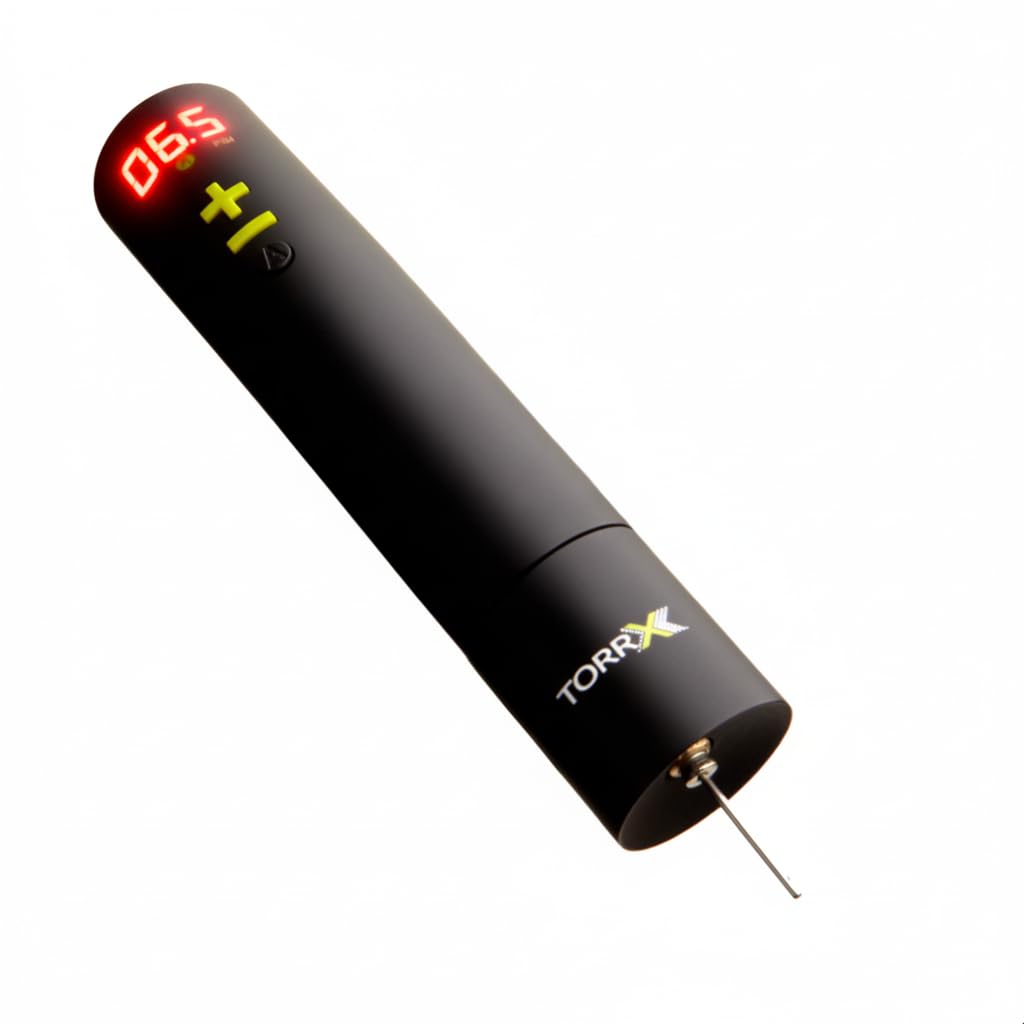
TorrX Smart Pump
Key Features
- Battery Capacity (mAh): 50+ ball top-ups
- Auto-Stop & Accuracy: Auto & manual, ML accuracy
- Portability & Accessories: Micro-USB cable incl.
- Price: Premium
The TorrX’s digital readout and auto-stop hit the exact pressure setpoint every time, and its dual-action pump inflates or deflates a basketball in about 30 seconds. Built to handle heavy workloads, it tops up over 50 balls before needing a recharge.
The unit holds up well in daily team environments, with many owners reporting years of service. One tradeoff: the micro-USB charging port can loosen after prolonged heavy use, though TorrX’s warranty support typically covers the fix.
This pump suits league coaches and athletic directors who need consistent accuracy and speed across dozens of balls weekly. It is premium-priced and heavier than portable options, so casual home users who inflate one ball a month are better served by a simpler, cheaper pump.
Pros
- Machine-learning auto-stop hits target pressure exactly every time.
- Fast inflate and deflate – processes a full team’s balls quickly.
- Durable build with battery life that lasts years under heavy use.
Cons
- Micro-USB charging port can loosen after extended heavy use; warranty support is available.
For coaches and equipment managers who need a pump that hits pressure precisely and lasts, the TorrX delivers — the micro-USB port tradeoff is manageable with warranty support.
Best for Budget Families
HYVOHEX Ball Pump
Key Features
- Max Pressure (PSI): 17 PSI
- Battery Capacity (mAh): 1500 mAh
- Auto-Stop & Accuracy: Auto-stop
- Portability & Accessories: USB-C, needle storage
- Price: Budget
Unlike speed-focused alternatives with sport presets, the HYVOHEX is built for grab-and-go convenience: pocket-sized, hidden needle storage, and enough battery for a weekend of games. That makes it right for families and coaches who already own a compatible USB-C cable and want a light pump that lives in the sports bag. The absence of an included cable is the friction point — some USB-C cables, especially from phone chargers, may not trigger charging, so plan on testing a few or keeping a dedicated cable with the pump.
Pros
- Pocket-sized and lightweight — lives in a sports bag without adding bulk.
- Simple one-button operation with auto-stop digital display makes inflation quick and accurate.
- Delivers strong inflation speed for its size, able to top off multiple balls rapidly.
Cons
- No included charging cable; some USB-C cables may not charge the pump, requiring a compatible cable.
If you have a compatible USB-C cable and want the most portable pump with onboard needle storage, the HYVOHEX slips into a bag and stays out of the way until you need it.
Best for Quick Inflation
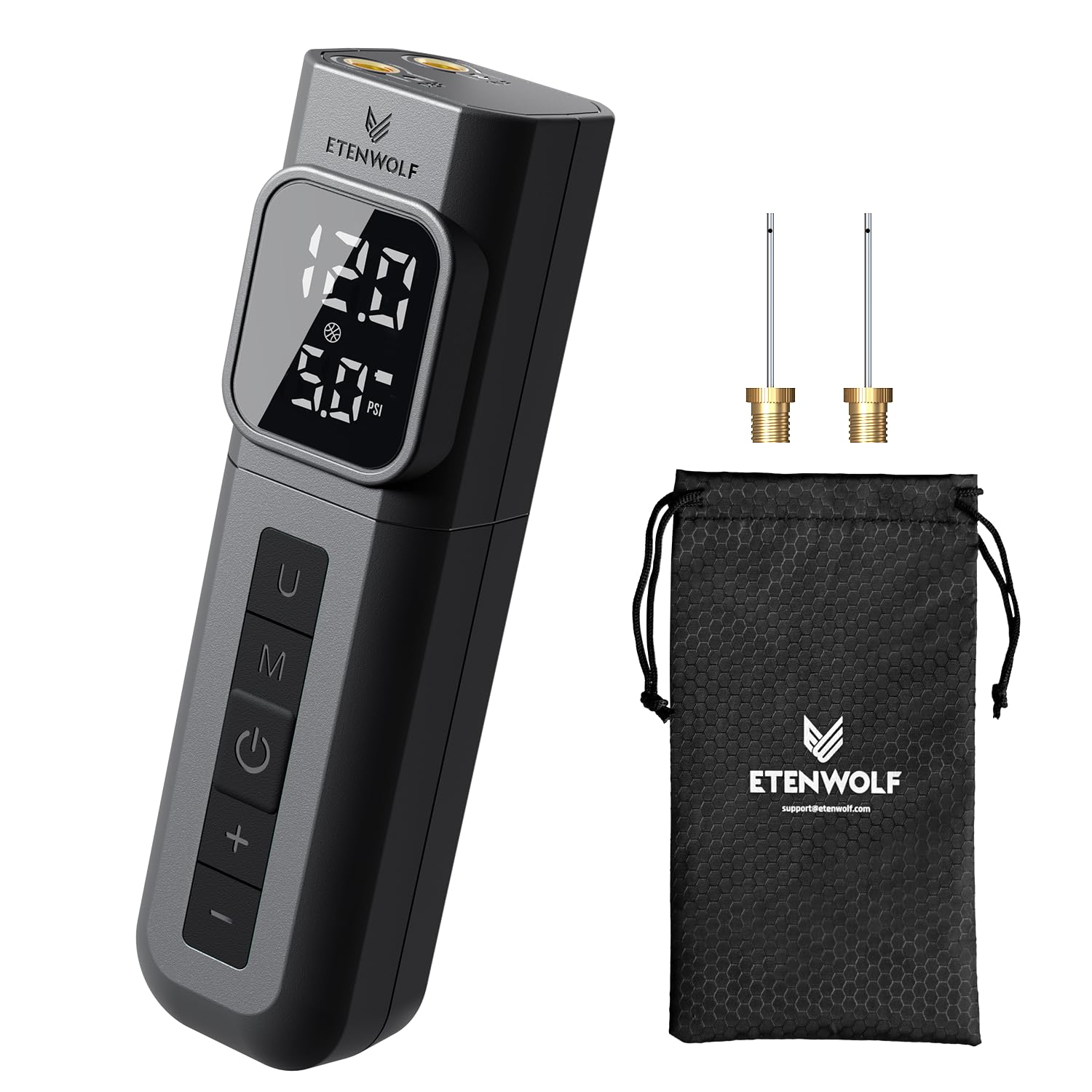
ETENWOLF P200 Pump
Key Features
- Max Pressure (PSI): 17 PSI
- Air Flow Rate (L/min): 6.5 L/min
- Battery Capacity (mAh): 2000 mAh
- Auto-Stop & Accuracy: Preset modes, auto-stop
- Portability & Accessories: USB-C, 2-yr warranty
- Price: Budget
The ETENWOLF P200 inflates a basketball in about 40 seconds — among the fastest in its price range. Preset modes for basketball, soccer, and volleyball take the guesswork out of pressure settings, and the 2000 mAh battery holds a charge for weeks between uses. The compact body and USB‑C charging add everyday convenience.
This pump is best for parents and coaches who need quick inflation of soft-to-medium pressure balls like basketballs and soccer balls. The motor may struggle to reach 13 PSI on firm footballs, occasionally shutting off before hitting that mark — so if you regularly inflate high-PSI footballs, consider a more powerful option. The 2-year warranty provides added peace of mind for the price.
Pros
- Inflates a basketball in 40 seconds — one of the fastest in the budget segment.
- Preset pressure modes make it simple for kids and parents to get the right inflation every time.
- Battery lasts for weeks on a single charge and recharges quickly via USB‑C.
Cons
- Motor can struggle to reach 13 PSI on firm footballs, occasionally shutting off early.
For basketball and soccer parents who value speed and simplicity, this pump delivers — just keep it away from high-PSI footballs.
Best for Casual Users
Pumteck Electric Pump
Key Features
- Max Pressure (PSI): 12 PSI
- Air Flow Rate (L/min): 4 L/min
- Battery Capacity (mAh): 2000 mAh
- Auto-Stop & Accuracy: Auto-stop, backlit LCD
- Portability & Accessories: USB, 0.55 lb
- Price: Mid-Range
Compared to the pro-grade top pick, the Pumteck prioritizes battery capacity and an easy-to-read display over heavy-duty durability. It inflates soccer balls, basketballs, and footballs with consistent auto-stop accuracy. Parents of young athletes and coaches needing quick pre-game top-offs will find it handy, but team environments should treat it as an occasional-use pump — quality-control inconsistencies can lead to units that stop working or won’t charge after a few months.
Pros
- Works reliably on many ball types—soccer, basketball, football—with consistent auto-stop.
- Excellent ease of use; set the PSI, hit start, and the pump stops automatically.
- Good build quality for the price; feels sturdy and includes a bright LED display.
Cons
- Some units may stop working or fail to charge after a few months — quality-control variance.
If you need a grab-and-go ball pump that handles occasional inflation without manual pumping, the Pumteck fits the bill — just budget for a possible replacement if used heavily.
Best for Home Inflatables
AirSilo Ball Pump

Key Features
- Max Pressure (PSI): 15 PSI
- Air Flow Rate (L/min): 5.5 L/min
- Battery Capacity (mAh): 40+ balls per charge
- Auto-Stop & Accuracy: Auto-stop
- Portability & Accessories: Adapters for floats, yoga balls
- Price: Mid-Range
An LED pressure gauge provides digital accuracy, and the adapter kit handles swim rings, yoga balls, and balloons alongside standard sports balls. Inflation speed is more measured than in sport-focused competitors, so filling a basketball or football takes extra time. For households that value multi-use capability and battery life lasting an entire season on a few charges, that trade-off is acceptable.
Pros
- Battery lasts entire seasons on just a few charges.
- Adapter kit handles pool toys, yoga balls, and swim rings beyond sports balls.
Cons
- Inflation speed can be slower than expected, particularly for larger balls.
A better fit for homes that regularly inflate pool floats and exercise gear, rather than a coach needing to blast through a dozen basketballs.
Best for Warranty Seekers
Motorenbau P307 Pump

Key Features
- Air Flow Rate (L/min): 4 L/min
- Battery Capacity (mAh): 2000 mAh
- Auto-Stop & Accuracy: Auto-stop
- Portability & Accessories: Storage bag, silicone hose
- Price: Budget
Lightweight at 0.55 lb, the pump includes a silicone hose, USB cable, and storage bag. Its 2000mAh battery and digital LCD display are impressive for a budget pump, but real-world accuracy and motor longevity remain unverified. The 3-year warranty provides some reassurance, though there are no published owner experiences to confirm reliability during outdoor team use.
Pros
- Ultra-lightweight at 0.55 lb, easy to toss in a gym bag.
- 3-year warranty backs the pump far longer than most competitors.
Cons
- 4 L/min air flow may feel slow for high-pressure footballs during rushed warmups.
If you’re willing to gamble on the 3-year warranty with a budget pump and don’t need proven accuracy for critical game-day prep, this is an intriguing low-cost option.
How to Choose
The most important decision with a digital ball pump isn’t maximum PSI or speed—it’s whether the pump’s pressure readings and battery hold up after months of regular use.
Max Pressure (PSI)
Most sports balls need between 8 and 13 PSI. A pump rated for 12 PSI may sound sufficient, but electric motors often struggle to maintain consistent pressure at their upper limit, leading to early shutoffs or inaccurate readings. If you or your team inflates footballs, a model with a 15–17 PSI rating leaves enough headroom for reliable stops.
The hidden issue is that motor power drops off near the rated max, so a 12 PSI pump may only consistently deliver 10–11 PSI under load. Always pick a pump whose stated maximum exceeds your highest-use pressure by at least 2 PSI.
Air Flow Rate (L/min)
For a single basketball, 4 L/min is adequate—you’ll wait 60–90 seconds. But for a coach topping off a dozen balls before practice, 6.5 L/min cuts that time nearly in half, reducing the pre-game bottleneck.
The trade-off is that ultrafast pumps can get hotter, which sometimes triggers thermal protection and forces a pause. Match the airflow to your typical volume; volume inflators benefit from higher L/min, while occasional users won’t notice the difference.
Battery Capacity (mAh)
A pump with 2000mAh may promise 50+ top-ups, but actual counts depend on pressure and ball size. Look for real-world claims like “40+ basketballs per charge” rather than raw mAh alone.
A pump that barely lasts through a weekend tournament is frustrating; choose a unit that claims at least 50 pump cycles on a full charge. Remember that frequent full-cycling from empty stresses lithium batteries, so topping up periodically preserves longevity.
Auto-Stop & Pressure Accuracy
Auto-stop prevents overinflation, but even with it, the displayed PSI can drift 1–2 PSI off from a calibrated gauge during the pump’s life. Sensor drift is common and often goes unnoticed until the ball feels wrong.
After the first few uses, compare the pump’s reading with a trusted analog gauge to learn its offset. For basketball, a discrepancy of just 1 PSI alters bounce noticeably; serious players should check and adjust the set point accordingly.
Portability & Included Accessories
A pump that disappears into a gym bag is great, but if it lacks a built-in needle compartment or doesn’t include a compatible charging cable, you’re left scrambling. Internal needle storage eliminates the lost-needle headache, and a pump light enough for pocket carry makes a real difference for on-the-go coaches.
Check whether the pump uses USB-C or micro-USB. USB-C ports are more durable and cables are easier to replace, but some pumps require a specific cable; verify compatibility immediately after unboxing. Extra adapters for pool floats or yoga balls add versatility that a sports-only user may never need.
FAQ
Why does my digital ball pump stop charging after a few months?
Usually the charging port — especially micro-USB — becomes loose or the battery management circuit fails. Pumps left plugged in after a full charge can overheat and degrade the battery faster. To extend life, unplug once the charge light turns green and avoid jiggling the cable while connected. If a pump fails under warranty, reach out to the brand quickly.
What PSI should I set for a basketball using an electric pump?
Official NBA balls are inflated to 7.5–8.5 PSI; most youth and recreational balls feel best at 8 PSI. Set the pump to 8 PSI, then check with a separate analog gauge — digital pumps often read 1 PSI too high. If your ball feels brick-like, the gauge is likely off; lower the setting by 1 PSI until the ball’s bounce and feel match your preference.
Why does my ball feel too hard even though the pump says 8 PSI?
Digital sensors can drift over time, causing the pump to display a lower pressure while actually overinflating. Always cross-check with an external gauge. A pump that reads 8 PSI but yields a rock-hard ball might be pushing 10 PSI. Adjust the set point down by 1–2 PSI until the ball’s feel matches what you expect on the court.
Can an electric ball pump inflate a football to 13 PSI?
Many budget pumps struggle to reliably reach 13 PSI, as their motors lose power near the top of their pressure range. Look for a model rated to at least 15 PSI and with a high-flow motor (6.5 L/min or more). The TorrX and ETENWOLF pumps can handle it, but some cheaper units shut off early or sound strained — test during the return window to make sure yours can deliver.