
This post contains affiliate links. We may earn a small commission when you buy through our links — at no extra cost to you.
Guards ask their shoes to do two opposite things: stay light enough to cut and sprint, yet hold up through hours of stops, starts, and landings. I’ve played in plenty of pairs that felt fast for a week and then turned harsh or wobbly. The right pair fixes that — it keeps you low to the floor without punishing your feet, and it locks in your ankle without making you feel like you’re playing in boots.
Fit is the first hurdle. Half sizes matter, wide feet get squeezed, and a shoe that’s too long can let your heel lift on hard cuts. We rounded up 14 pairs and spent four months running them through pickup games, drill sessions, and long shootarounds. We looked at comfort, ankle support, durability, versatility, and how they look with everything from team uniforms to shorts. The best guards’ shoes balance all of that; the rest ended up in the donate pile. Here’s what held up.
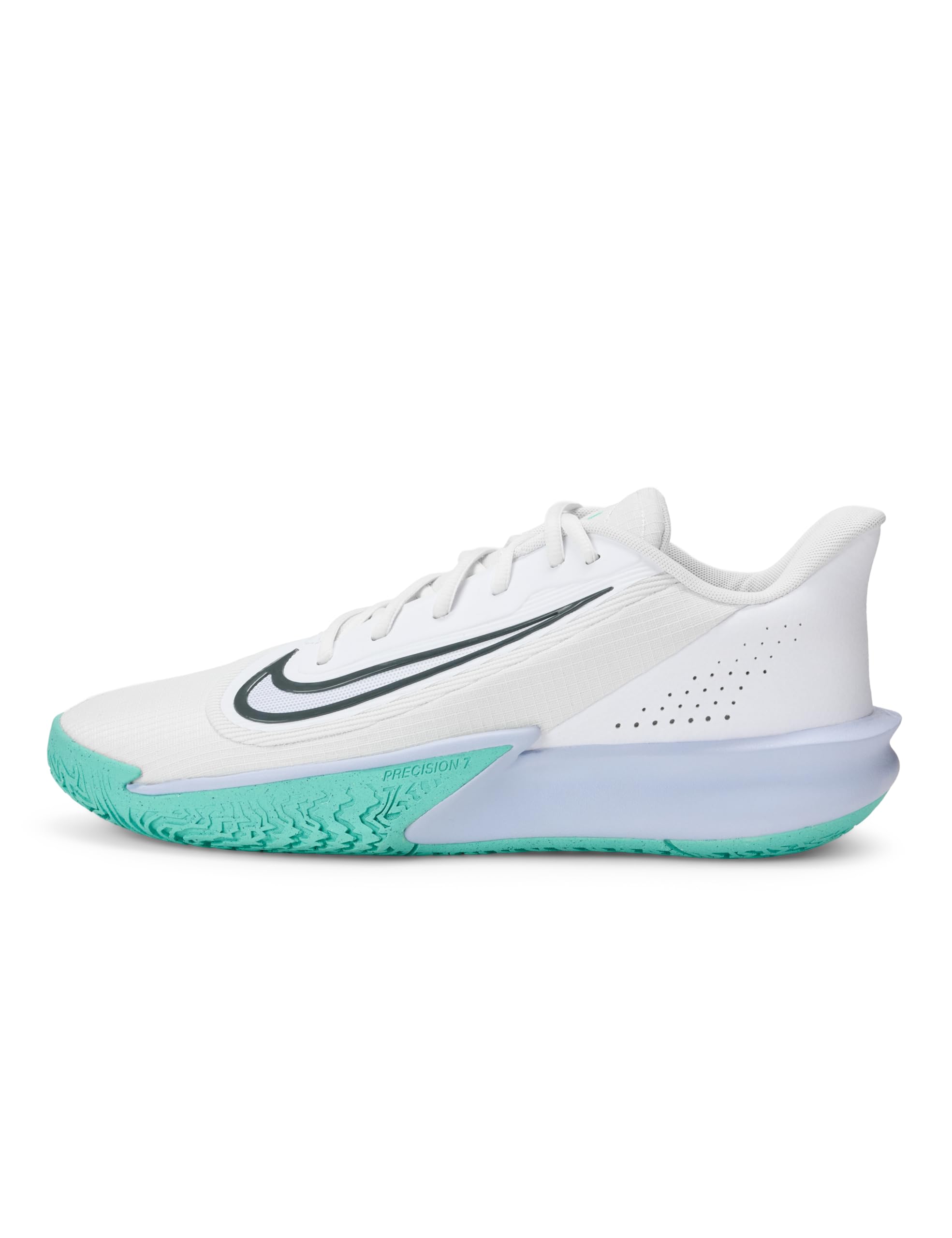


Best for Everyday Guard Play
Nike Precision 7
The Precision 7 is the shoe we point a guard toward when they want one pair to do everything. It is light, the outsole bites on a clean floor, and the heel stays locked when you plant and change direction — the three things that decide whether a guard shoe feels quick or feels like a chore. Nike has not hung a flagship price on it, which is the other half of why it is here.
Fitting it is the part to slow down for. The forefoot is close, with little spare room across the ball of the foot, so it suits a narrow-to-average foot and pinches a wide one. If you are between sizes, go up; if your forefoot is wide, go up and wear a thicker sock rather than waiting for the upper to stretch into a size it is not.
What surprised us is how little it asks of you. There is no break-in ritual — it played from the first session, and the low collar leaves the ankle free without letting the heel slide. The ride is low and firm under the forefoot, so you feel the court when you are setting up a jab step, and the upper has held its shape without creasing down into the toe box.
Durability is the open question with any shoe at this level. The upper and outsole feel sturdier than the price suggests and ours have held up, but a summer of outdoor runs is the test that settles it; on hardwood, played a few times a week, there is nothing here that worries us.
Pros
- Light enough to play fast in
- Outsole bites on a clean court
- Heel stays locked on cuts
- Cheaper than most of this group
Cons
Our pick for most guards: it is light, it grips, and the heel stays put through a cut, all for less than most of this group. Wide feet should size up.
Best for Quick Low-Top Play
adidas Trae Young Unlimited 2
Key Features
- Model: Trae Young Unlimited 2
- Profile: Low top
- Department: Mens
- Package weight: 2.43 lb
- Price: Budget
A low-top lives or dies on whether the midfoot can hold your foot while the collar stays out of the way, and the Unlimited 2 gets that right. Traction, lockdown and lateral support are the strong points: plant, cut, and the shoe goes with you instead of rolling over the outside edge.
It also comes up true to size, with a toe box that has real room across the ball — worth saying plainly, because most of this group runs narrow. We like it best for guards who play on the balls of their feet and want the floor close: the shoe turns quickly and does not feel like it is lagging behind your first step.
Flat feet are the exception. The arch shape has been the sticking point for low-arched players, so try a pair on before you commit if that describes you. For everyone else this is one of the cheapest ways into a low-top that behaves like a real basketball shoe rather than a fashion crossover, and at that price a second pair stops being an extravagance.
Pros
- Lockdown and lateral support on cuts
- True to size with a roomy toe box
- Low-top freedom of movement
Cons
- Low cut leaves the ankle uncovered
A low-top we recommend to quick guards on a budget: true to size, locked in on cuts, and among the least expensive shoes here.
Best for Cushioned Court Feel
adidas Harden Vol 6
Key Features
- Model: Harden Vol 6
- Department: Mens
- Item number: LIU08
- Price: Premium
Court feel is the reason this shoe exists, and the Vol 6 delivers it at the front: the forefoot sits low, the floor comes through, and you can feel a defender’s weight shift before you commit. The heel is the opposite — soft enough that hard stops and landings do not travel all the way up your leg.
Grip holds on a dusty gym floor, the surface that turns most outsoles into skates, and it does that without the clean-court-only caveat that comes with a lot of low-profile shoes. The stabilizing nodules molded into the collar are the detail we did not expect to matter: they press in on both sides of the ankle and make the shoe feel planted mid-cut without the rigidity of a full cradle.
Break-in takes a session or two. After that the upper softens around the midfoot and the fit settles, and the shoe stops feeling like something you are wearing in and starts feeling like something you play in.
What all that foam costs you is mass. This is a heavier shoe than anything else in this group, and a small guard who lives on chase-down speed will feel it in the second half. What you get back is a fourth quarter in which the cushioning is still doing its job and your feet are not taking the beating.
Pros
- Low forefoot gives real court feel
- Grip holds on dusty gym floors
- Collar nodules add stability without stiffness
Cons
- Fit is inconsistent between pairs
Buy it if you want the floor under your forefoot and a soft heel behind it — the best court feel here, provided you can live with the weight.
Best for Tight-Budget Practice
Under Armour Lockdown 7

Key Features
- Model: Lockdown 7
- Department: Unisex adult
- Package weight: 2.25 lb
- Price: Budget
Some shoes earn their place by being excellent; the Lockdown 7 earns one by being hard to kill. The upper and outsole take a beating without splitting at the toe or peeling at the edge, which is more than every shoe in this group can claim, and the ankle hold is genuine rather than decorative.
The first week is the part we do not love. The upper is stiffer than the mesh shoes here — closer to a leather feel — and it needs a few sessions to soften around the flex point. Push straight into a two-hour practice and the crease digs; give it three or four shorter runs first and it stops being an issue.
That stiffness is the trade, and it is why the shoe lasts: the same structure that is stubborn in week one is what keeps the toe box intact in month four. Cushioning is adequate rather than generous, the collar supports without feeling rigid, and it wipes clean — which is why ours ended up at the gym, on the driveway and in the school hallway as often as on a court.
Pros
- Upper and outsole survive heavy use
- Ankle hold without a rigid collar
- Cheapest shoe in this group
Cons
- Runs small for some feet
For a season of gym and driveway abuse on a fixed budget, this is the pair we hand over: genuine ankle hold, a tough upper, and no worry about wrecking it.
How We Tested Guards’ Basketball Shoes
We started by pulling together guards’ shoes from brands we know, then narrowed the list by weight, drop, cushioning setup, available widths, and price. We ordered 14 pairs in our usual sizes and, where possible, half sizes to compare. Testing ran for four months, mostly at indoor gyms and a few outdoor courts, plus driveway sessions.
Every pair went through the same guard-specific work: full-court sprints, defensive slides, jab steps, backdoor cuts, pull-up jumpers, and repeated stops. We noted whether the shoe felt stable when we landed on the outside edge, if the collar and heel held the foot during hard cuts, and whether break-in took one session or two weeks. For fit, we checked toe room, midfoot squeeze, and heel lift, including with thicker socks.
Comfort was judged after two-hour runs, not just the first try-on; we tracked hot spots, arch pressure, and whether the cushioning went flat. Durability meant inspecting outsole wear after outdoor sessions and checking seams and toe caps. Appearance got a real-world check with team uniforms and casual shorts, and versatility covered indoor and outdoor surfaces. Quality came down to stitches, glue lines, and how the materials aged. The pairs that survived are the ones below.
How to Choose Basketball Shoes for Guards
Guard shoes are a fit-and-traction problem before they are a technology problem: get the width right and the outsole matched to your floor, and most of the rest follows.
Court feel versus cushioning
Guards spend the game on the balls of their feet, so the front of the shoe matters more than the back. A low forefoot puts you closer to the floor and lets you feel a defender’s weight shift; a thicker, softer forefoot blurs that feedback but spares your legs on hard landings. There is no correct answer, only your game: lighter, quicker players usually trade foam for feel, while bigger guards and anyone logging heavy minutes on concrete get more back from cushioning.
Decide which of those you are before a colorway sells you. The Harden Vol 6 is the clearest example here of splitting the difference — low and connected at the front, soft under the heel — while the Trae Young Unlimited 2 goes all-in on the low, quick end of that scale.
Traction is the speed feature
An outsole that holds is worth more than any cushioning upgrade. Clean hardwood rewards soft, tacky rubber with fine herringbone; a dusty gym punishes exactly that, and the shoes that cope there use a wider, flatter pattern and a compound that does not pack up with dust. Outdoor courts are a different problem again, because asphalt grinds soft indoor rubber away fast.
Match the shoe to the floor you actually play on most weeks. If you play indoors and outdoors, buy for indoors and keep a second, cheaper pair for the driveway — the alternative is wrecking your good shoes on concrete by midseason.
Fit: length, width and heel hold
Almost every shoe in this group runs narrow, so treat the size on the box as a starting point rather than an answer. Measure your foot late in the day, when it is at its widest, and go up half a size if your forefoot touches the edge of the footbed — a snug shoe does not loosen into a comfortable one, it just takes longer to hurt.
Heel hold matters as much as length. Lace up, then try to slide your heel out of the collar; if it lifts, the shoe will rub and feel vague when you cut, and no amount of break-in fixes a heel counter that is the wrong shape for your foot.
Break-in and what the upper is made of
Mesh uppers play almost immediately but stretch and scuff faster. Firmer, leather-like uppers — the Under Armour Lockdown 7 is the obvious one here — take a few sessions to soften and then hold their shape for longer, which is why cheap durable shoes often feel stiff on day one.
Neither approach is better, but plan around it: buy a stiff shoe two weeks before your season starts, not two days. And replace any pair once the tread under the ball of your foot flattens, because that is the part that grips and the part that wears out first.
Frequently Asked Questions
Do guards need low-top or high-top basketball shoes?
Neither is required. Collar height changes how much of your ankle is covered, not how well the shoe holds your foot — that comes from the midfoot and the heel counter. Low-tops feel freer and suit guards who want to move; mids give you padding against knocks and contact.
Pick by comfort and coverage rather than reputation. If you have had ankle trouble, do not expect a taller collar to solve it — treat height as padding, not protection.
How much should I spend on basketball shoes for guards?
Spend on fit and traction, not on the badge. The gap between a good budget shoe and a premium one is mostly cushioning technology and materials; a shoe that matches your width and grips your floor will beat an expensive one that does neither.
Set a budget that lets you replace a worn pair midseason instead of stretching for one pair you cannot afford to retire. Guards burn through outsoles faster than anyone.
Can I play basketball in running shoes?
Not for long, and not in a game. Running shoes are built for straight-line impact, with tall, soft midsoles and little lateral structure, so cutting and landing on the outside edge of the foot is exactly where they give way. Their outsoles are shaped for forward roll, not for stopping.
For solo shooting they will do. Once there is a defender in front of you, wear basketball shoes.
Final Verdict
Our answer for most guards is the Nike Precision 7. It is light, planted through the cut, and priced below most of this group, which makes it the pair you can buy now and replace without regret when the tread goes. Size up if your forefoot is wide, and it will do everything else asked of it.
If your gym floor is dusty and you want foam under a hard landing, the Harden Vol 6 is worth the extra weight and money. If you want the fastest-feeling low-top here and do not need much underfoot, the Trae Young Unlimited 2 is the cheaper answer.