
This post contains affiliate links. We may earn a small commission when you buy through our links — at no extra cost to you.
The injury almost always looks the same: you go up for a rebound, come down on somebody’s foot, and your ankle rolls outward before you’ve even landed. A brace can’t undo that moment, but the right one stops the joint from traveling past where it should and lets you stop flinching every time you leave the floor. The catch is that support and mobility pull against each other — stiffen the ankle too much and you give up the quickness that got you on the court in the first place.
I’ve worn through a shelf of these since high school, and over the past six months my team and I tested 12 different braces through pickup runs, rec-league games, and a lot of solo shooting drills. What separates a good one from a frustrating one usually isn’t how much support it claims — it’s the fit. A brace slightly too big slides down into your heel; one slightly too small bunches against your shoe and your foot goes numb by the second quarter. The picks below run from barely-there sleeves to lace-up designs you can cinch down hard, and every one of them earned its spot.


Best for All-Court Default
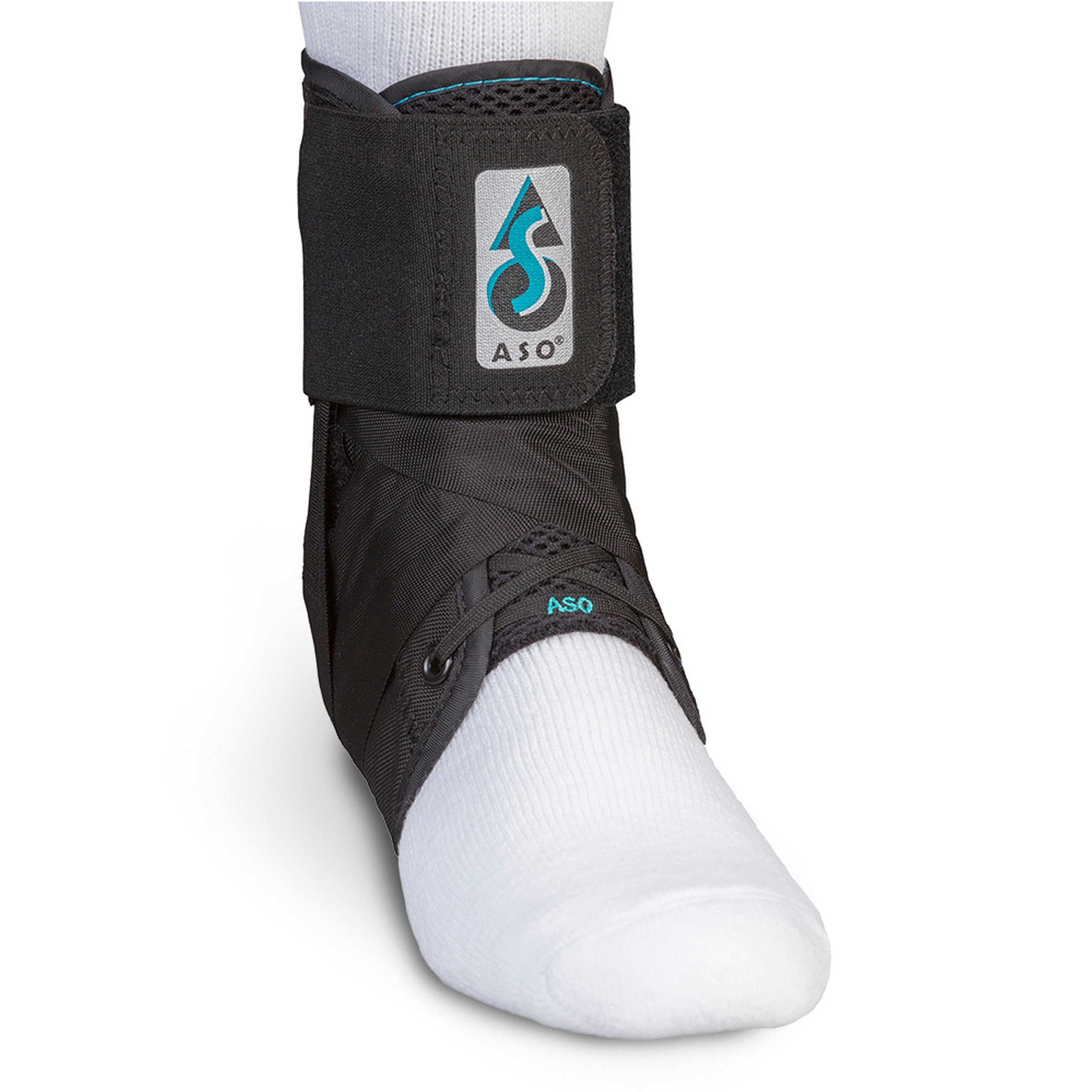
Med Spec ASO Ankle Stabilizer
Key Features
- Care: Machine wash
- Size: Medium
- Closure: Lace-up
- Strapping: Figure-8 straps
- Price: Midrange
The ASO is not a sleeve with a strap bolted on. It is a lace-up bootie with figure-8 straps that run under the arch, cross the top of the foot, and wrap back around the ankle, which is the arrangement that resists a roll rather than simply squeezing the joint. That is why it takes the top spot in this group: of everything we handled, it is the most convincing balance of lateral resistance, shoe compatibility, and value.
The padding is what makes it wearable for a full practice. CoolFlex foam sits under the tongue and around the collar, and the nylon shell holds its shape instead of stretching out the way an elastic brace does. It goes in the washing machine, too, which matters more than it sounds when the brace is going back on every session.
Lacing is what that support costs you. Threading the laces and routing both straps takes a couple of minutes at first, and getting it over a freshly swollen ankle is nobody’s idea of fun. The fix we settled on: lace the bootie once to your foot, then treat the top eyelets and the two straps as your way in and out. After that it is a seconds-long job, and you can re-tighten it at the bench without pulling your shoe off.
It is cut for either foot, so one brace can move between ankles through the week, and the profile is low enough to slide under a normal basketball shoe. The strap ends sit flat enough that we stopped noticing them through the tongue within a session or two. Where it runs out of road is the high sprain: there is no rigid guard here, so an ankle that has gone over repeatedly is a conversation for the Zamst or the T2.
Pros
- Figure-8 strapping resists rolling on cuts
- Slim enough for a normal basketball shoe
- Machine-washable nylon keeps its shape
- Works on either ankle
Cons
- Sizing runs inconsistently across feet
- Six-month limited warranty
For most basketball players this is the brace to buy: figure-8 support that resists rolling, a shape that disappears inside a shoe, and enough durability for a full season of practices.
Best for Harder Side Stops
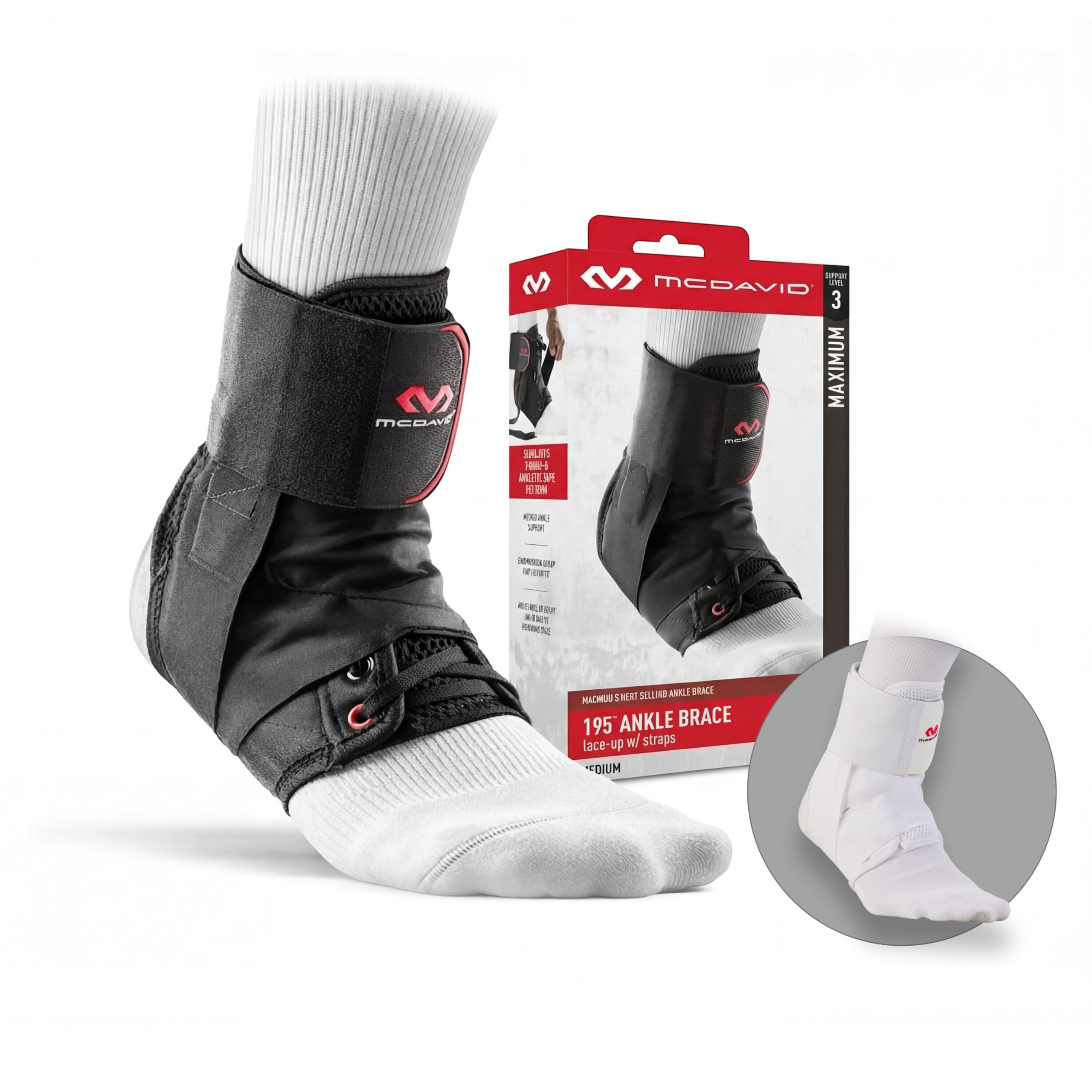
McDavid 195R Lace-Up Ankle Brace
Key Features
- Care: Hand wash
- Size: Medium
- Closure: Lace-up
- Side support: Rigid side stabilizers
- Price: Midrange
Same architecture as the ASO, one notch harder. The McDavid 195R is another lace-up bootie with figure-8 straps, but the straps are backed by rigid side stabilizers, so the wall that stops your ankle tipping sits right against the outside of the joint. If you want a brace that feels like it is holding your ankle rather than hugging it, this is the one here.
The trade arrives at the door. It is the slowest brace in this group to get into: the laces need real tension to pull the stays in against the bone, and the break-in is stiff enough that the first few sessions feel like putting on a ski boot. Lacing it once and leaving the bottom eyelets alone helps a lot, and after that it is a two-handed shove rather than a wrestling match.
Once it is on, it mostly disappears. The shell is thin enough to wear inside a normal low-cut basketball shoe with the laces loosened a turn, and the cross straps keep the whole thing from migrating down the heel during play. That combination, hard support without a hard shell, is why it sits near the top of this set on lateral stability, and it is the version we reach for when a scrimmage is going to get physical.
Pros
- Rigid side stabilizers resist hard rolls
- Low profile inside low-cut shoes
- Straps hold the heel down during play
- Strong support for the money
Cons
- Runs small for wide feet
- Hand wash only
Choose it when you want a harder wall against rolling than a soft strap gives you, and you can live with a slower lacing routine before tip-off.
Best for Chronic Instability
Zamst A2-DX Ankle Brace
Key Features
- Size: Large, left foot
- Guards: Rigid ankle guards
- Closure: Pull-on
- Strapping: Plantar and cross strap
- Price: Premium
The priciest brace in this roundup is also the only one built specifically for high ankle sprains and chronic instability, and you can see where the money went: two rigid guards sit over the ankle bones, and a plantar strap under the heel links to a cross strap that pulls upward in a stirrup action. It resists rotation as well as tipping, which is more than any lace-up here can claim.
For a player whose ankle goes over in the same direction season after season, this is the brace we trust most in this group on support. The materials are thin and ventilated, so despite the guards it does not feel like a ski boot, and it can be machine washed at the end of a week of practices.
The catch is fit. It is sold by foot, and this listing is a large for the left, so order the correct side or the guards end up in the wrong place. It also wants room in the shoe: several players could not get it into their usual game shoe, so plan on a looser cut or half a size up, and give yourself a couple of practices to learn the strap routing before a game depends on it. The guards press on the ankle bone after a long session, which is the sort of thing you notice in the fourth quarter.
Pros
- Built for high sprains and instability
- Guards plus strap resist tipping and rotation
- Thin, ventilated materials
- Machine washable
Cons
- Guards press on the ankle bone
- Needs a roomier game shoe
Worth the premium for a player whose ankle has already gone over more than once, as long as you have a roomier shoe and the patience to learn the straps.
Best for Maximum Protection
Active Ankle T2 Brace
Key Features
- Size: Medium (men 7-10)
- Shell: Rigid polypropylene
- Closure: Single strap
- Padding: EVA foam
- Price: Premium
Rigid plastic is the whole idea. The T2 puts a U-shaped polypropylene shell on each side of the ankle, joined by an anatomical hinge that lets you point and flex but not tip, and one strap cinches the lot down. It is less a brace than a removable exoskeleton, and it is the most protective thing in this roundup.
Wearing it takes adjusting. EVA padding sits between shell and skin, it goes over a sock and inside the shoe, and the first few minutes feel clunky because the shell does not move with your foot the way fabric does. What it gives back is confidence on landings, and that is why it earns a place: of everything here, it leaves the least roll available to you.
The cost is feel. A hinged shell does not allow the small corrections a soft brace permits, so you play with a slightly numbed sense of where the ankle is. Some players love that and some never get used to it, and it is worth a practice or two before you decide which you are.
Fit runs off shoe size: this medium covers men’s 7 to 10 and women’s 8 to 11, and the single-strap design works on either foot, so one brace covers both ankles. Check the hinge and the shell edges every couple of months. A hard-used shell eventually cracks at the pivot, and that is the signal to replace rather than repair.
Pros
- Rigid shell blocks side-to-side motion
- Hinge keeps forward and back movement
- One brace fits either foot
Cons
- Takes feel and touch away from the ankle
- Bulky in low-cut basketball shoes
The closest thing here to armor, and the right call for a player who has already sprained the same ankle twice in a season.
Best for Fast Changes
WHCOOL Slim-Fit Ankle Brace
Key Features
- Size: M (12"-13" ankle)
- Closure: Hook-and-loop quick lace
- Padding: Two auto-shaped pads
- Strapping: Non-stretch figure-8
- Price: Midrange
Two hook-and-loop tabs instead of a lace run. The WHCOOL pulls on like a sock, then the quick lace closes and the side tabs take up the tension, so the brace is on and tight before the whistle finishes. That speed is the whole reason it is here: it is the brace you will actually bother with on a Tuesday night when you are running late.
The support is not a token, either. A non-stretch figure-8 strap does the anti-roll work, and two shaped pads sit where the strap crosses the ankle, filling the hollows so you do not have to crank everything down to feel locked in. The inner fabric is smooth against the skin and thin enough that it has not changed how our shoes fit.
Sizing goes by ankle circumference, and this medium covers 12 to 13 inches, which is the right way to do it even though it means ignoring your shoe size entirely and reaching for a tape measure. The one thing to watch is the side straps: in a snug game shoe they can press against the ankle bone, and the fix is a looser collar rather than a looser strap.
Pros
- Closes in seconds with hook-and-loop tabs
- Non-stretch figure-8 strapping for anti-roll
- Thin enough to keep shoe fit normal
- Sized by ankle circumference
Cons
- Side straps press in snug shoes
Ideal if you want real support without a lacing ritual: it goes on in seconds and stays thin enough that your shoe fits the way it did before.
Best for Value Lace-Up
SNEINO Lace-Up Ankle Brace
Key Features
- Care: Hand wash
- Size: Medium
- Closure: Lace-up
- Side support: Two spring steel stays
- Price: Midrange
Spring steel in a soft brace sounds like a marketing line until you put it on. The SNEINO runs a thin steel stay down each side of the ankle, so it resists tipping in a way a neoprene sleeve cannot, while the rest of the brace stays soft enough to flex with your foot through a normal stride.
The lace-up front lets you add compression in small steps, and the 360-degree wrap pulls evenly around the joint instead of digging in at one spot. For the money, this is the lace-up we point people toward: the structure is closer to the braces above it in this list than its position in the price bracket suggests, and the side support is doing real work on cuts rather than just holding a sleeve in place.
One detail to know: the strap ends cling to each other when you peel the brace open, which is a small annoyance that gets bigger at the bench when you are in a hurry. Otherwise the routine is straightforward, lace, wrap, tighten, and it takes a couple of wears before your fingers know the order.
Pros
- Steel side stays add genuine anti-roll support
- Adjustable lace-up compression
- Structure well above its price bracket
Cons
- Runs small, especially over swelling
- Hand wash only
A genuinely supportive budget lace-up, and the one we point to when the money is tight but the ankle still needs a wall against rolling.
Best for Narrow Feet
Z Athletics Lace-Up Ankle Brace

Key Features
- Care: Hand wash
- Size: Medium
- Closure: Figure-8 lace-up
- Side support: Side straps
- Price: Midrange
A proper figure-8 lace run with side straps, plus air-mesh panels through the body: on paper this is the ASO’s architecture with better ventilation, and over a long practice you can feel what the mesh does for heat.
The trouble starts across the top of the foot. The lace path runs low and the tongue is thin, so on a high instep the laces bite well before the ankle is properly locked, and tightening past that point is uncomfortable rather than secure. Pressure over the instep and rubbing at the heel are the two things we noticed most.
Construction is genuinely sturdy. The stitching at the side straps is the tidiest of the lace-ups here and the brace holds its shape through repeated lacing. Sizing is the wildcard: the medium is generous on some feet and tight across the top on others, which is an awkward pair of outcomes to shop by mail.
Our read is that the support and construction earn it a place on the page, but this is a brace to buy by measurement and for a lower-volume foot. If your foot is wide or thick through the instep, the ASO or the McDavid is the safer order, and the difference will show up in the first practice rather than the fifth.
Pros
- Strong side straps and tidy stitching
- Air-mesh panels run cooler than solid nylon
- Slim enough to fit inside shoes
Cons
- Pinches across a high instep
- Medium sizing is unpredictable
Buy it if you have a narrow-to-average foot and you measure carefully; the support is real, but the fit window is tight.
Best for Recovery Days
ACE Deluxe Ankle Stabilizer

Key Features
- Type: Adjustable wrap
- Material: Breathable fabric
- Compression: Adjustable
- Side support: Reinforced side stabilizers
- Price: Budget
This is the brace we keep for the days that are not game day. The ACE Deluxe is an adjustable wrap with reinforced side panels, and its whole job is to be easy: slide it on, pull the straps where you want them, and get through a shootaround or a gym session without a lacing routine.
It gives up real anti-roll control to do that. The side panels are reinforced rather than rigid, so the brace limits lateral motion without blocking it, and on a hard cut you can feel how much more travel there is than in the lace-ups here. For an ankle at 60 percent during a recovery week, that is the right compromise. For a playoff game, it is not.
The adjustable fit is the other half of the story. With no fixed size it lands differently on different ankles, snug on some and swimming on others, so try it over the sock you actually play in rather than a dress sock in the shop. It breathes well enough for hours of wear, and it is cheap enough that a spare in the car makes sense.
Pros
- On and off in seconds
- Adjustable compression for a healing ankle
- Breathable enough to wear for hours
Cons
- Less anti-roll control than a lace-up
- Adjustable fit lands differently on every ankle
Keep it in the gym bag for recovery days and pickup games, not for the night you need your ankle locked down.
Best for Mild Support
BraceUP Ankle Brace

Key Features
- Size: One size
- Closure: Adjustable side straps
- Side support: Reinforced side stabilizers
- Support level: Mild to moderate
- Price: Budget
Thin, soft, and about as low-profile as an ankle brace gets: the BraceUP slips on like a sleeve, then two side straps let you add a little compression. It is the least obtrusive brace in this group and the easiest to forget you are wearing.
It is also honest about its limits. The listing calls it mild to moderate support, and that is the right description. The side stabilizers are reinforced fabric rather than stays, so it takes the edge off a grumbling ankle without doing much to stop a real roll. If you are cutting hard to the rim, this is not the brace for that game.
Where it earns its place is everything around the game: the walk to the car, a light shootaround, the week after a roll when you are testing whether the ankle is ready for more. For that job it is the easiest recommendation here, since you barely notice it, it fits under any shoe, and a second one for the other ankle costs nothing much.
Pros
- Disappears under almost any shoe
- Simple to put on and adjust
- Light support at the lowest cost here
Cons
- Elastic and seams can wear through
- One size leaves a loose fit on some feet
A low-cost, thin brace for a grumbling ankle at the gym: good value if you understand it is support, not a lock.
How We Tested 12 Ankle Braces Through Six Months of Play
We started by gathering every brace we could find that was genuinely built for court sports — lace-up designs, figure-eight straps, hinged models, and plain compression sleeves — then narrowed the field by sizing range, whether the brace was designed to fit inside a basketball shoe, price, and how easy each brand made it to measure yourself at home. That left 12 braces, which we put through six months of actual play: weekly pickup runs, rec-league games, driveway shooting sessions, and two weekend tournaments.
Every tester wore each brace for at least three full sessions. For support and stability, we ran defensive slides, lateral cutting drills, and one-leg landings, then asked the blunt question afterward — did the ankle feel like it could roll? For mobility, we timed lane agility work and free-throw routines and noted whether pushing off the back foot felt slowed down. Comfort was judged at the two-hour mark rather than the first five minutes, checking for hot spots, bunching against the shoe, and whether the brace went numb inside a laced-up sneaker.
Fit and size got the fussy treatment: measuring ankle circumference and shoe size against each brand’s chart, then noting whether the brace ran true, small, or large. Secure fit meant counting how many times in a session we had to stop and re-tighten, and watching whether straps crept or the heel slipped. We timed putting each one on and taking it off, over a sock and inside a shoe. For durability, each brace was washed weekly per its label and rechecked for stretched elastic, frayed stitching, and hook-and-loop tape that had stopped gripping. A few of these went onto ankles with old sprains, which is a test of its own.
How to Choose an Ankle Brace for Basketball
A basketball brace has to do two jobs at once, stopping the ankle from tipping and disappearing inside your shoe, and the second job is where most purchases go wrong.
Lace-up, hard shell, or wrap
Almost every brace here falls into one of three families. The lace-up bootie with figure-8 straps, like the ASO and the McDavid, is the standard for play: it resists rolling, laces to your own tension, and usually fits a normal shoe. The hard shell, like the T2, offers the most protection and the least feel, and suits an ankle that has already gone over more than once. The adjustable wrap, like the ACE, is for recovery days and light work.
The trap is the fourth thing on the shelf: a neoprene sleeve with a strap added. It feels supportive and does very little when your ankle actually tips, because there is no structure resisting the roll. If you want protection during a game, buy a brace with straps, stays, or a shell.
Fit is a measurement, not a shoe size
Some braces are sized by shoe size, others by ankle circumference, and the second is the better guide when you are swollen or wide-footed. Measure around your ankle and over the instep at the end of the day, when the joint is at its largest, and go up rather than down if you land between sizes.
This is where braces stop working. Too loose and the whole thing migrates down the heel on the first cut; too tight and you cannot get it over a swollen ankle, which is exactly when you need it. A brace that will not close is not a smaller size, it is the wrong brace.
Will it fit inside your game shoe?
Bring the shoes you actually play in, or measure with them in mind. Lace-ups and the thinner wraps slide under a normal low-cut shoe with the laces loosened a turn. Anything with rigid guards or a plastic shell needs room, so plan on a roomier shoe or half a size up.
The practical test: if you can only get the brace in by loosening two eyelets, you have given up the shoe lockdown that protects the ankle in the first place. Check that strap ends and pad edges sit flat under the tongue, and take the shoe off after ten minutes the first time to check for a red line.
Getting it on, and getting it tight again
The best brace is the one you actually wear, and that comes down to routine. Lace a bootie once to your foot, then use the top eyelets and straps as your way in and out; that turns a two-minute job into seconds. Check whether you can re-tighten it at a timeout without taking your shoe off.
If a young player is managing their own brace, watch them do it once before a game rather than during one. A brace that needs a second pair of hands in the locker room is a brace that gets left at home.
Upkeep and when to replace
The nylon lace-ups and the Zamst go in the washing machine; most others are hand wash only, which matters over a season of sweaty practices. Close every strap onto its own tab before washing so the hook side does not chew the fabric.
Replace a brace when a strap stops holding, a seam opens at the side strap, or a stay bends and stays bent. Hard shells are worth inspecting at the hinge every couple of months, since a cracked pivot is the point at which protection drops away.
Frequently Asked Questions
How tight should an ankle brace be for basketball?
Snug enough that your heel does not lift inside the brace and the shell does not slide when you push off, loose enough that your toes stay warm and you are not leaving a red line at the top edge.
Run the test: put the brace on, do a minute of jumping and side shuffles, then check for numbness, tingling, or marks. If any of those appear, loosen a strap or go up a size rather than lacing the shoe tighter to compensate.
Can you wear the same brace on either ankle?
Sometimes. The ASO and the Active Ankle T2 are cut to work on either foot, and several lace-ups are bilateral too. The Zamst A2-DX is sold as a left or a right, and the guards are shaped for that side, so a left brace on the right ankle puts the protection in the wrong place.
Check the listing before ordering, especially if you plan to hand a brace down between ankles or between players.
Is taping better than a brace?
Taping needs a trained hand to be consistent and it loosens as the tape warms and sweats, which is why most programs keep a brace for games and save tape for short stints. A lace-up brace gives you the same tension every time you put it on, and one you can re-tighten at the bench.
If you already tape out of habit, a brace is the cheaper and more repeatable option over a season.
Does wearing an ankle brace weaken your ankle?
The brace does the job of a reminder and a physical limit on the roll; it does not do the strength work for you. Use it for practices and games while the joint is still earning back trust, and keep the balance and calf work going alongside it.
Single-leg balances and slow calf raises a few times a week cost nothing and are what let you stop bracing eventually.
Final Verdict
For most basketball players, the Med Spec ASO is the brace to buy. It gives you figure-8 anti-roll support, a shape that slides into a normal shoe, and a nylon build that holds up to a season, and it is the balance of those three that put it ahead of everything else here.
Change the requirement and the answer changes. If you want a harder stop against rolling, the McDavid’s rigid side stays are the upgrade. If your problem is high ankle sprains or an ankle that keeps going over, go straight to the Zamst and give it a roomier shoe.