
This post contains affiliate links. We may earn a small commission when you buy through our links — at no extra cost to you.
The morning after a long night of pickup runs, my knees usually tell me exactly how much jumping I did. Insoles won’t add inches to anyone’s vertical, but the right pair changes where landing force goes — spreading it through the arch and heel instead of stabbing into the ball of your foot. That’s the difference between a pair you forget about by the second quarter and one that has you shuffling to the car, and it’s why I stopped treating insoles as an afterthought.
Over the past four months, my team and I wore 14 different pairs through rec-league games, blacktop shootarounds, and all the stairs that come afterward. What separated them had surprisingly little to do with how plush they felt in the box — thickness matters more than most shoppers expect, because too much of it lifts your heel above the shoe’s own heel cup and leaves you feeling wobbly on landings. A pair also needs a game or two to settle before you judge it. Below are the ones that earned a permanent spot in our game shoes, whether your arches are flat or sky-high.
Our Top Picks



The Best Basketball Insoles for Jumping, Reviewed
MOVE Game Day Pro – Best Overall
Key Features
- Sizing: No trimming required
- Stability: X-Frame torsional support
- Energy return: Pulsion foam, composite base
- Impact cushioning: Shockfree foam heel
- Price: Premium
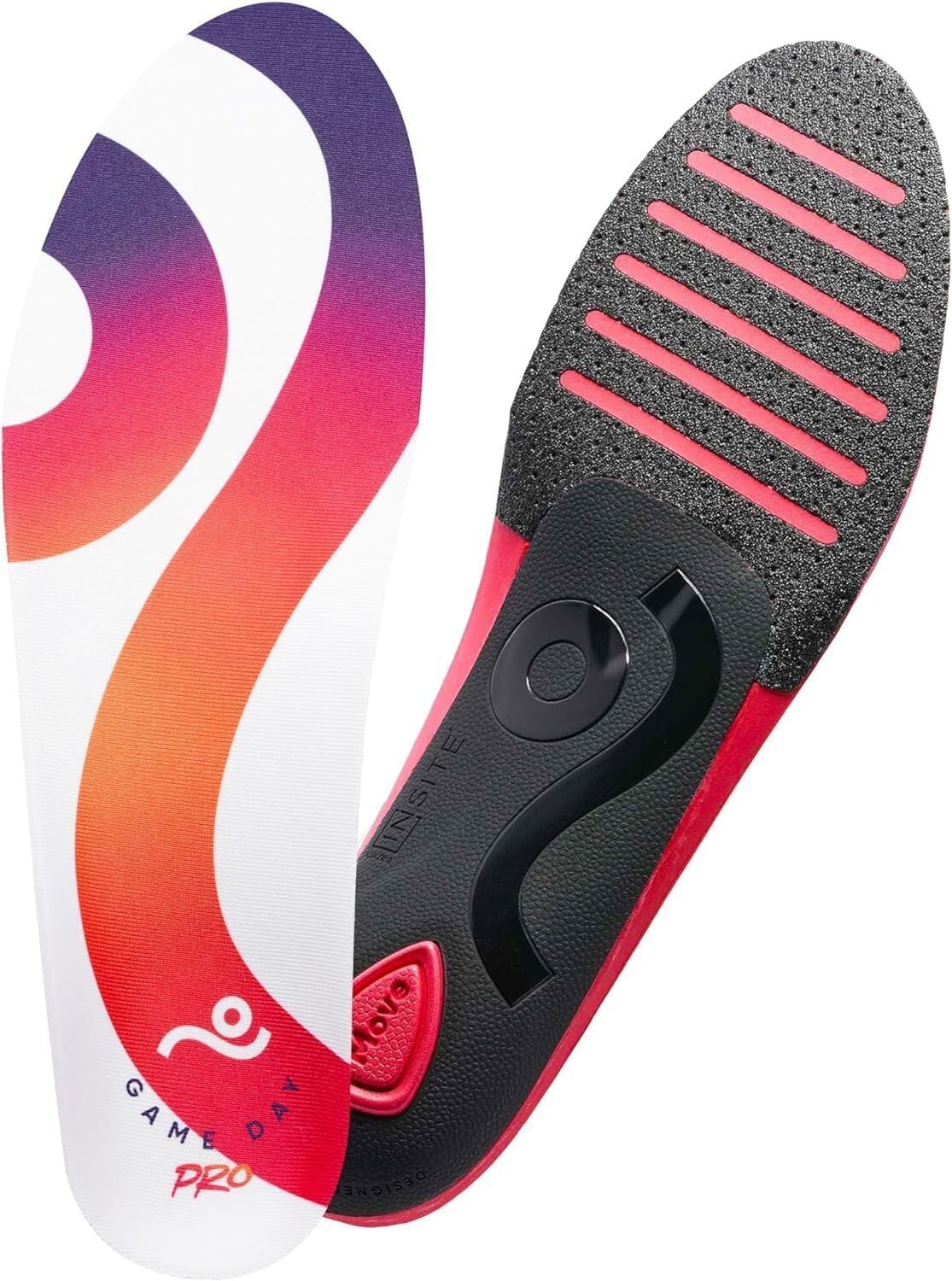
MOVE builds the Game Day Pro around a split: a firm, springy base with a carbon-like composite plate for the push-off, and a softer Shockfree foam under the heel for the landing. An X-Frame under the midfoot ties the two together so the plate doesn’t roll inward when you cut.
That split is why this is the pair we point most basketball players toward first. Jumping is only half the job. The repeated landings, the hard stops and the lateral push make up the rest, and the Pro is the only insole here built around both ends of that cycle. We prefer a firm platform under the forefoot with real cushioning behind it to a uniform slab of gel that feels soft in the hand and vague on the court.
Each size is cut at the factory, so there’s no trimming and no guesswork: pull the stock footbed out, drop the Pro in, play. The first thing we check with any insole is whether it drops into a game shoe without scissors, and this one does. It is a substantial full-length insert, though, so a low-volume shoe that was already snug will feel snugger.
What you’re paying for is the plate and the torsional frame. If your week is mostly pickup runs at the park, the standard Game Day gives you most of the same comfort with a softer ride and less structure. The Pro earns its keep once your schedule includes practices and games you want to be fresh for.
Pros
- Firm, springy platform for takeoff
- Shockfree heel foam softens landings
- X-Frame steadies quick cuts
- No trimming, drops straight in
Cons
- Top cover can wear through with heavy court use
- One of the pricier pairs here
Our pick for jump-heavy basketball: a firm plate for takeoff, real heel cushioning for landings, and torsional support that keeps hard cuts from rolling you over.
MOVE Game Day – Best for All-Day Comfort
Key Features
- Sizing: No trimming required
- Cushioning: Dual-foam, high energy return
- Arch support: Patented contoured shape
- Price: Midrange
The standard Game Day is the Pro’s softer sibling, and the gap between them matters more than the similar name suggests. Both use MOVE’s contoured arch shape and a dual-foam system, but this one leaves out the composite plate and the torsional frame, so it flexes with your foot instead of pushing back.
That makes it the insole to wear from warm-ups to the drive home. The heel is plusher, the fit needs no trimming, and the arch support is built on the same contoured shape as the rest of the line. It also slots into a second pair of shoes more happily than a plated insole does, which counts for a lot if you keep one pair in your game shoes and another in your everyday sneakers.
For recreational players who get on court two or three times a week and want one pair for games and everything else, this is the better buy. The one thing it gives up is torsional rigidity under hard cuts. If you want a firm platform that resists a sharp plant, that’s the Pro, not this.
Pros
- Plusher ride than the Pro
- No trimming required
- Contoured arch support
Cons
- Less torsional support on hard cuts
The pair we suggest for players who want court comfort and everyday cushioning from one insole, with the firm plate and torsional frame left to the Pro.
EASYFEET Flame Boost – Best Value for Energy Return
Key Features
- Sizing: Trim to fit with guides
- Arch shell: 72D thermoplastic polyurethane
- Arch profile: Medium-low
- Shock absorption: PU gel heel and forefoot pads
- Price: Midrange
The box leads with two figures: up to 62% shock absorption and up to 47% energy return. Those are EASYFEET’s numbers, not something we can confirm on a court, so judge the design instead. Gel pads sit under the heel and the ball of the foot, the arch is a firm 72D TPU shell, and an Orxinlite layer is meant to move air under the foot.
Basketball is named in the listing alongside running and training, and the shape reflects it. The shell is firm enough to push back when you load it, the foam body takes the sting out of the strike, and the guide lines across the toe make trimming to your shoe a five-minute job rather than a careful project.
It’s a genuinely springy insole, which is what makes it interesting for jumping, and it’s the pair here where the energy-return idea shows up most clearly under the forefoot. What it isn’t is plush. The cushioning is concentrated in the pads, so a player who wants a soft, sinking landing will find it on the firm side.
We rate it the best value for a springy ride in this set. If you know you need a high arch, this isn’t the shape for you, because the medium-low profile leaves high arches under-supported and no amount of break-in changes that. For a neutral or low arch and a budget that won’t stretch to the premium pairs, it does the job well.
Pros
- Gel pads under heel and forefoot
- Firm 72D TPU arch shell
- Trim guide lines across the toe
Cons
- Heel can break down within weeks
The best energy-return value here: gel under the heel and ball plus a firm arch shell give a springy ride for far less than the premium pairs.
PowerStep Pulse – Best for Foot Pain
Key Features
- Warranty: 60-day guarantee, lifetime arch warranty
- Cushioning: Dual-layer foam, metatarsal pad
- Arch support: Neutral, full-length
- Price: Premium
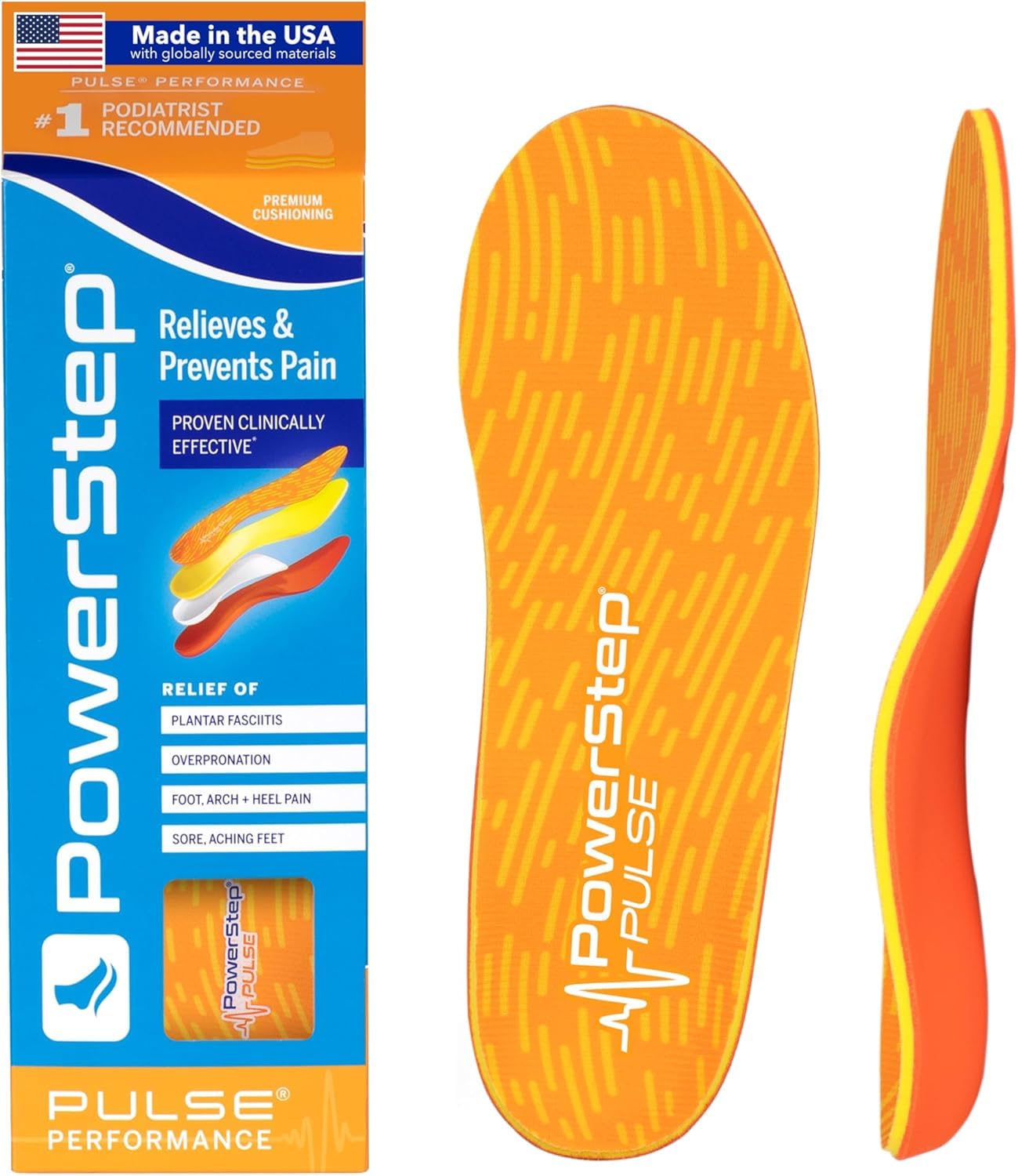
Some players need a spring; others need their arches to stop aching by the second quarter. The Pulse is for the second group: a full-length insole with a neutral-arch shell, a metatarsal pad under the ball of the foot, and dual-layer foam that softens the strike.
We rate it the best foot-pain option in this set, and it’s the pair to try if a flare-up is what sent you looking for insoles in the first place. It’s firm and dense rather than bouncy, so you feel the support more than a spring. That’s exactly what a sore arch wants and not what a player chasing a carbon-plate pop is after.
The neutral arch is the version in this listing, so if you already know you need a high-arch profile, order that one rather than forcing this shape under your foot. The 60-day guarantee and the lifetime warranty on the plastic arch shell are unusually generous for the category.
Pros
- Full-length neutral-arch support
- Metatarsal pad relieves ball-of-foot pressure
- 60-day guarantee and lifetime arch warranty
Cons
- Premium price for a foam insole
The pick for players whose feet hurt: firm, full-length neutral-arch support with a metatarsal pad, backed by a guarantee, and less bounce than the jump-first pairs.
Superfeet High Impact – Best for High Arches
Key Features
- Build: Memory foam, stabilizer cap
- Sizing: Trim to fit
- Shoe fit: Roomy to moderate
- Arch support: Medium to high
- Price: Premium
Superfeet’s high-impact insole is the firmest thing in this roundup, and it makes no apology for it. The arch is built up for medium-to-high feet, a stabilizer cap runs through the midfoot, and the heel sits down in a sculpted cup rather than resting on top of the foam.
There’s memory foam in the arch, but not much plush under the ball of your foot, and on a hard landing you feel the ground through it. That’s the trade: you give up softness and get a platform that holds its shape and doesn’t let your foot slide.
For a high-arched player who lands hard and has rolled an ankle or two, this sits near the top of this set for stability. The heel cup and the cap hold the foot instead of letting it wander. Under a flat or neutral foot, the same shape will feel like standing on a ridge, and no amount of break-in fixes an arch that’s in the wrong place.
It’s trim-to-fit rather than sized to your shoe, so follow the printed cutting guide and size up when you’re between sizes, as Superfeet advises. It’s not the pair to buy in a hurry the night before a game.
Pros
- Medium-to-high arch support
- Stabilizer cap steadies the midfoot
- Trim-to-fit sizing for roomy shoes
Cons
- Runs narrow for wide feet
- Can flatten or separate after a few months
Built for high arches and hard landings: firm, stable and steady underfoot, with a ride that will feel harsh if you’re after cushioning.
Sof Sole Airr – Best Budget Cushioning
Key Features
- Sizing: Men’s 9-10.5
- Forefoot: Gel pad
- Top cover: COOLMAX moisture-wicking
- Heel cushioning: Skydex air bubbles
- Price: Budget
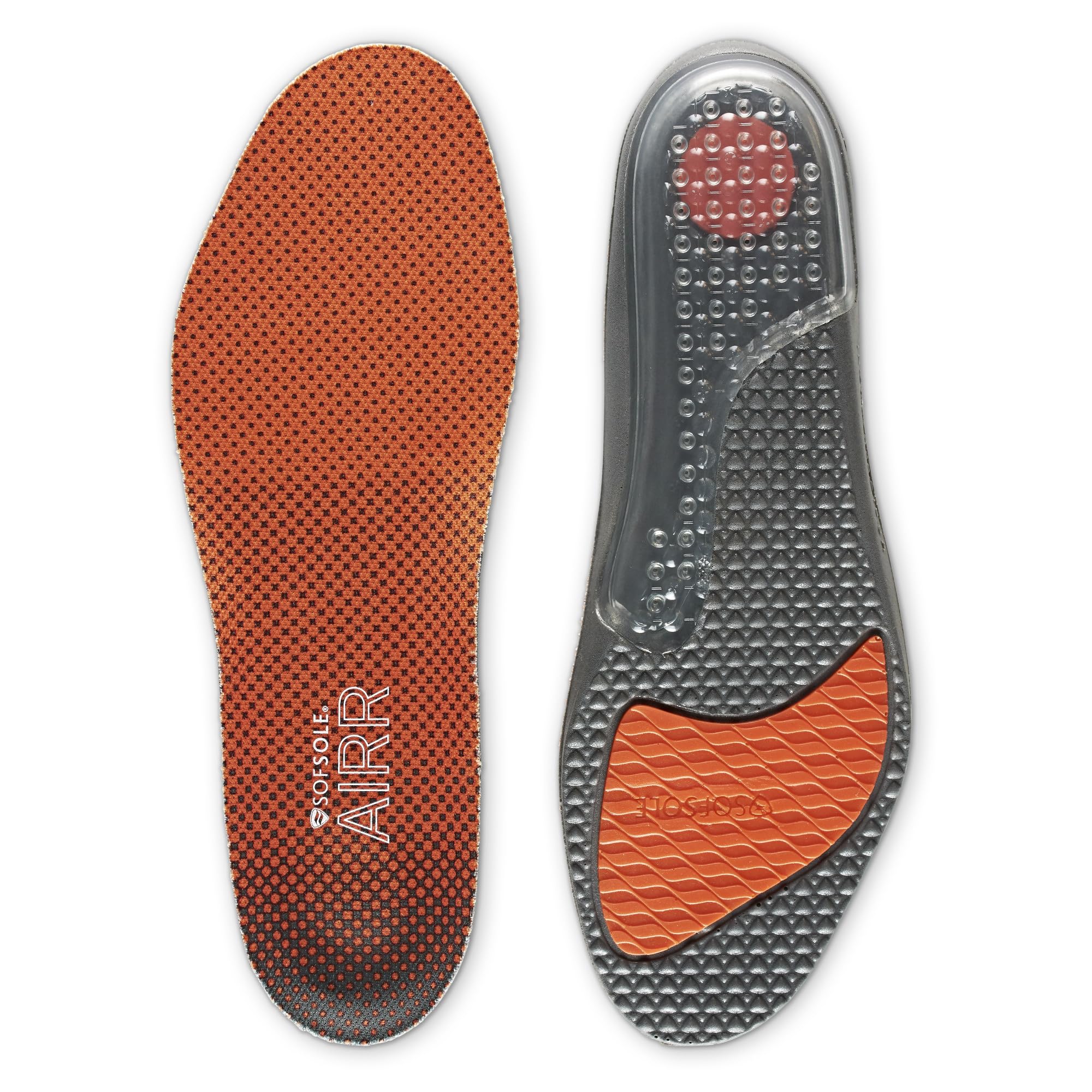
If you want the softest landing for the least money in this set, the Airr is the pair: Skydex air bubbles sit under the heel and arch, a gel pad sits under the forefoot, and a COOLMAX cover handles sweat.
It’s sized to the shoe rather than trimmed, and it runs on the small side. This listing covers men’s 9 to 10.5, so compare that range with your game shoe before you order rather than assuming your sneaker size carries over.
Sof Sole lists it for running, cross training and walking as well as court use, and it’s the pair here that doubles most easily as an everyday insert when the basketball shoes are in the bag. The COOLMAX cover is part of that, and so is the price, which leaves room to keep a second pair in rotation instead of moving one set between shoes every night.
Pros
- Skydex air bubbles absorb heel impact
- Gel pad under the forefoot
- COOLMAX cover manages sweat
Cons
- Thin under the ball of the foot
- Sizing runs small
The value pick for cushioning: air bubbles in the heel and gel in the forefoot soften landings for a lot less than the plated pairs.
CRUVHEAL Sport – Casual Gel Comfort

Key Features
- Break-in: 3-7 days, 2-5 hours daily
- Warranty: 1-year coverage
- Stability: Deep curved heel cup
- Shock absorption: Gel pads, heel and forefoot
- Price: Midrange
CRUVHEAL’s sport insole is the cheapest way into a gel-and-heel-cup design here, and for casual players it’s a fair one. Gel pads sit under the heel and the forefoot, and a deep curved heel cup with non-slip gel holds the back of the foot in place during quick stops.
The brand suggests a three-to-seven-day break-in at two to five hours a day, which is sensible for any of these, and the one-year coverage survives trimming, which is more than most brands offer at this price. Buy it as a cheap test of whether you like a gel feel, or as a second pair for a shoe you only play in occasionally.
Pros
- Gel pads at heel and forefoot
- Deep curved heel cup
- One-year coverage after trimming
Cons
- Bulky heel cup crowds snug shoes
- Runs large in the upper sizes
A cheap way to try gel cushioning and a deep heel cup, best for casual play and everyday wear rather than a dedicated jump shoe.
XEPXEP Carbon Fiber – Budget Carbon Plate

Key Features
- Plate: Aerospace-grade carbon fiber
- Warranty: 1-year warranty, 90-day returns
- Top layer: Honeycomb mesh, PU foam
- Price: Midrange
Carbon-fiber plate insoles tend to sit at the top of the price range. XEPXEP’s version lands in the middle of this set instead, which is the main reason it’s worth a look.
The build is an aerospace-grade carbon plate under a PU foam body, with a honeycomb mesh top meant to move air and sweat. It’s aimed at basketball and running shoes, and the listing covers it with a one-year warranty and a 90-day refund or replacement even after trimming.
The feel is the thing to get used to. The plate reads as springy underfoot, and it takes away some of the softness a foam-first insole gives you, which suits a player who wants a firm platform and frustrates one who wants to sink into the heel. Check the size on the box against your shoe before you play in them.
Our take: it’s the cheapest legitimate way to find out whether a plate suits your game. If it does, the premium pairs add a better heel cup and more structure around the plate. If it doesn’t, you’ve spent mid-range money finding out rather than premium money.
Pros
- Carbon plate at a mid-range price
- Honeycomb mesh top breathes
- 1-year warranty and 90-day returns
Cons
- Springy plate, less cushioning underfoot
The affordable way to test whether a carbon plate suits your game: springy, supportive and well covered by warranty, with less cushioning than the foam-first picks.
How We Tested Basketball Insoles for Jumping
The shortlist started with research rather than shopping. We read through customer reviews for nearly 60 pairs, dropped anything that came in only one arch height or was too thick to sit inside a standard basketball shoe without pushing the foot up into the laces, and cut models with a history of tearing at the ball of the foot. That left 14 pairs, ranging from thin foam inserts to stiff orthotic-style shells. Each pair logged at least three sessions over four months of rec-league games, outdoor blacktop, and solo shootarounds.
Cushioning and firmness were graded by landing on it: rebounding off one foot, coming down heel-first and then on the ball of the foot, and noting whether the foam bottomed out or sprang back. Arch support got checked in the paint — standing, pivoting, boxing out — and if the arch edge dug in mid-play, the pair was done. We trimmed every insole to its owner’s shoe size and wore them in our own game shoes, watching whether the toe box felt cramped or the heel slipped, and whether the laces needed retying at halftime.
Foot relief was measured the unglamorous way: how our arches felt on the stairs the next morning and after a full day standing at work. Durability came down to time on court, specifically whether the top fabric wore through at the ball of the foot and whether the cushioning flattened into a pancake by week six. Functionality and value were judged together — how many months of twice-a-week ball a pair seemed to have in it, and whether the comfort held up past the honeymoon.
How to Choose Basketball Insoles for Jumping
For jumping, the landing matters as much as the takeoff, and the insole that keeps your legs fresh late in a game is usually the one that absorbs impact well rather than the one with the stiffest plate.
Landing Support Before Energy Return
No insole creates force. What a firm plate or a springy foam can do is give back some of the energy you put into it, and what cushioning does is stop each landing from taking more out of you than it has to. Those two jobs pull in different directions, and most insoles lean one way. The MOVE Game Day Pro is our clearest example of a pair that splits them: a composite base for the push-off, a soft foam heel for the landing. If your knees ache the day after you play, put the money into absorption instead of a plate.
The trap is assuming stiffer means more powerful. A plate your foot cannot flex makes the small muscles around your arch work harder, and it only pays off if you already land cleanly and play at speed.
Match the Arch, Then the Firmness
Arch height decides whether an insole feels supportive or like a stone under your foot, and it’s the specification most players skip. A neutral insole such as the PowerStep Pulse suits a foot that needs support without much lift. A medium-to-high shape like the Superfeet High Impact gives a high arch something to rest on and feels wrong under a flat one.
Before you cut anything, take the stock footbed out and stand barefoot on the new insole. If the arch presses hard into the middle of your foot, it’s too high. If your ankle rolls inward when you shift weight, you want more support, not less.
Fitting It Inside a Basketball Shoe
Take the shoe’s own footbed out first; layering an insole on top of it steals toe room and changes how the shoe fits. A cushioned full-length insole takes more space than the flat liner it replaces, so a shoe that was already snug across the forefoot will feel tighter. Loosen the laces before you decide it’s too much, and remember that cleats are the tightest fit of all.
Size-specific pairs like the MOVE insoles skip trimming but commit you to the size chart. Trim-to-fit models need the printed guide followed rather than eyeballed, and if you’re between sizes, size up and trim down.
Break-In and Rotation
A new arch feels like a lump for the first few days even when it’s right. CRUVHEAL’s suggestion of three to seven days at two to five hours a day is a sensible ramp for any of these: wear them around the house and through warm-ups before a game that counts.
If you play several times a week, two pairs rotated between shoes last longer than one pair worn every session, because the foam gets time to recover between runs.
Frequently Asked Questions
Do basketball insoles actually help you jump higher?
Not on their own. No insole adds the force your legs produce. A plate can return a little of the energy you put into it, and a cushioned heel keeps landings from draining you, but the gain shows up as fresher legs late in a game rather than a bigger vertical.
Judge a pair by how your knees and feet feel the day after a hard run, not by a single jump test on the day you unbox them.
Can I wear these insoles in running shoes or cleats?
Most of the pairs here are built for non-cleated athletic shoes, and a full-length insole moves between trainers easily. Cleats are the tight fit: they have less volume and a snugger toe box, so try the insole in the game shoe before you cut anything.
If the shoe was already tight across the forefoot, keep the thinner pair for cleats and put the cushioned one in your basketball trainers.
How long should a pair of insoles last?
Expect the foam to give out before anything else. Retire a pair when the forefoot stops springing back, the top cover wears through, or the heel feels flat under your thumb.
Check them at the start of each season and keep a spare set, especially if you play several times a week. A carbon plate outlasts the foam around it, but a cracked plate ends the pair regardless of how the cushioning looks.
Are the expensive insoles worth it for a basketball player?
The pricier pairs here buy structure: a composite plate, a torsional frame, a firmer arch shell, a deeper heel cup. If you play once a week, a budget pair with decent heel cushioning covers the job.
If you practice and play several times a week, that structure is what holds up under repeated landings, and it’s the difference you notice in the last quarter. If you just want to test a plated feel, the mid-range XEPXEP pair is the cheap way in.
Final Verdict
Start with the MOVE Game Day Pro. It’s the only pair in this set that treats takeoff and landing as separate problems, and the torsional frame is what keeps it steady when a landing turns into a cut.
If your feet hurt more than they need bounce, the PowerStep Pulse is the better buy. And if you want one insole for the court and everywhere else, the standard Game Day is softer and easier to live with.