
This post contains affiliate links. We may earn a small commission when you buy through our links — at no extra cost to you.
Cheap hand pumps often break after a few uses, and electric pumps can stop working within months. The problem isn’t bad luck — it’s picking a pump built for your actual routine, whether that’s topping off a ball before a pickup game or inflating a dozen balls before practice.
Manual dual-action pumps strike a reliable balance between speed and durability, while electric models trade long-term simplicity for quick, effortless inflation. The choice comes down to how often you pump and whether you’re willing to replace batteries or carry a backup.
This guide focuses on pumps that deliver consistent pressure without failing early. The best option for most players is a straightforward manual pump with a gauge, but there are solid electric picks for coaches and frequent users who value speed over longevity.



Best for Occasional Use
Franklin Sports Hand Pump
Key Features
- Power Source: Manual
- Action: Single-action
- Max PSI: 150
- Included Accessories: 3 needles, gauge, bag
- Build Quality: Plastic/metal
- Price: $
The Franklin Sports Hand Pump fits neatly in a sports bag and comes with a pressure gauge, three needles, and a carry bag. The single-action operation is simple enough for a child to use, and the compact design means it travels easily. For the price, it includes everything a casual player needs to top up a ball before a game.
This pump suits anyone who inflates a basketball every few weeks — parents, recreational players, or as a gym-bag spare. For heavier weekly use, the handle may loosen and the needles can snap; it’s built for light duty, not team practice. The gauge is helpful for hitting a consistent pressure, though its accuracy varies enough that players who need precise PSI should double-check with a separate gauge.
Pros
- Compact size fits easily in a sports bag
- Simple to operate, even for children
- Includes pressure gauge, spare needles, and carry bag at a low price
Cons
- Pressure gauge may not be perfectly accurate for fine-tuning
- Handle can loosen and needles may snap under repeated heavy use
For occasional topping off and casual play, this pump delivers everything needed without overspending — just keep it to light duty.
Best for Coaches, Teams
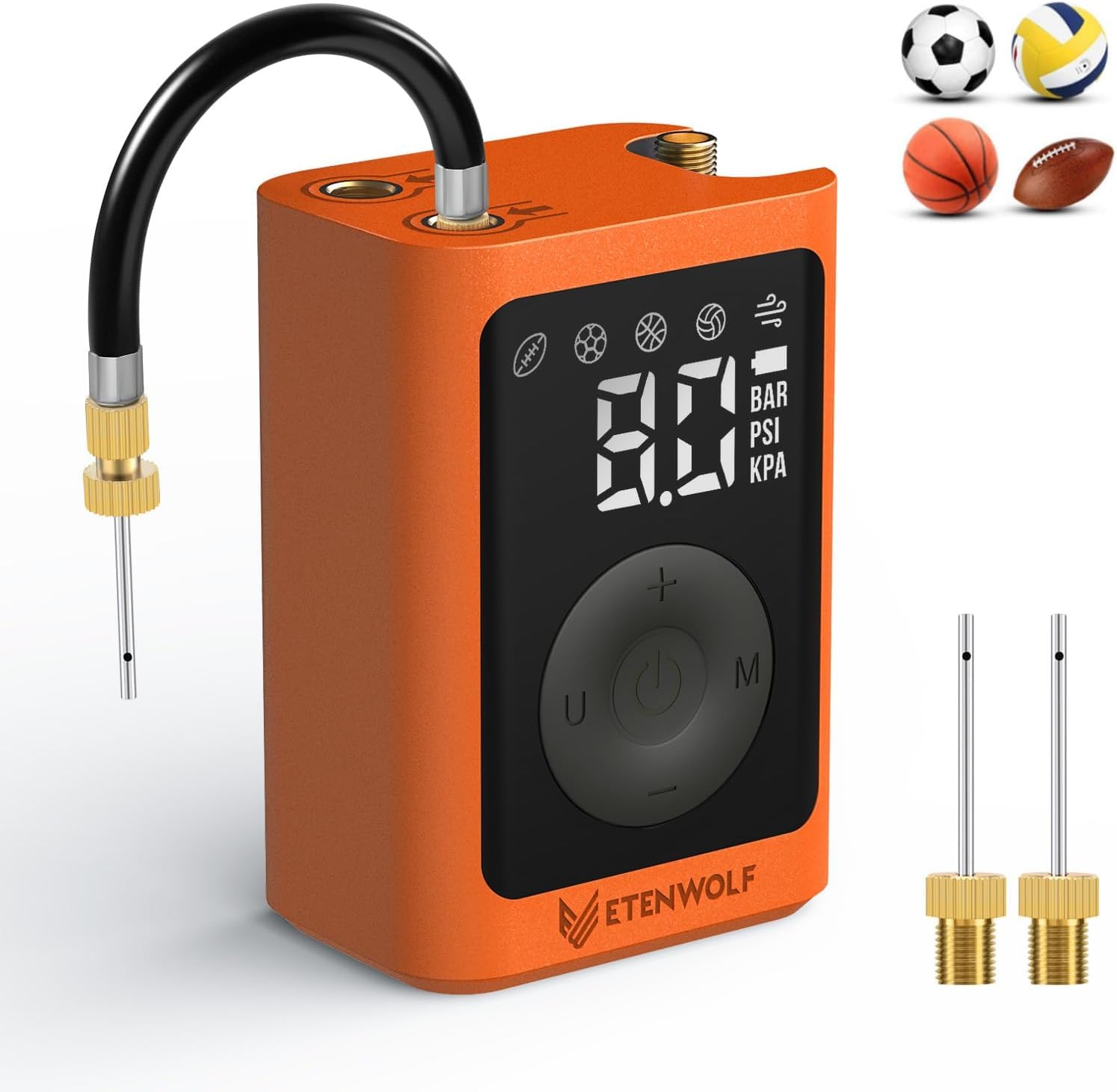
ETENWOLF P300 Plus
Key Features
- Power Source: Electric (rechargeable)
- Action: Auto-stop
- Max PSI: 17
- Included Accessories: 2 needles, hose, bag, USB
- Build Quality: Plastic
- Price: $$
The ETENWOLF P300 Plus skips the small battery trade-off by packing 3200mAh, which keeps it running through multiple game preps without needing a charge. The included flexible hose reaches awkward valve angles, and the deflate function helps adjust over-inflated balls quickly.
This pump suits team users who want one device for a full practice session. A small portion of units have experienced motor issues after a few months of regular use, so it’s worth keeping an eye on performance over time. The felt storage bag is convenient but doesn’t seal shut securely.
Pros
- 3200mAh battery inflates many balls on a single charge.
- Flexible hose reaches awkward valve angles easily.
- Deflate function helps adjust over-inflated balls quickly.
Cons
- Some units may stop working after a few months of use.
- Storage bag doesn’t stay closed securely, a minor inconvenience.
For coaches or frequent users who need a battery that lasts through an entire session, the P300 Plus delivers — just be aware that long-term durability can vary between units.
Best for Travel, Kids
Wilson Dual-Action
Key Features
- Power Source: Manual
- Action: Dual-action
- Included Accessories: Needle in handle
- Build Quality: Plastic
- Price: $
Wilson’s compact dual-action pump delivers on its core promise: inflating a basketball or football with both push and pull strokes, and the built-in needle storage means you won’t lose the needle in your bag. The small size does mean more strokes for a completely flat ball, so it’s best for topping off a slightly low ball or as a spare in a gym bag rather than a primary pump for multiple flat basketballs. Some units may arrive without the included needle, so it’s worth checking the handle upon arrival.
Pros
- Compact with built-in needle storage – easy to carry in a gym bag.
- Dual-action inflates on both strokes – cuts effort compared to single-action pumps.
- Wilson brand at a budget-friendly price – adds confidence for a backup pump.
Cons
- Some units may ship without the needle – check the handle upon arrival.
- Small volume requires many strokes for a flat ball – suited for top-offs, not full inflation from empty.
A convenient backup for basketball players who want a tiny pump that stays in the bag; just verify the needle is included.
Best for Multi-Use, Tires
Franklin Foot Pump
Key Features
- Power Source: Foot-operated
- Action: Single-action
- Max PSI: 100
- Build Quality: Metal
- Price: $$
The Franklin Foot Pump uses a foot pedal so your hands stay free — a practical upgrade from hand pumping if you inflate both balls and bike tires. The alloy steel body gives it a durable feel that plastic pumps lack. However, the built-in gauge can read a few PSI off, and the plastic valve connector may wear down over time. This pump works best for users who want one tool for multiple inflation tasks and don’t mind checking pressure with a separate gauge occasionally.
Pros
- Foot pedal operation reduces hand fatigue during inflation.
- Steel construction feels more durable than plastic alternatives.
- 100 PSI output covers balls, bike tires, and car tires.
Cons
- Pressure gauge can be inaccurate by several PSI — use a separate gauge for precise fills.
- Plastic valve connector may crack or strip over time, especially under repeated use.
A solid choice if you need a single foot pump for both sports balls and tires, as long as you’re willing to double-check pressure with a separate gauge.
Best for Tech Users, Presets
Pumteck MY01 Electric
Key Features
- Power Source: Electric (rechargeable)
- Action: Auto-stop
- Max PSI: 15
- Included Accessories: 2 needles, USB-C cable
- Build Quality: Plastic
- Price: $$
The one-touch presets for basketball, football, soccer, and volleyball take the guesswork out of inflation, and the deflate function is genuinely useful for packing balls or correcting over-inflation. However, the pressure sensor can vary between units, occasionally causing over-inflation or failing to auto-stop – a tradeoff for the added convenience. This pump suits tech-savvy coaches who want quick adjustments and don’t mind double-checking pressure manually, rather than buyers seeking a set-and-forget tool for years of regular use.
Pros
- One-touch presets deliver the right pressure for basketball, football, soccer, and volleyball.
- Deflate function makes packing and correcting over-inflated balls simple.
- Fast inflation with a rechargeable battery that handles multiple balls per charge.
Cons
- Pressure sensor can be inconsistent, leading to over-inflation or failure to auto-stop in some units.
- Battery capacity may degrade with extended use over time.
The MY01 offers real time-savings with presets and deflate, but the pressure-sensor gap makes it a better pick for users who can verify pressure manually than for those wanting fully hands-off reliability.
Best for Kids, Travel
SPORTBIT Dual-Action

Key Features
- Power Source: Manual
- Action: Dual-action
- Max PSI: 15
- Included Accessories: 5 needles
- Build Quality: Plastic
- Price: $
The SPORTBIT Dual-Action pump cuts inflation time by pumping on both push and pull, and its soft-grip handle makes it easy for kids to use. Five included needles add value for light or occasional use. However, some units have shown the pump mechanism or needle failing within weeks, so this is better suited as a travel backup or for a single user than for frequent team practice.
Pros
- Dual-action inflates on both strokes, reducing time to full pressure.
- Includes five replacement needles and a comfortable soft-grip handle.
Cons
- Plastic build can wear out sooner than sturdier alternatives under regular use.
Best as a compact backup or for a single child’s basketball – not for daily team use.
Best for Needle Storage
REVIVL Dual-Action

Key Features
- Power Source: Manual
- Action: Dual-action
- Included Accessories: 5 needles, storage bag
- Build Quality: Plastic
- Price: $
The built-in needle storage prevents misplacing spare needles, a practical touch for tossing this pump into a gym bag or keeping in the car. Dual-action inflates on both strokes, but the small air volume means it may take more strokes to fill a fully flat basketball or larger ball – fine for topping off during a game, slower for inflating from empty. Best as an on-the-go backup for kids or casual use rather than a primary pump for heavy team practice.
Pros
- Handle stores spare needles so you don’t lose them.
- Dual-action inflates on both push and pull strokes.
Cons
- Small air volume slows inflation for larger balls like exercise balls.
A handy travel companion for topping up basketballs and soccer balls, but not the quickest option for inflating a flat exercise ball.
Best for Families, Gifts
MINGRU 3-Pack

Key Features
- Power Source: Manual
- Action: Single-action
- Included Accessories: 4 needles, 2 nozzles
- Build Quality: Plastic
- Price: $
This three-pack offers unbeatable value for households needing pumps in multiple bags or for donation boxes like Operation Christmas Child. Each pump includes needles, nozzles, and a hose, though some units may arrive with pump failures or needle threads that don’t fit standard ball valves — a risk worth noting when buying for reliability-critical use.
Pros
- Great value for three pumps – ideal for families or as gifts.
- Compact and easy to use with various attachments.
Cons
- Some units may arrive with pump failure or needle threads that don’t fit standard valves.
Best for families or gift-givers who need multiple pumps; less suited for scenarios where each pump must work every time.
Best for Accurate Pressure
eBall Pump with Gauge

Key Features
- Power Source: Manual
- Action: Single-action
- Max PSI: 20
- Included Accessories: 3 needles, pouch
- Build Quality: Aluminum/brass
- Price: $$
The eBall pump’s metal build and precise gauge make it a solid choice for fine-tuning ball pressure. But the manual action pushes air slowly – getting a ball from flat to game-ready takes repeated strokes, which can be frustrating if you need quick inflation.
Pros
- Accurate pressure gauge with release valve for fine PSI adjustments
- Durable metal and brass construction with carrying pouch
Cons
- Inflating a flat ball requires many strokes due to slow airflow
Best for players who already have partially-inflated balls and want precise final pressure – not for quickly reviving a flat ball.
Best for Electric Value
ETENWOLF P300

Key Features
- Power Source: Electric (rechargeable)
- Action: Auto-stop
- Max PSI: 17
- Included Accessories: 2 brass needles, USB-C
- Build Quality: Plastic
- Price: $$
This pump’s 17 PSI covers basketballs and most sports balls, and the deflate function is handy for adjusting pressure. The battery holds up well for several inflations, and the integrated needle storage keeps the kit tidy. However, it lacks the hose and bag of the step-up model, and the smaller battery means you’ll recharge sooner with heavy use. Occasional sensor quirks may cause the auto-stop to trigger early or late, so it pays to double-check pressure with a separate gauge.
Pros
- 17 PSI maximum covers basketball, soccer, and volleyballs
- Compact body with built-in needle storage
Cons
- Pressure sensor can occasionally misread, requiring manual pressure checks
A good value for casual use if you don’t mind checking pressure manually and can work without a hose or storage bag.
Best for Compact Electric
HYVOHEX Electric

Key Features
- Power Source: Electric (rechargeable)
- Action: Auto-stop
- Max PSI: 17
- Included Accessories: 1 needle, USB-C
- Build Quality: Plastic
- Price: $$
Measuring pocket-sized fits stash stash stow, the HYVOHEX electric pump inflates a basketball in under a minute. However, some units may lack the USB-C cable, and the 1500mAh battery is smaller than competitors – heavy users may need frequent charging. Best for occasional inflation where portability matters more than runtime.
Pros
- Inflation speed – fills a ball in under a minute.
- Compact design with hidden needle storage for easy portability.
Cons
- USB-C cable may be missing from the package – have a spare cable handy.
Works well if you already own a USB-C charger and only inflate a few balls occasionally.
Best for Budget Backup
Sports Stable Dual-Action

Key Features
- Power Source: Manual
- Action: Dual-action
- Included Accessories: 5 needles
- Build Quality: Plastic
- Price: $
Dual-action inflates basketballs and soccer balls faster than single-action pumps; the compact size slips into a gym bag. The non-threaded needles are proprietary — replacements must come from Sports Stable, and some units have shown durability issues. Best as a spare for occasional use.
Pros
- Inflates balls faster than single-action pumps due to dual-action design.
- Includes five needles with one already installed, saving time unboxing.
Cons
- Needles are non-threaded, making replacements difficult to find outside the brand.
A decent backup pump for the car or gym bag if you don’t mind sourcing replacement needles from Sports Stable.
How to Choose
The most overlooked buying mistake is choosing a pump based only on price or power source, not on how often you’ll actually use it and what pressure you need.
Power Source: Manual vs Electric
Manual pumps are lighter, cheaper, and rarely fail beyond a broken needle. They require physical effort but work every time you need them.
Electric pumps save effort and inflate in under a minute, but rely on batteries and motors that can fail after a few months. If you only pump a ball once a week, manual is simpler. If you inflate a dozen balls before practice, electric saves hours.
Action Type: Single vs Dual
Dual-action pumps push air on both the push and pull strokes, cutting the number of strokes in half. They are noticeably faster than single-action pumps when inflating a basketball from flat.
The trade-off is slightly more complex internals, but most dual-action manual pumps are still very durable. For casual use, either works; for frequent inflation, dual-action saves time.
Maximum PSI
Most basketballs require 7–9 PSI, soccer balls 8–15 PSI, and footballs 12–14 PSI. A pump that reaches at least 15 PSI covers all common sports balls.
Electric pumps often cap at 12–17 PSI — fine for balls but not for bike tires. Manual pumps can go to 100+ PSI. If you need a multi-purpose pump, choose a manual or foot pump with higher max pressure.
Included Accessories
A pressure gauge is the most useful accessory — without it you’ll over- or under-inflate. Many budget pumps include a gauge, but accuracy varies.
Extra needles (at least 2–3) are important because they bend or break. A carry bag helps keep everything together. Some pumps store a needle in the handle, which prevents losing it.
Build Quality and Warranty
Plastic pumps are light and cheap but the handle or valve connector can crack after repeated use. Metal or reinforced plastic handles last longer.
Warranties are rare on sub-$20 pumps. A known brand like Wilson or Franklin Sports typically means better quality control than generic no-name pumps. Check reviews specifically for durability mentions before buying.
FAQ
Can I use a basketball pump for soccer balls and volleyballs?
Yes, because the valve is the same standard needle size across nearly all sports balls. Just make sure the pump’s max PSI covers the ball’s requirement — soccer and volleyball typically need 8–15 PSI, well within any pump listed here.
Why does my electric ball pump stop working after a few months?
The most common cause is a failing pressure sensor or a dying battery. Many electric pumps use inexpensive sensors that drift over time, causing the auto-stop to malfunction. If you need long-term reliability, a manual pump with a separate gauge avoids this failure mode entirely.
What PSI should I set for a basketball?
Official NBA and most recreational basketballs are designed for 7–9 PSI. If you’re unsure, start at 8 PSI and adjust by feel — a properly inflated ball should bounce back to waist height when dropped from shoulder height.
Is a foot pump better than a hand pump for basketballs?
Foot pumps are easier on your arms and can also pump bike tires, but they are bulkier and the built-in gauges are often inaccurate. For basketball-only use, a compact hand pump with a gauge is more portable and just as effective — unless you need the multi-use capability.