
This post contains affiliate links. We may earn a small commission when you buy through our links — at no extra cost to you.
Needles that bend on first use, plastic handles that snap, gauges that read wrong – cheap ball pumps often fail long before they should. The problem isn’t the price tag; it’s the internal seal and needle connection, two details most listings gloss over.
This guide cuts through the guesswork by matching each inflator to the right workload. Whether you need a manual pump for occasional top‑offs or an electric model for team‑sized sessions, the trade‑offs are clear: faster inflation often trades against long‑term durability, and built‑in gauges are reliable only on certain pumps.
The picks here focus on real‑world staying power – the ones where the handle doesn’t snap and the needle stays straight. You’ll see exactly which features matter for your basketball routine and which marketing claims you can ignore.



Best for Family Ball Maintenance
Franklin Sports Ball Kit
Key Features
- Power Source: Manual
- Max PSI: 150
- Included Components: Pump, 3 needles, hose, gauge, carry bag
- Price: $
A complete kit that includes a hand pump, three needles, a pressure gauge, and a storage bag – all for a budget-friendly price. The simple push-pull action is easy enough for kids to use, and the compact size fits neatly into a sports bag or closet. This pump is designed for occasional top-offs, not heavy daily workloads.
For families with a few basketballs, soccer balls, or volleyballs that need an occasional air boost, this kit delivers without fuss. The handle and internal mechanism can wear down if used for extended pumping sessions or aggressive force – it’s built for convenience, not coaching durability. If you’re inflating more than a handful of balls per week, a sturdier pump would be a better fit.
Pros
- Compact and portable with a built-in gauge and storage bag.
- Simple push-pull operation makes it easy for kids to use.
- Consistent performance for topping off sports balls around the house.
Cons
- Handle and internal mechanism can break under aggressive or extended pumping sessions.
This kit fits families who want a simple, affordable pump for occasional ball maintenance. For daily team use or heavy inflation routines, a more robust model is worth the extra spend.
Best for Coaches & Teams
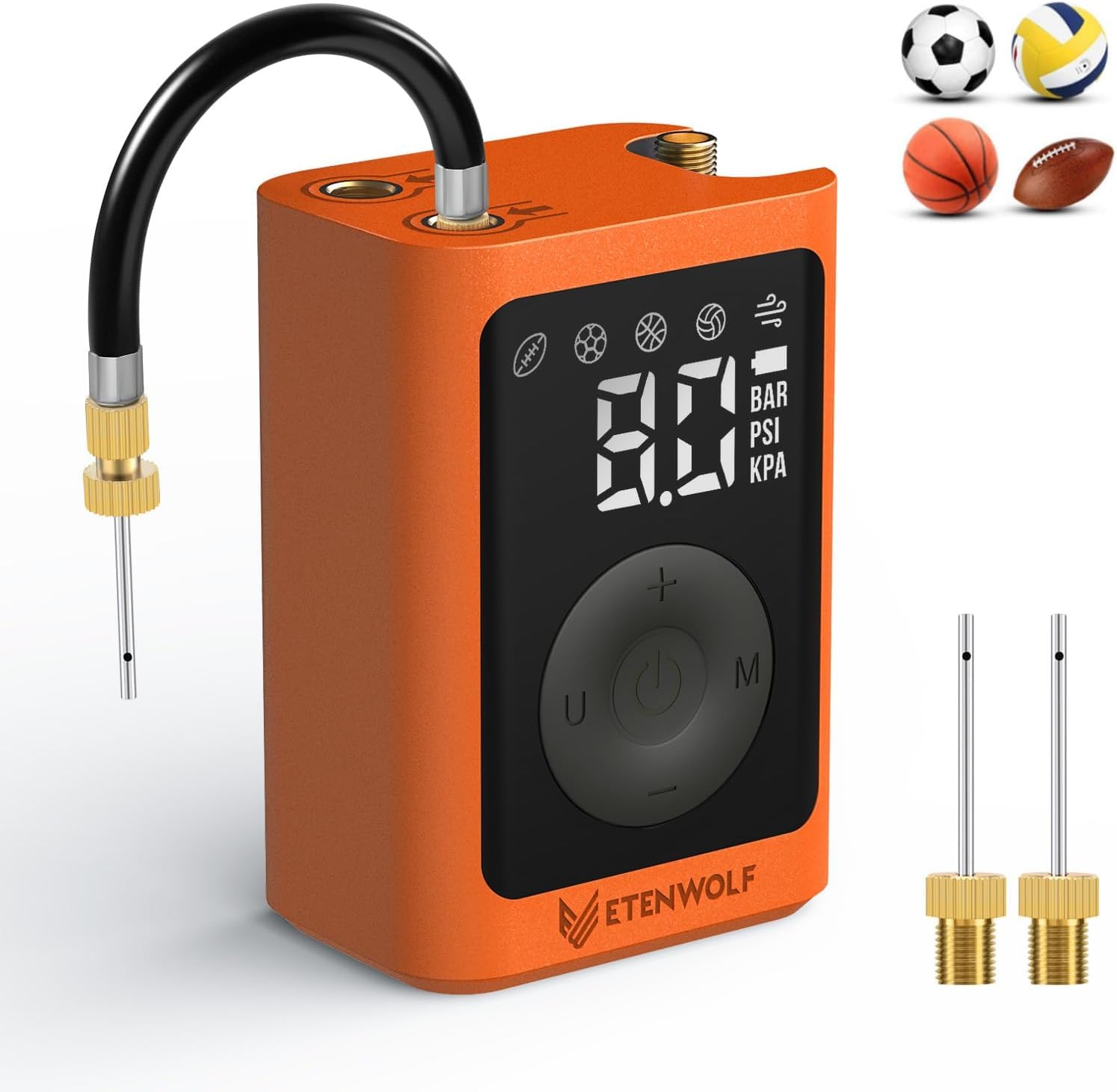
ETENWOLF P300 Plus
Key Features
- Power Source: Rechargeable (3200mAh)
- Max PSI: 17
- Included Components: Pump, 2 brass needles, USB cable, bag, hose
- Price: $$
The P300 Plus stands apart from compact electric pumps by packing a 3200mAh battery that delivers enough capacity for coaches and teams to inflate multiple balls without frequent recharging. It includes a separate air hose and storage bag, making it a complete carry-ready kit. This pump suits anyone who needs a heavy-duty electric option and is comfortable with the possibility of sensor drift over time — warranty support is responsive if issues arise. Its larger size and mid-range price reflect the added battery and accessories, so it’s overkill for light users who only need occasional top-ups.
Pros
- Largest battery in the electric pump set – inflates dozens of balls per charge.
- Includes air hose and storage bag for convenient carrying and storage.
Cons
- Sensor drift can occur after months of use, though warranty support is responsive.
For high-volume ball inflation with minimal recharging, the P300 Plus delivers unmatched battery life and a complete kit — if you get a sound unit, it’s a strong value for teams and coaches.
Best for Budget Fast Inflation
SPORTBIT Push-Pull Pump
Key Features
- Power Source: Manual
- Max PSI: 15
- Included Components: Pump, 5 needles, flexible hose
- Price: $
The SPORTBIT pump uses a push-pull mechanism that moves air on both strokes, so you inflate a ball in roughly half the effort of a standard single-action pump. The soft silicone grip stays comfortable even during repeated use, and the kit includes five needles so you won’t be hunting for a spare mid-game.
This is a smart fit for recreational players and parents who want a faster manual pump without spending much. Keep in mind the seals and pump body can wear out after a few months of regular use – it’s best for occasional top-offs and family sessions rather than weekly team maintenance.
Pros
- Dual-action inflates on push and pull, cutting stroke count in half.
- Comfortable silicone grip stays secure even with sweaty hands.
- Comes with five needles, reducing the need for replacements.
Cons
- No built‑in pressure gauge – you will need a separate gauge for accurate inflation.
- Internal seals and pump body may develop leaks after months of regular use.
Best for occasional ball top‑offs and family use where speed matters more than longevity.
Best for Budget Electric Inflation
ETENWOLF P300 Electric
Key Features
- Power Source: Rechargeable (2600mAh)
- Max PSI: 17
- Included Components: Pump, 2 brass needles, USB cable, storage bag
- Price: $
The ETENWOLF P300 hits target pressures within 0.3 PSI and holds enough charge for 30+ ball inflations, making it a natural fit for cost-conscious coaches or families who regularly top off soccer and basketballs. Some units may develop sensor errors or stop charging after several months – a tradeoff acceptable when upfront savings matter more than long-term consistency.
Pros
- Auto-shutoff stops within 0.3 PSI of your target – no over-inflating or constant checking.
- One charge handles multiple sessions; owners report inflating 30+ balls before needing a recharge.
- Compact enough to toss in a gear bag with the included storage pouch.
Cons
- A minority of units can stop charging or produce sensor errors after a few months of use.
If you want electric inflation without the premium price and can accept occasional unit variance, the P300 is a smart buy for regular ball maintenance.
Best for Multi‑sport Households
Franklin Foot Pump
Key Features
- Power Source: Foot pedal
- Max PSI: 100
- Included Components: Foot pump, hose, adapters
- Price: $$
This foot pump reaches 100 PSI, making it useful for bike and car tires alongside basketballs and soccer balls. The foot operation is more comfortable than hand pumping for larger volumes, and the alloy steel body feels sturdier than plastic alternatives.
Best for households that maintain bikes or cars and want one pump for multiple inflatables. The built-in pressure gauge can be off by several PSI, so those who need precise ball pressure should keep a separate gauge handy – the pump itself is capable, but the gauge is not a reliable reference point.
Pros
- High 100 PSI maximum handles tires and sports balls alike.
- Foot pedal operation is faster and less tiring than hand pumps for large volumes.
- Alloy steel construction adds durability compared to plastic hand pumps.
Cons
- Pressure gauge readings may be inaccurate – best to use a separate gauge for precise ball inflation.
- The gauge mounting and hose connection can wear over time, potentially causing leaks.
Best for anyone who needs a single pump for tires and balls and doesn’t mind double-checking pressure with a separate gauge – its real strength is versatility, not precision.
Best for Tech‑friendly Users
Pumteck MY01 Electric
Key Features
- Power Source: Rechargeable (USB‑C)
- Max PSI: 15
- Included Components: Pump, USB‑C cable, 2 needles, manual
- Price: $$
The Pumteck MY01 sets itself apart with four preset modes that let you inflate a basketball, soccer ball, football, or volleyball at the press of a button — no manual guesswork. The built-in deflation function is a practical addition for dialing back over-inflated balls. This pump suits tech-savvy users or coaches who handle multiple ball types and want quick, repeatable results. However, the pressure sensor may drift over time, so occasional manual checks with a separate gauge are advisable for precision work.
Pros
- Four preset ball modes for one-button inflation of basketball, soccer, football, and volleyball.
- Deflation function allows precise adjustment of over-inflated balls.
- Compact body with built-in needle storage for easy portability.
Cons
- Pressure sensor accuracy can drift over time, potentially leading to over- or under-inflation.
If you manage multiple ball types and want electric convenience with deflation, the MY01 is a capable choice – just keep a manual gauge handy to verify pressure over time.
Best for Ultra‑portable Top‑ups
REVIVL Dual Action Pump

Key Features
- Power Source: Manual
- Included Components: Pump, 5 needles, flexible hose, storage bag
- Price: $
This pump’s main advantage is its size — small enough to drop into any bag without adding weight. The built‑in needle storage keeps the set together, and the dual‑action mechanism with a flexible hose reduces strain on the needle during use. However, the tradeoff for that portability is low air volume per stroke; inflating a completely flat ball takes considerably longer than most manual pumps. This is a pump for quick top‑ups on already‑inflated balls, not for re‑inflating from scratch.
Pros
- Dual-action design with flexible hose helps prevent needle bending.
- Needle storage inside the handle keeps accessories organized and prevents loss.
Cons
- Plastic housing and internal seal may degrade over time with regular use.
Best as a backup or bag‑carry pump for athletes who only need occasional top‑ups, not for fully inflating flat balls.
Best for Precision Inflation
eBall Manual Pump

Key Features
- Power Source: Manual
- Max PSI: 20
- Included Components: Pump, 3 needles, hose, storage pouch
- Price: $$
All-metal construction with aluminum and brass gives this pump a durable feel, while the built-in gauge and release valve enable precise inflation. The compact design includes a storage pouch for portability. But airflow is slow — inflating a completely flat ball requires many strokes, so this works best for topping off already-inflated balls rather than full inflation from empty.
Pros
- All-metal aluminum body with brass fittings feels durable and premium.
- Built-in pressure gauge and release valve allow exact pressure adjustment.
Cons
- Slow airflow requires many strokes to inflate a completely flat ball from empty.
Best for volleyball or basketball players who already have partially inflated balls and want to dial in precise pressure — skip this if you regularly inflate flat balls from scratch.
Best for Tiny Backup Pump
Wilson 6" Dual Action

Key Features
- Power Source: Manual
- Included Components: Pump with one needle
- Price: $
The Wilson 6-inch dual-action pump is about as small as a manual pump gets — the needle stores in the handle, and the dual-action mechanism cuts strokes in half compared to basic pumps. That speed advantage disappears when you need to bring a completely flat ball back to life: the small cylinder delivers low air volume per stroke, so full inflations take noticeable effort. Packaging inconsistency means the needle may be missing from the box, so checking the package is a good habit. This pump works best as an emergency backup for someone who already has a main pump at home — not as the go-to solution for regular ball prep.
Pros
- Fits in a pocket or gym-bag pouch with needle stored inside the handle.
- Dual-action inflates on both strokes, making it faster than single-action mini pumps.
Cons
- Underpowered for reviving a fully flat ball from scratch — many strokes needed per ball.
Grab this only if you need a just-in-case pump for the car or kid’s sports bag and already have a faster option at home.
Best for Screw‑fit Needle Value
Sports Stable Dual Action

Key Features
- Power Source: Manual
- Included Components: Pump, 5 needles
- Price: $
The screw‑fit needle connection reduces air leaks and wobble, making this a capable budget dual‑action pump. However, the needles are non‑standard and hard to replace if lost, and the plastic build is less durable than pricier options. Best for occasional use where needle loss is unlikely.
Pros
- Screw‑fit needle connection reduces air leaks and wobble during pumping.
- Comes with five needles stored inside the pump body.
Cons
- Non‑standard needles require proprietary replacements if lost or bent.
A decent choice for budget‑conscious buyers who prioritize secure needle fit over easy replacement – best for occasional use where spare needles aren’t a concern.
Best for Palm‑sized Electric
HYVOHEX Electric Pump

Key Features
- Power Source: Rechargeable (1500mAh)
- Max PSI: 17
- Included Components: Pump, 1 needle, USB‑C cable
- Price: $
Palm-sized and fast – fully inflates a ball in under a minute. The 1500mAh battery is smaller than alternatives, and some units ship without a USB-C cable, making it a slight gamble given the new brand.
Pros
- Pocket-sized design – easy to carry for travel.
- Fast inflation – fills a ball in under a minute.
Cons
- Charging cable may be absent from the packaging – plan accordingly.
Works well for a traveler who already has a USB-C cable on hand and wants the smallest electric pump available.
Best for Basic Electric Inflation
Pumteck Electric Pump

Key Features
- Power Source: Rechargeable (2000mAh)
- Max PSI: 12
- Included Components: Pump, USB cable, case
- Price: $$
Inflation is fast and hands‑free for soccer and basketball balls up to 12 PSI. The auto‑shutoff saves time during practice. However, the pump cannot reach the 13 PSI needed for footballs. Battery and sensor reliability varies between units, making it best for occasional use rather than daily coaching.
Pros
- Automatic inflation to a preset PSI — no manual pumping needed.
- Fast inflation — fully inflates a ball in 1–2 minutes.
Cons
- Maximum pressure of 12 PSI — not enough for footballs and some other balls.
Best as a backup pump for basketball and soccer balls if you don’t need more than 12 PSI and accept the possibility of unit variance.
Best for Cheapest Dual‑action
ouyili Dual Action Kit

Key Features
- Power Source: Manual
- Included Components: Pump, 4 needles, hose
- Price: $
Dual‑action pumping inflates balls in half the strokes of a single‑action pump, and the compact body with four needles and a flexible hose tucks easily into a car or gym bag. However, the needles can bend on first contact with a stiff valve, and the plastic pump body feels light‑duty. This is a budget‑minded backup option for occasional top‑offs, not a daily driver for team practices.
Pros
- Dual‑action inflates balls in half the strokes of a single‑action pump.
- Compact size with four needles and flexible hose — easy to stash in a bag.
Cons
- Needles may bend on first use; pump feels light‑duty overall.
A cost‑effective backup pump for occasional ball top‑offs at home or in the car, but not built for regular or heavy use.
Best for Budget Storage Gimmick
Villkin Hand Pump

Key Features
- Power Source: Manual
- Included Components: Pump, 4 needles, 2 nozzles, hose
- Price: $
This budget pump keeps needles organized inside the handle and includes a flexible hose plus extra nozzles for various inflatables — convenient for occasional home use. The storage compartment holds only two of the four included needles, contrary to the description, and the single-action mechanism means slower inflation compared to dual-action pumps.
Pros
- Built-in handle storage keeps needles and nozzles together for easy access.
- Includes flexible hose, four metal needles, and two plastic nozzles for different inflatables.
Cons
- Storage compartment fits only two of the four included needles, not all as advertised.
Ideal for home users who want a cheap pump with handy storage and don’t mind slower inflation or the storage discrepancy.
Best for Emergency Backup Only
HDNNC Portable Pump

Key Features
- Power Source: Manual
- Max PSI: 20
- Included Components: Pump, hose, 4 needles, 2 nozzles
- Price: $
At under six dollars, this pump includes a hose, four needles, and two tapered nozzles in a package that fits any bag. The catch is in the construction: the needle can bend and the pump mechanism may stop working after one or two inflations. This is a last‑resort backup for when you need air once and can afford to toss it afterward, not a tool for regular use.
Pros
- Ultra‑low price with multiple adapters for balls and inflatables.
- Compact enough to stash in a glove box or small bag.
Cons
- Build quality is fragile — needle bending or pump failure can happen on first use.
Fine as a disposable emergency pump stashed in a car or for a child who loses gear, but expect it to need replacing after one or two inflations.
How to Choose
The durability of a ball inflator depends less on the brand and more on the needle connection and internal seal – two specs most listings never mention.
Manual vs. Electric Operation
Manual pumps are cheaper, simpler, and never run out of battery. But the physical effort adds up fast if you inflate multiple balls or top off a completely flat basketball from zero – expect 40–60 strokes with a single‑action pump.
Electric pumps save time and effort, but their internal seals and pressure sensors are the first failure points. A $25 electric pump that dies after three months costs more per use than a $10 manual that lasts a year.
Maximum PSI
Basketballs typically need 7–9 PSI, soccer balls 8–12, and footballs 13. A pump rated to 15 PSI covers all three. Pumps that claim 100+ PSI (like foot pumps) are overbuilt for balls but useful for bike tires – though their gauges for low pressures are often inaccurate.
The trap: some electric pumps hard‑cap at 12 PSI, which is fine for basketball but too low for footballs. Always check the PSI ceiling against the balls you actually own.
Dual-Action Mechanism
Dual‑action pumps inflate on both the push and pull strokes, roughly doubling air volume per cycle. For a manual pump, this cuts inflation time nearly in half – a real difference when you’re pumping up a flat ball before practice.
The trade‑off: dual‑action pumps often have more moving parts and plastic internals that can wear out faster than a simple single‑action design. Choose dual‑action for speed, single‑action for longevity.
Included Accessories
Most kits come with needles, a hose, and sometimes a gauge. The gauge is the most variable component – cheap built‑in gauges can be off by 2‑3 PSI, which is enough to make a basketball feel dead or overinflated.
Extra needles are valuable because the thin metal bends easily, especially if you don’t lubricate the tip before inserting. Five needles in a kit is a useful buffer, but the needle connection type (screw‑fit vs. push‑on) matters more for air leaks.
Battery Capacity & Charging
Electric pumps use lithium‑ion batteries ranging from 1500mAh to 3200mAh. A 2000mAh battery typically inflates 20–30 balls per charge – enough for a full practice. Higher capacity adds weight and cost but reduces recharge frequency.
USB‑C charging is now standard, but battery longevity is the hidden risk. Many units stop holding a charge after 6–12 months because the internal battery management circuit fails, not the cells themselves. This is a known pattern in budget electric pumps.
FAQ
Why does my ball pump needle keep bending?
Needles bend most often because they aren’t lubricated before insertion. A drop of saliva or water on the needle tip reduces friction and prevents the metal from catching on the valve wall. Bent needles can also result from inserting at an angle – always push straight in. Replace a bent needle immediately to avoid damaging the ball valve.
How accurate is the pressure gauge on a foot pump for basketballs?
Foot pump gauges at this price point ($20–$30) are notoriously inaccurate, often reading 2–4 PSI off. For a basketball needing 8 PSI, that error can mean the difference between a bouncy ball and a flat one. Use a separate digital gauge for critical pressure, or rely on a manual pump with a better‑rated gauge like the Franklin Ball Kit.
Can I use an electric ball pump for bike tires?
Only if the electric pump exceeds the bike tire’s required PSI. Most electric ball pumps cap at 15 PSI, while road bike tires need 80–100 PSI. Using them for bike tires will either underinflate or damage the pump. Foot pumps and some manual pumps that reach 100+ PSI are safe for both balls and bikes, but their built‑in gauges are unreliable for low pressures.
What is dual-action on a ball pump and does it really help?
Dual‑action means the pump inflates on both the push and pull stroke, doubling the air volume per cycle compared to a single‑action pump. Yes, it significantly reduces the number of strokes needed – about half the effort to inflate a flat basketball. The trade‑off is slightly more mechanical complexity, which can lead to earlier failure in budget models.