
This post contains affiliate links. We may earn a small commission when you buy through our links — at no extra cost to you.
The adjustable basketball hoop market is full of claims like ‘shatterproof’ backboards and ‘professional-grade’ performance. In practice, many hoops wobble on hard shots, crack within months, or require a weekend of frustration to assemble.
The key to a good purchase is matching the hoop to your actual use. A 44-inch polycarbonate backboard works for kids’ driveway games but won’t survive hanging on the rim. Serious players need a glass in-ground system—and should expect trade-offs in installation and cost.
This guide focuses on real-world reliability, not marketing specs. The right hoop for you is the one that actually holds up to your regular play, not the one with the most impressive tagline.


Best for Families & Beginners
Lifetime 44" Impact Portable
Key Features
- Backboard: 44" Impact acrylic
- Height Range: 7.5 – 10 ft
- Adjustment: Telescoping mechanism
- Base Stability: 27-gallon water/sand
- Mount Type: Portable
- Price: $$
After thousands of owners put this hoop through daily driveway use, the feedback is clear: the Lifetime 44" Impact delivers dependable performance for a third of what similar-sized portables cost. The acrylic backboard handles normal shooting without cracking, and the steel rim with braces stays straight through years of family games. That kind of track record is rare at this price point.
The tradeoff for that low price? Assembly is a two-person, two-hour job with diagram-only instructions that can be confusing. And once set up, adjusting height requires some muscle — the telescoping mechanism can bind if bolts are over-tightened. These are real hurdles, but they’re one-time setup tasks that don’t affect day-to-day shooting.
This hoop is ideal for budget-conscious families with kids aged 6–14 who want a name-brand system without overspending. First-time buyers will appreciate the huge community of owners — replacement parts and tips are easy to find. If you’re a serious high school player or need a glass backboard, look at the Silverback 48" instead.
Pros
- Value that few competitors match at this price point with a decade of satisfied owner feedback
- Sturdy enough for family use without wobble during normal shooting sessions
- Clear height adjustability works well once set, letting the hoop grow with younger players
Cons
- If you’re assembling alone, expect confusion from diagram-only instructions and many small parts that require careful sorting
- When you need to change height without a second adult, the telescoping mechanism can bind if bolts are overtightened
Best for families who want a reliable hoop at a low price and don’t mind a one-time assembly project.
Best for Serious Players
Silverback In-Ground 60"
Key Features
- Backboard: 60" tempered glass
- Height Range: 7.5 – 10 ft
- Adjustment: All-steel actuator
- Base Stability: Concrete anchor
- Mount Type: In-ground
- Price: $$$
The Silverback’s 60-inch tempered glass backboard provides a true, consistent rebound that matches much more expensive hoops. The trade-off comes with the two-piece pole – hard shots and dunks cause noticeable wobble that a vibration dampener can reduce.
This hoop is for homeowners who can pour concrete and want permanent installation, and for serious players who prioritize authentic rebound over zero flex. The 150-pound glass backboard requires three to four people to install.
Pros
- Tempered glass backboard delivers a true, consistent rebound.
- Good value compared to other glass in-ground basketball hoops.
Cons
- Noticeable wobble on hard shots due to two-piece pole design – a vibration dampener can reduce it.
Serious players who want glass rebound without paying Goalrilla prices should consider the Silverback – just plan for a vibration dampener to address the pole flex.
Best for Large Backboard Fans
Lifetime 48" Speed Shift
Key Features
- Backboard: 48" polycarbonate
- Height Range: 8 – 10 ft
- Adjustment: Speed Shift lever
- Base Stability: 31-gallon water/sand
- Mount Type: Portable
- Price: $$
The 48-inch polycarbonate backboard gives you a noticeably larger target and better rebound than the top pick’s 44-inch board, and the Speed Shift lever adjusts height with one hand — no wrestling with pins or tools. That convenience comes at a cost: putting this hoop together is a multi-hour ordeal with confusing diagrams and a high parts count. Families who prioritize a bigger playing surface and easy height changes and can dedicate a weekend to assembly will find this a rewarding upgrade over the standard Lifetime models.
Pros
- One-handed Speed Shift lever makes height adjustment the easiest in this class.
- 48-inch backdoor offers a larger target and better rebound than most portable hoops.
- Sturdy base and pole design hold up well in wind and weather.
Cons
- Assembly instructions include errors and QR code videos don’t always match the exact model.
- Putting it together is notoriously difficult — expect 4+ hours even with mechanical experience.
A smart pick if you want the largest backboard in this price range and the smoothest height adjuster, but only if you have the time and patience for a complex assembly process.
Best for Frequent Height Changers
Yohood Quick Adjust 44"
Key Features
- Backboard: 44" PC (or 48" option)
- Height Range: 5.25 – 10 ft
- Adjustment: Rotating handle
- Base Stability: Water/sand up to 150 lbs
- Mount Type: Portable
- Price: $$
The rotating‑handle mechanism on this Yohood hoop lets you adjust the height from 5.25 to 10 feet in seconds — no pin‑pulling or wrestling with bolts. That convenience is the main reason to choose it over the top‑pick Lifetime 44", which requires a more awkward screw‑type system. The triangular support and a base that holds up to 150 lbs of water or sand give it a planted feel for a portable, and the polycarbonate backboard offers a clean rebound.
For families who regularly drop the rim for younger kids and raise it back for adults, this is the most practical option in the mid‑range. The tradeoff: durability under heavy use isn’t as proven as the Lifetime. A number of owners encountered rim bending after a year, especially if the hoop tips over in wind. Assembly also demands patience — plan for a few hours and careful reading of the instructions.
Pros
- Quick height adjustment with a rotating handle — tool‑free and genuinely fast.
- Stable when base is filled; triangular frame adds rigidity for a portable.
- Quality materials and clear instructions make setup manageable despite the complexity.
Cons
- Assembly is time‑consuming and requires careful attention to detail.
- Rim bending or backboard damage has been reported after a storm or repeated hard use.
If you change hoop height often and want a portable that stays put, the Yohood delivers where it matters most — just be aware that long‑term toughness isn’t its strong suit.
Best for Value & Support
AWII SPORT 44" Portable
Key Features
- Backboard: 40/44/48" impact PC
- Height Range: 5.5 – 10 ft
- Adjustment: 10-level push-button
- Base Stability: Triangular water/sand
- Mount Type: Portable
- Price: $$
The AWII SPORT delivers a stable playing surface even on uneven ground, thanks to its triangular base that holds water or sand. Height adjustment is quick via a push‑button mechanism — no tools needed. Where it differs from the top pick is the trade‑off: the rim can bend if the hoop tips over in wind, though the company offers free replacements. This suits families who prioritize easy setup and good support over absolute durability in exposed locations.
Pros
- Stable base on uneven surfaces, with good build quality from the triangular support design.
- Tool‑free height adjustment via a push‑button system that changes levels quickly.
- Responsive customer service that sends free rim replacements when wind damage occurs.
Cons
- In strong wind the hoop can tip, bending the rim — the company replaces it, but it’s an extra step.
- The included net may fray or tangle sooner than expected.
A smart choice for families who want easy height changes and a brand that stands behind its product — just keep it out of open, windy areas if you’d rather skip a warranty claim.
Best for Space-Saving
Silverback Wall Mount 54"

Key Features
- Backboard: 54" polycarbonate
- Height Range: 7.5 – 10 ft
- Adjustment: All-steel actuator
- Base Stability: Wall anchors (not incl.)
- Mount Type: Wall-mount
- Price: $$
This wall-mounted hoop delivers a big 54-inch playing surface without the driveway footprint of a portable base. Stability is excellent when secured to a solid brick or garage wall. However, mounting hardware is not included (buyer must source bolts separately), and the polycarbonate backboard lacks the crisp rebound of glass—a fine tradeoff for recreational play but not for serious practice.
Pros
- Sturdy and solid when installed on a solid wall – feels more stable than portable hoops.
- Space-saving wall mount design frees up driveway space for narrow garages or driveways.
Cons
- Mounting hardware is not included, requiring a separate trip to the hardware store.
Best for homeowners with a solid wall who want a permanent, space-saving hoop and are comfortable sourcing their own mounting bolts.
Best for Ultra-Budget
DUMOS 10ft Portable
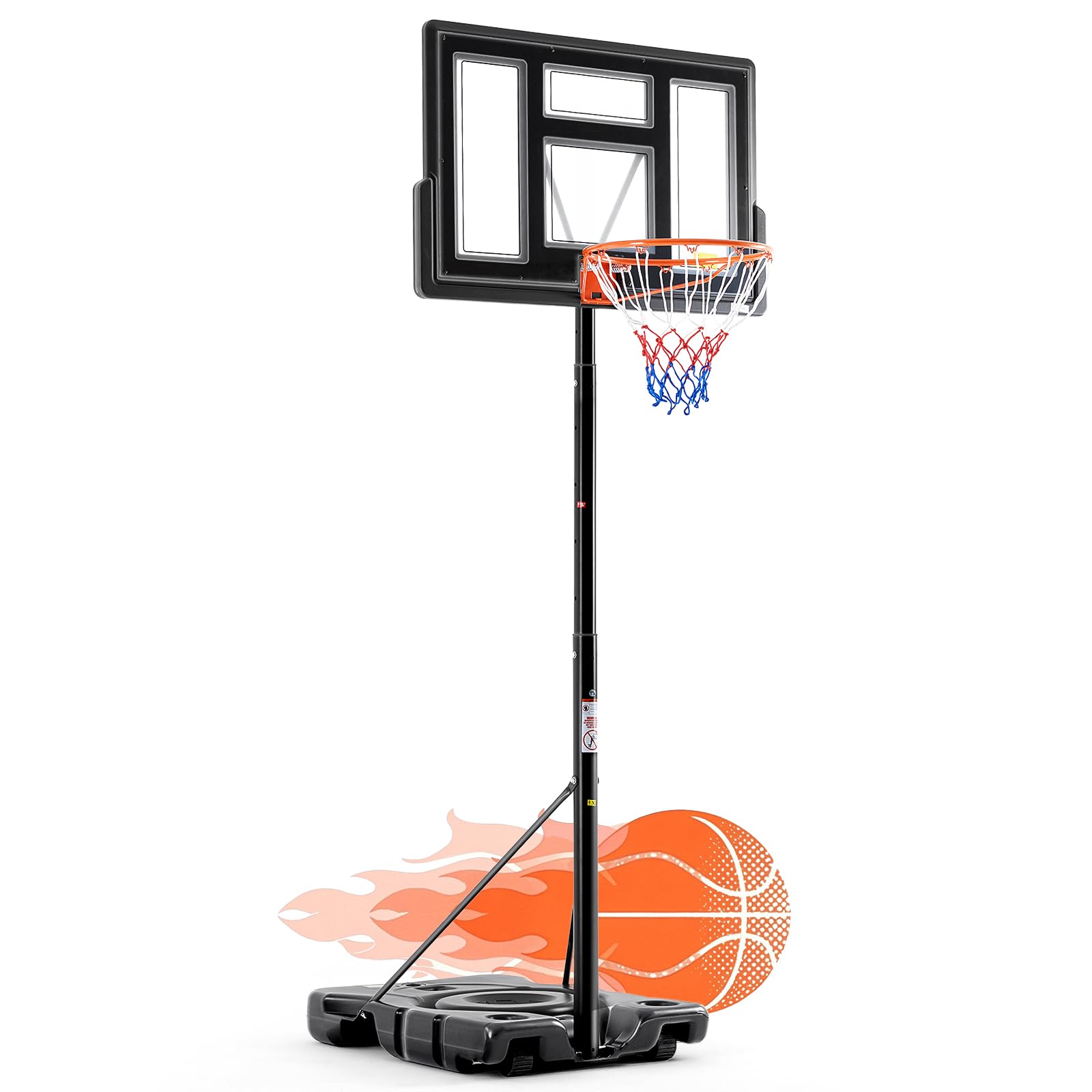
Key Features
- Backboard: 44" polycarbonate
- Height Range: 6.1 – 10 ft
- Adjustment: Bolt removal
- Base Stability: Fillable (not specified)
- Mount Type: Portable
- Price: $
Assembles quickly with clear instructions and feels sturdier than its price suggests. However, durability is uncertain – some units have experienced rim bending, backboard warping, or base leaks after limited use. This suits light, occasional play where cost is the primary concern.
Pros
- Excellent price for a full-size adjustable hoop – hard to beat under $100.
- Assembles quickly with clear instructions.
Cons
- Durability concerns – rim may bend, backboard may warp, base may leak after limited use.
A budget-friendly option for light, occasional use if you’re willing to accept potential durability tradeoffs.
Best for Young Kids
Yohood Kids 8.5ft

Key Features
- Backboard: PC (size not given)
- Height Range: 4.82 – 8.53 ft
- Adjustment: 12 levels via pole
- Base Stability: Water/sand up to 93 lbs
- Mount Type: Portable
- Price: $
Assembly takes under an hour with clear instructions, and the 12-level adjustment lets the hoop grow with a child from toddler to age seven. The low price and light weight also make it easy to move indoors or out. However, the backboard and rim may develop cracks or bend after a few months of regular play – this hoop is best kept for occasional, gentle use by younger kids who will outgrow it before durability becomes a concern.
Pros
- Easy assembly with labeled parts – most people finish under an hour.
- 12‑level height adjustment covers toddlers through age seven.
Cons
- Backboard and rim may bend or crack within months under regular use – suited for light, occasional play.
This hoop works well for toddlers and preschoolers who will outgrow it before wear becomes an issue. For older kids or regular driveway use, consider a more durable portable system.
Best for Toddlers
Yohood Kids 7ft
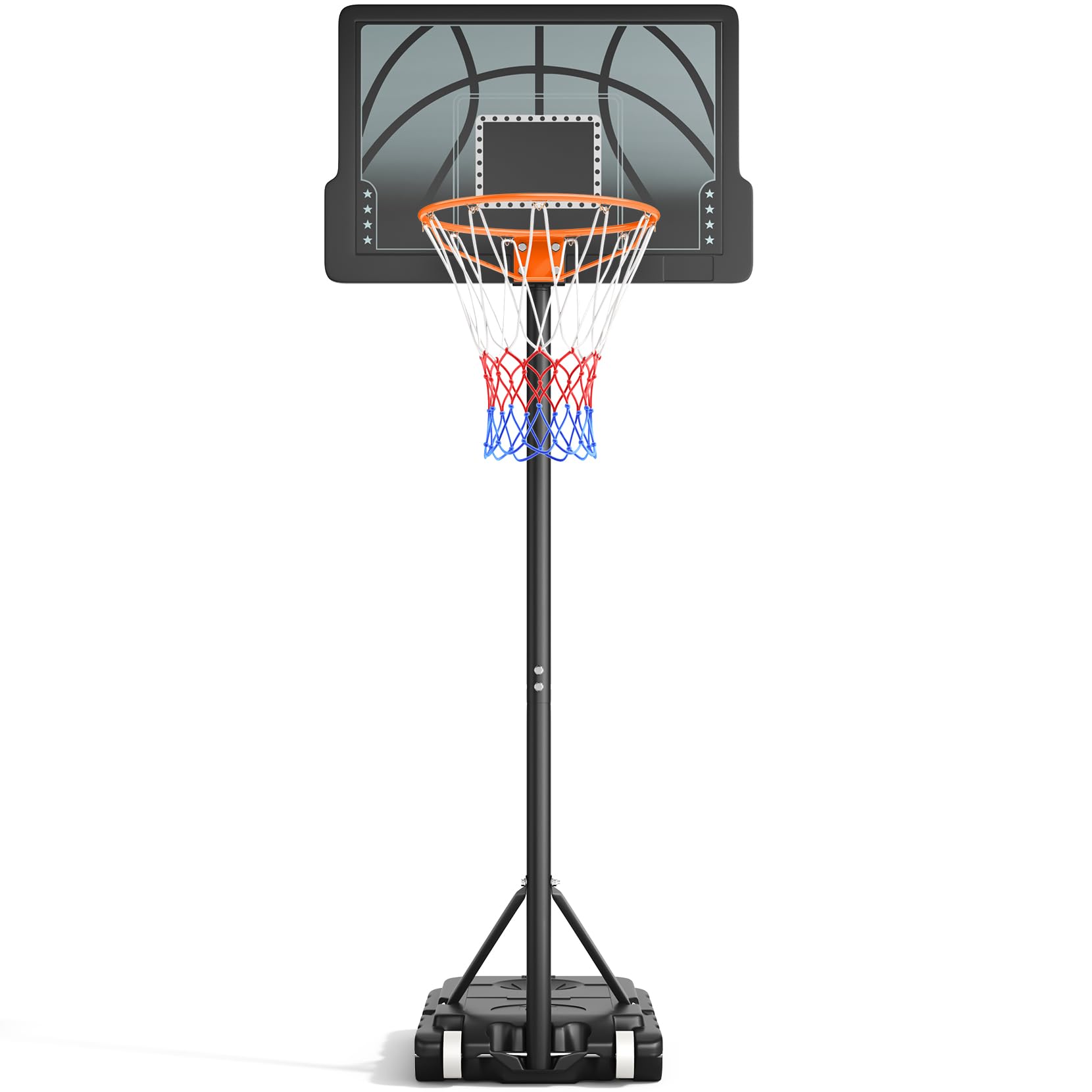
Key Features
- Backboard: 30" plastic/PC
- Height Range: 3.6 – 7 ft
- Adjustment: Knob and sliding pole
- Base Stability: Water/sand up to 57 lbs
- Mount Type: Portable
- Price: $
Designed for the youngest players, this hoop lowers to 3.6 ft so toddlers can actually make baskets. Assembly is quick, and the price is budget-friendly. However, the 30-inch backboard and 7 ft maximum height limit its usefulness beyond age 7. Older kids will need a larger system for proper practice.
Pros
- Lowest 3.6 ft height lets toddlers learn to shoot at a realistic level.
- Simple assembly with clear instructions gets the hoop ready in minutes.
Cons
- 30-inch backboard limits shooting practice and is quickly outgrown as kids improve.
Best for households with a toddler or preschooler who wants a hoop to start with; plan to replace with a larger system once the child reaches age 7 or shows serious interest.
Best for Light Summer Use
IGL Portable 40"

Key Features
- Backboard: 40" acrylic
- Height Range: 3 – 10 ft
- Adjustment: 4-pole configuration
- Base Stability: Dual fill up to 140 lbs
- Mount Type: Portable
- Price: $$
This hoop assembles in about 45 minutes and adjusts from toddler height to regulation, suiting mixed-age family play. However, the backboard and rim can develop issues with normal shooting, and the base may shift or tip in a breeze — better suited for light, temporary use on calm summer days.
Pros
- Assembles quickly with clearly labeled parts — most complete in under an hour.
- Adjusts from 3 to 10 feet, covering young kids through adults.
Cons
- Backboard and rim can develop issues under normal play; base stability may be inadequate in wind.
A decent choice for families who want a quick, temporary hoop for occasional summer use, but not built for regular or windy-weather play.
How to Choose
The single most important thing to know is that backboard material and height adjustment mechanism determine both play quality and long-term satisfaction.
Backboard Size and Material
Backboard material directly affects rebound and durability. Polycarbonate (PC) is common on portable hoops—it’s impact-resistant against normal shooting but will crack or warp if anyone hangs on the rim. Tempered glass, found on premium in-ground systems, provides a consistent, true rebound similar to an indoor court.
Size matters too: a 44-inch board is fine for kids and casual play, but serious shooters benefit from a 54- or 60-inch board that gives a larger target and more predictable off-rim angles. A bigger backboard also reduces the chance of the ball flying into the neighbor’s yard.
Height Adjustment Range and Mechanism
The adjustment mechanism is a key usability trade-off. Budget hoops often use a telescoping pole that requires loosening bolts and lifting with force—frustrating when you change heights often. Mid-range models offer levers (Speed Shift) or rotating handles that let one person adjust from 7.5 to 10 feet in seconds.
Also check the minimum height. A hoop that goes down to 4.5 ft works for toddlers, while one that only reaches 7.5 ft excludes younger kids. If you have children of different ages, a wide range with tool-free adjustment is worth the premium.
Base Weight Capacity and Stability
Portable hoops rely on a fillable base for stability. Water adds about 8 lbs per gallon; sand adds roughly 12 lbs per gallon. A 27-gallon base filled with sand weighs over 300 lbs and will hold steady in moderate wind and light play. Smaller bases (20 gallons) may tip when a teen jumps for a rebound.
In-ground systems trade portability for rock-solid stability. They require a concrete footing—usually a 250–350 lb pour—that eliminates wobble. However, installation is permanent and labor-intensive. Wall-mounted hoops are stable on solid walls but transfer vibration to the house; the included hardware rarely matches your wall type.
Mounting Type and Installation Complexity
Portable hoops are the most common because they require no drilling or concrete, but assembly can take 2–4 hours and often frustrates buyers. In-ground systems demand a full day of digging and pouring concrete, plus alignment patience. Wall-mount setups are fastest if you have a sturdy wall and own a drill, but you must source your own mounting bolts.
Installation difficulty is the top complaint across all types. Before buying, check if the hoop includes clear instructions (some rely solely on diagrams) and consider watching assembly videos. If you aren’t handy, a portable with simpler assembly (under 1 hour) may be a better fit than a feature-rich but complex model.
FAQ
Will a portable basketball hoop tip over if my kid dunks on it?
It depends on the base weight and how hard your kid dunks. A base filled with sand (300+ lbs) is stable for casual hanging, but a water-filled base can still tip if a player pulls down on the rim. For safe dunking practice, an in-ground system with a concrete anchor is the only reliable option. Always add extra weight to the base if possible.
How do I fix a wobbly in-ground basketball hoop after installation?
Wobble often comes from the pole flexing at the joint (especially two-piece poles) or from insufficient concrete. Check that the concrete base is at least 300 lbs and that the pole is level. Adding a vibration-dampening pad or cross-bracing can reduce flex. If the backboard itself rattles, tighten all bolts and consider replacing washers with lock washers.
What is the best height adjustment system for a driveway hoop?
For frequent changes, a lever or crank system (like Speed Shift) is best—one hand, no tools. Telescoping mechanisms require loosening bolts and lifting, which is fine if you rarely adjust. Rotating handle systems (like Yohood Quick Adjust) are also fast and tool-free. Avoid bolt-removal systems; they take minutes per change.
Can I leave my portable basketball hoop outside all winter?
Yes, if you drain the base and store the backboard indoors or cover it. Water expands when frozen and can crack the base. Sand is fine year‑round. The pole and rim may rust if not painted; apply a rust inhibitor. Many owners report that their Lifetime hoops survive several winters with minimal care, but budget hoops degrade faster.