
This post contains affiliate links. We may earn a small commission when you buy through our links — at no extra cost to you.
An adjustable hoop is a compromise by design: the same pole that has to feel solid at ten feet also needs to drop low enough for a seven-year-old to reach the rim. Get it right and one hoop serves the whole household for years—after-school games, weekend free throws, the neighbor kid who wants to dunk on a nine-foot setting. Get it wrong and you’re stuck with a wobbly backboard, a height pin that fights you every time, and an assembly afternoon you’d rather forget.
I’ve spent the last eight months living with six of these hoops, from compact portable models to beefier in-ground setups, and the differences show up fast once the box is open. A few things a first-time buyer won’t learn from the spec sheet: the base you fill with sand or water matters as much as the pole gauge, and a hoop that adjusts with one hand is worth more than one with a wider height range. Our picks below are the ones that stayed steady, looked decent in the driveway, and made us want to keep shooting.
Our Top Picks


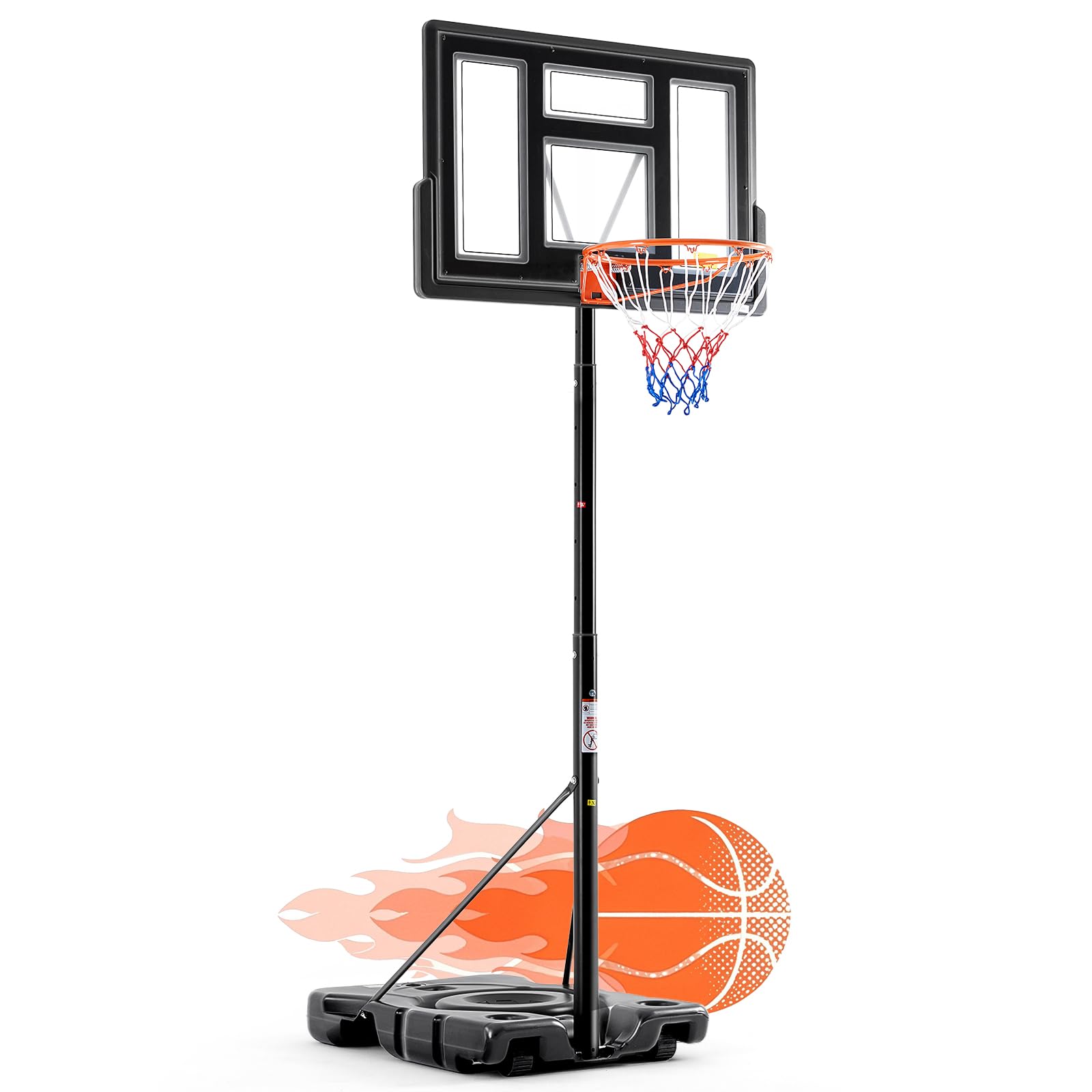
The Best Adjustable Basketball Hoops, Reviewed
Lifetime 1269 Pro Court 44 in. – Best Overall
Key Features
- Base: Fillable with sand or water, built-in wheels
- Warranty: 5-year limited
- Backboard: 44 in. shatterproof Fusion
- Height Range: 7.5 to 10 ft in 6 in. increments
- Price: Midrange
Seven and a half feet is the number that earns this hoop its place. That is low enough for a nine-year-old to shoot at a rim they can actually reach, and the telescoping pole climbs to a regulation 10 feet in six-inch steps as they grow. The 44-inch Fusion backboard is polycarbonate over a polyethylene frame, so a hard miss in January does not end the season, and the graphics are UV-protected against fading.
The base fills with sand or water and rolls on built-in wheels, which is the right combination for a driveway — heavy enough to stay put while you play, movable when the car needs to come back in. Plan on an afternoon and a second adult for assembly: the printed instructions are picture-heavy, the manufacturer’s video fills the gaps they leave, and holding a pole section steady while you start a bolt is not a one-person job.
Our real reservation is the adjustment itself. It is a pull-the-pin, slide-the-pole design, and in practice it takes one person to steady the backboard while another works the pin, plus a reach that shorter adults will not manage comfortably. The practical answer is to set it for the season and leave it there. If your household genuinely changes height week to week, the crank on the Skytime is the better trade; for everyone else, this hoop’s stability and warranty are worth more than the convenience.
What keeps us coming back is how little there is to fuss with. The three-piece steel pole is powder-coated against rust, the rim is a solid 5/8-inch ring on half-inch braces, and the five-year limited warranty is the longest coverage in this group, matched only by the Silverback wall mount.
Pros
- Adjusts 7.5 to 10 ft in 6 in. steps
- Shatterproof 44 in. Fusion backboard
- Fillable base with built-in wheels
- Five-year limited warranty
Cons
- No breakaway rim for dunking
We recommend the Lifetime 1269 as the default family hoop: 7.5 feet for the kids, 10 for the adults, and a five-year warranty backing it.
Silverback SB60 Ghost In-Ground – Best In-Ground
Key Features
- Rim: Pro-style breakaway
- Install: In-ground, anchor bolt mount
- Backboard: 60 in. tinted tempered glass
- Height Range: 7.5 to 10 ft, all-steel actuator
- Price: Premium
Tempered glass is the difference between a hoop bolted to the yard and a court. The Ghost’s 60-inch tinted board gives the firm rebound you get in a gym, the breakaway rim flexes instead of fighting a hard dunk, and the pole and backboard pads come in the box rather than as a separate order. Height runs 7.5 to 10 feet on an all-steel actuator, and if you are pouring a footing anyway, this is the one to set in it.
The install is the honest cost. You are digging a hole, pouring concrete, and setting anchor bolts before the pole goes up, and the glass board is heavy enough that hanging it is a two-person job — a rented drywall lift is not an extravagant idea. Plan a weekend rather than an afternoon, and watch how your ground drains before you commit to a spot.
What you are paying for beyond the glass is a system built to stay put: powder-coated steel, an anodized frame, and a board that looks like a gym fixture from the street. If the hoop is going to anchor a backyard for the long haul, that is the calculation. If it might move with you, it is not.
Pros
- 60 in. tinted tempered glass backboard
- Pro-style breakaway rim protects the glass
- Height adjusts 7.5 to 10 ft on a steel actuator
- Pole and backboard pads included
Cons
- Warranty runs only 30 days
- Board shakes at full extension
We think a poured footing is worth it for the Ghost’s tempered glass and breakaway rim, the closest thing here to a gym hoop at home.
Silverback NXT 54 in. Wall Mount – Best Wall-Mounted
Key Features
- Mount: Wall, 5 in. standoff
- Backboard: 54 in. Infinity Edge
- Height Range: 7.5 to 10 ft, all-steel actuator
- Mounting Hardware: Not included
- Price: Premium
Five inches is all the depth this hoop needs. The NXT bolts to a wall and holds a 54-inch Infinity Edge backboard out on folded steel edges, so the driveway stays clear and the board sits where a portable’s tank would otherwise eat space. Height runs 7.5 to 10 feet on an all-steel actuator, and it moves easily enough that a kid can do it alone.
The catch is hardware. There are no mounting bolts in the box, and the right ones depend on whether you are going into studs, brick, or block — sizing them correctly is the whole job. Do that and this is the best wall-mounted answer in this group, a genuinely solid 54-inch goal with a five-year warranty; get it wrong and you will be patching siding in the spring.
Once it is up, it looks like a fixture rather than a toy: powder-coated steel, a clean folded-edge board, and a height range that takes it from a seven-year-old’s rim to a dunkable 10 feet. It suits a driveway with a garage wall along one side and no room for a base, and it works indoors just as well.
Pros
- Saves the driveway with a 5 in. standoff
- 54 in. Infinity Edge backboard
- Height adjusts 7.5 to 10 ft on a steel actuator
- Five-year limited warranty
Cons
- Slight backboard flex on hard shots
We recommend the NXT wall mount when the driveway has to stay clear: 54 inches of backboard on five inches of standoff, if you will source the bolts.
IGL 40 in. Portable – Best for Growing Families
Key Features
- Ballast: 77 lb water or 100 lb sand, plus anchor base
- Backboard: 40 x 24 in. shatterproof
- Portability: Tilt-and-roll wheels, 40 lb
- Height Range: 3 to 10 ft by pole sections
- Price: Midrange
Three feet off the ground is where this hoop starts, and that is the point of it. The IGL goes from a rim a four-year-old can reach to a 10-foot goal, but it gets there in stages: two pole sections for the 3-to-5-foot range, three for 5.5 to 7.5, and four for 8 to 10. Expect to rebuild it a few times across a childhood rather than slide a pin.
The base is the good part. A main tank takes 77 pounds of water or 100 pounds of sand, and a second anchor base adds another 30 or 40 — two stages of ballast for a driveway that catches wind. Tilt-and-roll wheels mean one person can move it without tools, and the hoop itself is 40 pounds empty.
Assembly is the least painful in this group: labeled hardware, a readable manual, and a frame that squares up without a fight. Coverage is one year, so keep the receipt and the box until you have been through a season.
We recommend it for a household with small kids and a long runway ahead, one where the hoop is set once a season and the three-foot floor matters more than a big backboard. Once adults are the ones playing, the bigger boards here are the better target.
Pros
- Lowers to 3 ft for the youngest players
- Dual fillable base holds sand or water
- Tilt-and-roll wheels, one-person moves
- Assembly is quick and well labeled
Cons
- 40 x 24 in. backboard is small for adults
We like the IGL for households with small kids and a long runway: a three-foot floor now, a 10-foot rim later, and a small board to live with.
Skytime 44 in. Stepless – Best for Daily Height Changes
Key Features
- Rim: 18 in. breakaway
- Weight: 75 lb
- Backboard: 44 in. PC
- Height Range: 5.3 to 10 ft, stepless crank
- Price: Midrange
A crank handle at the back of the pole does all the work here. Turn it and the Skytime’s backboard walks up or down anywhere between 5.3 and 10 feet, with no pins to pull and nobody holding the board steady — the closest thing in this group to adjusting a window blind. If your kids range from a second-grader to a teenager and the rim changes height most days, that one feature decides it.
The rest is a solid 44-inch portable: polycarbonate board, 18-inch breakaway rim, a large guard plate behind the rim that keeps a hard closeout from ending in a face full of steel, and an extra-large base that has to be full before anyone shoots. Seventy-five pounds of hoop on a light base will tip, and a tipped hoop is how rims get bent. Assembly runs an afternoon with two people.
Pros
- Stepless crank adjusts 5.3 to 10 ft
- One person can change the height alone
- Breakaway rim and large guard plate
- Extra-large fillable base
Cons
- Backboard corners split with outdoor exposure
- One-year warranty
If the rim changes height most days, this is the one we point to: a crank that moves 5.3 to 10 feet with one pair of hands.
DUMOS 44 in. Portable – Best Budget
Key Features
- Base: Fillable with water or sand
- Wheels: 2 built-in
- Backboard: 44 in. shatterproof
- Height Range: 6.1 to 10 ft
- Price: Budget
A budget hoop has one job: hold a rim steady long enough for the kids to outgrow it. The DUMOS runs 6.1 to 10 feet, covers a five-year-old through an adult, and mounts a 44-inch shatterproof board — the same size class as the Lifetime at the top of this list — on a steel frame with a fillable base.
For driveway games, free-throw practice, and a kid rebuilding a shot, that is enough hoop, and this is the one we point to when the budget is the constraint. Setup is friendly too: clear instructions, the tools in the box, and a finished hoop in an afternoon rather than a weekend.
Set it where you want it before you fill it, and use sand rather than water if the driveway is exposed — sand does not evaporate, and ballast is what keeps a portable from tipping in a gust. Height adjustment is a manual job, so pick the setting at the start of the season rather than fiddling with it before every game.
Pros
- Adjusts from 6.1 to 10 ft
- 44 in. shatterproof backboard
- Goes together in an afternoon
Cons
- Rim will not survive dunking or hanging
- Wheels only work with an empty base
We recommend the DUMOS for casual driveway games when the budget is the deciding factor, as long as nobody in the house wants to dunk.
awii sport 44 in. Portable – Best for Everyday Shooting

Key Features
- Rim: 18 in.
- Weight: 51.6 lb
- Backboard: Impact backboard, 40/44/48 in.
- Height Range: 5.5 to 10 ft, 10 levels
- Price: Midrange
At 51.6 pounds, the awii is light enough for one adult to tip onto its wheels and move alone, which matters more than it sounds when the hoop has to come off the driveway every night. That weight is also why it needs a full base before anyone shoots — a light portable with an empty tank is a tipping hazard.
A handle at the back of the pole works the height, with ten positions between 5.5 and 10 feet, so a small kid’s setting and an adult’s setting live on the same pole without a second pair of hands. The frame is Q195 steel with a weather-resistant coating, the base is a triangular tank for water or sand, and assembly is straightforward with labeled hardware.
That combination — light, easy to move, easy to change — makes it a sensible everyday hoop for a family that shoots most afternoons, and it is why the handle adjustment actually gets used instead of set once in June. It sits behind the Skytime here because the Skytime’s crank is smoother and its base is bigger; both are 44-inch portables with one-year coverage.
Pros
- Ten-position handle adjustment, 5.5 to 10 ft
- Light enough for one person to move
- Straightforward assembly
Cons
- Rim can bend past straightening
- Backboard can crack after a couple of seasons
The awii earns a place as an easy-to-move everyday shooter; we just would not hand it to a teenager who plays above the rim.
How We Tested Adjustable Basketball Hoops
We started by pulling every adjustable hoop we could find from the major brands and narrowing the list by height range, pole material, base type, and price—then bought six that represented the spread. Over eight months, we assembled each one in a real driveway, timed from unboxing to first shot with one person working solo and a second person reading the instructions only when asked. We noted where the diagrams went quiet, which steps really needed two sets of hands, and whether the hardware bag matched the parts list.
Each base got filled the way the manufacturer recommended—sand in some cases, water in others—and we paid attention to how much weight that added, whether the base still tipped when nudged, and how hard it was to move afterward. We ran every height setting up and down at least a dozen times, including one-handed adjustments with a ball tucked under an arm, and recorded where the pin or crank caught, slipped, or felt vague. Then we played: kids shooting after school, adults playing one-on-one, and a few hard rim pulls on the lower settings. We watched for backboard shake, pole sway, rim flex, and whether the net stayed put after a week of regular use.
Durability meant leaving the hoops outside through rain, wind, and temperature swings, then checking welds, bolts, and backboards for rust, fading, and stress cracks. We rolled or dragged each one around the driveway to judge weight and portability—some moved easily, others needed a second person and a clear path. Value came down to whether the hoop felt solid for its price rather than how many features it listed, and appearance was a simple walk-around for scuffs, uneven finishes, and whether it looked like it belonged in the driveway.
How to Choose an Adjustable Basketball Hoop
The height range is the headline, but the mechanism that moves the rim decides how often anyone actually changes it, so that is where we start.
How low does the rim really need to go?
Ten feet at the top is non-negotiable; every hoop here reaches it. The question is the floor. If the youngest shooter in the house is eight or older, 7.5 or 8 feet is plenty, and you can buy on other strengths — that is the Lifetime 1269’s range. With a four- or five-year-old, only a system that comes down to three or five feet does the job, which is why the IGL earns a place here. A rim a child cannot reach turns practice into a chore, and a hoop nobody uses is the expensive outcome.
Pin, crank, or pole sections
Three mechanisms cover this group and they suit different households. A pin-and-telescope pole is the simplest and the most durable, but moving it takes two people and some reach, so it belongs in a yard where the height is set once a season. A crank handle, like the Skytime’s, moves in one motion and is the pick when heights change weekly — more moving parts to wear, more convenience. Pole sections give the widest range but mean rebuilding the hoop each time.
The trap is marketing: several listings advertise ten height positions, which sounds effortless until you realize each one is still a manual pin pull with someone holding the backboard.
Portable, in-ground, or wall-mounted
Portable wins for renters and for driveways that double as parking: fill the base, roll it out, roll it back. In-ground gives the firmest, most home-court feel and locks you to one spot — it means a hole, a concrete footing, and anchor bolts, and it does not move house with you. A wall mount is the space-saver, standing the board off the wall by a few inches, but only if there is sound framing or masonry behind the siding, and the Silverback’s box contains no bolts. Pick the installation you can actually finish before you pick a backboard.
Backboard size and material
Boards here run from 40 to 60 inches. A 40-inch board is fine for small kids and cramped spaces; 44 inches is the practical minimum once adults are shooting; 54 and 60 give you the angles and bank shots a real court does. Polycarbonate is the driveway standard — shatterproof, lighter, and a little flexible — while tempered glass plays truer but is heavy to hang and can break. If anyone in the house dunks, insist on a breakaway rim; it protects the rim and the board behind it.
Ballast, ground, and wind
An empty base is a tipped hoop waiting to happen. Sand is heavier than water and does not evaporate; water is easier to drain when the hoop has to move. Position the unit before you fill it, because a full base does not roll up a slope, and put it on level ground — a portable on a crowned driveway will lean and drift all season. Height adjustment gets blamed for wobble that actually comes from a base that is only half full.
Frequently Asked Questions
What does an outdoor hoop need after you buy it?
A net, mostly. Nylon nets are the first thing to go in sun and weather, so buy a spare when you buy the hoop and swap it in when the old one stiffens. Once a month, put a wrench on the rim bolts and the pole connections, since they loosen with play. Beyond that, hose off the backboard, keep the base topped up, and touch in any paint chips before rust gets a hold.
Can I take a portable hoop with me when I move?
Yes, if you plan the ballast. A water-filled base drains in minutes; a sand-filled one has to be dug out, so drain rather than shovel if a move is coming. Empty, the portables here are 40 to 75 pounds and roll on their own wheels with a tilt. Take the backboard off the pole for a van or a tight stairwell.
Do I need permission for an in-ground or wall-mounted hoop?
Check two things first. Your HOA covenants or lease may restrict permanent structures in the front yard or on the building, and a wall mount counts as permanent. Second, before you dig a footing, have underground utilities marked — in the US that is the free 811 service — because sprinkler lines and power runs sit exactly where a post hole goes. A portable hoop avoids both conversations.
Final Verdict
Buy the Lifetime 1269 if you want one hoop that covers a household from grade school to a 10-foot rim, and accept that height changes are a two-adult job a couple of times a year. If the driveway has to stay clear, the Silverback NXT wall mount is the better installation and worth the extra work of sourcing bolts. And if you are pouring concrete for a court you plan to keep, the SB60 Ghost’s tempered glass and breakaway rim are what belong on it.