
This post contains affiliate links. We may earn a small commission when you buy through our links — at no extra cost to you.
Speed hurdles for basketball training should be durable enough to withstand constant footwork, yet many sets snap or crack the first time a player lands on them. The difference often comes down to construction: fixed-height designs with fewer moving parts tend to last, while adjustable models introduce joints that can fail under impact.
That doesn’t mean adjustability is a mistake—it lets you vary drill heights from 6 to 12 inches for progressive training. But if your priority is gear that survives season after season of intense footwork, you’ll want to understand how materials and joint design affect longevity before you buy.
This guide picks hurdles that hold up to that reality, from shatterproof sets for heavy team use to budget-friendly options that work for home drills. What you choose depends on where you train and how often they’ll be stepped on—so each recommendation accounts for that trade-off.


Best for Heavy Training
NWS Forza Fixed
Key Features
- Height: Fixed 6"
- Number of Hurdles: 6
- Material Durability: Shatterproof plastic
- Portability: No bag; lightweight
- Price: Premium
The NWS Forza hurdles handle aggressive foot traffic without cracking, thanks to a solid one-piece plastic construction that falls forward on contact instead of snapping. In high-intensity basketball agility drills, they stay visible with a bright yellow finish that stands out on any surface. They’re heavy enough (22 lbs for the set) to stay put during lateral movement, yet light enough to reposition quickly.
This set is for coaches and trainers who run team practices on outdoor courts or turf and need gear that won’t need replacing mid-season. The premium price reflects that durability, but the tradeoff is storage: no carrying bag is included, so stacking the six hurdles for transport can get messy. If you need adjustable heights or a budget-friendly option, look elsewhere – the fixed 6-inch height is a deliberate compromise for sturdiness.
Pros
- Withstands repeated stepping without cracking – ideal for high-volume team drills.
- Improves foot speed and agility effectively in basketball-specific drills.
- High-visibility yellow stands out on grass, concrete, or gym floors.
Cons
- No carrying bag included – stacking hurdles for transport can be messy without a dedicated storage solution.
If your basketball program demands hurdles that survive aggressive foot traffic and outdoor abuse, the NWS Forza set delivers unshakable durability – just budget for your own carrying solution.
Best for Progressive Training
QUICKPLAY Adjustable
Key Features
- Height: Adjustable 6"/9"/12"
- Number of Hurdles: 6
- Material Durability: Plastic with quick-click joints
- Portability: Carry bag included
- Price: Mid-Range
Instant 6/9/12-inch height adjustment makes these hurdles a practical choice for basketball agility training that progresses from low step-overs to higher clearances without needing multiple sets. The quick-click mechanism snaps into place and folds flat into the included carry bag, so setup and teardown fit into tight practice windows. The lightweight build travels easily from gym to court. The adjustable joints, however, can break if stepped on directly—a compromise inherent to the click mechanism. This makes the set better suited for individual or small-group drills where foot placement can be controlled, rather than chaotic team sessions where hurdles may be kicked repeatedly.
Pros
- Three height settings from 6 to 12 inches let you progress drills without buying separate fixed-height sets.
- Quick setup and teardown—hurdles click into place and fold flat into the included bag.
- Portable and lightweight, ideal for moving between home, gym, and field.
Cons
- The joint mechanism can break if stepped on directly, a vulnerability not present in one-piece fixed hurdles.
This adjustable set suits the athlete who wants height progression in one bag, as long as footwork keeps the impact on the bars rather than the joints.
Best for Budget Home Use
Trademark 5-Pack
Key Features
- Height: Fixed 6"
- Number of Hurdles: 5
- Material Durability: Single-piece plastic
- Portability: No bag
- Price: Budget
The Trademark Innovations 5-pack delivers the lowest price in a fixed-height set, with single-piece molded hurdles that skip breakable joints entirely. Compared to the nearly indestructible NWS Forza set, these are lighter and far more affordable, though you trade away shatterproof durability.
They work well for budget-conscious home drills, footwork practice, and youth teams where a hurdle might get stepped on occasionally. Some units may arrive with slight warping or uneven heights — a non-issue for casual training, but a reason to avoid them if you need millimeter-level consistency for competitive work.
Pros
- Excellent value for a basic speed hurdle set
- Effective for footwork and lateral agility drills
Cons
- Some hurdles may arrive warped or have uneven heights
- Plastic can crack or shatter when stepped on heavily
For casual home workouts and youth teams on a tight budget, the value is hard to beat — just inspect each hurdle on arrival.
Best for Team Practices
ASENVER 12-Pack
Key Features
- Height: Fixed 6"
- Number of Hurdles: 12 + 10 cones
- Material Durability: ABS plastic
- Portability: Velcro straps, no bag
- Price: Mid-Range
This 12-pack with bonus cones delivers more equipment for your money than any other set aimed at basketball agility training. Where the top-pick fixed hurdles are virtually indestructible, these ABS plastic hurdles trade some robustness for a lighter build and lower per-unit cost. The set arrives with Velcro straps for bundling, making it easy to toss into a gear bag.
Youth team practices and large group drills benefit most—the quantity allows plenty of stations, and the lower per-unit durability is a manageable tradeoff for budget-conscious programs. Individual athletes and competitive high school or college teams will want sturdier hurdles built for repeated high-impact drills.
Pros
- 12 hurdles and 10 cones provide more training obstacles per dollar than any comparable set.
- Lightweight construction allows fast setup and quick transitions between drills.
Cons
- Some hurdles can crack during heavy foot contact, limiting lifespan under team use.
For a youth team needing maximum drill stations on a tight budget, this set’s value is hard to beat—but know each hurdle is lighter-duty than the top pick.
Best for Durable Adjustable
Body Sport Adjustable
Key Features
- Height: Adjustable 6"/9"/12"
- Number of Hurdles: 5
- Material Durability: Plastic snap-lock
- Portability: Carry bag included
- Price: Mid-Range
The snap-lock mechanism stays put once set, avoiding the wobbly joints that plague other adjustable hurdles. Sturdy construction resists cracking at connection points — a failure point seen in competing adjustable designs. This set is well-suited for home gyms and small group training where three height options are needed without frequent breakage. Coaches requiring proven long-term durability will be better served by the fixed-height top pick, which sacrifices adjustability for near-indestructible build quality.
Pros
- Sturdy build resists cracking and stands up to repeated footwork drills.
- Snap-lock height settings stay put and make storage simple.
Cons
For individual or small-group training where adjustability is a priority, this set offers sturdy build quality at a mid-range price. Coaches leaning on heavy daily team use should opt for fixed hurdles, which handle constant impact without compromise.
Best for Pt & Light Use
Yes4All 5-Pack
Key Features
- Height: Fixed 6"
- Number of Hurdles: 5
- Material Durability: ABS plastic
- Portability: Carry strap included
- Price: Budget
The Yes4All hurdles stay anchored through sharp lateral cuts and quick step-overs, resisting the shift that plagues lighter cone-only setups. Compared to other affordable fixed-height options, the single-piece ABS design feels less brittle while remaining easy to toss into a bag with the included carry strap. They’re a practical fit for solo basketball agility work or physical therapy routines where cost matters and you won’t subject them to repeated team-wide stomping. Check each hurdle upon delivery—some units may arrive slightly warped, so uniform height isn’t guaranteed out of the box.
Pros
- Stays firmly in place during lateral cuts and step-overs.
- Decent longevity for a budget hurdle under normal footwork.
- Carry strap makes the five-pack easy to move and store.
Cons
- The lightweight build can tip over if struck with force mid-stride.
When shatterproof build isn’t required and you want simple, stay-put hurdles for at-home agility or rehab, this set offers solid value—just inspect for evenness on arrival.
Best for Light Training
SKLZ 6X Fixed Hurdles
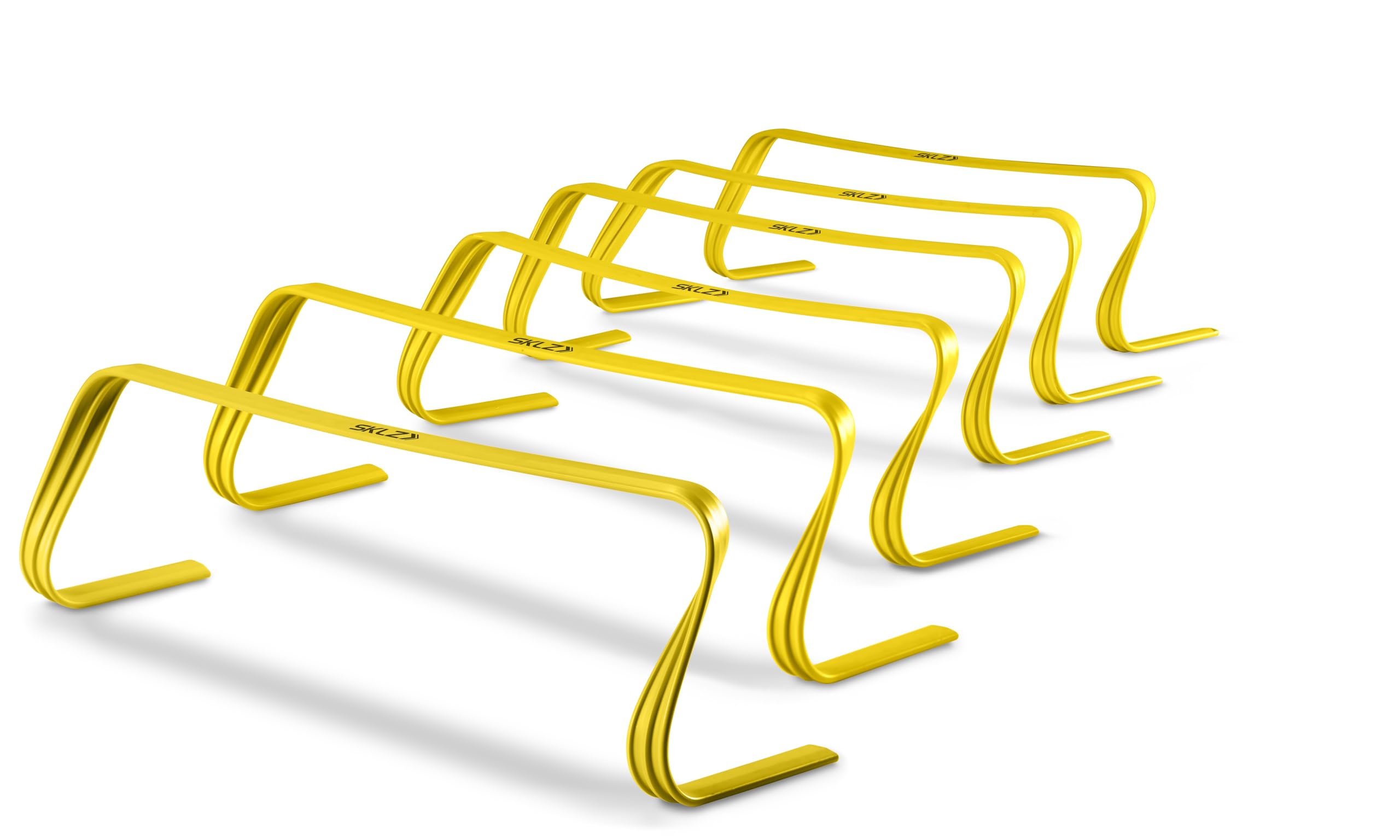
Key Features
- Height: Fixed 6"
- Number of Hurdles: 6
- Material Durability: Flexible composite plastic
- Portability: Carry bag included
- Price: Mid-Range
The SKLZ hurdles’ flexible composite plastic bends on impact and springs back, reducing mid-drill resets—a clear advantage for individual agility work. The set includes a carry bag and weighs only two pounds, making it easy to tote to a court. The trade-off: under repeated hard landings, especially at the upright ends, the plastic can snap. That makes these better suited to light-to-moderate use rather than high-traffic team practices.
Pros
- Bends and recovers from foot contact, minimizing drill interruptions.
- Lightweight and portable with included carry bag.
Cons
- Plastic may snap under repeated hard landings, particularly at the ends.
A practical option for solo athletes and light training sessions where the bounce-back design saves time—not for team drills with constant foot traffic.
Best for Youth Clinics
GHB 10-Pack Fixed

Key Features
- Height: Fixed 8"
- Number of Hurdles: 10
- Material Durability: Detachable PVC
- Portability: Carry bag included
- Price: Budget
The 10-pack provides 30 feet of hurdle coverage for group drills at a fraction of the cost of premium single-piece designs. Assembly is tool-free and the carry bag simplifies transport. The detachable PVC construction, however, can crack under direct foot strikes — a tradeoff that’s acceptable for low-impact youth footwork but risky for high-intensity adult training.
Pros
- Ten hurdles for the price of three or four premium fixed-height sets.
- Assembles without tools and packs into the included carry bag in seconds.
Cons
- PVC joints can crack under direct foot impact — keep spares for high-traffic drills.
An economical way to fill a court with obstacles for youth footwork, provided you accept that a hard step can crack a joint.
Best for Ultra-Portable
GHB Adjustable 5/6

Key Features
- Height: Adjustable 8.3"/12.6"
- Number of Hurdles: 5 or 6
- Material Durability: Plastic rotating legs
- Portability: Foldable, bag included
- Price: Budget
The GHB hurdles fold completely flat and slip into the included carry bag, offering unmatched portability among speed hurdles. Two adjustable heights (8.3" and 12.6") add a modest progression for drills. However, the rotating legs bend and break easily, so this set is only for the lightest use where foot contact is virtually absent.
Pros
- Folds flat and packs into the carry bag for effortless storage between sessions.
- Two adjustable heights offer a basic step-up in drill difficulty.
Cons
- Not suitable for drills where foot contact with a hurdle is possible—common in basketball agility training.
If storage space is tight and you only need hurdles for light solo footwork or kids’ backyard play, this set’s portability is hard to match—but it cannot survive the repeated foot contact of basketball agility training.
Best for Compact Storage
Hikeen Adjustable

Key Features
- Height: Adjustable up to 12"
- Number of Hurdles: 6 + cones
- Material Durability: Plastic
- Portability: Foldable, bag included
- Price: Mid-Range
Compact storage and adjustable height make this foldable set convenient for home workouts. The six hurdles collapse flat and tuck away easily, while height settings grow with your drills. Long-term durability under repeated, high-impact use remains unconfirmed, so this set fits lighter solo sessions better than team-practice wear and tear.
Pros
- Compact foldable design stows easily under furniture or in a closet.
- Adjustable heights allow progression from low step-overs to higher plyometric drills.
Cons
For home users needing space-saving hurdles for occasional solo drills, the Hikeen set offers a practical, low-profile option. Athletes running frequent, high-impact practices should consider fixed-height alternatives with established track records.
Best for Rock-Bottom Price
SMTPDT 5-Pack

Key Features
- Height: Fixed 9"
- Number of Hurdles: 5 + 10 cones
- Material Durability: Plastic detachable
- Portability: Carry bag included
- Price: Budget
The SMTPDT 5-Pack combines five detachable hurdles, ten cones, and a carry bag at an ultra-low price. The hurdles are light and easy to move, but the snap-together pieces can separate during drills. This kit fits one-time youth events or playful obstacle courses, not serious basketball agility training where height consistency is essential.
Pros
- Comes with 10 cones and a carry bag at a budget-friendly price.
- Lightweight design simplifies setup and transport between locations.
Cons
- Snap-together hurdle joints can loosen during drills, causing the hurdles to come apart.
For a single-day event or light play, this kit delivers cones and basic obstacles for minimal cost; expect to reassemble hurdles between runs.
How to Choose
For basketball speed hurdles, durability starts with joint design: the fewer breakable connections, the longer the hurdles survive repeated foot strikes.
Height: Fixed vs. Adjustable
Fixed 6-inch hurdles have no moving parts, so there is no weak point to snap when a player lands on them. This makes them the most reliable choice for repetitive footwork drills where contact is inevitable.
Adjustable hurdles that switch between 6, 9, and 12 inches use interlocking or snap-together joints. Every joint is a potential failure site—landing on the mechanism can crack the plastic or separate the pieces, especially during fast, high-impact agility sequences.
Number of Hurdles in the Set
A set of 5 or 6 hurdles is sufficient for most individual and small-group basketball drills. More hurdles let you run team stations, but bulk packs often trade material thickness to hit a lower per-hurdle price.
If you coach a youth team or run camps, a dozen hurdles can be useful—just expect more frequent replacements because the individual units are typically less robust.
Material and Build Quality
Shatterproof or thick, flexible plastic withstands repeated stomping far better than rigid, brittle PVC. Look for hurdles described as shatterproof or that bend and bounce back rather than cracking on impact.
Thin-walled, generic plastic hurdles may look identical in photos but can snap the first time a full-grown athlete steps on them. The weight of the set is often a clue: heavier hurdles (like the 22-pound NWS set) use denser, tougher plastic.
Portability: Bags and Folding
If you train at multiple locations, a carry bag or foldable design saves frustration. Fixed hurdles without a bag can be stacked but get unwieldy; folding adjustable hurdles collapse flat but often sacrifice durability at the hinge.
For a permanent home gym or court, portability matters less than structural integrity. Focus on whether the hurdles will live in a storage closet or a gym bag.
FAQ
Why do my speed hurdles keep snapping when my players step on them?
Most breaks happen at joints where adjustable legs or crossbars connect; the impact of a foot concentrates force on a thin plastic tab or clip. Fixed-height, single-piece hurdles eliminate those weak points entirely, so they survive repeated stepping without failure. Switch to a shatterproof fixed set if your team regularly clips the hurdles during drills.
Are adjustable height hurdles worth it for basketball agility training?
Adjustable hurdles give you 6-, 9-, and 12-inch options for progressive overload, which can be useful if you want to train explosive step-overs or mix in track-style drills. However, the locking mechanisms are almost always the first failure point—if your main need is rapid footwork where athletes frequently land on the hurdle, a fixed 6-inch set will outlast any adjustable model.
How many hurdles do I need for basketball footwork drills?
Five or six hurdles are enough for cone-weave, lateral step-over, and quick-feet patterns that a single athlete or small group runs. Larger team sessions can benefit from 10 to 12, but those bulk packs typically use thinner plastic and may need to be replaced sooner.
Can I use speed hurdles on grass or turf without them tipping over?
Lightweight plastic hurdles can tip on uneven natural grass, especially if there is any wind. For outdoor grass or turf training, choose a heavier, shatterproof fixed set with a wider base; if you must use lightweight hurdles, stick to flat courts or indoor surfaces to keep them upright during rapid direction changes.