
This post contains affiliate links. We may earn a small commission when you buy through our links — at no extra cost to you.
A resistance band is the rare piece of training gear that gets harder the more you stretch it — pull a loop to double its length and the tension roughly doubles with it. That’s why coaches hand them out before practice: they load hip and glute strength, ankle stability, and the lateral first step that decides a closeout, all without a rack of dumbbells.
The trouble is that the tension printed on the package is often wishful thinking, and a band that rolls up your shin mid-slide — or snaps — is worse than no band at all. I keep one in my car for driveway sessions, and over four months my team and I put 15 band sets through warmups, weight-room days, and hotel-room workouts on the road. Judge a band by its shortest usable length, not its longest: the tension you actually train in lives in the first few inches of stretch. The picks below earned a permanent spot in the gym bag.
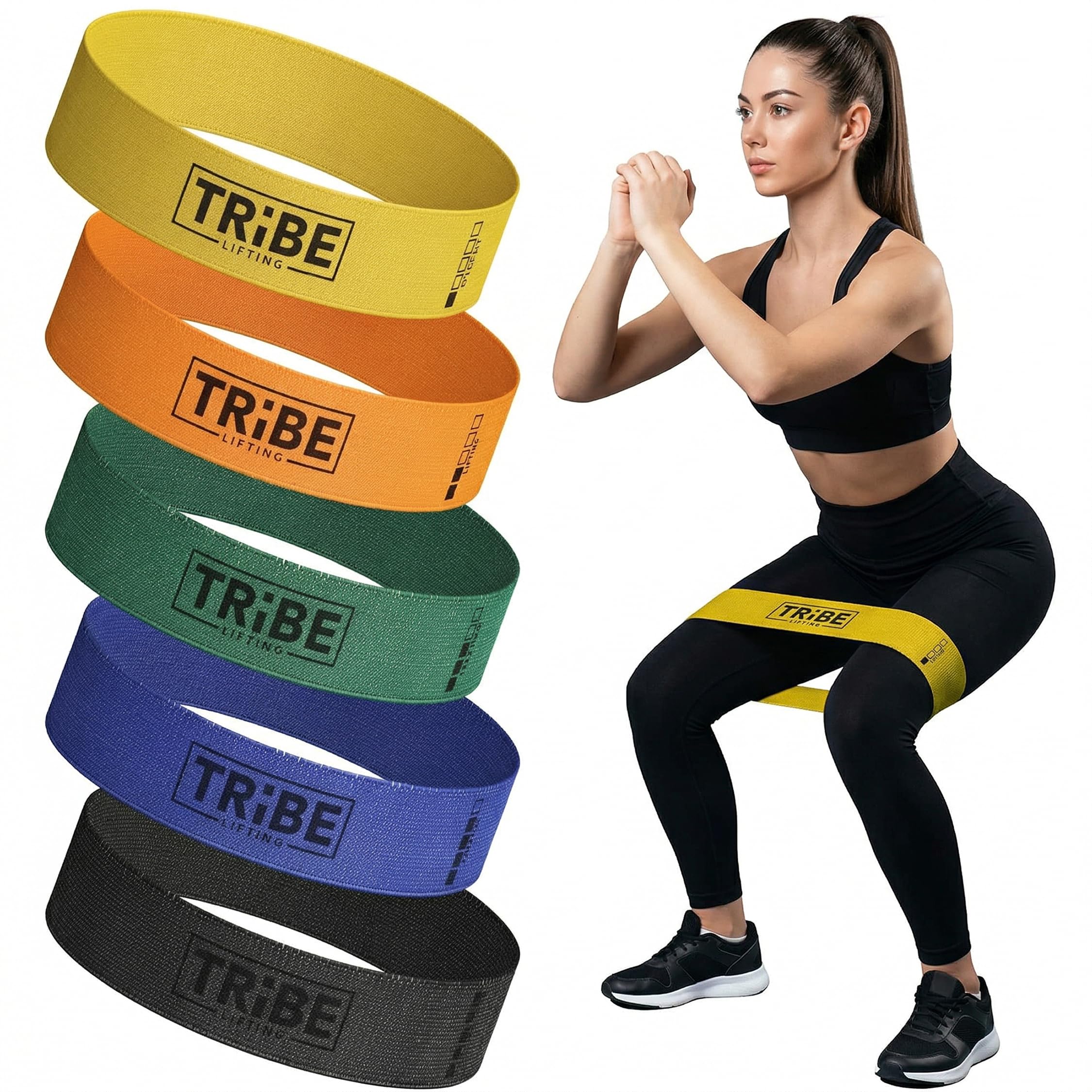


Best for Court Warm-Ups
Tribe Lifting Fabric Bands
Key Features
- Levels: 5
- Band style: Fabric loop
- Dimensions: 12 x 2 in
- Resistance range: 40–180 lb
- Price: Midrange
The first thing we noticed about the Tribe Lifting bands is how little they move. The woven fabric stays flat above the knee during lateral band walks, and it doesn’t pinch or catch bare skin the way thin latex loops can. That sounds like a small detail until you’ve spent a warm-up resetting a band every few steps; for basketball players, the right band is the one you don’t have to think about.
The five tensions run from 40 to 180 pounds, which is a more useful spread for lower-body work than the light flat bands sold for general fitness. We used the lighter loops for glute bridges and monster walks, then moved up for heavier activation and hip thrusts. The 12-by-2-inch size fits above the knee or around the ankles without feeling like a tourniquet, and the fabric doesn’t roll into a rope when you sweat.
What we appreciate most is the lack of fuss. There’s no door anchor to rig, no handles to clip in, and no long loop to untangle; you step in and go. That makes it the set we reach for before a run of suicides or a shooting session, when we want a few minutes of hip and glute work rather than a full strength block.
Pros
- Fabric loops stay flat during leg work
- Five tensions from 40 to 180 lb
- Comfortable against bare skin
Cons
- Lower-body focus only
We recommend the Tribe Lifting set as the default for basketball players: the fabric loops stay put through lateral warm-ups, and the five tensions cover activation through heavy glute work.
Best for Pull-Up Strength
SUNPOW Pull-Up Bands
Key Features
- Length: 180 in
- Levels: 5
- Band style: Long loop
- Resistance range: 5–145 lb
- Price: Premium
Five long loops, from 5 to 145 pounds, give the SUNPOW set a wider spread than most bands sold for stretching. We used the light band for shoulder warm-ups and the heavier loops for assisted pull-ups and resisted squats; the jump between levels is sensible rather than a collection of near-identical rubber.
The long-loop shape is the reason this earns a spot for basketball players. Loop one around a pull-up bar and step in, and you get enough assistance to finish clean reps without a spotter; loop it around your feet for hamstring work or hold it for shoulder dislocates. We found the 5-to-145-pound range more useful than a single heavy band, because you can warm up and train strength with the same set.
For a player who wants to work pull-ups, shoulder mobility, and stretching without a rack of bands, this is the most complete long-loop set here. The carry bag and instruction guide make it easy to keep the whole range together, and the bands are long enough to use on a bar or anchored low for rows.
Pros
- Wide 5–145 lb range
- Long loops assist pull-ups
- Useful for stretching and squats
Cons
- No handles or door anchor
- Bulkier than flat bands
We recommend the SUNPOW set for players who want one bag of long loops for assisted pull-ups, stretching, and full-body strength, with a broader range than most flat bands.
Best for Full-Body Strength
WHATAFIT Tube Bands
Key Features
- Levels: 5
- Included: Door anchor, ankle straps, bag
- Band style: Tube with handles
- Resistance range: 10–150 lb
- Price: Midrange
The WHATAFIT set looks more like a portable cable machine than a bag of loops: five colored tubes with handles, two ankle straps, and a door anchor. That sounds like more gear than a basketball player needs until you want to train rows, presses, and leg kickbacks without a rack. We clipped the handles on for rows and presses and used the ankle straps for hip work; the stackable tubes made it easy to move from warm-up weight to something more challenging.
The resistance range is the practical part. The five tubes are rated at 10, 20, 30, 40, and 50 pounds and stack up to 150 pounds, so one set covers light shoulder work and heavier pulling. The clips and collars feel sturdy, and the door anchor opens up pulling movements that a plain loop band can’t match.
What we like most is the flexibility of the attachments. The handles make pulling and pressing feel more like gym work, and the ankle straps add a lower-body option that most tube sets skip. It’s the set we pack when we want a complete strength session, not just a warm-up.
Pros
- Stackable tubes up to 150 lb
- Handles and ankle straps add variety
- Door anchor opens pulling moves
Cons
- Setup takes longer than a loop band
We recommend the WHATAFIT set when you want handles, a door anchor, and stackable tubes that turn a hotel room or garage into a full-body gym.
Best for Shoulder Mobility
THERABAND Flat Bands
Key Features
- Levels: 3
- Band style: Flat band
- Dimensions: 60 x 4 in
- Resistance range: 3–6.7 lb
- Price: Budget
The THERABAND set is the lightest thing on this list, and that’s the point. The three flat bands run from 3 to 6.7 pounds, which is barely resistance for a squat but exactly what we want for shoulder dislocates, arm circles, and the kind of controlled range-of-motion work that keeps a basketball player’s shoulders healthy.
The 60-by-4-inch flat shape is easy to tie to a rack or hold in both hands, and the color coding makes it simple to progress without guessing. We used the yellow band for warm-up and the green band for light strengthening; the non-latex material is a nice option for anyone who reacts to natural rubber. The bands are thin enough to fold into a pocket, so they travel well.
For the specific job of pre-game shoulder care and rehab-style mobility, it’s the set we keep in the bag. The three levels are enough to build a short routine, and the flat bands are easy to wipe down after use.
Pros
- Light 3–6.7 lb range for shoulder work
- Non-latex material
- Folds flat for travel
Cons
- Too light for strength work
- Can slip when tied loosely
We recommend the THERABAND set for shoulder mobility, arm care, and rehab work, where light, flat bands are more useful than heavy loops.
Best for Latex-Free Training
LEEKEY Pull-Up Bands
Key Features
- Levels: 4
- Material: Latex-free synthetic rubber
- Band style: Long loop
- Resistance range: 15–125 lb
- Price: Midrange
The LEEKEY set skips natural latex entirely, using layered synthetic rubber for four long loops that run from 15 to 125 pounds. For anyone who has had a latex band leave a rash or a lingering rubber smell, that’s a meaningful difference. The bands feel smooth and consistent through the stretch, with no sticky tackiness on the surface.
The range is aimed at assisted pull-ups and general strength: a light red loop for warm-ups, a black for medium assistance, and purple and green for heavier work. We used them for pull-up assistance and band pull-aparts, and the longer 82-inch loops give you enough room to step into them without feeling cramped. The carry bag and exercise guide are basic but useful.
For a latex-free set that handles pull-up progression and upper-body warm-ups for basketball, this is the one we recommend. The four bands are clearly sized, and the whole set packs into a small bag, which makes it easy to keep in a locker or car.
Pros
- Latex-free synthetic rubber
- 15–125 lb range for pull-ups
- Packs into a small bag
Cons
- Only four resistance levels
- Long loops are awkward for lateral walks
We recommend the LEEKEY set for players who want latex-free pull-up assistance in four clear tensions without paying for a five-band kit.
Best for Budget Stretching
Fit Simplify Loop Bands

Key Features
- Levels: 5
- Included: Carry bag and guide
- Band style: Flat loop
- Dimensions: 12 x 3 in
- Price: Budget
The Fit Simplify set is the budget option here: five color-coded latex loops, a carry bag, and a small instruction sheet. We liked it for upper-body stretching and light warm-ups before shooting sessions, where a simple loop is all you need. The five tensions are clearly different, and the whole thing disappears into a gym bag.
The 12-by-3-inch loops are easy to hold for shoulder work, and the latex has enough grip for light rows and pull-aparts. The width keeps them from digging into your hands during pull-aparts, and the carry bag makes it easy to toss in a backpack. It’s a useful backup for a gym bag or a second set for home.
Pros
- Five color-coded resistance levels
- Light and portable with carry bag
- Good for upper-body stretching
Cons
- Loops roll during leg work
We recommend the Fit Simplify set as a budget-friendly way to stretch and warm up the upper body, especially if you want a simple loop set for a gym bag or desk drawer.
Best for Pull-Up Assistance
WSAKOUE Pull-Up Bands

Key Features
- Length: 82 in
- Levels: 5
- Band style: Long loop
- Resistance range: 5–125 lb
- Price: Midrange
The WSAKOUE set gives you five long latex loops from 5 to 125 pounds, a storage bag, and an instruction manual. The bands are 82 inches long and 2 inches wide, which is enough to loop around a bar or step into for assisted pull-ups. The colors are easy to tell apart, and the set covers warm-up through moderate strength work.
We used the lighter bands for shoulder warm-ups and the heavier loops for assisted pull-ups and squats. The latex has a smooth, elastic feel, and the bands didn’t have the chemical smell that sometimes comes with cheaper rubber. The set is easy to pack, and the bag keeps the loops together.
The five levels are a useful step up from a three-band flat set, and the long loops work for pull-up assistance, stretching, and low-anchor rows. The manual is basic, but it gives you a starting point if you haven’t used long bands before.
What we like most is the value: five tensions, a bag, and a manual in one kit. It’s a sensible choice for a high-school or recreational basketball player who wants a pull-up assist set without spending much, and it doubles as a stretching band.
Pros
- Five tensions from 5 to 125 lb
- Long 82-inch loops for pull-ups
- Good value kit with bag and guide
Cons
- Top resistance is lower than our main pull-up pick
We recommend the WSAKOUE set as a lower-cost pull-up band kit with five tensions for warm-ups, assisted pull-ups, and stretching.
How We Tested Resistance Bands Like a Basketball Player Would
We started with a shortlist of roughly 40 band sets and narrowed it by construction — layered latex loops, woven fabric loops, and tube kits with handles and door anchors — then filtered out anything without a stated tension range, anything whose reviews clustered around clips failing, and anything that cost more than the drills justified. That left 15 sets, which we used for four months.
Each one went where a player actually uses a band: in a pre-practice warmup of lateral walks, monster walks, and glute bridges; on weight-room days for terminal knee extensions and light resisted jumps; and in hotel rooms on road trips, anchored to a door hinge and a bed frame because that’s what was there. We also ran the same lateral-slide drill on a rubber gym floor and on hardwood to see which bands crept.
We hung each band from a scale and pulled it to half and full elongation to see whether the printed pound rating held up, then noted where the tension actually started to bite. During ten-yard slides we watched whether the loop rolled down the calf or stayed put, and whether ankle straps closed over a size-13 sneaker. Handles and clips got swapped with sweaty hands while we counted the seconds, and every kit was stuffed into a gym bag’s shoe compartment to see what still fit.
Durability showed up in small ways: we checked seams for stress whitening and chalky residue after each session, left the latex bands in a hot car for a week, and washed the fabric ones. Two bands went soft enough to be useless by week six, and one snapped at the anchor point. What’s below is what survived all of that.
How to Choose Resistance Bands for Basketball
The right band for basketball depends less on how many loops come in the bag than on which movements you need to load and whether the band stays where you put it.
Start with the movement, not the band count
A fabric loop is the most useful shape for lower-body warm-ups: it stays flat above the knee for lateral walks, monster walks, and glute bridges. A long loop is better for assisted pull-ups, stretching, and resisted squats, while a flat band is the one we reach for when the goal is shoulder mobility or rehab. Tube sets with handles are the outlier: they’re better for rows, presses, and kickbacks than for quick court-side activation.
The trap is buying a cheap latex loop for dynamic leg work. If it rolls into a rope every few steps, you’ll spend more time adjusting than training. Match the shape to the job, and accept that one set may not cover everything.
Match the resistance range to the work
For basketball, you need two different kinds of resistance: light enough for shoulder warm-ups and mobility, heavy enough for glute activation and strength. A set that runs from a few pounds to over 100 pounds covers both, but you don’t need the biggest number if you only want pre-game activation. The Tribe Lifting bands run from 40 to 180 pounds, which is aimed at lower-body work; the SUNPOW set runs from 5 to 145 pounds and covers pull-ups and stretching.
Check how the levels stack. Tubes that combine to 150 pounds give you finer progression than five fixed loops, while a five-band loop set gives you quick jumps. Buy for the range you’ll actually use, not the maximum on the box.
Grip, width, and comfort matter more than you think
A band that stays in place is worth more than one with an extra tension level. Fabric bands grip bare skin and stay flat during lateral movement; latex loops are cheaper and pack smaller but can roll, especially on sweaty legs. Width matters too: a 2-inch band is fine above the knee, while a 6-inch flat band gives more surface area for shoulder work.
If you have sensitive skin or a latex allergy, choose a synthetic or non-latex option. The LEEKEY set is latex-free, and the THERABAND flat bands are non-latex. Comfort isn’t a luxury here; a band that pinches or slips won’t get used.
Pack for where you train
A court-side warm-up calls for a band you can step into without setup: a fabric loop or a flat band that folds into a pocket. A full strength session at home or in a hotel room justifies a tube set with handles, a door anchor, and ankle straps. Long loops are the bulkiest but the most useful for pull-up assistance.
Look at what comes in the bag. A carry bag is standard, but a door anchor, ankle straps, and an instruction guide change what you can do. If you travel with a team, a set that packs flat and doesn’t need a door will get more use than a complete kit that stays at home.
Frequently Asked Questions
Can resistance bands replace weight training for basketball?
No, and we don’t treat them that way. Bands are best for warm-ups, hip and shoulder activation, mobility, and travel workouts; they can add resistance to squats, rows, and pull-ups, but they don’t replace heavier strength work or plyometrics. Use them as a complement to your program, not the whole program. If bands are all you have, progress by stacking bands and adding reps.
How do I anchor a resistance band without a door?
Loop a long band around a sturdy post, rack upright, or heavy piece of equipment that won’t tip, and check the anchor before every set. Never attach a band to a sharp edge, a movable chair, or a door handle that can pull loose. Tube sets with a door anchor need a securely latched door; if you don’t have one, use the bands for standing rows or step-on exercises instead.
How often should I use resistance bands for basketball?
Use them as part of your warm-up before most practices and games, and add two or three short strength sessions per week on non-consecutive days. Keep the warm-up light and fast, and save the heavier band work for after practice or a separate session. If a band causes joint pain or leaves a mark that doesn’t fade, back off and check your setup.
Final Verdict
We recommend the Tribe Lifting fabric bands as the first set for most basketball players. They stay put through lateral warm-ups and glute work, and the five tensions are enough to progress without a pile of gear. If your priority is assisted pull-ups and longer stretching, add the SUNPOW set; if you want handles and a door anchor for rows and presses, choose the WHATAFIT kit. Start with the band that matches the work you’ll actually do before practice.