
This post contains affiliate links. We may earn a small commission when you buy through our links — at no extra cost to you.
Every garage with a driveway hoop has the same problem: a basketball that rolls under the car, a soccer ball behind the recycling bin, a football nobody can find before practice. A good rack puts every ball where a kid can grab it and put it back without being nagged. And what separates a rack you keep for a decade from one that wobbles by August isn’t the number of tiers printed on the box.
I have two kids, a sloped driveway, and a garage floor that stays damp every spring, so I’m picky. Over the past eight months, my team and I assembled, loaded, rolled, and reloaded 12 racks and carts. The deciding factors turned out to be assembly, sturdiness, capacity, and how each one handled a full-size basketball.
The details that matter rarely make the title. A rack claiming 14 balls is useless if the rungs won’t clear a size-7 ball, and wall-mounted rails save floor space but only if you’re willing to hunt for studs. Between a cart that flexes under a full load and a wall system that’s overbuilt for a single hoop, there’s a rack genuinely worth the money — those are the ones below.
Our Top Picks


The Best Outdoor Basketball Storage Racks, Reviewed
EXTCCT 4-Tier Ball Rack – Best Overall
Key Features
- Frame: Powder-coated alloy steel
- Tiers: 4
- Wheels: 4 locking casters
- Side baskets: 2, removable
- Price: Midrange
The things that make ball storage irritating are balls scattered across the garage floor and a cart that rolls away when a kid leans on it. This rack solves both with the same frame, and it does it for less than most of the alternatives here. Four steel shelves, two wire baskets that lift off and carry to the driveway, and casters with brakes — that is the whole pitch, and it is enough.
Where it separates from the cheaper racks is the build. The shelves are steel rather than fabric, the side baskets are mesh so you can see what is in them, and the powder-coated finish holds up to a garage that gets used hard. It swallows a full set of basketballs with room left for the footballs and volleyballs that never get their own home, and the brakes hold on a smooth concrete floor instead of letting the cart creep toward the door.
The trade-off is floor space: this is a footprint you park somewhere, not something that vanishes against a wall. If your garage is tight, the three-tier STORAGE MANIAC here is less than ten inches deep, and the larger EXTCCT rack below is the upgrade when you want more steel and a flat top shelf. For a family with a full season of sports and one spare wall, this is where we start.
Pros
- Four steel tiers plus two removable baskets
- Locking casters hold position on concrete
- Powder-coated steel frame resists garage wear
- Straightforward bolt-together assembly
Cons
- Open frame leaves balls exposed to weather
Our default pick for a busy garage: four tiers, two removable baskets, and locking casters that handle a whole family’s gear at a midrange price.
EXTCCT Heavy-Duty Gear Rack – Best Heavy-Duty
Key Features
- Tiers: 4
- Warranty: 2 years
- Dimensions: 16"D x 48"W x 50"H
- Shelf capacity: 440 lb
- Price: Premium
It is the same four-tier idea as our top pick, stretched wider and built heavier. The frame uses 0.8-inch steel tube, the shelves carry a 440-pound rating, and there is a flat shelf across the top instead of another row of ball cradles, which turns out to be the part we appreciate most, because that is where helmets, cones, and a pump end up.
Where this one earns its price is the accessories. Three hooks take helmets, bags, and rackets; a side rack holds bats upright; the wheels lock. Set beside a plain ball rack it looks less like storage and more like the equipment cage a school gym keeps in the corner, and the two-year warranty covers the frame rather than just the paint. If more than one sport lives at your house, this swallows the whole pile, not just the basketballs.
It is a specialist’s rack in that sense. Our top pick is still the better buy if basketballs are the entire problem, and the price difference between the two is easy to feel. This is the one for the family whose garage absorbed every sport and never recovered, and for the coach who needs bats off the floor as much as balls.
Pros
- 440-pound shelf rating on a 0.8-inch steel frame
- Flat top shelf plus three hooks and a bat holder
- Two-year warranty on the frame
- 48-inch width holds a whole family’s equipment
Cons
- Costs noticeably more than our top pick
- 48-inch width needs its own stretch of wall
We reach for this one when a garage doubles as the neighborhood equipment room: a wider, heavier frame rated for 440 pounds, with hooks and a bat holder built in.
Kingarage Ball Storage Bin – Best for Outdoor Courts
Key Features
- Wheels: 4 locking casters
- Bin volume: 81.4 gallons
- Dimensions: 31.5 x 31.5 x 27.6 inches
- Ball capacity: At least 25 basketballs
- Price: Midrange
If your balls live outside rather than in a garage, start here. The Kingarage is a mesh basket on a double steel frame, with no shelves and no bungee cords to re-hook, and it holds at least 25 basketballs, which is more than most families own and about right for a driveway that half the neighborhood uses. The nylon mesh drains, so a rain shower does not leave you with a bucket of standing water, and the frame is coated against rust.
We like it for the same reason we like a laundry basket: you throw things in and it is done. There is no arranging balls on rungs, so a nine-year-old can clean up the yard without supervision, and the four casters lock when you want it to stay put by the garage door. Tipping a ball into the top is easier than threading it onto a hook, which matters more on a Tuesday night than it sounds like it should.
The comparison with the racks is straightforward: the bin wins on speed and volume and loses on order. Balls pile instead of sitting in a row, so you cannot see at a glance whether the game ball is in there. For a driveway with a dozen kids rotating through it, that is the right trade — nobody has ever missed a turn because a ball was not lined up.
Pros
- Holds at least 25 full-size basketballs
- Mesh sides drain and let air through
- Four locking wheels roll and stay put
- Loads in seconds with nothing to arrange
Cons
- No lid to keep leaves and debris out
- 31.5 inches across, so it needs a corner
For a driveway that never really gets put away, this is the bin we hand people: at least 25 basketballs, locking casters, and mesh that drains.
Feyejade 8-Tier Wall Rack – Best Wall-Mounted
Key Features
- Mount: Wall
- Tiers: 8
- Dimensions: 8.8"D x 16.9"W x 66.5"H
- Ball capacity: 14 balls
- Price: Budget
Wall space is the only storage a lot of us have left, and this rack uses it as efficiently as anything here. It is a vertical column of eight tiers that mounts flat to the wall — 16.9 inches wide and 66.5 inches tall — and it holds up to 14 balls across three hook sizes, so footballs and volleyballs sit as comfortably as basketballs.
The design detail we appreciate most is that it comes apart. The sections detach, so you can run all eight in one narrow strip, split them into two shorter runs on either side of a garage door, or lay them horizontally under a shelf. The hooks are height-adjustable as well, which matters more than it sounds: drop the bottom row to where a six-year-old can reach it and keep the top for the good ball.
What we noticed in use is that the hooks have some give. Load a heavy ball onto one and there is a wobble you can see, and that flex is the part we trust least over time. It is not a reason to skip the rack — seat the heaviest balls on the lowest tiers, where the arm is shortest, and the flex stops mattering — but it is why this sits below the steel racks above. As storage per square foot of wall, nothing else here comes close.
Pros
- Eight tiers hold up to 14 balls
- Sections split into 1, 2, 3, or 4 runs
- Height-adjustable hooks for kids and adults
- Uses wall space, not floor space
Cons
- Needs a solid wall to drill into
We put this on the wall when floor space is the whole problem: eight tiers hold 14 balls and give back every square inch.
STORAGE MANIAC 3-Tier Rack – Best for Narrow Spaces
Key Features
- Tiers: 3
- Extras: 3 hooks and side bat rack
- Wheels: 4, 2 lockable
- Dimensions: 9.84"D x 30.71"W x 33.66"H
- Price: Midrange
At 9.84 inches deep, this is the narrowest floor rack we recommend, and that single number is the reason to buy it. Slide it into the strip between the car and the wall, or the dead space beside a water heater, and it does its job without asking you to reorganize anything else. It stands 33.66 inches tall and 30.71 wide, so it stays clear of a garage door track and below eye level.
Three tiers, three hooks, and a side rack for bats and rackets. We like the mix: balls drop into the tiers, gloves and a pump go on the hooks, and the bat rack keeps aluminum bats off the floor instead of leaning in a corner. Assembly is quick, the casters lock, and nothing about the frame feels like it is about to fold under a load.
Capacity is honest rather than generous — it is the rack for a family whose ball problem is a small pile, not a wall of them — and that is the right size for the space it is built to fill. If you need a cart that swallows 12 basketballs, this is not it; if you need something that disappears beside the car and still holds the week’s gear, few things here do it better.
Pros
- 9.84 inches deep, so it fits the gap beside a car
- Three tiers plus three hooks and a bat rack
- Four wheels with two locking casters
- Quick assembly with labeled parts
Cons
- Fabric bins rule out uncovered outdoor use
We keep this one for garages where the car still has to fit: under ten inches deep, with three tiers, hooks, and a bat rack.
Hencawima Ball Rack – Best Budget
Key Features
- Mount: Wall or floor
- Dimensions: 11.41"D x 21.65"W x 29.33"H
- Item weight: 6 lb
- Weight capacity: 100 lb
- Price: Budget
This is the least expensive rack on our list, and it is the one we point to when someone just wants the balls off the floor. It is a narrow steel column, 21.65 inches wide and 29.33 tall, with elastic cords down the front and a wire mesh floor at the bottom so the lowest ball rests on something solid instead of sagging through.
Two things make it more useful than the price suggests. It mounts either way — screw it to a wall, or stand it on its adjustable feet — so it works in a garage, a basement, or a covered porch. And the 100-pound capacity is far more than a rack of basketballs ever asks of it.
The cords run down the middle as well as the front, which is the detail we like most: you can pull a ball out of the middle of the stack without unloading everything above it. Assembly is a short job with clear directions, and the part to get right is tension. Stretch the cords tight before you load the rack, because a loose cord lets a ball slip out the side the first time someone grabs one.
At six pounds it moves easily from porch to basement when the season turns, and the adjustable feet let it sit level on a garage floor that slopes toward the door. What you get for the money — coated steel, a mesh bottom, and both mounting options — is more than the price suggests. For a family with a small pile of balls and no room to spare, this is the sensible first rack.
Pros
- Least expensive rack we recommend
- Mounts to a wall or stands on adjustable feet
- 100-pound capacity for a column this size
- Middle elastic opening for quick access
Cons
- Cords and clips are the wear points
We send budget shoppers here: a 100-pound-rated rack you can hang on a wall or stand on the floor, for the least money on this list.
DUDUXI Sports Organizer – Mixed Sports Gear
Key Features
- Tiers: 3
- Extras: 3 hooks and bat rack
- Wheels: 4 swivel
- Baskets: 2 removable wire mesh
- Price: Midrange
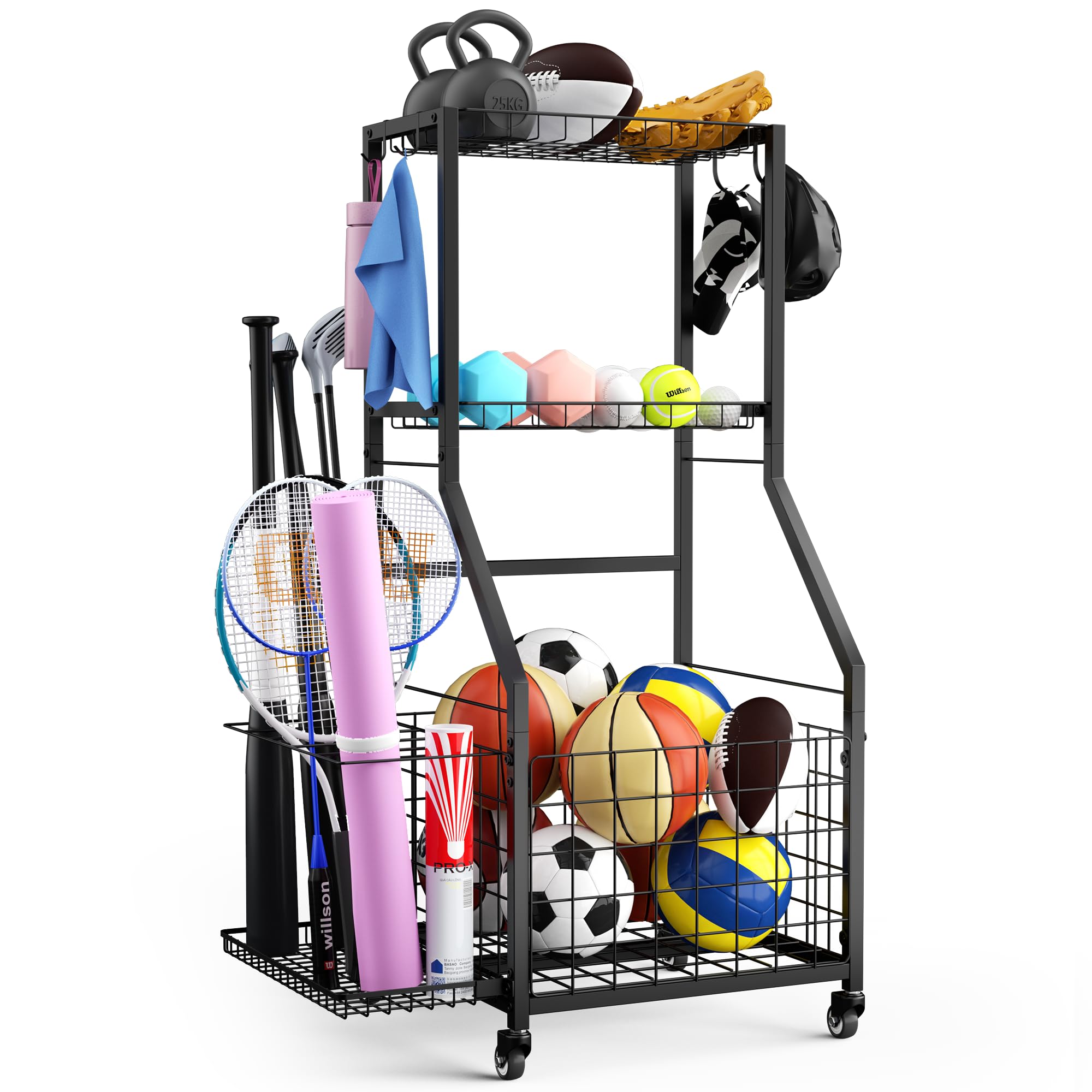
Hooks are the reason to look at this one. Three run down the side for helmets, bags, and gloves, a bat rack holds bats and rackets upright, and the three tiers combine one deep bin with two wire baskets you can lift out and carry. If your garage is a pile of sports gear rather than a stack of basketballs, this is the shape you want.
The frame is steel on swivel casters, and the side hooks do more work in a house with helmets and cleats than the shelves do, simply because that gear has nowhere else to go. The removable baskets are the other detail worth noting — they turn a trip out to the driveway into one carry instead of three.
What tempers our enthusiasm is scale. Read the dimensions before you order and picture a cart that holds a family’s gear but not a dozen basketballs, because that is what this is: a mixed-sport organizer with ball capacity, not a ball rack that happens to have hooks. Sized for that job, it earns its place and holds up under a loaded bin.
Assembly is the other soft spot. The instructions are the least clear of anything here, and the build goes smoothly when the parts are laid out and matched to the diagram first. Do that and the casters track straight, the frame does not flex, and the whole cart rolls out to the driveway without a wobble.
Pros
- Three hooks plus a side bat rack
- One bin and two removable wire baskets
- Swivel casters roll from garage to driveway
Cons
- Smaller in person than the listing photos suggest
We recommend it when the garage holds more than balls: hooks, a bat rack, and removable baskets turn one cart into a whole-team organizer.
rehomerance Lockable Ball Cart – Best for Locked Storage

Key Features
- Lids: Double, lockable
- Frame: Steel and wire mesh
- Wheels: 4 lockable casters
- Dimensions: 33.5"W x 26"D x 28.7"H
- Price: Premium
Padlock hasps on both lids make this the only cart here you can actually lock. The two tops open on 270-degree hinges and fold flat against the sides, so you can reach in from any direction, and once they are closed and locked the bin becomes a steel box. For a school, a club, or a garage that other people share, that changes the calculation.
It measures 33.5 inches wide, 26 deep, and 28.7 tall, and it is built from steel tubing and wire mesh with a gloss coating. It rolls on four casters that lock. Loading it is easy because there is no lid to prop open — the hinges fold the top out of the way and leave both hands free.
The mesh is the part we think about. Air moves through it, which is what you want when a wet ball goes in after practice, and it lets you see roughly how full the cart is without opening it. There are no dividers inside, though — this is a bin, and everything in it ends up in a pile.
What you are paying for is the lock, the folding lids, and casters that hold their position, and the padlock is on you to supply. That is a fair trade if gear walks off where you store it, and a harder one to justify in a garage where the only person taking a ball out is your own kid.
Pros
- Double lids with hasps for padlocks
- 270-degree hinges fold fully out of the way
- Four lockable casters stay where you park them
- Mesh sides let wet gear breathe
Cons
- Padlock sold separately
- Premium price for a single open bin
We keep this one for gear that has to stay where it is put: the only pick with lockable lids, and folding tops make loading easy.
How We Tested Outdoor Basketball Storage
We started by pulling every rack and cart we could find from major retailers, then narrowed the list by mounting type, claimed capacity, wheeled versus stationary, and price. Anything that didn’t state what it held, or that was clearly meant for an indoor gym only, came off. That left 12 units, which we tested over eight months.
Each one got loaded with a real household’s worth of balls — size-7 basketballs, soccer balls, volleyballs, footballs — and then handed to kids between six and thirteen who were told to take a ball out and put it back. It was chaos, but it’s the only honest way to learn whether a capacity claim survives contact with a full-size basketball. We timed assembly using only the hardware in the box, noting which builds needed two adults, which instructions were pictograms with no words, and where a rung or shelf bowed under load.
The outdoor-rated units lived on a driveway through rain, wind, and two snowfalls, and we checked the finish and joints afterward for rust, flaking, and wobble. We rolled the wheeled carts over a garage threshold and cracked concrete to see whether they tracked or skidded, then loaded each one past its stated capacity to watch for sagging. Finally, we weighed what each cost against how much of it was metal versus plastic, since value here mostly comes down to how long the thing stays square.
How to Choose Outdoor Basketball Storage
Where the rack goes matters more than how many features it lists, so settle the wall, the floor, and the weather before you compare shelves.
Pick the shape before the brand
Three shapes cover almost every situation: a rolling cart with tiers, a rack that mounts to a wall, and a mesh or lidded bin. A cart is the most flexible, because it parks in the garage and rolls out to the driveway, but it needs floor you are not using for anything else. A wall rack gives that floor back and takes up almost no width, which is the only realistic answer in a one-car garage or a basement with a narrow walkway. A bin is the fastest to load and the least picky about what goes in it.
Be honest about which one you will use. A wall rack mounted behind a parked car is worse than a cart, and a cart squeezed past a water heater is worse than a wall rack.
Capacity is a count, not a claim
A large-capacity rack can mean twelve basketballs or four, and the difference is usually the shape of the tier rather than the size of the frame. Full-size basketballs are about 9.5 inches across, so a cradle narrower than that holds a soccer ball and drops a basketball. Count the balls you actually own, including the half-flat football and the volleyball nobody uses, then buy for that number plus a couple of spares. Bins are the exception: their capacity is volume rather than slots, so one rated for 25 basketballs swallows a pump and a stack of cones in the same space.
What holds balls in, and what lets them out
Cords, wire baskets, and lids do the same job and fail in different ways. Elastic cords are quick for a child to use and they let go of small balls; wire baskets keep their shape but hide what is inside; lids keep weather and hands out while adding a step between a kid and the ball. If the rack is for children, watch the height of the bottom tier and how much tension the cord needs. A rack a seven-year-old cannot load on their own stops being storage and becomes a chore you finish yourself.
Where it sits decides how long it lasts
Powder coating and a rust-resistant finish are the minimum for anything that stays outdoors, and a mesh or open bottom matters more than it sounds: a rack that traps water at the base rusts from the bottom up. Fabric bins and fabric tiers belong in a garage, never on an uncovered patio. The ground counts too. Casters roll on concrete and pavers and dig into grass and gravel, so a cart that lives on a lawn is really a cart that gets carried.
Frequently Asked Questions
Can I mount a ball rack on a wood fence?
A fence can hold a light rack if the screws go into the posts or the rails rather than the pickets, but it is a compromise: pickets are thin, they flex, and a loaded rack pulls outward. For anything holding more than two or three basketballs, mount to a garage wall with the screws driven into studs. If no stud wall is available, a floor rack skips the problem entirely.
How long does assembly take?
Most of these go together in well under an hour with the hardware in the box, and the tiered steel racks take longest because every shelf has four bolts. Sort the bolts by size and match the labeled parts to the diagram before you start, and leave the casters until the frame is upright. On a cord-style rack, stretch the elastic before the rack is loaded, not after.
Should I deflate basketballs to store more of them?
Rarely worth it. A deflated ball takes up nearly the same shelf footprint, and you need a pump before anyone can shoot. Deflating pays off in one situation: packing a bin or a car trunk tight for the off-season, where a flat ball slides into gaps a round one cannot. If space is that tight, a wall rack buys back more than a pump does.
How tall is a wall-mounted rack, and will it fit my garage?
The Feyejade eight-tier rack runs 66.5 inches tall, and the shorter Hencawima column is 29.33 inches. Measure from the floor to the lowest obstruction, whether that is a garage door track, a shelf, or a light fixture, and leave a few inches above the top tier so a ball can be lifted out. If the only free wall sits under a window, split the sections and run them horizontally.
Final Verdict
Start with the EXTCCT four-tier rack. It covers the most situations for the fewest compromises: four steel shelves, two baskets you can carry to the driveway, locking casters, and a frame we trust more than anything else in this group.
If your gear outgrew basketballs years ago, the wider EXTCCT with the flat top shelf and the 440-pound rating is the one to stretch for. And if the balls never come indoors at all, skip racks and take the Kingarage mesh bin: nothing to re-hook, nothing to arrange, and room for 25 basketballs.