
This post contains affiliate links. We may earn a small commission when you buy through our links — at no extra cost to you.
A basketball hoop with a base is a balancing act: an adjustable rim up top and a couple hundred pounds of water or sand down below keeping it upright when someone hangs on the rim. Get it right and your driveway becomes the place kids pick over screens after dinner, with a rim that climbs from nine feet to ten as they grow. That’s the gap these hoops fill — real games and real rebounds without pouring concrete.
I’ve had a portable hoop at the end of my driveway for years, and over the past six months my team and I ran eight of them through after-school games, dusk shooting sessions, and the occasional rim hang. One thing shoppers overlook: a base is only heavy once it’s full, so check the fill and drain ports first — draining a 40-gallon base with a garden hose decides whether you ever move it to mow. Backboard size and how the height adjustment actually moves matter nearly as much as the base. The picks below earned their spots.
Our Top Picks


The Best Basketball Hoops with a Base, Reviewed
Lifetime 1269 Pro Court – Best Overall
Key Features
- Weight: 48 lb
- Backboard: 44 in. shatterproof
- Base fill: Sand or water
- Height range: 7.5 to 10 ft
- Price: Midrange
Set the 1269 beside the rest of this list and nothing about it stands out: 44 inches of backboard, a round three-piece pole, a base you fill with a hose. Then compare the details and the gaps close. It covers 7.5 to 10 feet in 6-inch steps, the Fusion board is polycarbonate over a polyethylene frame, and Lifetime backs the whole thing for five years.
That combination is why it earns the top spot. Nothing here asks less of you: fill the base with sand or water, tip it onto its wheels, and the telescoping pole covers a 7-year-old and an adult without a second hoop in the yard. The 44-inch board is big enough for real bank shots, and the UV-protected graphics are there for a reason if the hoop lives outside year-round.
The base is the part that decides whether you like it. A 48-pound frame plus sand in the tank puts the weight low and behind the pole, so a clanged shot rocks the board rather than walking the hoop across the driveway. Sand beats water if you can haul it: it’s denser, it doesn’t slosh, and it won’t split the tank in a freeze.
The height crank is the one thing we minded. Near the top of the range it takes two people, one holding the board while the other works the pin, so set the height before the game rather than during it. Assemble it on a flat surface with a second adult, and position the base before you fill it.
Pros
- Full 7.5 to 10 ft range in 6-inch steps
- Fillable base with wheels for moving
- 44-inch shatterproof board at a midrange price
- Five-year limited manufacturer warranty
Cons
- Assembly takes two adults and a couple of hours
- Solid rim, not a breakaway
We recommend it as the default family hoop: a 44-inch board, a genuine 7.5-to-10-foot range, a base that takes sand, and five-year coverage at a midrange price.
IGL Portable Hoop – Best for Toddlers Through Teens
Key Features
- Weight: 40 lb
- Backboard: 40 x 24 in.
- Base fill: Two fillable chambers
- Height range: 3 to 10 ft
- Price: Midrange
Three feet is the number that earns this one its place. Drop the IGL to its lowest setting and the rim sits at toddler height, which is the difference between a hoop a 3-year-old shoots at and one they only watch an older sibling use. Very few fillable-base hoops go that low and still climb to 10 feet.
That span is the whole argument for buying it. A family with a 4-year-old and a 13-year-old can have one hoop at 5 feet in the morning and 10 feet after school. The base is two chambers: a main tank that takes 100 pounds of sand or 77 of water, and an anchor tank that adds 40 or 30. That’s a lot of ballast for a 40-pound frame, and it’s what keeps the pole honest at the top of the range.
The height comes from adding or removing pole sections rather than from a crank. The listing splits the range into 3-to-5, 5.5-to-7.5, and 8-to-10 bands, so plan on changing it seasonally rather than between players. Assembly is one of the easier jobs in this group: the hardware and tools come in the box and the labeling is clear.
What you give up is board size. Forty by twenty-four inches is a generous target for a small child and a stingy one for a teenager working on bank shots, and the board and net are the parts to keep an eye on over a couple of seasons. As a hoop for a family that spans a decade of ages, though, nothing else here covers 3 to 10 feet in one frame.
Pros
- Goes as low as 3 ft for toddlers
- Climbs to a full 10 ft
- Two fillable chambers add real ballast
- Light enough for one person to roll
Cons
- 40 x 24 in. backboard is small for teens
- Board and net are the first parts to wear
We pick it for the family with a toddler and a teenager: it drops to 3 feet and climbs to 10 on a base that takes serious ballast.
Lifetime Courtside 48 – Best for Teens and Adults
Key Features
- Rim: Slam It breakaway
- Backboard: 48 in. polycarbonate
- Base fill: 31 gal, sand or water
- Height range: 8 to 10 ft
- Price: Premium
There’s no setting below 8 feet on this one, so if a small child is going to shoot on it, keep scrolling. The Courtside is built for players who are already strong enough for a real rim: teenagers, adults, and the neighbor who wants to try a dunk.
What you get for that is the biggest backboard in this roundup, 48 inches of polycarbonate, and a Slam It rim with double compression springs and welded net hooks. A hard dunk gives instead of bending the pole, which is the difference between a hoop that survives a teenage summer and one that doesn’t.
For a household of teenagers and adults, we think it’s the most convincing system here. The Speed Shift handle moves the rim between 8 and 10 feet in 6-inch steps with one hand, the 31-gallon base takes sand or water, and the whole thing carries Lifetime’s five-year warranty. The clear steel-framed board on a blue pole also reads more like a school hoop than a driveway toy.
Assembly is the tax on all that. Two adults, an afternoon, and instructions that skip steps — the base alone is heavy enough that you want it positioned before you fill it, and the pole sections are easier to line up with someone holding the other end.
Pros
- 48-inch board is the biggest here
- Breakaway rim handles dunks
- Speed Shift changes height one-handed
- Five-year limited warranty
Cons
- Two adults and an afternoon to assemble
- Can wobble at full height
For teenagers and adults who play hard, we think this is the best hoop here — a 48-inch board, a breakaway rim, and one-handed height changes.
awii sport Portable Hoop – Best for Quick Height Changes
Key Features
- Weight: 51.6 lb
- Warranty: 1 year
- Height range: 5.5 to 10 ft
- Height positions: 10 levels
- Price: Midrange
Ten lift positions between 5.5 and 10 feet, and nothing to unbolt between them: the awii’s adjuster is a row of height buttons on the pole that let one person walk the rim up or down without fetching a wrench.
The frame is Q195 steel with a weather-resistant coating, and the base uses a triangular support structure that sits more steadily on an uneven driveway than a flat-bottomed tank. The PE base takes water or sand, the rim is a standard 18-inch ring, and at 51.6 pounds the whole thing rolls back into the garage without a fight.
Check the listing before you order. This model spans 40-, 44-, and 48-inch backboards under one title, and the board you get changes how the hoop plays for a teenager. Read the option you’re buying rather than the headline photo.
If the rim height in your driveway moves more than once a week — a 6-year-old before dinner, adults after — this is the hoop we reach for. The rim can bend under heavy contact, and the fix is a replacement ring rather than a stronger one, so treat dunking as outside its job. For everything short of that, it’s the least fussy height change in this group.
Pros
- Ten-position lift, adjustable without tools
- Steel frame with weather-resistant coating
- 51.6 lb, so it rolls away easily
Cons
- Rim can bend under hard contact
- Backboard size varies by listing option
We reach for this one when the rim height changes often: ten lift positions, no tools, and a steel frame that rolls away after.
Yohood Kids Hoop – Best for Young Kids
Key Features
- Weight: 30 lb
- Backboard: Polycarbonate
- Height range: 4.82 to 8.53 ft
- Height positions: 12 levels
- Price: Budget
A hoop for a young child has one job: put the rim where they can shoot at it properly. The Yohood does that with 12 settings between roughly 4.8 and 8.5 feet, a wider span than the kid-first hoops further down this list, and enough to follow a child from kindergarten into middle school.
We ended up liking that range more than the price suggests. At 4.8 feet a small kid can shoot with a normal motion instead of a two-handed heave, and 8.5 feet is close enough to a real rim that a 12-year-old doesn’t feel like they’ve outgrown it. The hoops that stop at 7 feet become garage clutter by the second summer.
The rest is sensible for the size. It weighs around 30 pounds, so moving it between the driveway and the grass is a one-person job and the front wheels do the work. The base is deliberately oversized for a hoop this small, which is the right way round, since the base is what keeps a light pole upright.
Two things to know. The backboard is small next to the rim, so it’s a shooter’s hoop rather than a bank-shot trainer. And the hardware works loose: check the bolts after the first week and again at the start of each season, and plan on extra ballast if your yard catches wind.
Pros
- 12 settings from 4.8 to 8.5 ft
- Light enough to move around the yard
- Oversized base for its size
Cons
- Small backboard limits bank shots
- Bolts work loose over time
We like it as a first real hoop for a young child, with 12 settings from 4.8 to 8.5 feet and a weight one adult can move.
DUMOS Portable Hoop – Best for Fixed-Height Setups
Key Features
- Rim: Shock absorbent
- Wheels: Two
- Backboard: 44 in. shatterproof
- Height range: 6.1 to 10 ft
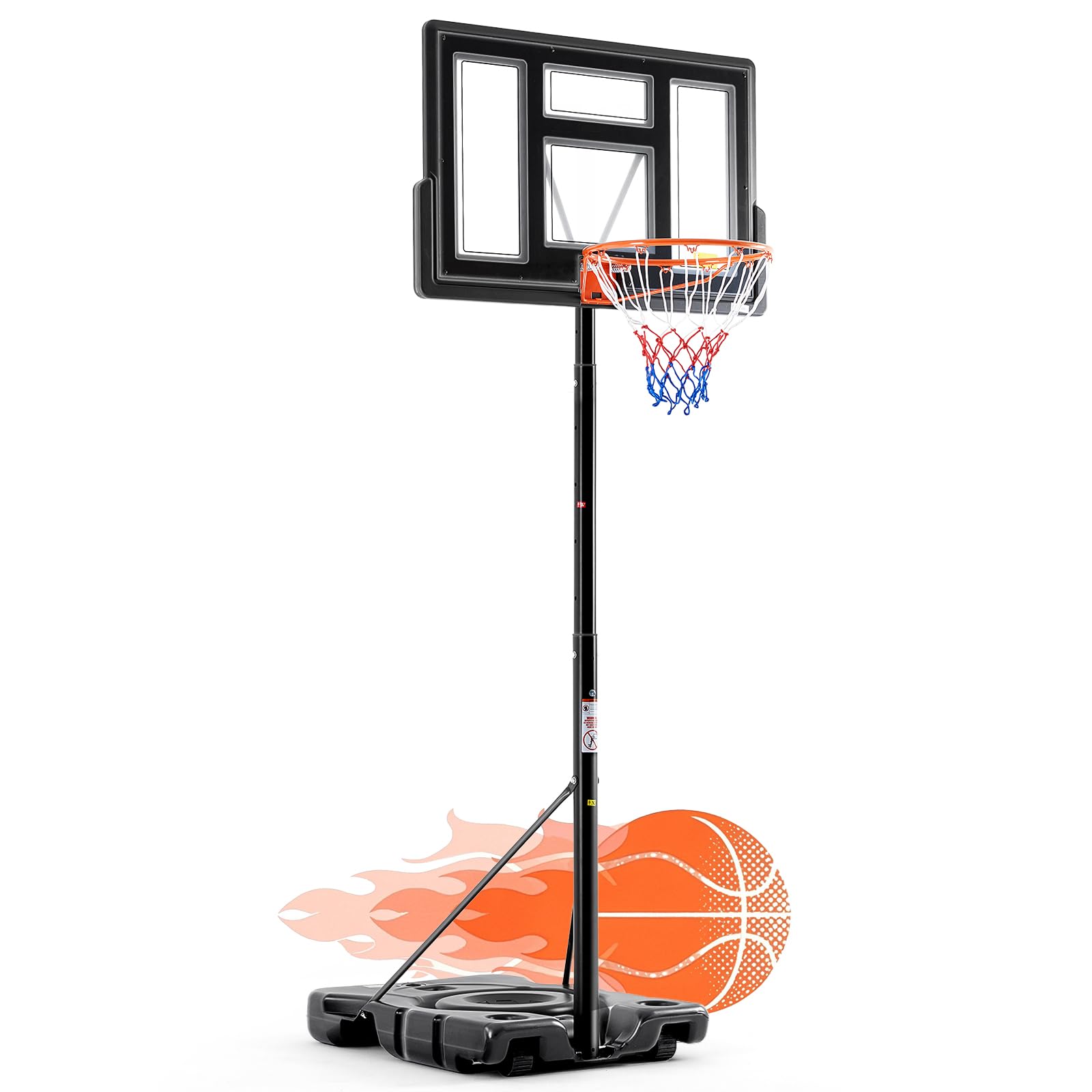
On paper the DUMOS covers the same ground as hoops further up this list: a 44-inch shatterproof board, a rim with some give to it, and a full 10 feet at the top of the range. It’s in the details that the gap opens.
Setup is one of its better stories. The tools come in the box, the instructions are clear enough that one person can work through most of it, and the base fills with water or sand before the two wheels take the weight.
The height adjustment is where our enthusiasm cools. The range runs from 6.1 to 10 feet, but changing it means loosening the pole and sliding it, which is a between-seasons job rather than a between-players one. For a household that sets one rim height and leaves it, that’s fine. For a driveway shared by a 7-year-old and a 16-year-old, it isn’t.
The other question is how it lasts. The board and rim can take damage under hard, regular use, and the net is the first part to go. That’s not unusual for the class, but it’s the reason this one sits below the Lifetime and IGL picks rather than alongside them.
Pros
- 44-inch shatterproof board
- Rim has some shock absorption
- One-person assembly for most of it
Cons
- Height changes need tools and time
We rate it for a household that sets one height and leaves it — a 44-inch board and 10 feet, as long as slow adjustment doesn’t bother you.
Seray Kids Hoop – Best for Toddlers and Poolside

Key Features
- Weight: 23 lb
- Warranty: 1 year
- Backboard: Shatterproof PC
- Height range: 3.2 to 7.2 ft
- Price: Budget
The Seray’s party trick is 3.2 feet, and that alone is why we recommend it to a house with a toddler. Dropped that low it’s a poolside hoop, a playroom hoop, or the first rim a 3-year-old can shoot at without a stack of cushions underneath.
We like it for exactly that and not much beyond it. The 3.2-to-7.2-foot range covers toddlers through about third grade, and the adjustment is a collar you twist rather than a pin you pull — quick when it moves freely, though it can stick. For the years when a child is learning to shoot, it beats a full-size hoop lowered all the way down.
At 23 pounds it’s the lightest thing here. One adult can carry it from the garage to the patio, and the base is generously sized for the pole that sits in it. The board is a shatterproof transparent panel, which matters when a plastic ball is coming at it from close range all afternoon.
What it isn’t is a family hoop. The pole is thin next to the 44-inch systems here, the base has cracked on some units, and 7.2 feet is the ceiling — a 10-year-old will want more. Buy it for the toddler-and-poolside years and expect to replace it when the shooting gets serious.
Pros
- Drops to 3.2 ft for toddlers
- 23 lb, easy for one adult to carry
- Height collar needs no tools
Cons
- Small pole and board sized for toddlers
- Base has cracked in some cases
We recommend it for toddler years and poolside play, where a 3.2-foot rim and 23 pounds of frame are exactly the point.
Play22 Kids Hoop – First Hoop

Key Features
- Frame: Alloy steel
- Wheels: Built-in
- Backboard: 33 in.
- Height range: 70 to 84 in.
- Price: Budget
Thirty-three inches of backboard is a lot for a kids’ hoop, and it’s the reason this Play22 is here: most hoops in this band give a child a small square to aim at, and this one gives them something that looks like the hoop at the park.
The height range is the compromise, and we think it’s the right one for the money. Seventy to eighty-four inches is roughly 5 foot 10 to 7 feet, so it suits a 4- to 9-year-old and stops well below a real rim. A tall 10-year-old has already outgrown it.
Setup is quick enough for a birthday morning: the hardware is labeled, the illustrated manual is usable, and the base fills with water or sand before the built-in wheels take over. The alloy steel pole carries a rust-resistant coating, which is what you want on something that lives outside.
Buy it as a first hoop and it makes sense — a big board, a friendly rim height, and a frame light enough to wheel out of the way. Buy it as a family’s only hoop and the 7-foot ceiling will have you shopping again in two years.
Pros
- 33-inch board, big for the class
- Quick, labeled assembly
- Fillable base with wheels
Cons
- Wobbles at its 7-foot setting
We suggest it as a first hoop for a 4- to 9-year-old: a 33-inch board and quick setup, with a 7-foot ceiling to plan around.
How We Tested Eight Hoops Over Six Months
We started with every base-style hoop we could find from the brands that own this category, then filtered by backboard size (anything under 44 inches got cut), height range, whether the base had separate fill and drain ports, and price. That left eight hoops, running from budget models to near-permanent ones meant to live outside year-round.
Each one was assembled by a single person using only the included instructions, and we timed it — noting missing hardware, steps that needed a second set of hands, and whether the diagrams actually matched the parts in the box. Then we filled the base and drained it with a garden hose, clocking both, because a base you dread emptying is a base that never moves. We set every hoop to its lowest and highest setting and cranked it both directions to see whether it took one hand or two and whether the rim stayed level afterward.
Play testing happened in driveways and cul-de-sacs, mostly after school and around dusk, with kids from about six upward and a few adults who should know better. We shot at every height setting, watched how each backboard returned a ball, and gave every pole a firm shove at full height to see how far the base rocked. Across six months we also tracked rust at the hardware, cracks along the base seams, net wear, and any wobble that only showed up after weeks outside.
Value came last: we weighed what each hoop asked of us against backboard size, adjustability range, and how well it held up through a full season of weather and constant use. The eight that made the cut are the ones we’d put at the end of our own driveways again.
How to Choose a Basketball Hoop with a Base
The base is the part you live with: how much weight it holds decides whether the hoop stays put, and how it rolls decides whether it ever leaves the garage.
Height range: look at both ends
The mismatch that ruins more purchases than any other is a hoop that doesn’t go low enough. Ten feet is regulation, and it’s where an adult hoop ends up; a child shoots with decent form several notches below that. Check the bottom of the range, not the top. Something like 5.5 to 10 feet covers a young family, 7.5 to 10 suits a house full of teenagers, and a hoop whose floor is 8 feet is an adult system however the listing phrases it.
Then look at how the height moves. A crank, a lever, or a lift handle you work standing up is worth paying for in a house where more than one player uses it. A hoop whose range comes from adding or removing pole sections is a seasonal change, not a between-games one.
The base is the whole product
Every hoop here anchors with water or sand, and the choice matters more than it sounds. Sand is denser — a tank rated for 100 pounds of sand holds about 77 pounds of water — and it doesn’t slosh or freeze. Fill the base where the hoop will live, because a full tank turns a one-person roll into a two-person shove.
Leave room behind the pole as well as in front. Overhang runs about 2 to 2.5 feet on these systems, so the pole sits that far behind the backboard, and the landing zone under it matters as much as the shooting zone.
Backboard size and rim type
Boards here run from 32 to 48 inches, and size is about what happens after a miss. A 44- or 48-inch board gives you a real bank shot and keeps the ball on the driveway; a 32- or 33-inch board is a target for a small child and not much else. Polycarbonate is the material to look for — every shatterproof board in this group is polycarbonate or acrylic over a frame.
The rim matters if anyone dunks or hangs. A breakaway or shock-absorbent ring gives under weight, and a solid ring passes that weight straight into the pole. Match the rim to the players, not to the price.
Assembly, weather, and the warranty
Budget two adults and an afternoon. The hoops that go together well have labeled hardware and a manual that matches the box; the ones that don’t turn a project into an evening. After the first week, re-tighten every bolt — that’s when a filled base settles — and do it again each spring. In a freezing climate, use sand rather than water so the tank doesn’t split.
Warranty is the clearest tiebreaker in this group. Lifetime covers its hoops for five years, most of the others run to one, and that difference is worth weighing against a lower price.
Frequently Asked Questions
Can I use a portable hoop on grass or a sloped driveway?
Grass works for a while and then doesn’t: a filled base sinks into soft turf and the pole starts to lean. Put the base on a slab, gravel, or the edge of the lawn where it meets pavement. On a slope, set the base across the fall line rather than pointing downhill, and check the pole with a level before you fill — a hoop that starts a degree off leans further once the ballast is in.
How high should the rim be for a child?
Ten feet is regulation and where adults play. For a child, drop it until they can shoot with a normal motion instead of a two-handed heave — for most 6- to 9-year-olds that lands between 7 and 8.5 feet. Set it, watch a dozen shots, and go down another notch if everything comes in flat. The adjustable hoops here move in 6-inch steps or finer.
Is a portable hoop as stable as an in-ground one?
No, and it isn’t meant to be. A filled base holds the pole up by weight rather than concrete, so a hard shot rocks the board and a badly placed hoop can shift in wind. What you get back is a hoop you can move, store, and take with you. If the hoop will never move and the ground is yours, in-ground is steadier; for a driveway, a rental, or a yard that floods, the base wins.
Final Verdict
If you want one hoop for a driveway with a range of ages on it, the Lifetime 1269 is the one we point you to: 44 inches of board, a real 7.5-to-10-foot range, a base that takes sand, and five years of coverage. Its one annoyance is the height crank, so set the rim before the game and leave it.
If everyone in the house is past elementary school and someone wants to dunk, the Courtside’s 48-inch board and breakaway rim are worth the step up. If there’s a toddler in the picture, the IGL’s 3-foot floor is the setting that actually gets used.