
This post contains affiliate links. We may earn a small commission when you buy through our links — at no extra cost to you.
The basketball training aids aisle is full of products promising to fix every part of your game at once. But the ones that actually deliver are the ones designed for a single, specific skill. Durability, however, is the weak link across the category — even highly-rated pop-up defenders and ball returns can fall apart within weeks.
This guide cuts through the noise by focusing on tools that survive repeated use and target the fundamentals that actually move the needle: dribbling with your head up, finishing through contact, and building hand strength. The trade-off? You may need separate gear for strength work and skill work — no single device does both well.
Whether you’re a coach outfitting a team or a player grinding solo, the right training aid is the one that aligns with a single weakness in your game. The picks here prioritize build quality and proven results over flashy marketing.


Best for All Players
Unique Dribble Specs
Key Features
- Training Type: Dribbling, head-up
- Durability: Durable flexible plastic
- Setup & Portability: Adjustable elastic strap
- Age/Skill Level: Youth to adult
- Indoor/Outdoor: Indoor/outdoor
- Price: $
The Dribble Specs block the lower field of vision so looking at the ball is not an option. Coaches and parents consistently report improvement in ball handling after using them, and the flexible plastic frame holds up to gym bag storage without cracking.
Best for players of any age who need to make head-up dribbling a reflex — beginners and youth teams especially. The strap fits average adult and older child heads well, but children with head circumferences under about 20 inches may find it too loose. During extended drills, the nose bridge can create pressure after 30 minutes, making this a tool for focused sessions rather than all-day wear.
Pros
- Forces head-up ball handling by blocking lower vision
- Budget-friendly enough to buy multiple pairs for team practices
- Flexible plastic frame withstands sweat and daily gym bag use
Cons
- Strap may not tighten sufficiently for children with small heads
- Nose bridge can become uncomfortable during sessions longer than 30 minutes
For developing head-up dribbling habits, this is the most direct and cost-effective tool available. Ideal for beginners and team settings, with the caveat that smaller children may need a different solution or padding adjustments.
Best for Strength Training
SKLZ Weighted Ball
Key Features
- Training Type: Strength, dribbling
- Durability: Synthetic leather cover
- Setup & Portability: Standard ball
- Age/Skill Level: Youth to adult
- Indoor/Outdoor: Indoor/outdoor
- Price: $$
The SKLZ Weighted Ball builds hand and wrist strength effectively, making standard balls feel lighter after consistent use. The claimed 3-lb weight can measure closer to 2.14 lbs in some units, and the bounce is less lively than a regulation ball — tradeoffs that matter less for strength-focused dribbling drills than for game simulation. This ball suits players seeking off-season conditioning and youth athletes transitioning to heavier competition, but it’s not intended for shooting practice.
Pros
- Builds hand, wrist, and arm strength for more powerful dribbling.
- Realistic grip and surface quality when properly inflated.
- Increases ball control confidence; standard balls feel lighter after use.
Cons
- Actual weight can be lighter than the advertised 3 lbs.
- Bounce can feel less lively compared to a standard basketball.
A functional strength-training ball for off-season work, though weight accuracy varies — worth weighing before heavy use.
Best for Contact Drills
GoSports Blocking Pad
Key Features
- Training Type: Contact, defense
- Durability: High-density foam, leather
- Setup & Portability: 5 handles, 2.13 kg
- Age/Skill Level: Youth to adult
- Indoor/Outdoor: Indoor/outdoor
- Price: $$
Rather than simulating a static shooter, the GoSports blocking pad is built for contact and finish-through drills. The high-density foam absorbs impact well, and the five reinforced handles give coaches and players multiple grabbing positions for controlled defensive pressure.
This pad suits basketball players who need to practice finishing through contact, as well as coaches training defensive aggression. The foam is dense enough for basketball drills but may lack firmness for heavy martial arts kicks.
Pros
- Composite leather and high-density foam withstand repeated contact drills.
- Five reinforced handles allow varied gripping positions for controlled training.
- Mid-range price delivers long-term value given the build quality.
Cons
- Foam firmness may be insufficient for heavy martial arts kicks, but this does not affect basketball use.
A durable choice for basketball players who drive into contact during drills — just don’t expect it to double for heavy martial arts kicking.
Best for Solo Shooting
GoSports XTRAMAN
Key Features
- Training Type: Shooting, driving
- Durability: Steel frame, nylon mesh
- Setup & Portability: Easy assembly, carry bag
- Age/Skill Level: Youth to adult
- Indoor/Outdoor: Indoor preferred
- Price: $$
The XTRAMAN does a solid job forcing players to elevate their shot — the 7-foot nylon mesh silhouette creates a genuine obstacle to shoot over. But the frame relies on stakes and a lightweight base, so even a light breeze can knock it over, and the steel poles may bend after repeated use. This makes it a practical tool for indoor gyms or sheltered outdoor courts, but less suitable for windy days or aggressive contact.
Pros
- Simulates a real defender for shooting practice
- Forces players to elevate their shot arc
Cons
- Can fall over in light wind or minor contact
- Frame poles may bend under repeated use
A focused shooting aid for players who train indoors or in calm conditions. Look to a foam blocking pad if contact drills are the priority.
Best for Young Beginners
Baden SkilCoach
Key Features
- Training Type: Shooting, hand placement
- Durability: Rubber, wound core
- Setup & Portability: Junior size 27.5"
- Age/Skill Level: Kids ages 4–8
- Indoor/Outdoor: Indoor/outdoor
- Price: $
The Baden SkilCoach uses printed hand graphics on a 27.5-inch rubber ball to show young shooters exactly where to place their hands for a proper release. This makes it a focused tool for teaching shooting fundamentals to kids aged 4–8 in clinics or at home. The ball does need frequent reinflation, so keep a pump nearby between sessions. It’s best suited for indoor use or supervised outdoor play where you can top it off before each use.
Pros
- Printed hand graphics show correct hand placement for young beginners.
- Size and weight are well-suited for small hands.
- Good value for a training-specific ball.
Cons
- Handprint decals may fade or peel after a few months of outdoor use.
A practical teaching ball for young beginners, provided you’re willing to reinflate it before each session.
Best for Team Drills
Liberty Goggles 12-Pack
Key Features
- Training Type: Dribbling, head-up
- Durability: Hard plastic, elastic strap
- Setup & Portability: 12 pairs, adjustable
- Age/Skill Level: Youth to adult
- Indoor/Outdoor: Indoor/outdoor
- Price: $
This pack gives a youth league or clinic the ability to run head-up dribbling drills with every player equipped at once. The hard plastic blocks downward vision effectively, forcing players to keep their eyes up during dribbling drills. At this price per pair, it’s the most cost-effective way to outfit an entire squad — far cheaper than buying singles. For individual practice, the top pick’s single goggle is a better choice. During extended drills, some players may find the strap pressure on the nose and temples uncomfortable; loosening the elastic helps, but those with sensitive faces should try before committing.
Pros
- Bulk pack saves teams money compared to buying individual goggles.
- Blocks downward vision to build head-up dribbling habit.
- Low per-pair cost fits tight team budgets.
Cons
- Straps can feel tight on the nose and temples during extended use.
For coaches running team practices, this 12-pack is a budget-friendly way to enforce head-up dribbling. For individual training, a single goggle is more practical.
Best for Youth Contact Training
Hikeen Blocking Pad
Key Features
- Training Type: Contact, defense
- Durability: Denser foam, leather cover
- Setup & Portability: 5 handles, 4–5 lbs
- Age/Skill Level: Youth to adult
- Indoor/Outdoor: Indoor/outdoor
- Price: $
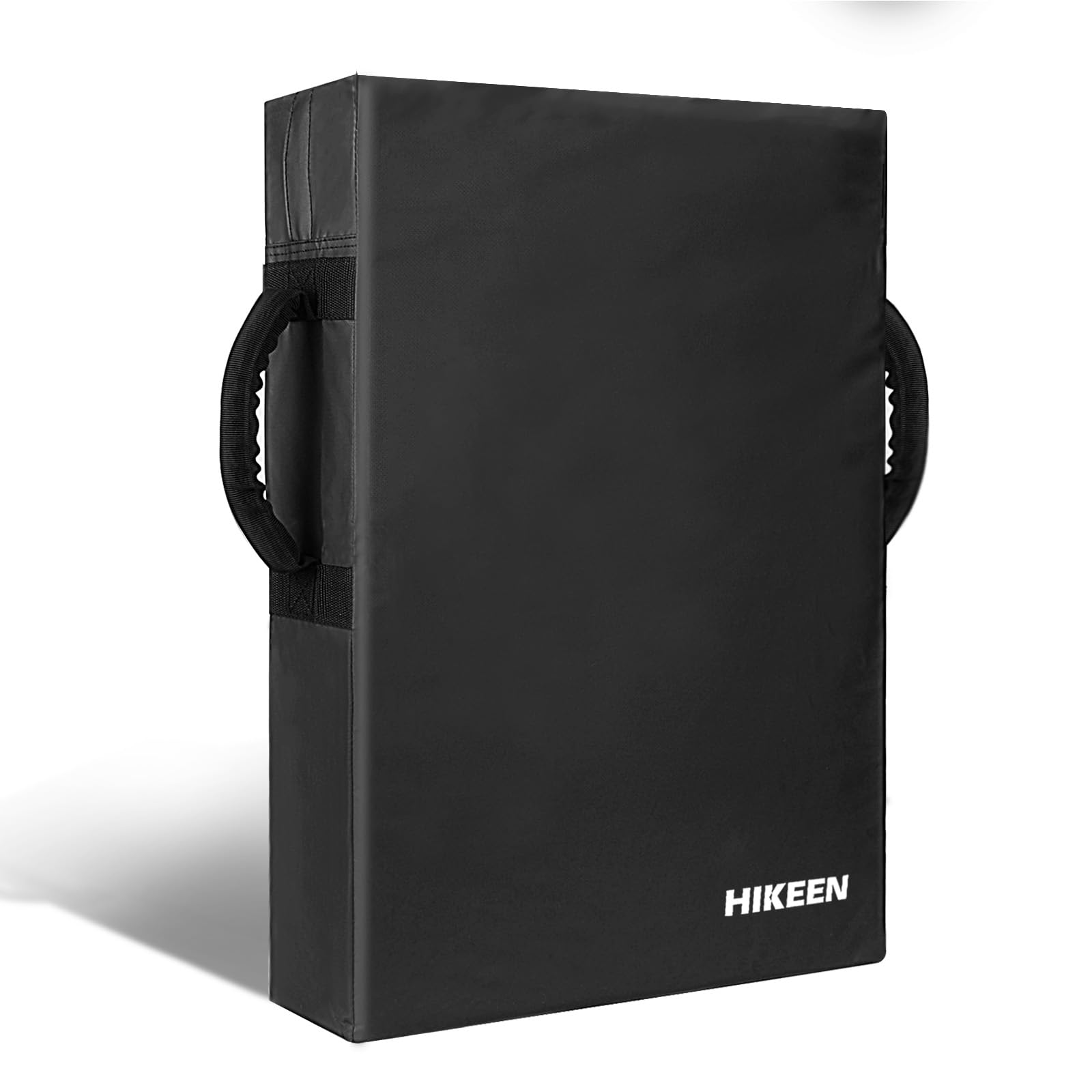
The Hikeen blocking pad uses dense foam and five reinforced handles to absorb impact during basketball contact drills. At a lower price than the GoSports pad, it suits youth practices and home sessions with parents. The padding is slightly thinner and the surface smaller than premium options, so adult-level impacts may feel less cushioned, but for controlled youth training its performance holds up well.
Pros
- Solid build quality with dense foam that absorbs impact well for contact drills.
- Good value for basketball training compared to pricier blocking pads.
Cons
- Padding thickness may be insufficient for heavy adult-level contact, limiting its use to youth or lighter drills.
A cost-effective pick for youth basketball contact drills where moderate foam thickness and a smaller surface area are acceptable.
Best for Budget Strength Training
NEOGOAT Weighted Ball

Key Features
- Training Type: Strength, dribbling
- Durability: PU leather, tacky grip
- Setup & Portability: Standard size 7
- Age/Skill Level: Youth to adult
- Indoor/Outdoor: Indoor/outdoor
- Price: $
This budget-friendly weighted ball has a tacky grip and solid construction that helps with hand strength and dribbling control. While the initial feel is promising, it hasn’t been as extensively tested as the SKLZ alternative, so long-term durability is less certain.
Pros
- Good build quality and grip for the price
- Effective for building hand strength and improving ball control
Cons
- Weight distribution can vary between units, noticeable during dribbling drills
Suitable for budget-conscious players wanting a weighted ball for strength training, provided you can accept potential unit-to-unit weight consistency.
Best for Data-Driven Training
Spalding Smart Ball
Key Features
- Training Type: Shooting, analytics
- Durability: Composite leather, sensors
- Setup & Portability: Bluetooth app pairing
- Age/Skill Level: Serious players
- Indoor/Outdoor: Indoor recommended
- Price: $$$
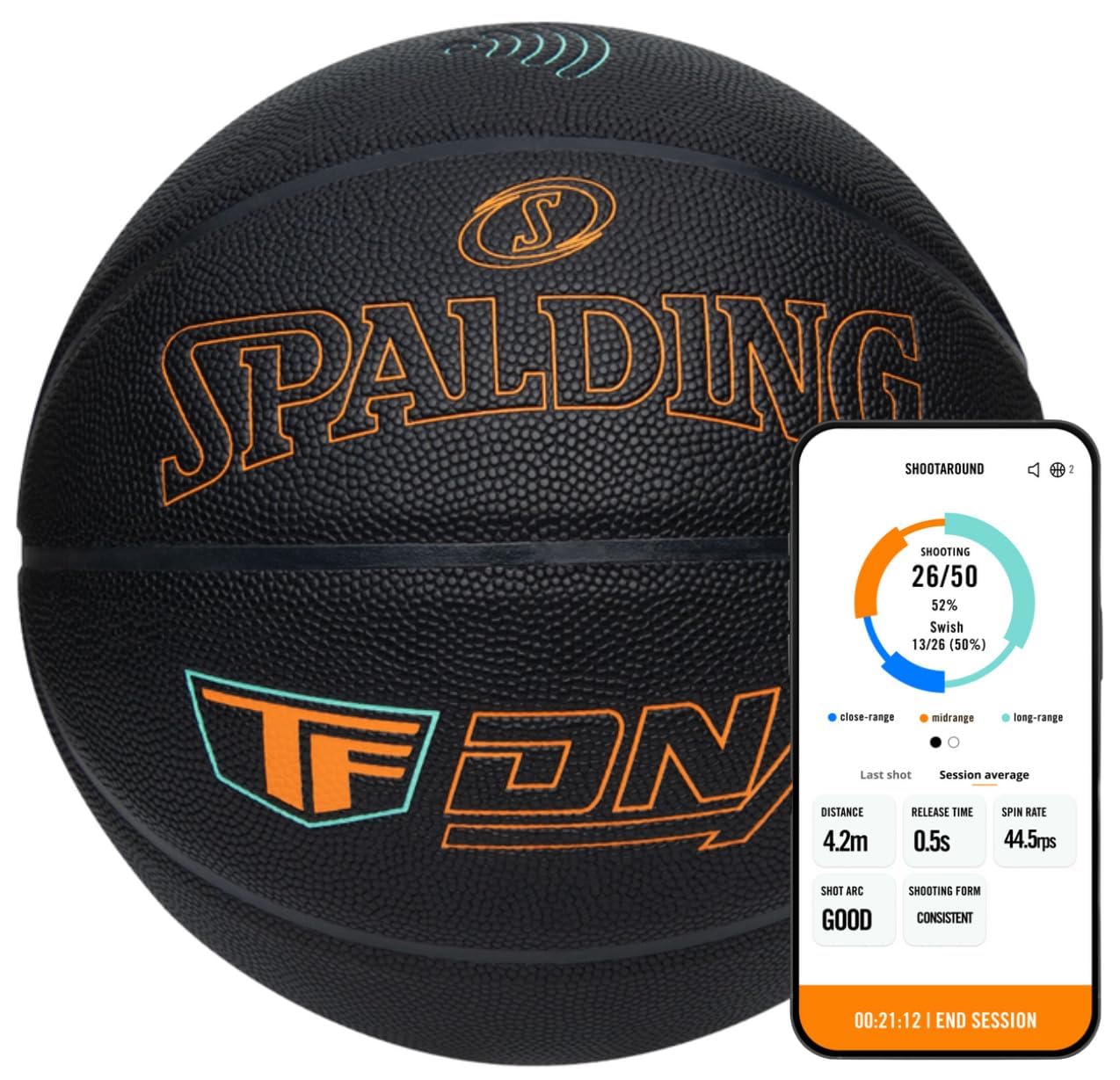
This smart basketball records detailed shot data including location, arc, and spin via a connected app. The composite leather cover provides a game-like feel, and the gamified challenges encourage extra reps. However, the subscription cost renews at a premium rate after the first year, and Bluetooth pairing can be unreliable for some users. Indoor use is recommended; outdoor surfaces may affect sensor accuracy.
Pros
- Tracks makes, misses, shot location, arc, and spin
- High-quality build with composite leather cover
Cons
- Subscription renewal adds ongoing expense for analytics access
Suits dedicated players and coaches who want objective shot data and are willing to accept the recurring subscription and occasional Bluetooth quirks.
Best for Team Obstacles
Hikeen Defender 4-Pack

Key Features
- Training Type: Obstacle, defense
- Durability: Alloy steel, nylon cover
- Setup & Portability: Pop-up, carry bag
- Age/Skill Level: Youth teams
- Indoor/Outdoor: Indoor/outdoor
- Price: $$
These pop-up defenders add multiple obstacles for youth basketball, soccer, or lacrosse drills. Setup is quick and the included sandbags keep them stable on indoor courts. Some units may develop clamp breakage after months of use, and the steel frame is best kept out of extreme weather. The 4-pack value appeals to coaches running light team practices.
Pros
- Sturdy build for their size; stable on indoor surfaces.
- Pop-up design and carrying bag make transport simple.
Cons
- Clamp breakage or metal wire popping may occur over time.
Best for coaches needing a pack of portable defenders for light team drills, but less suitable for heavy contact or prolonged outdoor use.
How to Choose
The most effective basketball training aids focus on one skill at a time; multi-sport marketing often masks weaker durability and less precise training.
Start with a Single Skill
A weighted ball builds hand strength but alters shooting mechanics. A dribbling goggle forces head-up play but does nothing for your shot. The right tool isolates a weakness – choose the skill you want to improve first.
Durability Over Flash
Pop-up defenders and ball returns often fail at seams or in the zipper after weeks. Look for reinforced stitching, metal frames, and high-density foam. If you practice outdoors, avoid plastic components that degrade under UV.
Setup vs. Stability
Pop-up designs are convenient but rarely stable in wind or light contact – add sand or water weights for outdoor use. Assembly-heavy products like rebounder frames offer better durability but take time to put together. Portability is a trade-off with stability: the easier it packs, the more likely it tips.
Match Size and Strength to User
Youth players need smaller balls (27.5") and lighter resistance to build correct form. Adult tools like a 3-lb weighted ball can strain a child’s wrist. Blocking pads for contact drills should match the user’s size – a large pad overwhelms a small player.
Where You Train Matters
Outdoor use demands weather-resistant materials: nylon mesh, rubber, and powder-coated metal. Indoor-only gear like the Spalding Smart Ball shouldn’t see concrete. Wind causes pop-up dummies to fall – indoor is safer for those designs.
FAQ
Do weighted basketballs help improve shooting accuracy?
Weighted basketballs are designed for strength, not shooting. Their heavier mass and altered bounce can change your shooting arc and release mechanics. Use them exclusively for dribbling and passing drills, not for practicing shots.
Why does my ball return keep getting stuck at the net?
Most ball returns rely on a steep net angle to funnel the ball back. Misalignment or a loose net causes the ball to catch. Tighten the net straps and ensure the rim is level. If the plastic clips crack, the device is likely a lost cause.
How do I stop my pop-up defender from falling over in the wind?
Add sand or water to the base bags – most come empty. Even then, wind over 10 mph can topple them. For outdoor stability, stake the base into the ground using the provided loops, or move training indoors.
Are dribbling goggles comfortable enough for long practice sessions?
Most goggles use an elastic strap and hard plastic that presses on the nose bridge. For sessions over 30 minutes, look for soft padding around the bridge or a strap that adjusts to a looser fit. Some users find them tolerable; others prefer short intervals.