
This post contains affiliate links. We may earn a small commission when you buy through our links — at no extra cost to you.
Backboards rarely fail dramatically. More often it’s a hairline crack after a winter of freeze-thaw, a rim that sags because a kid hung on it once too often, or bolts rusted solid into the bracket. A replacement backboard and rim combo fixes all three: you keep the pole and the footing and swap out only the part that broke. The catch is that these combos aren’t interchangeable, and the wrong one turns a Saturday project into three trips to the hardware store.
I’ve spent the better part of eight months with 12 of these, from 44-inch panels to 54-inch boards built for real play. Plenty of combos ship without mounting hardware or a bracket, so check what’s bolted to your pole before you order anything. Material matters just as much: a shatterproof panel shrugs off a hanging kid, acrylic looks sharper but scuffs, and HDPE is the forgiving pick for a busy driveway. Every combo below earned its spot on sturdiness, honest value, and looks that don’t make the driveway ugly, and each one is an afternoon job rather than a contractor’s visit.
Our Top Picks
The Best Replacement Basketball Backboards, Reviewed
Best Overall
Lifetime 73650 44-Inch Combo
Key Features
- Rim: 18 in. Slam-It
- Unit weight: 22.6 lb
- Backboard size: 44 x 30 in.
- Playing surface: Shatterproof polycarbonate
- Price: Midrange
A 44-by-30-inch board is the size that makes a replacement feel like an upgrade without turning into a construction project. It gives you enough surface for bank shots and free-throw work, and the shatterproof polycarbonate takes an overthrown ball without the cracking that ends most old backboards. What we like most is the proportion of it: enough board to play on, and 22.6 pounds light enough that two people can walk it up a ladder without a plan.
The mounting kit is not in the box, and Lifetime is unusually direct about that: the board hangs from the Universal Mounting Kit, models 1044 or 9594, sold on its own. That is the single fact to plan around, because the bolt pattern is built for that bracket and nothing else. Put the kit in the same order and the install is a straightforward bolt-up; skip it and you are drilling a plate in the driveway on a Saturday.
What keeps this at the top of the group is how little it asks you to give up. The rim is the standard Slam-It rather than the breakaway Pro fitted to the 48-inch board, so dunk contests belong elsewhere, but for driveway games, free-throw practice, and a kid learning to shoot, it is the right amount of hoop. The fade- and rust-resistant finish is the other reason we are comfortable pointing you here for a spot that gets sun and rain all year.
Pros
- Shatterproof polycarbonate playing surface
- 44 x 30 in. board with an 18 in. Slam-It rim
- 22.6 lb is manageable for two people
- Fade- and rust-resistant for year-round outdoor use
Cons
- Standard Slam-It rim, not the Pro breakaway
The safest swap for most driveways: a 44-inch shatterproof polycarbonate board, a solid Slam-It rim, and a price that stays well away from the big competition boards.
Best Budget
Lifetime 3823 44-Inch Combo
Key Features
- Rim: 18 in. classic orange
- Unit weight: 15 lb
- Backboard size: 44 in.
- Playing surface: Molded HDPE
- Price: Budget
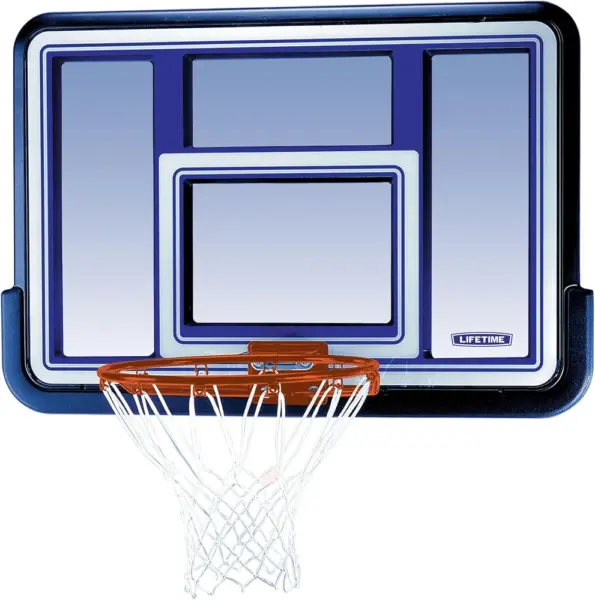
Fifteen pounds is the number that makes this board easy to live with. You can hold it in place with one hand and run a bolt with the other, which nobody says about the 34-pound steel-framed board, and it is why this is the pick for a swap you are doing alone on a Saturday. In the box: 44 inches of molded HDPE, an 18-inch classic orange rim, and a 50-gram nylon net.
Where the money goes is the surface. HDPE is the least rigid material in this group and it plays that way — the ball comes off softer than it does on the polycarbonate boards, and the panel has more give when a hard pass hits it. We think that is the right trade for a hoop that mostly sees kids, free throws, and driveway games, because it is the cheapest route back to a full-size board on a pole you already own.
The mounting side decides whether this is a ten-minute job or a second order. Lifetime builds the board to hang from its 1044 conversion kit on a Lifetime hoop, or the 9594 universal kit for a wall, roof, or eave, so the question to answer before you buy is which of those your pole or wall already carries. Get that right and the board drops onto existing holes instead of new ones.
Pros
- Lightest board here at 15 lb
- Cheapest board in this group
- Board, 18 in. rim, and net included
Cons
- HDPE surface gives a softer, less rigid rebound
- Mounting hardware sold separately
The budget answer: a 15-pound 44-inch board that one person can hang, for the least money of anything we recommend here.
Best for Dunking
Lifetime 73729 48-Inch Combo
Key Features
- Rim: 18 in. Slam-It Pro breakaway
- Frame: Steel-framed polycarbonate
- Unit weight: 34 lb
- Backboard size: 48 in.
- Price: Midrange
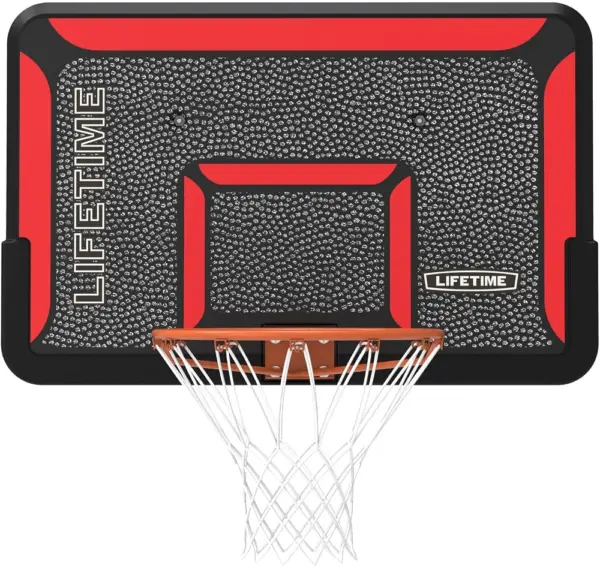
The rim is the reason to pay more here. Lifetime fits the Slam-It Pro: 18 inches of 5/8-inch solid steel, wrapped in 1/2-inch bracing, riding on double-compression springs, with a heavier net. Those springs are what give when someone hangs on the rim after a layup, and a rim that gives is a rim that does not take the board and the wall down with it.
Behind the rim is a 48-inch steel-framed polycarbonate board, and the extra rigidity shows in how the ball comes back off it — crisper than the HDPE panel on the budget pick, and with less flex on a hard pass. The hesitation is at the rim end. Net hooks and rim hardware can wear out, and it happens most with players who dunk every time they touch the ball, so treat the hardware as a part you may replace rather than a one-time install.
Order the mounting kit with the board. Lifetime’s listing says the bracket is sold separately in the subtitle, in the bullet points, and in the model name, and it still catches people out, because the box contains a board, a rim, and nothing to hang them from. At 34 pounds, plan on a second set of hands for the lift.
Pros
- Slam-It Pro breakaway rim with double-compression springs
- 48 in. steel-framed board for a crisper bounce
- Fade-resistant graphics rated for outdoor use
Cons
- Rim hardware and net hooks can fail under heavy dunking
For a house full of players who hang on the rim, the 48-inch steel frame and Slam-It Pro breakaway earn the extra money over the 44-inch boards.
Best for Bank Shots
Lifetime 71526 54-Inch Combo
Key Features
- Rim: 18 in. breakaway
- Backboard size: 54 in.
- Playing surface: Polycarbonate
- Mounting hardware: Sold separately
- Price: Premium
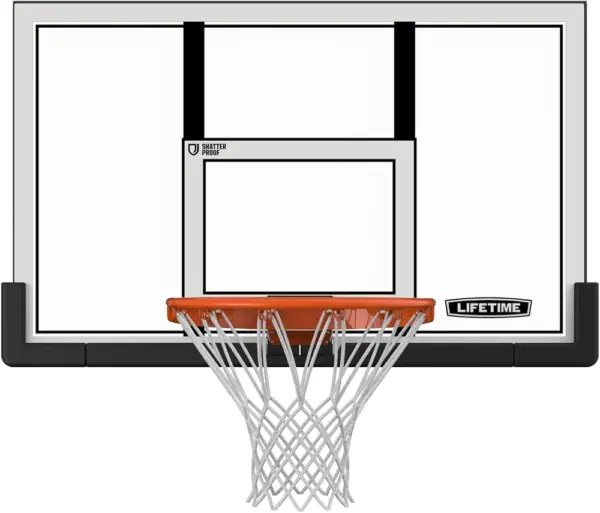
Size is the whole argument for this board. At 54 inches it is the largest surface in this group, and the difference shows on the shots that separate a good shooter from a lucky one: bank shots, angled drives, and the extra half-second a big board gives a rebounder. We would not push anyone toward it for a hoop that only sees casual play — the extra surface is wasted there — but for daily practice off the board, it is the one that changes the workout.
The trade is on the install side. The board and rim come on their own, the mounting bracket and hardware come separately, and the frame does not simply bolt onto whatever bracket an older Lifetime hoop is already wearing. Measure your current mount and match it to a current Lifetime kit before you order, because the wrong bracket turns an afternoon into a weekend.
It is also the most expensive board here, and the fit is fussier than the 48-inch steel-framed board that costs less. What you are paying for is surface area and the breakaway rim: the polycarbonate has real spring to it, and the spring-loaded rim means the board survives contact instead of absorbing it.
Pros
- 54 in. playing surface, the largest here
- Breakaway rim absorbs contact
- Polycarbonate surface with fade-resistant finish
Cons
- Most expensive board in this group
- Bracket sold separately; older Lifetime brackets do not fit
The biggest board in this group, and the one to buy if bank shots are part of your game and you are willing to sort the bracket carefully.
Best for Existing Lifetime Setups
Lifetime 73621 48-Inch Fusion Combo
Key Features
- Rim: 18 in.
- Unit weight: 26.3 lb
- Backboard size: 48 x 30 in.
- Playing surface: 3 mm Makrolon polycarbonate
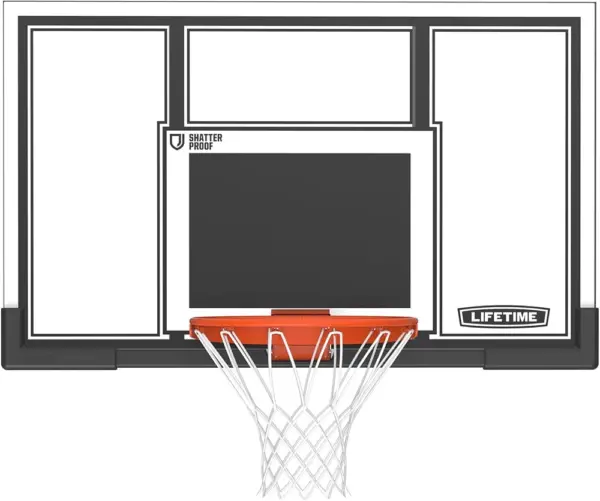
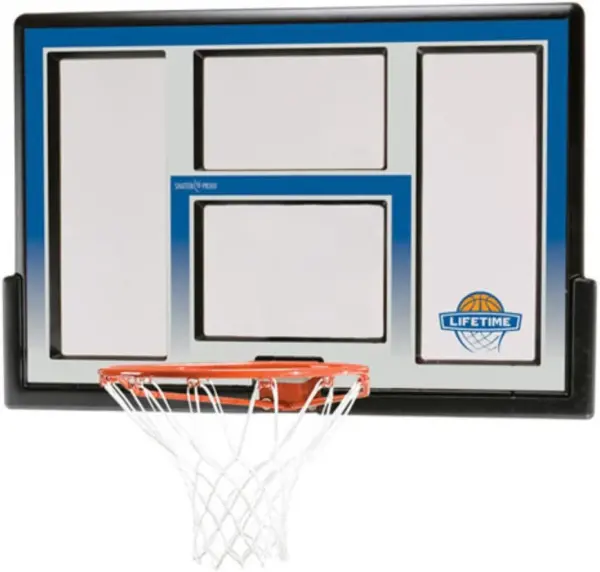
This one exists for a specific job: replacing an existing Lifetime backboard on a Lifetime system, where the bracket is already up and the only question is which surface goes back on it. Lifetime builds it for use with specific Lifetime systems and brackets, so the swap can be a straight re-bolt rather than a fabrication project with a drill and a template.
What you get is a 48-by-30-inch blow-molded frame with a frame pad and a 3 mm Makrolon polycarbonate playing surface — clear, with fade-resistant graphics behind it. That is a lighter package than the steel-framed 48-inch board at 11.93 kilograms, and it is the version that keeps the glass-clean look on an older pole without asking the mount to carry a steel frame.
Where we hesitate is rigidity. The hollow blow-molded frame is the least solid-feeling of the 48-inch boards here, and you notice it in how the ball comes back — fine for a garage or a family driveway, less satisfying if you are used to a steel frame behind the surface. The fit question is real too, since the board is built around Lifetime’s own brackets and the box does not include the one you need. Check that your mount is on Lifetime’s list before you commit.
Pros
- 3 mm shatterproof polycarbonate playing surface
- Padded blow-molded frame
- Lighter than the steel-framed 48-inch board
Cons
- Hollow frame feels less rigid than steel
- Built around specific Lifetime brackets
The direct-fit option for an existing Lifetime setup: a clear 48-inch Fusion board that re-boards a pole you already have without the weight of steel.
How We Tested Replacement Backboard Combos
We started with a list of about 30 replacement combos sold on their own, then narrowed it by panel size, panel material, rim type, and what actually comes in the box, since a board that arrives without a bracket is only a deal if your existing mount matches it. That left 12 units, which we installed on real poles in real driveways over eight months.
We mounted every board ourselves with a socket set and a level, timing the job and noting whether the hardware inside the box lined up with the bracket already on the pole. Anything that sent us back to the hardware store for a bolt got marked down, and we compared what arrived against price to see where the value actually sat.
Then we played. Kids hung on the rims, we fired chest passes off each panel, and we deliberately missed badly to see how a shatterproof face and an acrylic one took the same abuse. Once a month we re-checked every bolt for loosening, ran a hose over the panel to see whether water pooled at the frame, and looked for scuffs, rattles, and sun fading. We also asked the shortest players in the house whether the rim felt right for them, because a combo sized for adults is money wasted if it’s the kids who shoot every afternoon.
How to Choose a Replacement Basketball Backboard
The board is the easy half of this purchase — what decides whether a replacement works is the bracket already bolted to your pole, wall, or roof, and whether the new board hangs from it.
Start With the Bracket You Already Have
Every combo in this group is built around Lifetime’s own mounting kits: the 1044 quick-adjust conversion kit for a Lifetime hoop, and the 9594 universal kit for a wall, roof, or eave. Look at what is holding your old board before you shop. If it is a Lifetime bracket, the swap is a bolt-up job and you can shop on size and surface. If it is a homemade plate, a welded pole bracket, or a brand that no longer exists, expect to buy a kit or make an adapter.
The trap is the product photo: a board, a rim, a net, and no bracket anywhere in the frame. Most replacement combos at this level ship without one, and the mounting kit is a separate purchase. Order both in the same cart — the kit is the difference between a box of parts and a hoop.
Size and Playing Surface
Forty-four inches is the standard driveway size and the easiest to hang: less surface catches less wind, and a smaller board puts less leverage on the mount. Forty-eight and 54-inch boards give you more to shoot at, which matters if your game runs through the bank shot, but they weigh more and pull harder on whatever holds them.
On material, HDPE is the molded plastic panel — light, inexpensive, and the least rigid of the three. Polycarbonate is stiffer, shatter-resistant, and what we look for on a board that will live outside for years. A steel frame behind a polycarbonate face is the stiffest setup here and the one that feels most like a gym board.
Fixed Rim or Breakaway Rim
A fixed rim is bolted solid. A breakaway rim rides on compression springs, gives when someone hangs on it, and snaps back. That movement protects the board and the wall from the energy of a dunk, and it is the difference between a hoop that survives a teenage summer and one that does not. The 48-inch steel-framed board here is the pick with a true spring-loaded rim; the rest are fixed.
Weight, Tools, and an Honest Install Estimate
A 15-pound board is a one-person job with a ladder and a deep socket. A 34-pound board is not, so line up a second set of hands before delivery day. Either way, check the pole for rot at the base and the wall or eave for sound framing before you hang anything heavier than what came off, and keep the mounting kit on the same order as the board.
Frequently Asked Questions
Do replacement backboards come with a rim and a net?
The combos here all do: each ships with an 18-inch rim and a net, matched to the board it comes with. Board-only listings exist too, and they only make sense when your current rim is in good shape and lines up with the new board’s bolt holes. Read the included-components line on the listing before you buy — that line, not the photo, tells you what actually arrives.
Can I reuse the rim I already have?
Sometimes. The rim’s bolt pattern has to line up with the holes or studs on the new board, which is a coin flip across brands and a better bet within one maker’s range. Test it before you climb a ladder: lay the new board face-down, set the old rim on it, and see whether the holes line up with the rim sitting level.
How high should the rim sit?
Ten feet to the top of the rim is regulation, and it is where most adults want a driveway hoop. A new backboard does not change the height on its own — the bracket or pole does — so if your rim sits low, the fix is an adjustable mount rather than a different board. For young kids, 8 feet is a common starting height, and a quick-adjust bracket lets one person move it.
Final Verdict
Buy the Lifetime 73650 if you want the least complicated replacement: 44 inches of shatterproof polycarbonate, a solid Slam-It rim, and the shortest list of things that can go wrong. If cost is the deciding factor and the hoop is mostly for kids, the 44-inch HDPE board does the same job for less money.
And if someone in the house dunks, none of that matters. Get the 48-inch steel-framed board with the Slam-It Pro breakaway rim, and put the mounting kit in the same order.