
This post contains affiliate links. We may earn a small commission when you buy through our links — at no extra cost to you.
Play long enough with an outdoor ball and you forget what a real indoor one feels like. I spent years shooting in gyms with whatever was in the ball rack, until a teammate handed me his composite-leather ball and I could suddenly palm it off the dribble. The cover, the pebbling, the weight — it’s all tuned for a clean floor, and you feel the difference in your handle before you ever see it in your jump shot. What you’re buying is a ball that grips through sweaty hands, holds air all winter, and doesn’t go slick by February.
Over the past six months my team and I have put 10 indoor basketballs through rec-league nights, empty-gym shooting sessions, and plenty of solo free-throw reps. Two things nobody tells a first-time buyer: a ball’s feel shifts after a couple weeks of break-in, so the tackiest one out of the box isn’t always the tackiest in March, and a 29.5-inch men’s ball and a 28.5-inch women’s ball aren’t interchangeable at pickup. The picks below are the ones we kept reaching for.
Our Top Picks


The Best Indoor Basketball, Reviewed
Wilson Evolution – Best Overall
Key Features
- Use: Indoor only
- Size: Size 7 – 29.5"
- Cover: Evo microfiber
- Approval: NFHS approved
- Price: Premium
The Wilson Evolution is the indoor ball we reach for when the gym floor is clean and the game is serious. Its Evo microfiber cover has the soft, slightly tacky feel that makes catches and one-hand gathers feel calmer, and the pebbled channels run consistently across the ball. We like that it feels broken-in without turning mushy.
What earns it the top spot is the combination of that touch and real control. The Cushion Core gives it a soft response, while the composite channels keep your fingers oriented when you dribble into a pull-up. It is a size 7 ball, and the NFHS approval matters if you play high school or organized rec ball. This is not a ball for the driveway; the cover is built for hardwood.
We compared it with the Baden Elite and the Spalding React, and the Evolution is the one we want for a pure indoor game. The Baden is the better answer for size 6 hands, and the Spalding survives rougher surfaces. The Evolution asks you to keep it clean and use it where it belongs. The first time it comes off your fingers on a jumper, the soft cover explains why it stays in gym bags.
Pros
- Soft microfiber cover with reliable grip
- NFHS approved for organized indoor play
- True size 7 for adult games
Cons
- Valve can lose air quickly
Our top indoor pick for most adult and high school players is the Evolution: soft microfiber touch, NFHS approval, and true size 7 control.
Baden Elite – Best for Intermediate Hands
Key Features
- Size: Size 6 (28.5")
- Cover: Microfiber composite
- Inflation: Ships fully inflated
- Construction: Symmetrical panels
- Price: Premium
The Baden Elite we recommend here is a size 6 indoor game ball, and that is the first thing to know about it. At 28.5 inches, it fits players who find a full-size 7 ball too wide for comfortable control, and the microfiber cover has a tacky, soft feel that does not absorb moisture.
We prefer it for intermediate hands because the symmetrical panel construction spaces the panels evenly around the ball. The result is a more consistent feel wherever your fingers land and a bounce that stays true. The Cushion Control layer gives it a softer response than a basic rubber ball, and it ships fully inflated, so it is ready for a gym session without a pump.
This is a serious indoor game ball, not a driveway beater. If your league or player uses the 28.5-inch ball, the Baden is the one we hand over first. It has the kind of tack that makes a catch feel secure without grabbing the ball on the release.
Pros
- Tacky microfiber that resists moisture
- Symmetrical panels for even bounce
- Ships fully inflated and game-ready
Cons
- Current variant is size 6 only
For a size 6 indoor game ball, the Baden Elite is the one we hand over first, with tacky microfiber and an even, cushioned bounce.
Spalding React TF-250 – Best All-Surface Ball
Key Features
- Size: Official size 7, 29.5"
- Cover: All-surface composite leather
- Bladder: Butyl rubber
- Inflation: Shipped inflated
- Price: Midrange
If your indoor basketball also sees a driveway, the Spalding React TF-250 is the compromise we trust most in this group. It is a full-size 29.5-inch ball with an all-surface composite leather cover, and that cover is the reason it can move from hardwood to blacktop without feeling like a completely different ball.
We like the butyl rubber bladder for air retention, and the ball ships inflated and game-ready. The grip is good for a ball that has to handle both surfaces, with enough texture to control a dribble without the sticky feel of a dedicated indoor cover. It is not as soft as the Evolution, and that is the trade-off you accept for versatility.
For a player who wants one ball for a gym session and a driveway session, this is the practical choice. The React does not ask you to treat it like glass, and it still feels like a basketball rather than a rubber toy. The first scuff on a driveway is the point: this ball is meant to be used, not protected.
Pros
- All-surface cover handles gym and driveway
- Butyl bladder supports air retention
- Full size 7 and shipped inflated
Cons
- Air retention can disappoint
The React TF-250 earns its place as the full-size indoor/outdoor choice when one ball has to handle hardwood and driveway.
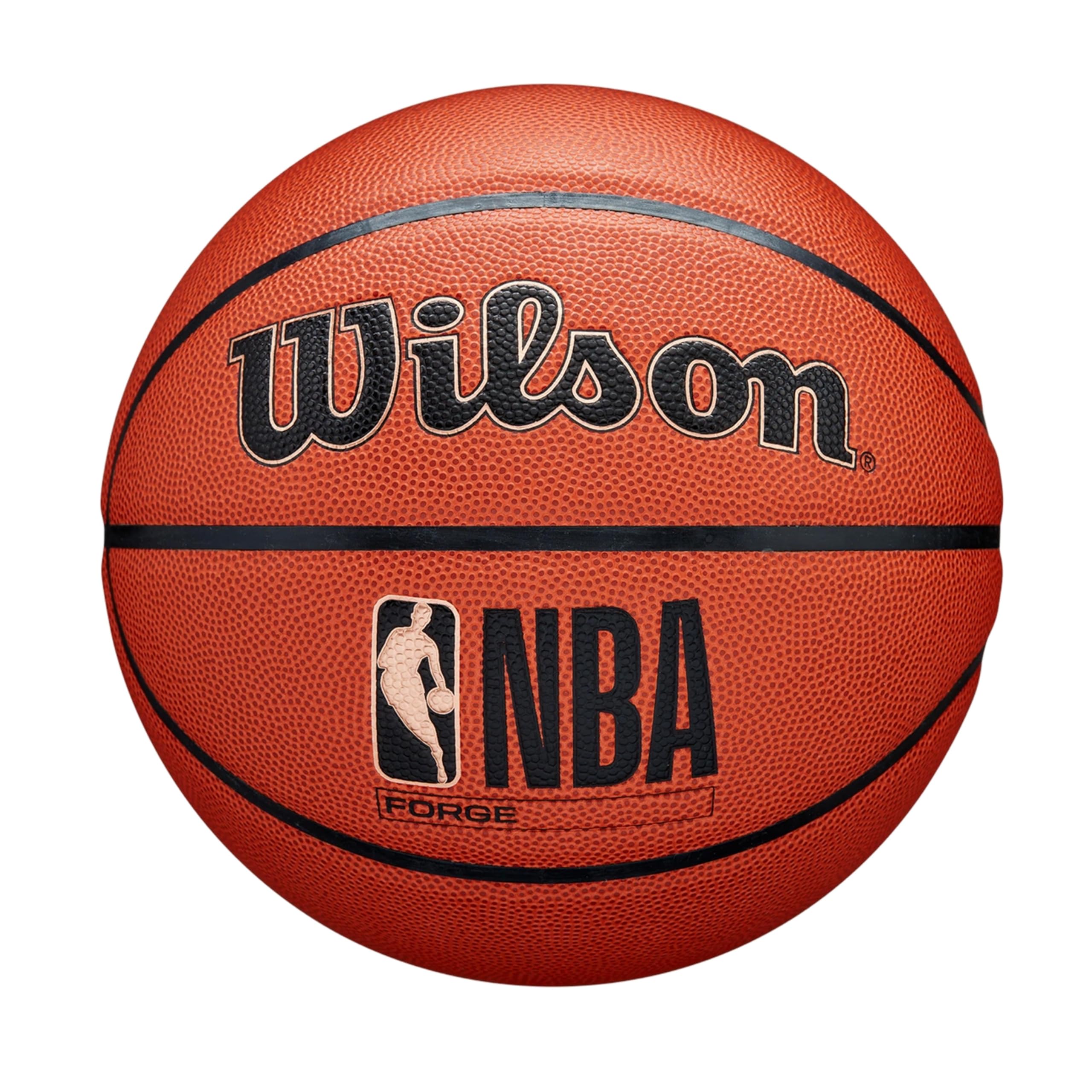
Wilson NBA Forge – Best Budget Indoor/outdoor
Key Features
- Use: Indoor/outdoor
- Size: Size 7 – 29.5"
- Cover: Pure Feel cover
- Air retention: Inflation retention lining
- Price: Budget
The Wilson NBA Forge is the ball we point to when the budget is tight but the court is still indoor. It is a full-size 29.5-inch ball with a Pure Feel cover and NBA-style seams, and it comes in at the value end of this group without looking like a beach toy.
We noticed the deep pro seams right away because they give your fingers a place to sit on the ball. The Pure Feel cover is firmer than the Evolution’s microfiber, and the inflation retention lining is meant to keep it playable between top-offs. For casual indoor runs, practice, and a backup bag ball, it does the job.
This is not the ball for a serious indoor league if you want the softest touch. It is the ball for a player who wants a full-size indoor/outdoor ball and does not want to worry about every scuff. We like it as the one you can leave by the door and grab without a second thought.
Pros
- Budget full-size indoor/outdoor ball
- Deep NBA-style seams for hand placement
- Pure Feel cover with retention lining
Cons
- Air retention can be inconsistent
Budget-minded players should start with the NBA Forge: a full-size indoor/outdoor ball with pro seams and a firmer Pure Feel cover.
Molten B7G3800 – Fiba-Style Play

Key Features
- Size: Size 7
- Cover: Indoor/outdoor synthetic
- Panels: 12-panel design
- Approval: FIBA approved
- Price: Midrange
The Molten B7G3800 is the only FIBA-approved 12-panel ball in this group, and that is its reason to exist. The two-tone panel layout looks different from a standard 8-panel ball, and the synthetic cover is built for indoor and outdoor play.
We like the way the 12-panel construction changes the ball’s flight and rotation, and the butyl bladder is there to help hold pressure. The grip is good for a synthetic indoor/outdoor ball, with enough texture for shooting and dribbling. It ships deflated, so plan on a pump before the first session.
The size information on this model line is worth checking when the ball arrives, because Molten sells it in more than one size and the label is what matters. If you want a FIBA-style ball for a rec league or a player who likes a firmer synthetic feel, this is the one. If you want the softest indoor touch, the Evolution is still the better choice.
Pros
- FIBA-approved 12-panel design
- Indoor/outdoor synthetic cover with butyl bladder
- Distinctive flight and good grip
Cons
- Firmer cover than indoor-only microfiber
The Molten B7G3800 is our FIBA-approved 12-panel pick for players who like a firmer synthetic ball that can play indoors or out.
AND1 Fantom – Casual Street Play

Key Features
- Size: Regulation size 7 (29.5")
- Cover: Rubber
- Channels: Deep channel construction
- Inflation: Ships deflated
- Price: Budget
The AND1 Fantom is a rubber ball that costs little and asks you to own a pump. It is a regulation-size 7 ball with deep channels and a bright old-orange finish, and it is built for indoor and outdoor casual play rather than a serious gym league.
We like the deep channel construction for hand placement, and the rubber cover is easy to palm when the ball is clean. It bounces well once inflated, and the low cost makes it an easy ball to keep in the car or send to the driveway with a kid. It is not a soft composite indoor ball, and it does not pretend to be.
We treat it as a casual-use ball that needs a pump nearby, not as the one you bring to a meaningful indoor game. The rubber cover is not as plush as a composite indoor ball, and that is part of the deal. We leave it in the car as the ball that can get scuffed and still be ready for a quick shootaround.
Pros
- Low-cost full-size rubber ball
- Deep channels help grip and control
- Built for casual indoor and outdoor use
Cons
- Air retention is a weak point
The AND1 Fantom is the cheap rubber ball we keep for casual indoor/outdoor use, not for a serious league game.
How We Tested 10 Indoor Basketballs (and Broke Them In)
We started with a list of roughly 40 indoor balls from brands we’d actually trust in a gym bag and cut it to 10 by checking official size and weight specs for men’s and women’s play, confirming each cover was leather or a composite built for hardwood, and spreading the field across price points. The goal wasn’t to crown the most expensive ball on the shelf; it was to find out which ones earned what they cost.
Before a shot went up, we inflated each ball to its recommended pressure with a dial gauge, weighed it on a kitchen scale, and ran a tape measure around its circumference. Then we rechecked pressure every week for six months, noting which balls held air between sessions and which needed topping off before every run. A ball that leaks slowly is a ball you end up babysitting.
On the court, every ball went through the same rotation: a Tuesday-night pickup run, Saturday-morning shooting in an empty gym, and a solo session of free throws and dribble moves where I switched balls mid-drill to compare them back to back. We paid attention to how the pebbling felt dry versus with sweaty hands, whether the cover stayed tacky or turned slick after a few weeks, and how each ball came off the rim and backboard. By month four, the seams on a couple had started to fray, which told us plenty about durability. And because a ball you don’t enjoy dribbling ends up at the bottom of the bag, we kept track of which ones we actually reached for.
How to Choose an Indoor Basketball
The first decision is not brand or price; it is whether you need a dedicated hardwood ball or one that can survive the driveway.
Start With Size, Then Weight
Size 7, the 29.5-inch ball, is the adult men’s regulation size and the default for most gym runs. Size 6, at 28.5 inches, is the intermediate ball used in women’s and many youth leagues; size 5 is for younger players. Weight follows size, so a ball that feels too heavy is often the wrong size rather than a bad ball. We start every recommendation with the player, not the brand. The Wilson Evolution is our size 7 reference; the Baden Elite is the size 6 pick.
Match the Cover to the Court
Microfiber and composite covers give the best grip on clean hardwood, but they wear quickly on concrete. Rubber covers survive rough surfaces but feel firmer and less tacky indoors. An indoor/outdoor ball is a compromise, not a free upgrade: it handles both, but it rarely feels as soft as an indoor-only ball. If most of your play is in a gym, choose the indoor cover and keep a second ball for the driveway. If one ball has to do both, the Spalding React and Wilson Forge are the practical picks.
Check Air Retention and the Valve
A basketball is a pressure vessel as much as a cover, so the bladder and valve matter. Butyl bladders and retention linings help, but every ball needs occasional top-offs. The useful test is simple: inflate the ball, let it sit overnight, and check it again. If it goes soft in a day, the valve or bladder is the problem, not the cover. We put air retention ahead of cosmetic details because a ball that will not hold pressure cannot do its job.
Bounce, Seams, and Approval
A consistent bounce comes from a round carcass, even panel tension, and the right inflation. Deep channels help your fingers find the ball, but they cannot fix a wobble caused by low air. Test a new ball on a flat floor before you judge it. NFHS and FIBA approvals matter for organized play; for rec games, they are useful signals but not a reason to pay more. The Evolution carries NFHS approval, while the Molten is the FIBA-approved option here.
Frequently Asked Questions
Why does a new indoor basketball feel slick or hard out of the box?
Composite covers can carry a factory film and feel firmer before they see regular play. Wipe the ball with a damp cloth, dry it, and use it for shootarounds before a game; avoid breaking it in on concrete. If the slickness remains after a few sessions, clean it again rather than sanding the cover.
How should I store an indoor basketball between games?
Keep it out of a hot car and away from direct sun, because heat and pressure changes are hard on the valve and cover. A mesh bag or a shelf in a closet is enough; do not stack heavy gear on it. Check the air before your next session, especially if the ball has been sitting for weeks.
What should I do if a seam starts to separate?
Stop using it for games and check the warranty before you glue anything. Wilson, Baden, and Spalding list limited warranties on these balls, and a separating seam is a defect claim rather than a maintenance issue. A ball used outdoors can wear at the seams faster, so keep the receipt and note where it was used.
Final Verdict
The Wilson Evolution is the indoor basketball we recommend first. Its microfiber cover gives the calm, tacky control that makes gym play feel easier, and the NFHS approval matters if you play organized ball.
If you need a size 6 ball, choose the Baden Elite; if your court is sometimes concrete, the Spalding React TF-250 is the better compromise.