
This post contains affiliate links. We may earn a small commission when you buy through our links — at no extra cost to you.
There’s a particular disappointment in pulling a basketball out of the garage, bouncing it once, and hearing that dull thud instead of a crisp return. A hand pump fixes it eventually, if you can find the needle, if the adapter hasn’t wandered off, if your arm holds out. A rechargeable pump is meant to erase that whole ritual: clip on, set a number, walk away. What it really fixes is the gap between "I’ll inflate that later" and a ball that’s actually ready when you grab it.
Over the past five months, my team and I put 13 rechargeable pumps through driveway shootarounds, weekend league games, and a lot of backyard volleyball. The lesson that surprised me is that a max-PSI claim on the box tells you almost nothing; what matters is whether the pump’s own gauge agrees with a separate gauge you trust. And a pump that costs as much as the ball it’s inflating had better last more than one season. The picks below are the ones that earned their spot.


Best for All Sports Balls
ETENWOLF 2600mAh Ball Pump
Key Features
- Airflow: 6.5 liters per minute
- Battery: 2600 mAh
- Max pressure: 17 psi
- Pressure accuracy: ±0.3 psi
- Price: Midrange
Seventeen psi is the number that decides this one. That’s the top of the ETENWOLF’s range, and it’s why we hand it to anyone whose bag holds a mix of balls: a football at 13 psi sits comfortably inside it, while a 12 psi pump can’t get there at all and the 15 psi models here arrive with nothing to spare. Inside that range it works to a stated ±0.3 psi and stops by itself when the ball reaches the number you set.
Six and a half liters a minute reads like a spec-sheet figure until you’re filling a bag before practice and realize you can start the pump and go lace your shoes. The detail we appreciated more is smaller: the two brass needles sit in a compartment on top of the body. Needles are the first thing lost in a duffel, and a pump that holds its own is a pump still working in February.
It’s about the size of a soda can cut in half and weighs 260 grams, so it disappears into a referee bag or a coach’s crate. The 2600 mAh battery pairs with a two-year warranty, the longest in this group, and that pairing matters in a category where the standard failure is a motor that quits and never restarts.
What you give up is accessories. There’s no hose and no storage bag, so the pump rides loose in whatever bag you drop it into while the needles stay neatly stowed. Against a pump that covers every pressure in a normal ball bag, that’s a small complaint.
Pros
- 17 psi ceiling clears footballs and basketballs
- Auto-stop with stated ±0.3 psi accuracy
- Two brass needles stored in the body
- 2600 mAh battery and a two-year warranty
Cons
- No hose or carry bag in the box
We recommend this to anyone whose bag holds a mix of balls: 17 psi clears a football, the sensor holds its target, and the needles travel in the pump.
Best for Pocket and Glovebox
HYVOHEX Mini Ball Pump
Key Features
- Weight: 7.05 oz
- Battery: 1500 mAh
- Display: Digital LED
- Pressure range: 2-17 psi
- Price: Budget
The HYVOHEX earns its spot by being the pump you can forget about. It’s palm-sized, and it still carries a 17 psi ceiling — the same as our top pick and two pounds more than the 15 psi pumps here. Small body, no pressure compromise: that’s the whole argument.
Inside is a 1500 mAh battery charged over USB-C, and the range starts at 2 psi, the lowest floor in this group, which matters if you also top up softer balls. What isn’t in the box is a charging cable — just the pump and a needle — so plan on one you already own. In a house with three USB-C cables behind the sofa that’s nothing; on a first charge with nothing unpacked, it’s an annoyance.
The LED screen shows live pressure and the pump stops at your target, so a ball takes seconds and no attention. The body is plastic and the needle storage is built into the housing rather than sealed away, which tells you what this pump is for: a bag, a glovebox, a drawer, not a toolbox. It costs less than our top pick and reaches the same ceiling, which makes it the natural second pump — one for the house, one for the car.
Pros
- Palm-sized and easy to keep anywhere
- 17 psi ceiling matches our top pick
- 2 psi floor suits softer balls
- On-board needle storage
Cons
- No charging cable in the box
Buy this if the pump needs to live in a glovebox or a drawer: palm-sized, rated to 17 psi, and cheaper than our top pick.
Best for Team Ball Carts
Pumteck AP1-M Ball Pump
Key Features
- Airflow: 4 liters per minute
- Dimensions: 3.94 x 2.76 x 1.65 in
- Max pressure: 15 psi
- Balls per charge: Up to 50, at 2-8 psi
- Price: Budget
A coach’s pump has a different job from a family’s. It lives in a crate with twenty balls, gets grabbed by whoever is nearest, and needs charge left in it on a Tuesday night in November. Pumteck rates the AP1-M at up to 50 basketballs on a full charge at 2-8 psi, and the squat little body is easy to grab one-handed off a sideline.
The trade-off is speed. Four liters a minute is the slowest airflow of the pumps here, roughly two-thirds of what the ETENWOLF moves, so a single flat ball takes noticeably longer. For the team job that’s an odd pairing — a big battery behind a modest motor — but it’s the right way around if the pump sits in a crate and gets used in short bursts all season instead of in one frantic ten minutes before a game.
The 2-15 psi range reaches a 13 psi football with almost nothing in reserve, and the LED readout shows live pressure as it climbs. USB-C charging means the same cable as everything else in the bag, and at 0.49 lb and under four inches long it takes less room than a spare pair of socks.
The auto-stop did its job without fuss in our time with it, and the button layout is simple enough to explain to a player in one sentence. Spending the money on battery rather than airflow is a deliberate trade, and for a crate of team balls it’s the right one. Hand it to someone who inflates one ball a month and they’ll spend every fill watching it.
Pros
- Rated for up to 50 basketballs a charge
- USB-C charging and a live LED display
- 0.49 lb body that fits a ball crate
Cons
- 4 L/min airflow is the slowest here
- 15 psi ceiling leaves little headroom
The team-crate pick: a big battery rated for 50 basketballs a charge, a clear display and a low price, as long as you can live with slow airflow.
Best for Match-Day Precision
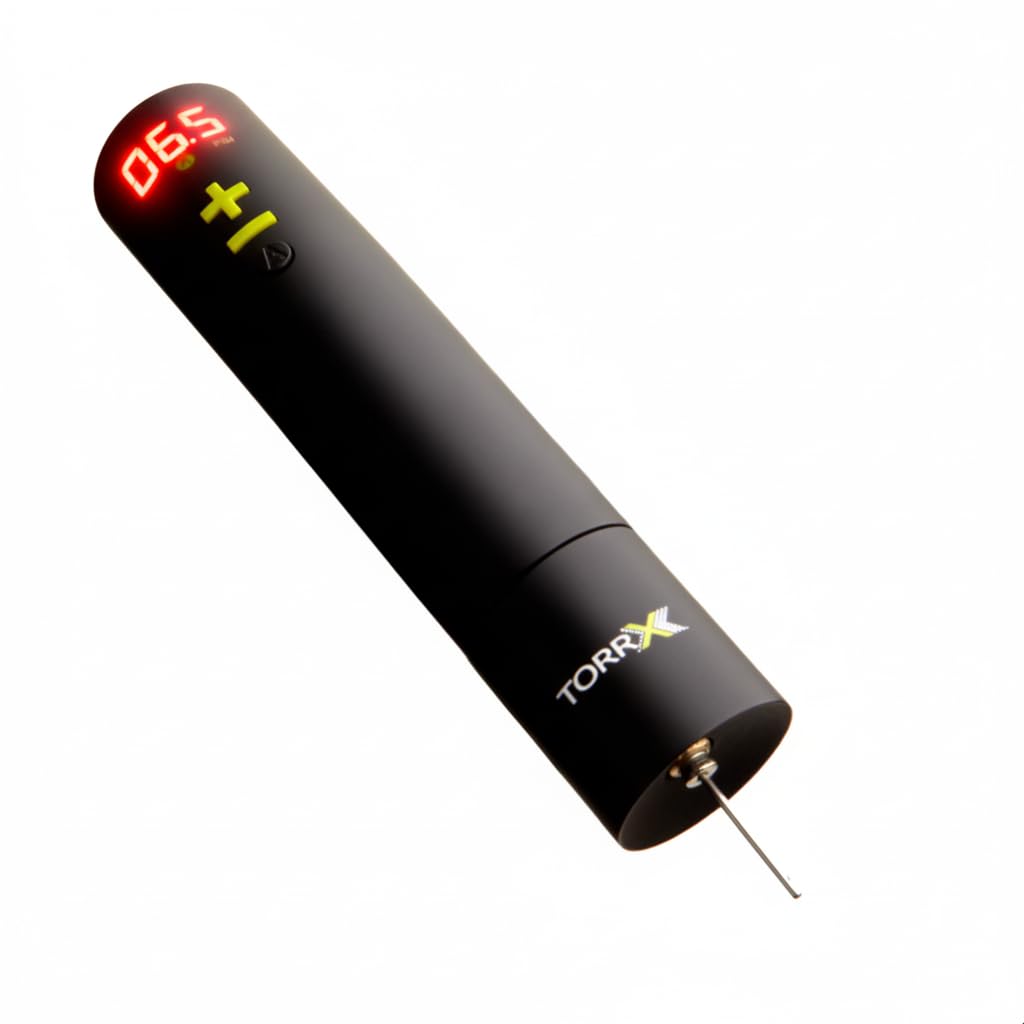
TorrX Smart Ball Pump
Key Features
- Modes: Automatic and manual
- Length: 10 in
- Gauge precision: 0.1 psi
- Balls per charge: 50+ top-ups
- Price: Premium
Precision is the only reason to spend real money on a ball pump, and the TorrX is the one pick here that makes the case cleanly. The gauge reads to 0.1 psi, the pump auto-calibrates, and in auto mode it inflates or deflates to whatever target you dial in. For a referee certifying that both teams’ balls match, that isn’t indulgence — it’s the job.
The battery claim is the biggest in this group, more than 50 ball top-ups on a charge, and it arrives in a neoprene case with a heavy-duty needle: kit built to survive a season in a coaching crate. It’s also 10 inches long, which is the honest cost of the extra hardware. This is a bag pump, and anyone used to a hand pump in a jacket pocket will feel the difference every time they reach for it.
The oversized display is easier to read outdoors than we expected, which matters because outdoors is where a ball pump gets used. The value question is the open one. It costs more than every other pump here by a wide margin, and a family with four basketballs gets nothing from extra precision that a 17 psi pump with a decent sensor doesn’t already give them.
What the money buys is settled arguments: the number on the display is close enough to the number in the ball that nobody has to guess, and the same instrument that filled it can check it. That’s a narrow need and a real one, and it’s the only case for paying this much for a pump.
Pros
- 0.1 psi gauge with auto-calibration
- Inflates and deflates to a set target
- More than 50 ball top-ups per charge
- Travel case and heavy-duty needle included
Cons
- Costs more than every other pump here
- 10 inches long, too big for a pocket
For referees and coaches who have to certify pressure, the 0.1 psi gauge and auto-calibration justify the premium; everyone else can skip it.
Best for Preset Simplicity
Pumteck MY01 Ball Pump

Key Features
- Modes: Inflate and deflate
- Presets: 4 ball modes
- Charging: USB-C
- Max pressure: 15 psi
- Price: Midrange
Four buttons do the thinking on the MY01: basketball, soccer, football and volleyball each get a preset, so the pump arrives at a sensible pressure without anyone looking up a number. It sounds like a small thing until you watch a nine-year-old inflate a ball without asking for help.
Pumteck also builds in deflation, and the 15 psi ceiling covers footballs with a couple of pounds to spare. The body is a 6.29-inch stick that slips into a bottle pocket, charging is USB-C, and two needles come in the box.
Where it loses ground to our top pick is the gauge. Readings are the unsettled part of this pump: a unit that shows zero or drifts off target makes the presets worthless, and a preset is only as good as the sensor behind it. Check the first ball against a gauge you trust and the rest of the ownership experience is easy.
It also costs more than the ETENWOLF while topping out two psi lower, a combination that’s hard to defend on a spec sheet. What it has going for it is the friendliest interface here and a deflate function that earns its place the first time a new ball arrives overinflated. That’s a real niche, just a narrower one than the price suggests.
Pros
- Four ball-type presets, including volleyball
- Inflates and deflates
- USB-C charging in a 6.29-inch body
Cons
- Gauge readings can show zero or drift
- Costs more than our top pick with a lower ceiling
The friendliest interface here, with ball-type presets and deflation, but you’re paying more than our top pick for a lower ceiling and less certain readings.
Best for Budget Team Bag
ETENWOLF P200 Ball Pump
Key Features
- Airflow: 6.5 liters per minute
- Battery: 2000 mAh
- Presets: 3 preset pressures
- Max pressure: 17 psi
- Price: Budget
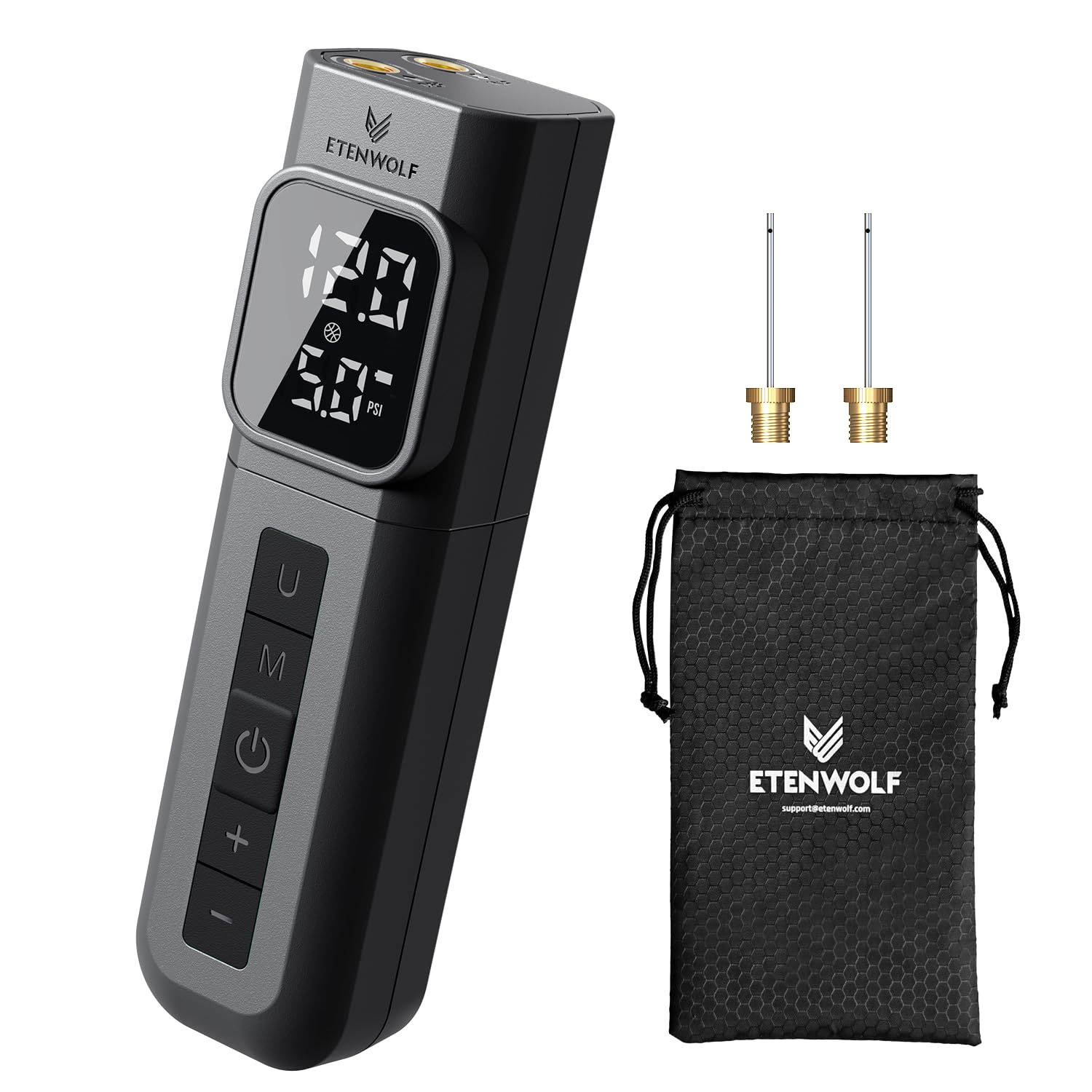
The P200 is the ETENWOLF you look at when the top pick’s price feels like more pump than you need. It keeps the 17 psi ceiling and the 6.5 liters a minute, adds a storage bag, and costs less than our top pick while doing the same basic job.
The shape is the bigger difference. This is a 6.71-inch stick rather than a cube, so it slides into a bottle sleeve but won’t sit flat on a table while you hold a ball on the needle. Three presets and a display that switches between PSI, BAR and KPA cover the basics, and the two-year warranty matches its more expensive sibling.
We kept coming back to it for exactly that reason: it does the top pick’s main job without the top pick’s price. At 0.3 kg it’s light enough to live in a bag year-round, and the 2000 mAh battery is more capacity than most families will drain in a season. For a household with three or four balls and one drawer to keep a pump in, this is plenty of pump.
Pros
- 17 psi ceiling and 6.5 L/min airflow
- Storage bag included
- 2000 mAh battery with a two-year warranty
Cons
- No needle storage compartment
The budget route to the top pick’s pressure and speed, with a bag and a two-year warranty; you give up the needle compartment and some battery.
How We Tested Rechargeable Ball Pumps
We started by gathering every rechargeable pump we could find with a built-in pressure indicator, onboard needle storage, and a battery you don’t have to babysit, which came to about 40 candidates. From there we cut anything with a fixed nozzle that couldn’t be replaced, a gauge we couldn’t read in dim garage light, or a price that made no sense next to a basic hand pump. That left 13 pumps, ranging from stripped-down budget models to ones with digital pressure settings.
Testing ran five months. In the garage, we flattened basketballs and soccer balls completely, then timed how long each pump took to bring them back to pressure and compared the pump’s built-in reading against a standalone gauge to see how far the indicator had drifted. We counted how many balls each one inflated per charge before the battery warning appeared. In the driveway we handed them to kids and to a friend who had never used a rechargeable pump, and watched whether the nozzle seated on the first try, whether the needle came out of storage without a fight, and whether anyone reached for the instructions. Where a pump offered preset pressure settings, we set a target and deliberately overfilled one ball to see whether the auto-stop actually cut off.
Every pump also spent a week rattling around in a car trunk and a cold night in an unheated garage, which is where battery life and reliability separate fast. After five months of repeated use, we noted which ones still seated cleanly, which gauges had lost accuracy, and whether the price still felt fair given how often we reached for that pump over the others.
How to Choose a Rechargeable Ball Pump
The gauge matters more than the motor: a rechargeable pump is only as good as the number it shows you, and most of the disappointments in this category start with a reading you can’t trust.
Start with the pressure ceiling
Every pump has a maximum, and it’s the first number to check against the ball you inflate most. American footballs sit at the top of the ball range, around 13 psi, so a pump that stops at 12 can’t fill one at all, and a 15 psi unit works with almost nothing in reserve. The 17 psi pumps here — the two ETENWOLFs and the HYVOHEX — leave room to spare. If your bag holds only basketballs and volleyballs, a lower ceiling costs you nothing; if there’s a football in there, buy the 17.
Treat the gauge as the feature you’re paying for
An auto-stop pump is only automatic if the sensor is honest. Set 8 psi and a pump reading three pounds low will cheerfully inflate to 11; a pump that sticks at zero never stops at all, and the ball keeps growing until somebody notices.
Test any new pump once. Fill a ball to a target, pull the needle, then push it back in and see whether the pump shows the pressure it just delivered. If the number has moved, finish with a separate gauge and treat the display as a rough guide rather than a setting.
Match battery and airflow to how many balls you own
Airflow and capacity are numbers you only feel at scale. One ball takes under a minute on any pump here, so a household topping up two or three balls a week gets nothing from 6.5 liters a minute over 4. The gap opens with volume: a fast pump suits a handful of balls filled quickly, while a big battery and a rated capacity suit a crate of them filled slowly. Buy for the busiest session you actually have — a Saturday with a dozen balls, or a Tuesday with two.
Check what’s in the box
Needles, a hose, a carry bag and a charging cable are all line items a maker can include or skip, and the differences show up on day one. The HYVOHEX arrives without a cable, so plan on a USB-C one you already own. None of our picks includes a hose, the accessory that lets the pump lie on the ground while you hold the ball steady. A storage bag matters more than it sounds when the pump rides in a crate with chalk and grit; the P200 and the TorrX include one.
Decide where the pump will live
The pump that gets used is the one that’s already nearby. A palm-sized model fits a glovebox or a kitchen drawer and gets reached for far more often than one that stays in the garage, while a 10-inch pump is excellent in a coaching crate and awkward in a jacket. Pick the spot first, then check dimensions against it: the difference between 3.5 and 6.7 inches is the difference between a drawer and a bottle sleeve.
Frequently Asked Questions
Is a rechargeable ball pump worth it if I only own one basketball?
Probably not, if that ball gets topped up twice a season. A hand pump costs little and never needs charging. The math changes with volume: once you’re filling several balls, or doing it courtside with a kid waiting, the value is in setting a number and letting the pump finish while you do something else. Count the balls in your house before you spend.
Can I use one of these on bike tires or car tires?
No. These pumps are built for the 2 to 17 psi a ball needs and top out well below what any tire requires, so the tire won’t inflate and the pump works hard for nothing. Keep it for basketballs, soccer balls, volleyballs and footballs, and use a floor pump or a compressor on anything with a Schrader or Presta valve.
Will it inflate exercise balls and inflatable pool toys?
Only if the pump reaches down to their pressure. The pumps here start at either 2 or 3 psi — the HYVOHEX at 2, the ETENWOLF models at 3 — and big exercise balls and inflatables run at low pressure, so check the pump’s minimum rating before you buy. For anything that needs barely any air, a hand pump gives you finer control than an auto-stop motor.
What do I do when a needle bends?
Replace it. A bent needle doesn’t seal, so the ball loses air as you fill it and the pump’s reading sags, which makes a perfectly good gauge look broken. The pumps here ship with one or two needles and several store them in the body. Keep a spare set with the pump and push the needle in straight rather than levering it sideways against the valve.
Final Verdict
The ETENWOLF 2600mAh is the pump we recommend to almost everyone. Seventeen psi covers every ball in a normal bag, the ±0.3 psi sensor and auto-stop take the guesswork out of a fill, and the needles live in the body instead of the bottom of a duffel.
Choose the HYVOHEX instead if the pump has to live in a glovebox or a kitchen drawer — it’s smaller and cheaper and still rated to 17 psi. And if your job involves certifying ball pressure before a match, the TorrX’s 0.1 psi gauge is the one feature here worth paying a premium for.