
This post contains affiliate links. We may earn a small commission when you buy through our links — at no extra cost to you.
Nobody has ever improved a jump shot by walking to retrieve the ball. A rebounder exists to end that walk — it catches what drops through the net and sends it back to your shooting pocket — so the only question that matters is whether you keep shooting or keep chasing. Get the return angle right and a half hour becomes 200 shots instead of 60; get it wrong and you’re untangling a ball from the net or jogging into the street.
I’ve kept one at the end of my driveway most of this year, alongside nine more that my team and I assembled, adjusted, and left out in the rain over eight months. The ones worth owning share traits no spec sheet lists: the return lands where you actually shoot from, the net is soft enough to kill the ball’s speed without swallowing it, and the frame doesn’t flinch when a hard pass hits it. Assembly and stability matter more than most shoppers expect, and a couple of cheap models scuffed the ball within a week. The picks below are the ones that kept us shooting.
Our Top Picks


The Best Basketball Hoop Rebounders, Reviewed
Dr. Dish IC3 Rebounder – Best Overall
Key Features
- Net height: 17 in above the rim
- Return arc: 180° manual rotating ramp
- Portability: 35 lb with wheels
- Shot coverage: Made and missed shots
- Price: Premium
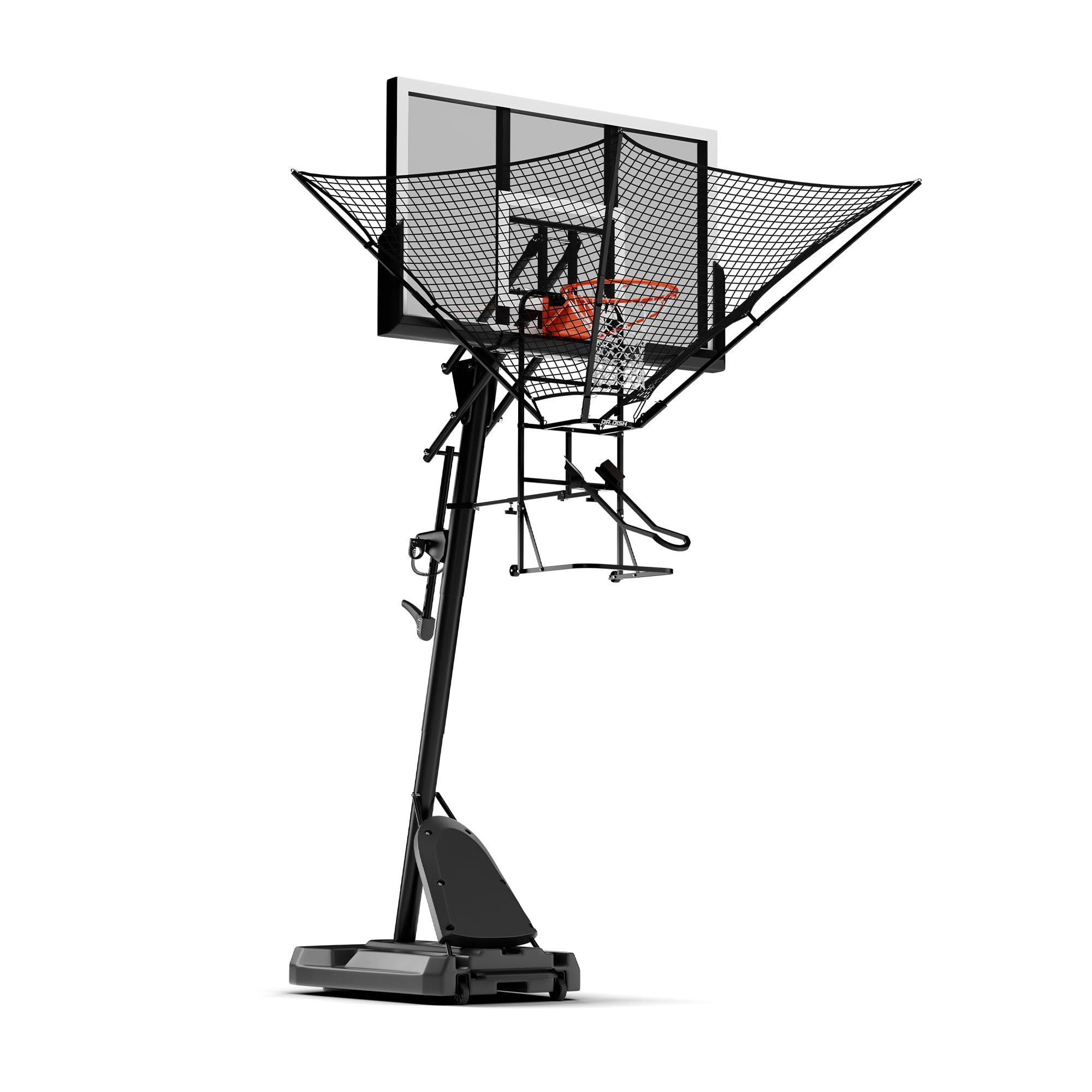
A rebounder either hands the ball back or it does not, and the IC3 is the only pick here that does it from anywhere on the court. It hangs a 3-inch weave net above the rim, catches makes and misses alike, and feeds them down a ramp you can swing through 180 degrees, so you can shoot from the wing, the elbow or the top of the key without moving the rig. That is why it is our top pick.
The net sits 17 inches above the rim, which we think is the smartest part of the design. A flat shot clips the front edge on the way through; a shot with real arc drops in clean. You end up grooving loft without a coach telling you to, and that habit travels to every other hoop you play on. At 35 pounds with wheels, it also rolls from the driveway into a garage or a gym without a second person.
Two basketballs turn it into a rhythm drill: one is dropping through the net while the other leaves your hand. The listing puts the ceiling at 800 shots an hour with two balls, and the difference between that rhythm and shagging your own rebounds is not subtle. The frame sits on the rim rather than fighting it, and nothing about the build feels like a toy.
One annoyance to plan for: a ball can wedge between the net and the rim and needs knocking loose, and slackening the front netting helps. The bigger question is whether you need this much machine. If the goal is simply that balls stop rolling into the street, the Hathaway does that for a fraction of the money, and a rim chute like the GADFISH handles makes for less again.
Pros
- Catches made and missed shots
- Ramp returns the ball around a 180-degree arc
- Net height trains arc on every shot
- 35 lb with wheels for easy moving
Cons
- Costs more than any other pick here
- Netting is fiddly to stretch onto the frame
If you want real no-chase shooting practice, this is the one we point you to: it returns makes and misses from anywhere on the arc, and the raised net quietly teaches arc.
Hathaway Rebounder Net – Best Backstop Value
Key Features
- Weight: 5.5 lb
- Anchors: Four 1.5 gal water bags
- Hoop fit: 48-60 in hoops
- Net size: 10 ft x 9 ft x 5 ft
- Price: Midrange
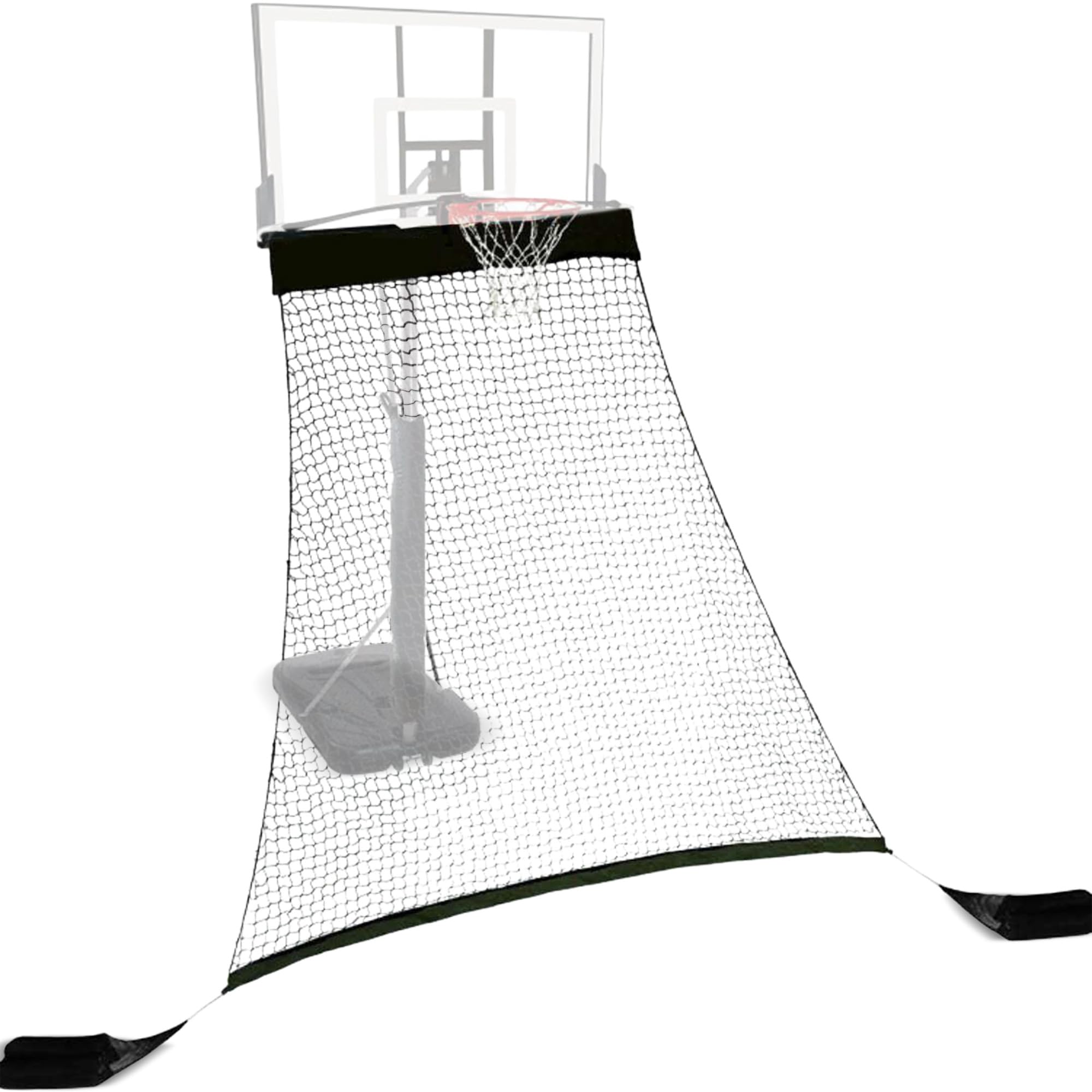
Ten feet wide, nine feet tall and five feet deep, hung off the hoop with a webbing harness and no tools at all. The Hathaway is not a return chute and does not pretend to be one — nothing comes back to your hands. What it does is end the walk. Made shots drop straight down into the net and settle at the base, and most misses follow them in rather than sailing into the neighbor’s yard.
That is exactly what a driveway hoop needs, which is why we rate it the value pick of the group. Four 1.5-gallon bags ride the bottom edge, filled from a hose or a sandbag, and they keep the whole thing from walking across the court when a hard miss hits high. Empty, the net weighs about as much as a hoodie and packs into its own carry bag, so it can travel to a park or a friend’s hoop and be up in a few minutes.
Two practical notes. The harness is cut for 48- to 60-inch hoops, and on a wider frame the strap can come up short — a spare carabiner bridges the gap. The bags are the part that ages: fill them where the net stands, do not drag them full, and drain them before the first freeze. Do that and it will keep earning its place.
Pros
- Big 10 x 9 ft net catches most misses
- Four water bags hold it down in wind
- Carry bag makes it genuinely portable
Cons
- Fits only 48-60 in hoops
We rate this the value pick of the group: a huge anchored net that catches makes and most misses, packs into a bag, and hangs without tools.
GADFISH Return Attachment – Best Budget Ball Return
Key Features
- Mount: 3 screw-secured metal hooks
- Material: Painted metal
- Rim size: 18 in
- Warranty: Lifetime
- Price: Budget
Three hooks over the rim, a metal chute under the net, and made shots come rolling back to your feet. That is the whole idea, and this is the cheapest version of it here — a fraction of a full return system, in a box you can carry with one hand.
The build is the part we did not expect at this price. It is painted metal rather than the molded plastic most rim chutes use, the three hooks are wrapped in rubber so they do not chew up the rim’s finish, and screws lock them down instead of relying on a friction fit. Setup is a handful of screws and about a minute, it fits a standard 18-inch rim, and the frame carries a lifetime warranty.
Where it gives ground is holding still. The hooks can work loose after enough hard makes and want retightening, and a frame that snaps at a weld is the failure to watch for — the warranty covers the part, not the wait. For a young player learning to shoot, or a tight driveway where you only need makes returned, we think it is the sensible spend. If misses need catching too, that is backstop territory.
Pros
- Metal chute instead of molded plastic
- A few screws and a minute to fit
- Lifetime warranty on the frame
Cons
- Hooks work loose and need retightening
- Frame can snap at a weld
Our budget pick for actual ball return — three rubber-wrapped hooks, a metal chute, and a minute of setup, with a lifetime warranty behind the frame.
Silverback Yard Guard – Best for Silverback Hoops
Key Features
- Storage: Folds flat to the pole
- Coverage: 10 ft x 8 ft
- Post fit: 4 x 4 in
- Price: Premium
Check the post before anything else. This net bolts to a 4-by-4-inch goal post and is built around Silverback’s own in-ground hoops, so a round pole or another brand means looking elsewhere. If you do have one, the fit is the cleanest in this guide: the arms clamp on, the net spans 10 feet wide and 8 feet tall, and when the season ends the whole assembly folds flat against the pole.
What we like most is what that folding does for a backyard — nothing to take down, nothing leaning in the garage, no stray balls in the landscaping. It swallows hard misses without flinching and stays put in wind. Two cautions: the netting can tear where it meets the pole after a couple of summers of sun, and this is priced like the permanent installation it is, so it only makes sense if the hoop is staying up for good.
Pros
- Folds flat against the pole
- 10 ft wide coverage for stray balls
- Straightforward install on 4×4 posts
Cons
- Fits only 4×4 in posts
- Net can tear at the pole seam
For a Silverback in-ground hoop we like this best of all: it folds against the post, catches nearly everything, and disappears when the season ends.
Franklin Pass Back Rebounder – Best for Portable Systems
Key Features
- Weight: 16 lb
- Storage: Folds compact
- Hoop fit: Any portable system
- Net size: 10 ft x 8 ft
- Price: Midrange
Ten feet by eight feet of net on folding arms, and when practice is over it collapses against the pole instead of hanging in the wind. Franklin’s Pass Back is a catcher, not a return — the ball stops where you can step to it rather than coming back to your hands.
Coverage is the reason we rank this above the smaller backstops. Most backyard misses do not come back to the rim; they sail long, and a 10-by-8 sheet is what turns a twenty-foot retrieval into a rebound you can walk to. It attaches to any portable basketball system, which is a wider fit than the pole-specific nets here, and the folded profile keeps a driveway looking tidy.
Setup is the low point. The net has to be stretched onto the frame, the printed instructions are thin, and it is genuinely a two-person job. Set aside an afternoon, recruit a second pair of hands, and do it before the season rather than ten minutes before practice.
Where that leaves us: if the hoop sits on a portable base near a fence line or a road, and you want the widest catch area you can fold away, it earns its place. If the balls just need to stop rolling, the Hathaway does the same work for a lot less, and it goes up without a wrestling match.
Pros
- 10 x 8 ft catch area for long misses
- Fits any portable hoop system
- Folds compact for storage
Cons
- Netting can tear within a season outdoors
- Pins on the lower arms can misalign
We recommend this when the hoop lives on a portable base and long misses are the problem — just plan an afternoon and a helper for the net.
GoSports Basketball Rebounder – Best for Pass-Back Drills

Key Features
- Frame: Adjustable telescoping legs
- Anchors: Two sandbags, sand not included
- Material: Aluminum and nylon
- Footprint: 43 x 25.5 x 43 in
- Price: Midrange
This is not a rim return, and we want to be plain about it: the GoSports rebounder sits on the ground, you throw the ball at it, and it fires the ball back at you. What that buys is catch-and-shoot work — you supply the pass, catch the rebound, and shoot, with no partner and no chasing.
Telescoping legs change both the height of the return and the angle it comes back at, so it can fire flat for quick-release reps or loft the ball for a lob. Rubber feet bite into concrete and two sandbags hold it down on a driveway (sand is not included), and the frame folds for storage. It is also the most versatile thing here — the same net takes a soccer ball or a baseball.
Fitting the net is the fussy part: it is drum-tight on the frame and easier with two people than one. And be clear about the boundary — this returns a ball you throw at it, not a shot that drops through a rim. For pass work and catch-and-shoot reps it is genuinely useful; for hundreds of reps at the hoop, you want a chute.
Pros
- Adjustable legs change return angle and height
- Folds down for storage
- Takes a soccer ball or baseball too
Cons
- Bungees and straps can give out
This is a pass-back net, not a rim return, and we like it for catch-and-shoot reps when there is no partner to feed you.
What Eight Months of Shooting Taught Us
We started with roughly 30 rebounders that either fit a standard 10-foot rim or clamped onto an adjustable-height hoop, then cut the list to ten by price, footprint, and whether the frame folded down for storage. Ten units, eight months, and plenty of evenings that ran past dark.
Testing happened where rebounders actually live: a driveway on weekend mornings, a portable unit wheeled onto a gym floor, and one windy afternoon that told us more about stability than any spec ever could. We also set one up on a sloped driveway to see how much shimming it took to stop the frame creeping between shots.
We assembled every unit alone with only the included tools, timing each build and counting trips back to the instructions. We chalked the feet and fired 50 shots to see whether the frame walked across the concrete, then took 20 shots each from five spots on the court and counted how many returns landed within arm’s reach. We also ran 25 straight makes to see whether balls stacked up in the net and jammed, and checked the ball for scuffs and the net for sag after every session.
Four units stayed outside for the full eight months, which is where durability really shows: rust at the joints, straps that lost tension, nets that went slack. We also asked what the extra money bought on the pricier models — thicker tubing earns the spend, a nicer logo doesn’t.
How to Choose a Basketball Hoop Rebounder
The first decision is not size or budget but whether you want the ball thrown back to your hands or simply stopped from rolling into the street.
Return chute or backstop net
A return chute hangs from the rim and rolls made shots back out to your shooting spot. A backstop is a large net behind or around the hoop that catches makes and misses and drops them at the base. The first removes almost all the walking; the second removes the long retrievals and the balls in the road. If your misses fly twenty feet down a driveway, a backstop fixes more of your problem than a chute that only handles makes. If you run structured workouts from five spots, the chute keeps you standing in one place.
Measure the rim, then the post
Two measurements decide whether a rebounder works at your hoop. First the rim: hook-style chutes clamp onto the rim itself, and a heavy breakaway or double-spring rim can defeat them, which is the main reason a cheap chute disappoints. Then the post: pole-mounted backstops are cut for a specific section, whether that is a 4-by-4 post or a 48- to 60-inch hoop, and a round or oversized pole needs an adapter. Five minutes with a tape measure saves a return.
Coverage against space
Coverage and room trade against each other. A 10-by-8 or 10-by-9 net catches the misses that sail long, but it needs clear space behind the hoop and enough height that a high bounce stays inside. A rim chute or a compact freestanding rebounder takes up no room and only handles balls that reach it. Measure from the pole to the fence, the garage or the property line — a net five feet deep squeezed against a wall is a net that does not catch much.
Anchors, sun and what wears out first
Every backstop here depends on weight, and the bags are the first thing to fail. Water and sand bags split when they are dragged full or left out through a freeze, so fill them where the net stands and drain them before winter. Sun is the slower killer: polyester and nylon netting lasts a few seasons outdoors, and tears usually start where the net meets the pole or the frame. We favour nets that come down and store over nets that have to stay up.
Frequently Asked Questions
Do I need two basketballs to get the most from a return system?
One works. Two make it a rhythm drill: the second ball is in the air as the first drops through the net, so you shoot continuously instead of waiting on the return. The IC3 here is rated at up to 800 shots an hour with two balls.
Will a rim attachment work on an adjustable-height hoop?
Yes for anything that hangs on the rim, because a chute does not care how high the rim sits. Pole-mounted backstops are the exception: their brackets clamp a fixed section of post, so set the hoop at playing height and check the bracket lands on straight post rather than on a telescoping joint.
Can I use a rebounder with a hoop mounted on a garage or wall?
A rim-hung chute works on any standard rim, including wall-mounted and roof-mounted units. Backstop nets do not: they strap or bolt to a pole, and none of the pole-mounted nets here is built for a wall mount. With no post, choose a chute or a freestanding rebound net instead.
Final Verdict
If you want what this search actually describes — shots coming back to you so you can keep shooting — the Dr. Dish IC3 is the pick, and the net sitting 17 inches above the rim is a coaching tool thrown in with it. If balls in the street are the real problem, hang the Hathaway and keep the difference. If you want a return on a tight budget, the GADFISH does the core job for a fraction, as long as you accept retightening the hooks now and then.