
This post contains affiliate links. We may earn a small commission when you buy through our links — at no extra cost to you.
A missed shot shouldn’t turn into a sprint across the driveway. A good basketball practice net keeps the ball close to the hoop, returns makes and misses at a useful angle, and lets you get up more shots without resetting your feet every time. I grew up doing the chase-it-down drill on a gravel driveway, so I notice the small stuff: whether the frame wobbles, whether the net swallows a hard miss, and whether setup is a one-person job or a family project.
Over the past six months, my team and I set up and shot against 12 practice nets, from compact return-style models to larger backyard frames. The best ones assembled solo without a fight, stayed taut after repeated hits, and kept low misses from turning into a wrestling match with the netting. A model can look sturdy on the box and still be the one that leaves balls wedged under the frame or rattling around inside. The picks below are the ones that held up through all of it.
Our Top Picks



The Best Basketball Practice Nets, Reviewed
Dr. Dish IC3 Rebounder – Best Overall
Key Features
- Weight: 35 lb
- Mounting: Rests on rim, optional pole support
- Return arc: 180-degree manual rotation
- Rim clearance: 17 inches above rim
- Price: Premium
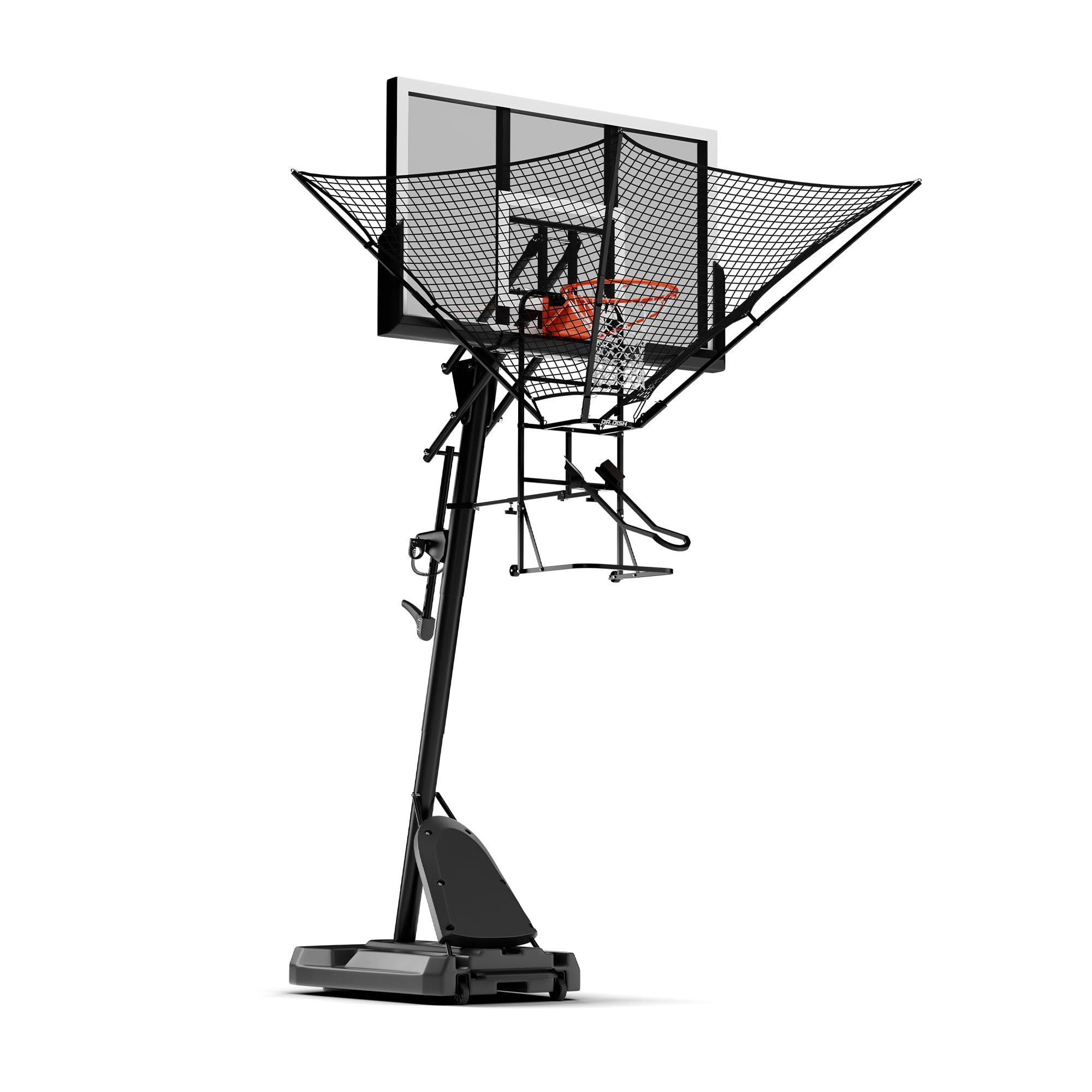
Seventeen inches is the number that explains the IC3. The net sits that far above the rim, so a flat shot hits netting and dies instead of dropping through, and a shooter gets immediate feedback about arc without anyone saying a word. It is a training design rather than a containment one, which is why it belongs on your hoop instead of behind it.
What it does that nothing else here does is return both makes and misses. The ramp under the rim catches the ball and rolls it back out, and because the return rotates a full 180 degrees by hand, you can aim the pass to the elbow, the wing, or wherever your next shot is coming from. With two balls in rotation the pace is relentless — it is rated at up to 800 shots an hour, and while we never counted, the shift in a session is obvious: your legs give out before your patience does. At 35 pounds with wheels, it also moves from driveway to gym without a second person.
The catch is that a ball can hang between the net and the rim, which stops the drill until you free it. Keeping a second ball in your hands is the practical fix: you shoot through the pause instead of standing over it. And this is a shooter’s tool at a premium price, not a barrier — it does nothing about the balls that miss the whole apparatus and roll into the street. If that is your problem, a backstop is the better spend.
Pros
- Returns makes and misses, not just bricks
- 180-degree return aims anywhere on the court
- Net above the rim trains shot arc
- 35 pounds with wheels, movable alone
Cons
- First assembly can run long
Our top pick for anyone chasing their own misses: it returns made and missed shots, aims the pass where you want it, and turns a solo session into a real workout.
GoSports Basketball Rebounder – Best Pass-Back Trainer for Solo Drills
Key Features
- Frame: Telescoping legs, adjustable angle
- Storage: Folds after assembly
- Anchoring: 2 sand bags (sand not included)
- Dimensions: 43 x 25.5 x 43 inches (D x W x H)
- Price: Budget
The player this suits is the one with nobody to pass to. Set the GoSports frame up and the ball comes back to you off the net — no hoop, no pole, no partner required. We like it for catch-and-shoot form and for passing accuracy, because the telescoping legs change both the height of the return and the angle it comes back at, and a ball arriving at chest height is a far better rehearsal for a closeout than one bouncing off a garage door.
It is aluminum and nylon and stands about 43 inches tall on a 43-inch-deep base, with a 25.5-inch-wide net, so it behaves like portable equipment rather than a fixture: once it is built it folds for storage, and building it is a one-time job. Two sandbags come in the box without the sand, and you will want them filled on a driveway where a kid leans into the frame.
The net is tight enough to fight you during the first assembly, so line up a second pair of hands for that step and store the frame folded and hung rather than breaking it down every session. None of that changes the value: this is the least expensive way here to get a ball that comes back to you.
Pros
- Adjustable return height and angle
- Folds for storage after assembly
- No hoop or partner needed
Cons
- Straps and bungees are the weak points
For solo drills away from a hoop, this is the one we recommend: the ball comes back at the height and angle you set, and the frame folds away afterward.
Hathaway Rebounder Return Net – Best Hoop-Mounted Backstop
Key Features
- Weight: 5.5 lb
- Mounting: Webbing harness, 48-60 inch hoops
- Net size: 10 ft x 9 ft x 5 ft
- Anchoring: Four 1.5-gallon refillable bags
- Price: Budget
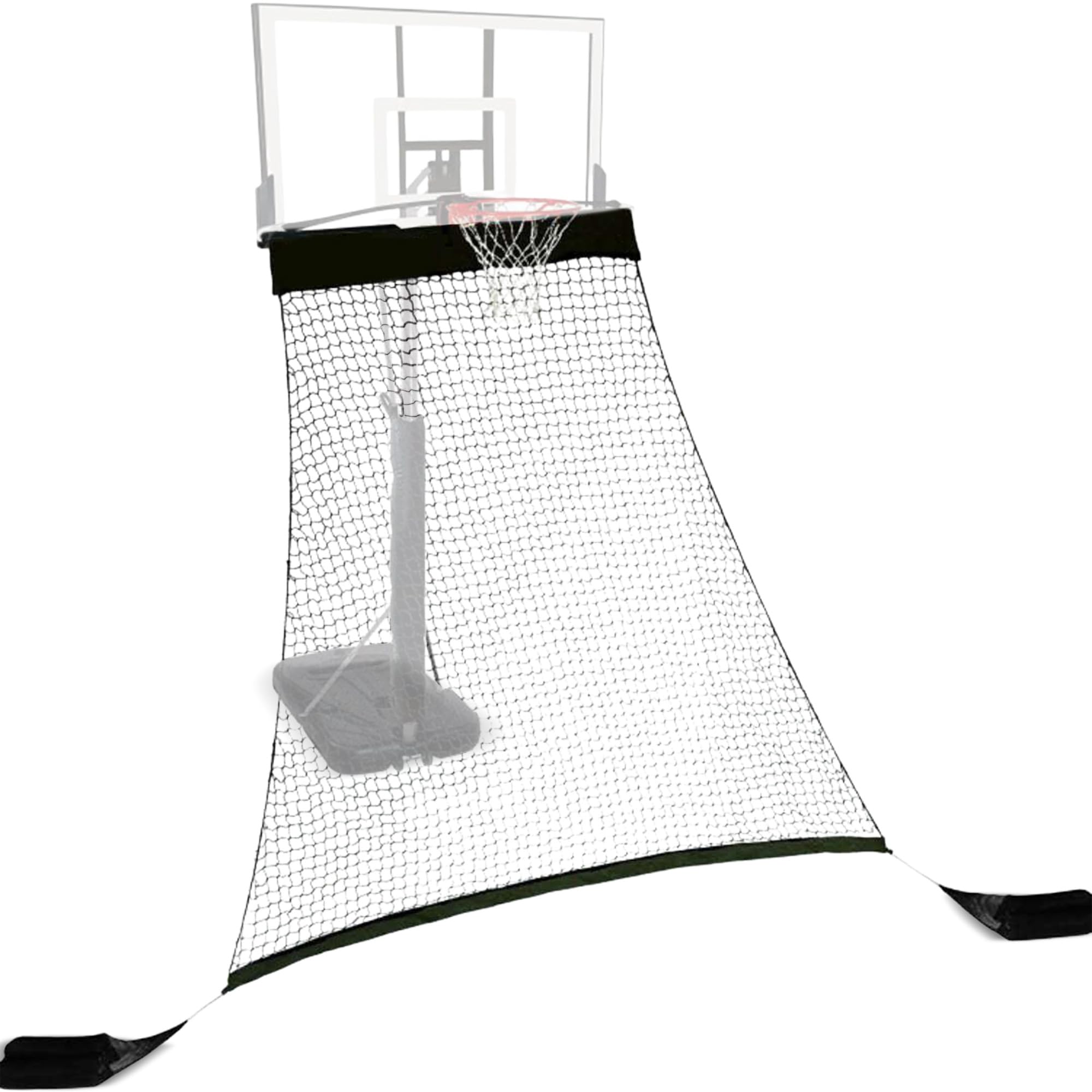
Lighter than the Franklin net and quicker to hang than anything that needs assembling, the Hathaway is the backstop we reach for when a hoop sits near a street. It is a 10-by-9-foot polyester net on a webbing harness that straps onto hoops with 48- to 60-inch openings, no tools involved, and the whole thing weighs five and a half pounds.
What we appreciate is the honest division of labor: this net catches the ball, it does not return it. Misses drop into the pocket behind the hoop and stay there, which is exactly the outcome you want when the alternative is a ball rolling into traffic, and it manages that without a frame to stake or a base to trip over. The four water bags give it enough weight to hold in a breeze, and the nylon bag makes winter storage a two-minute job.
Two things to plan for. The net hangs five feet deep behind the rim, so it needs real clearance behind the pole — on a tight driveway that depth is the deciding measurement. And the anchor bags are the part to watch: a split seam turns four weights into four puddles, so fill them once, set them down gently, and do not drag them across asphalt.
Pros
- Tool-free harness for 48-60 inch hoops
- Catches misses instead of letting them roll
- 5.5 pounds and packs into its own bag
Cons
- Needs five feet of clearance behind the pole
The backstop we recommend for a home hoop near a road: it straps on without tools, swallows most misses, and comes down for winter in a couple of minutes.
ZivPlay 12 x 10 Backstop – Best for Containing Misses
Key Features
- Included: Carry bag
- Mounting: Round and square hoop poles
- Net size: 12 x 10 feet
- Anchoring: 2 sand bags, 4 ground stakes
Twelve by ten feet is more catching area than any of the hoop-mounted nets here, and that is the argument: a backstop earns its keep only when the ball actually hits it, and the extra width swallows the flat misses and bank shots that sail past a ten-foot net. We like the freestanding design for the same reason — it does not care what your hoop looks like, round pole or square, portable or in-ground, because it stands behind the whole setup on its own legs.
The 5-ply polyester netting is held by two sandbags and four ground stakes, and the carry bag turns it into a barrier you can take to a team practice. Setup is quick and needs no tools. And like every barrier here, it stops the ball; it will not feed one back to you.
Pros
- 12 x 10 feet catches more of the misses
- Stands on its own behind any hoop style
- Sandbags, stakes and carry bag included
Cons
- Frame tubes can rust through outdoors
If your problem is balls leaving the yard, this is the catcher we point to: twelve by ten feet, freestanding, and supplied with the anchors to keep it there.
Franklin Defender Pro Net – Best for Portable Hoop Systems
Key Features
- Frame: Fiberglass
- Storage: Folds compact
- Mounting: Portable hoop systems
- Net size: 10 x 8 feet
- Price: Midrange
Check your setup before you order this one. Franklin builds the Defender Pro around portable basketball systems, where the net attaches to the hoop structure and extends out rather than standing on its own legs behind the pole — so it suits the driveway hoop that gets wheeled into the garage better than an in-ground goal with a padded post.
What you get is a 10-by-8-foot fiberglass-framed net that folds up small when practice ends. The tension in the netting is what sells it: a ball hits and drops rather than firing back at the shooter’s face, which is what you want for close-range work under the rim, and the folding frame is what makes it livable on a driveway that has to stay clear the rest of the week.
Otherwise the value is straightforward: ten feet of coverage, a frame that folds flat and stows, and a fraction of what the brand-specific guards cost. If you want something you can hang and pull down in minutes rather than fold, the Hathaway does that job at a lower weight.
Pros
- 10 x 8 feet of catching surface
- Folds compact for a clear driveway
- Attaches quickly to portable hoop systems
Cons
- Netting is the first part to wear
Our pick for portable hoop systems: ten by eight feet of net that attaches to the structure, catches misses, and folds small enough to forget about.
VEVOR 12 x 9 Barricade Net – Budget Barrier Net

Key Features
- Mesh: 1.75 inch
- Frame: Fiberglass rods, steel base
- Included: Carry bag
- Net size: 12 x 9 feet
- Price: Budget
Every driveway has one: the ball that clears the rim, bounces once, and ends up in the neighbor’s yard. A barrier is the unglamorous answer, and the VEVOR does that job for the least money here — 12 by 9 feet of 7-ply netting with a 1.75-inch mesh, strung on flexible fiberglass rods over a powder-coated steel base.
It is a wall, not a rebounder, and we like that about it in a shared space: the ball hits, drops, and stays on your side of the netting. Setup is the part that takes muscle — the connectors are tight and want a second person — but the frame goes up in a few minutes, and the carry bag means a coach can move it from field to field.
Where it earns its place beside larger, dearer barriers is the multi-sport use: baseball, soccer, lacrosse and tennis all stop at the same 1.75-inch mesh, so one net covers whatever the kids are playing this month. If what you want is a ball fed back to you for shooting reps, this is not the product — but as a fence between your misses and the street, it is the cheapest pick here.
Pros
- Large barrier for the smallest outlay here
- 1.75-inch mesh holds a basketball
- Fiberglass rods on a steel base
- Carry bag for transport
Cons
- Wants level ground to sit flat
A barrier rather than a rebounder, and the cheapest way here to keep balls in the yard: twelve by nine feet that sets up fast and takes a hit.
Wiseek 16 x 10 Backstop – Large Yard Barrier

Key Features
- Mesh: 1.75 inch
- Net size: 16 x 10 feet
- Anchoring: 8 ground stakes, 2 empty sandbags
- Price: Midrange
The box tells you what kind of product this is: six base tubes, six side tubes, eight ground stakes, two empty sandbags and a 600D carry bag. Assemble it and you have 16 by 10 feet of 1.75-inch mesh, which is a serious amount of wall for a backyard.
That size is the point. If your hoop sits in front of open ground — a field, a long lawn, a neighbor’s garden — a ten-foot net just gives the wild shots a bigger target to miss. Sixteen feet wide and ten high catches the ones that would otherwise be gone, and the mesh is sized to hold a basketball, a softball or a soccer ball alike.
Getting it up is straightforward: tubes and connectors, no tools, and the frame goes together logically. The anchors want attention, though, since the ground stakes are what hold it on turf, and the sandbags arrive empty when the surface is hard and stakes will not bite.
Our advice is to treat it as a portable barrier rather than a fence: put it up for practice, take it down after, and it earns its keep as the widest net here for the money — particularly for a coach who needs a backstop that travels.
Pros
- 16 x 10 feet of coverage
- Goes up without tools
- Stakes, sandbags and carry bag included
Cons
- Pole inserts can snap at the joint
For a big yard or a traveling team, this is the most coverage here: sixteen by ten feet of netting that goes up without tools and packs into a bag.
Goalrilla Yard Guard – Best for Goalrilla Goal Owners

Key Features
- Weight: 18.8 lb
- Storage: Folds behind pole
- Material: Powder-coated steel, nylon
- Pole fit: 5 x 5 to 6 x 8 inch Goalrilla poles
- Price: Premium
It folds behind the pole. That single detail is why the Yard Guard is worth a look at all: most backstops are either up or in the garage, and one that swings out of the way keeps the court looking like a court. It fits Goalrilla goals with 5×5, 5.5×5.5, 6×6 or 6×8 inch poles, and the pole pad is not included.
On the court it does what a defensive net should. It keeps the ball in front of the goal, shelters shrubs and landscaping behind the basket, and is sturdy enough that a game of knockout stops being a fetch-and-return exercise. The powder-coated steel and nylon netting go up quickly, so one person can have it out before a session.
What we like about the form factor is that it is attached: no stakes to pull, no base to move, nothing to trip over at the edge of the driveway, and the net stays square to the backboard instead of drifting out of line the way freestanding barriers can.
Here is the honest math: it is the most expensive backstop here by a wide margin, and it only fits one brand of goal. If you own a Goalrilla, nothing else mounts as cleanly or folds as neatly, and that is a real advantage worth paying for. If you do not, it is simply not a product you can use — a freestanding net like the ZivPlay contains the same misses for a fraction of the outlay.
Pros
- Folds behind the pole out of the way
- Fits Goalrilla pole sizes cleanly
- Shelters landscaping behind the basket
Cons
- Top edge of net and clasps wear
Only for Goalrilla owners, and for them it is the neatest solution: it bolts to the pole, folds out of the way, and keeps balls in the court.
How We Tested Basketball Practice Nets
We started by pulling together a shortlist of nets that could handle solo shooting practice, then filtered it by frame construction, footprint, assembly requirements, and price. I ruled out anything that needed permanent mounting or a second adult just to get upright, since most people will be setting these up alone in a driveway or backyard. The final group of 12 nets included return-style trainers, compact frames, and larger backyard setups.
Testing ran for six months. I assembled each net from the box, timed the first solo setup, and noted whether the instructions matched the hardware in front of me. Then I shot from five spots around the arc with youth and regulation balls, checking whether the net returned the ball to a useful spot or spat it out sideways. I tracked every ball that wedged in the netting, bounced under the base, or stopped short of the return chute.
After each session, I checked frame joints, pole wobble, net attachment points, and stitching for wear. The nets stayed outdoors through sun, wind, and rain, and I moved a few between driveway and gym to see how they handled storage and re-setup. I also kept notes on what each one demanded in setup time, storage space, and mid-session fiddling, because that is where value shows up. The best nets were the ones that still felt solid after repeated hits and did not make me fish the ball out every third shot.
How to Choose a Basketball Practice Net
The most important decision here is not brand or budget: it is whether you want the ball returned to you or simply kept out of the street, because those are two different products sharing one name.
Return the ball or contain it
A rebounder sends the ball back toward the shooter. The Dr. Dish IC3 does it from the rim, returning both makes and misses and swinging its return ramp through 180 degrees; the GoSports pass-back frame does it from the floor, bouncing the ball back off a taut net for catch-and-shoot and passing work. Either one buys reps, and reps are the whole currency of shooting practice.
A backstop just stops the ball. The Hathaway and Franklin nets hang off the hoop structure, while the ZivPlay, VEVOR and Wiseek nets stand on their own legs behind it. None of them will feed you the ball, but all of them end the walk to the neighbor’s yard. Buy the return if you shoot alone, the barrier if your misses are the problem; getting those two the wrong way round is the mistake this category sets for you.
Match the mount to the hoop you own
Where the net attaches decides whether it works at all. Rim-mounted systems sit on the rim itself and need a clean rim to rest on. Hoop-mounted backstops use a harness around hoops with 48- to 60-inch openings, which covers most residential goals but not a pole wearing a thick pad. Freestanding nets do not care: they stand on their own feet and work with in-ground, portable and wall-mounted goals alike. A few, like the Goalrilla Yard Guard, bolt to one brand’s poles and nothing else.
Before ordering, measure the pole and look at your rim. If the goal has a breakaway rim or a wide pole pad, lean toward a freestanding net over anything that clamps or straps, and confirm the hardware is made for a pole that size. Ten minutes with a tape measure saves a return.
Size the net to your misses
Width is what catches balls. A ten-foot-wide net covers the misses off a typical driveway hoop; if there is open ground behind the basket, or the shooters are young and the misses are wide, go to twelve feet or more. The Wiseek’s sixteen-foot width is what you want in front of a field, and it is overkill on a narrow driveway where the net is in the way more than it is in use.
Depth matters as much and gets checked less. A hoop-mounted net like the Hathaway hangs five feet behind the rim, so it needs five clear feet behind the pole. Stand behind your goal and pace it out before you choose.
Anchors, weather and what wears out first
Every net in this group needs holding down: sandbags, water bags, ground stakes or some combination, and the bags ship empty more often than not. On a driveway, use sand or water bags; on turf, use stakes. Refill the bags at the start of the season rather than discovering a split seam halfway through a session.
Nothing here is a permanent fence, and the parts that fail are predictable: bungees and straps on the pass-back frames, the plastic pole inserts on the big barriers, the top edge of the net on the brand-specific guards. If the net has to stay up all year, expect to replace the wear part, and check that the frame comes apart for storage.
Frequently Asked Questions
Do I need a practice net if I already have a hoop?
The hoop is not what limits a solo session; the chasing is. If you shoot alone and the ball leaves your property, a net buys you noticeably more reps in the same half hour. If someone already rebounds for you, a return system adds much less.
Run a quick test: take twenty shots and count how many you have to walk after. Anything above a handful means a net will pay for itself.
Why does the ball keep hanging in the net?
On a rim-mounted return, a ball can settle between the net and the rim and stop the drill dead. The practical fix is to shoot with two balls: one hangs, you shoot the other, and you free the first on your way back through the lane.
On a backstop, the ball is supposed to stay caught — it drops into the pocket behind the hoop. If balls are rolling back underneath, restake or reweight the bottom edge so it sits on the ground.
Can a baseball backstop net be used for basketball?
Yes, as long as the mesh is small enough. A 1.75-inch mesh, which the VEVOR and Wiseek nets both use, holds a basketball, a soccer ball and a softball alike. The netting does not know the difference between sports.
What it will not do is pass the ball back to you. A multi-sport barrier is a wall, so set it behind the hoop rather than expecting it to replace a rebounder.
Final Verdict
If you shoot alone and want a session that feels like a workout, the Dr. Dish IC3 is the pick: it returns makes and misses, sends the ball wherever your next shot is coming from, and drills shot arc while it does. It is the biggest outlay here, and it does nothing about a ball that misses the whole apparatus.
If containment is the real problem, take the ZivPlay 12 x 10 backstop for the coverage and the anchors, or the Hathaway if you want a net light enough to hang and pull down on your own. Those two answer the question most people are actually asking when they search for a practice net.