
This post contains affiliate links. We may earn a small commission when you buy through our links — at no extra cost to you.
Footwork is the quiet separator in basketball: a defender who can slide, stop, and redirect without crossing their feet stays on the floor. The right training equipment turns that vague advice into something repeatable—set up a ladder, dots, or a resistance band, and you have a drill instead of a suggestion. Cheap gear can slide on hardwood, tangle in the bag, or fall apart, but the best pieces stay put, pack small, and make daily footwork feel less like a chore.
I’ve spent the past five months running 15 different footwork tools through driveway sessions, gym-court workouts, and basement drills, and the differences showed up fast. Price wasn’t the deciding factor—some of the priciest kits were the first to sit in the garage, while a few simple pieces became daily habits. Adjustability and stability mattered more: a ladder that won’t lie flat or a band that slides down your leg is worse than no gear, and portability only counts if setup takes seconds, not minutes. The picks below are the ones that stayed in my trunk and made footwork feel trainable.
Our Top Picks


The Best Basketball Footwork Training Equipment, Reviewed
MANTRA Agility Ladder Set – Best Overall
Key Features
- Rungs: 12
- Included: 8 cones, carry bag
- Rung spacing: Adjustable
- Ladder length: 19.6 ft
- Price: Budget
The 19.6-foot ladder and eight-cone bundle is the combination we reach for first when a footwork session needs to cover more than straight-line quick feet. With 12 rungs and adjustable spacing, it can be set tight for short steps or opened up for longer strides, so the same ladder works for a young player learning rhythm and an older player drilling faster contacts. The cones are the difference between a ladder drill and a basketball drill: set them as gates, use them to mark a closeout line, or build a change-of-direction finish at the end of the run.
Setup is simple: roll it out, straighten the straps, and set the rung spacing before the first rep. The whole set is light enough to carry in its bag without a second thought, and the bright yellow rungs are easy to see on a gym floor or a mown field. On grass, the rungs sit best when the strap is pulled taut; a wrinkle in the strap is what turns a clean run into a stumble.
We used the cones for lateral slides and the ladder for quick feet, and the pairing kept the session moving without dragging out extra equipment. The adjustable spacing is the part we value most: it lets one ladder serve a beginner’s step pattern and a tighter, faster sequence later. The eight cones are not an afterthought, either; they turn the end of the ladder into a decision point, which is closer to what a defender forces you to do.
Pros
- Long 19.6-foot run for multistep drills
- Adjustable rung spacing for progression
- Eight cones and carry bag included
Cons
- Needs a long clear space to lay out fully
We recommend the MANTRA set as the default basketball footwork buy: a long, adjustable ladder and useful cones in one affordable kit.
GHB Pro Agility Ladder – Best Budget Ladder
Key Features
- Rungs: 12
- Included: Carry bag, drills guide
- Rung width: 16.5 in
- Ladder length: 20 ft
- Price: Budget
The GHB Pro is the budget ladder in this group, and it keeps the job simple. You get 12 rungs across 20 feet, each 16.5 inches wide, with spacing that adjusts up to 15 inches. It packs down to 17.56 inches long and weighs 4.8 ounces, so it disappears into a backpack or a car trunk between sessions. For a player who needs a ladder at practice and does not want to baby it, that small packed size is a real convenience.
We think it earns its place as the ladder you leave in the car for simple quick-feet sessions. Setup takes seconds: unroll, straighten the two straps, and adjust the rungs. The 20-foot length gives enough room to string three or four steps together without turning around, and the 16.5-inch width fits a normal stance.
It is a ladder, not a kit, so pair it with cones if you want change-of-direction work. The car-trunk test is the one it passes most easily: it takes up less space than a pair of basketball shoes and costs little enough to keep as a second ladder.
Pros
- 20-foot length for basic sequences
- Packs down to 17.56 inches
- Adjustable rung spacing up to 15 inches
Cons
- Straps tangle and rungs slide
- Buckles can break if stepped on
If you want a no-frills ladder for quick-feet drills, the GHB Pro is the budget pick we hand to players who just need reps.
Teenitor Agility Ladder – Best for Long Drill Lines
Twenty-three feet is a lot of ladder. That length is the reason to choose the Teenitor over the 20-foot options here: you can run a longer sequence before resetting, which suits a player working on sustained quick feet rather than a short burst. The 13 rungs and green straps are straightforward, and the whole thing rolls into a carry bag.
The extra length has a cost in space. In a short driveway, the Teenitor feels like a ladder that needs a court; on an empty gym floor or a long strip of grass, the run is the point. The reinforced nylon straps and plastic rungs are built for repeated sessions, and the 23-foot size is easy to see and straighten.
We liked it most for longer footwork sets where the player stays in motion. If your training area is tight, the 20-foot MANTRA or GHB is easier to live with; if you have the room, the Teenitor’s extra feet are worth having. The 23-foot run is the feature that changes the session, not the rung count.
Pros
- 23-foot length for extended sequences
- 13 rungs across a long run
- Carry bag included
Cons
- Straps can tangle when packed
We recommend the Teenitor for longer drill sequences: 23 feet and 13 rungs give you room to string patterns together.
YISSVIC Agility Ladder & Cones – Best for Grass Courts
Key Features
- Rungs: 12
- Included: 10 cones, 4 metal pegs, carry bag
- Rung spacing: Adjustable
- Ladder length: 20 ft
- Price: Budget
The four metal pegs are the reason we choose the YISSVIC set for grass. Push them through the end straps on a soft field and the ladder stops creeping every time a player pushes off. That matters for basketball footwork on grass, where a sliding ladder turns a drill into a reset. The 20-foot, 12-rung ladder is the same basic length as our top pick, and the ten cones give you enough markers for gates, lanes, and change-of-direction turns.
Setup is familiar: unroll the ladder, set the rung spacing, and peg the ends if you are on grass. The orange rungs are easy to spot against green, and the whole set packs into a carry bag. On a gym floor, the pegs stay in the bag; the ladder is light enough to move from one drill to the next without a second trip.
We used the cones for defensive slides and the ladder for quick feet, and the combination works because the markers are simple to reset. The 20-foot run is short enough for a driveway and long enough for three-step patterns, which makes this a practical outdoor set rather than a specialist’s field kit.
Pros
- Four metal pegs anchor on grass
- Ten cones add marking options
- 20-foot, 12-rung ladder
Cons
- Cones are small enough to hide in thick grass
We choose the YISSVIC set when the ladder has to stay put on grass: four metal pegs, ten cones, and a 20-foot run.
ProMidas Disc Cones – Best Cone Set
Key Features
- Included: Mesh bag, strap
- Cone weight: 0.78 oz
- Cone diameter: 7.5 in
- Cone quantity: 25
- Price: Budget
At 22 grams each and 7.5 inches across, these are not the tiny markers that vanish in a gym bag. The weight helps them sit on a court or a mown field, and the bright orange is easy to see when you are moving quickly. The 25-pack is enough for a full lane of gates, a defensive slide course, or a change-of-direction square.
We think the flexible plastic is the right call for footwork drills: a clipped edge folds instead of cracking, and the stack goes back into the mesh bag without a fight. The bag has a strap, so you can carry the set over a shoulder or clip it to a backpack. On a smooth court, they stay where you put them, and the flat profile makes them easy to reset with a toe.
The cones are not a complete footwork system on their own; they mark the turns while a ladder or rings set the rhythm. That is the role we want from them, and the 25-pack gives enough markers to run a session without stopping to collect. If you already have a ladder, this is the simplest way to add direction changes. The 25-pack is the number that matters; it lets you set a full course without reusing the same cone twice.
Pros
- 25 bright 7.5-inch discs
- 22-gram weight helps them stay put
- Mesh bag and shoulder strap
Cons
- Soft plastic can hold a crease after a hard step
We recommend the ProMidas discs as the cone set for basketball footwork: bright, stable enough for quick cuts, and easy to stack and carry.
MUROZA Agility Training Set – Best All-In-One Kit
Key Features
- Included: 12 cones, parachute, jump rope, bag
- Ladder width: 16.7 in
- Ladder length: 20 ft
- Hurdle heights: 8.5–12 in
- Price: Midrange
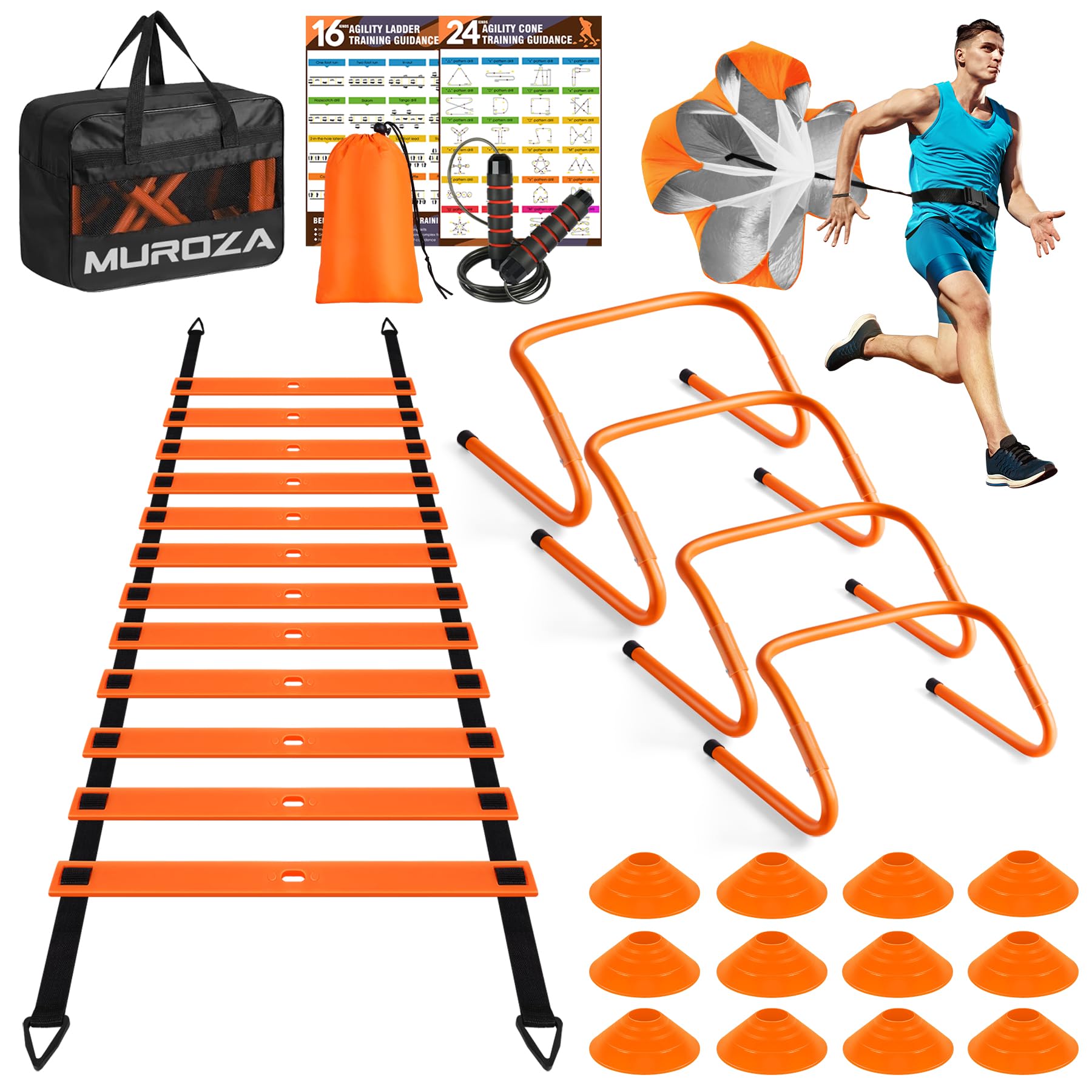
The adjustable hurdles are the part that makes this more than another ladder set. They rotate between 8.5 and 12 inches, so you can keep a beginner low over the hurdle or raise the height for a more demanding lateral step. That range gives a basketball player a way to work on hip height and control without buying a second piece of equipment.
The rest of the kit is generous: a 20-foot, 16.7-inch-wide ladder, 12 disc cones, a resistance parachute, an 8.5-foot jump rope, four stakes, a carry bag, and training guides. The ladder is the anchor, the cones mark the turns, and the hurdles add a different kind of footwork. The parachute is the piece we treat as a bonus rather than the reason to buy; it adds resisted sprinting, not ladder rhythm.
We think the hurdle height range is the most useful upgrade here for basketball, because it lets you change the drill without changing the equipment. The kit is also the easiest way to set up several stations: ladder on one end, hurdles on the other, cones in between. The four stakes are easy to overlook, but they are what keep the ladder ends from creeping on grass.
Pros
- Adjustable 8.5–12 inch hurdles
- 20-foot ladder plus 12 cones
- Parachute, rope, stakes, and bag included
- Training guides included
Cons
- Parachute feels light-duty
The MUROZA kit is the one we recommend when you want a full footwork session in a single bag: ladder, hurdles, cones, parachute, rope, and stakes.
GHB Hex Agility Rings – Best for Pattern Drills

Key Features
- Rings: 6
- Included: Two storage bags
- Connectors: 5 per ring
- Ring diameter: 21 in
- Price: Midrange
Six 21-inch hexagons are a different shape from a ladder, and that is the appeal. You can lay them in a line for quick feet, build a hexagon for lateral steps, or separate them into stations for a small group. The 21-inch diameter gives an adult enough room to step through without clipping the edge, while the six-ring set is still small enough to store in two bags.
Each ring has five connectors, so you can rearrange the set into a chain, a star, or a cluster. The plastic is light enough to reset between drills without dragging, and the bright orange rings are easy to see on a gym floor. The connectors are simple clips, and rearranging the set takes a minute rather than a tools-and-instructions session.
We used the rings for defensive slides and change-of-direction patterns where the ladder’s straight line is too rigid. The hex shape lets a player step out and back, which is closer to a closeout and recover than a straight sprint. They are also easier to carry separately than a long ladder when you only have a small gym space.
We think the rings earn a place as a second footwork tool rather than a first purchase. If you already own a ladder, they add a useful pattern; if you are starting from nothing, the MANTRA set covers more ground for less. The 21-inch size is the detail that matters: big enough for an adult stride, small enough to fit six rings in a trunk.
Pros
- Six 21-inch rings with five connectors each
- Build hexagons, chains, or stations
- Two storage bags included
Cons
- Connector clips are the weak point
- Bulky when left assembled
We recommend the GHB hex rings for pattern work, but treat the connector clips as the wear item.
How We Chose and Tested the Best Footwork Trainers
We started with a shortlist of more than 30 agility ladders, cone sets, resistance-band systems, and footwork mats, then cut it by reading specs, checking footprint and packed size, and dropping anything that looked like a rebranded toy. Fifteen units made the cut. Price wasn’t the gatekeeper—we weighed what came in each box, whether the pieces worked together, and how much actual drill variety the kit supported.
Over five months, I used each one at least three times a week: before work in the driveway, on a gym court Saturday mornings, and in a basement when the weather turned. My team and I timed solo setup, packed each kit into a backpack, and noted whether it fit alongside a ball and shoes. On the court, we ran defensive slides, closeouts, and ladder patterns in both sneakers and court shoes, watching for cones that tipped, bands that slid down a leg, and ladders that bunched up instead of lying flat. We adjusted band resistance, rung spacing, and cone height where possible, then checked whether those settings held through a full drill.
At the end of each session, we checked straps, stitching, plastic thickness, and how the pieces stored—durability showed up in frayed edges and cracked cones, not in the first impression. We also tracked how often we reached for each tool; anything that stayed in the bag lost ground, no matter how well it was made. The final ranking reflects a simple tradeoff: does it hold up, pack up, and make footwork drills harder to skip?
How to Choose Basketball Footwork Training Equipment
The right setup is the one you can lay out in the space you actually have and reset without losing a minute of the session.
Fit the ladder length to your space
The first decision is how much ladder you can lay out. A 20-foot ladder with 12 rungs is the practical middle ground: long enough for three or four steps before a turn, short enough to fit a driveway or half-court. The 19.6-foot MANTRA and 20-foot GHB and YISSVIC sets sit here; the 23-foot Teenitor is for a player with a longer clear run. Measure the space and leave a step at each end. A longer ladder bunched into a short area teaches nothing but frustration.
Check how the ladder anchors
Rungs that slide or straps that twist are the most common irritations in this category, so look at how the ladder holds its shape. On a gym floor, flat rungs and a taut strap matter more than pegs. On grass, four metal pegs are the difference between a ladder that stays put and one that creeps with every push-off; the YISSVIC set includes them, while the budget GHB does not. Choose the anchoring method for the surface you actually use, not the one you might use someday.
Choose a ladder, a cone set, or a full kit
A ladder is the core tool, but cones are what turn it into basketball footwork. We put a ladder-plus-cones set first for most players because it covers quick feet and change of direction in one purchase. The MANTRA set does that with eight cones; the ProMidas 25-pack is the better add-on if you already own a ladder. A full kit like the MUROZA adds hurdles, a parachute, and a rope. Buy the extras you will use; a parachute is a sprint tool, not a substitute for ladder rhythm.
Pick cones and rings for direction changes
Cones and rings should be chosen for the surface and the pattern. A 7.5-inch disc with some weight, like the ProMidas cones, sits still on a court and is easy to see; tiny, thin cones are harder to spot and less likely to stay flat. Hex rings are for direction changes rather than straight-line speed. The GHB rings are 21 inches across, large enough for an adult stride, and the connectors let you build a chain or a hexagon. Check the clips, because that is where modular sets tend to wear.
Frequently Asked Questions
How do I keep a speed ladder from tangling?
Roll it end to end instead of stuffing it into the bag. Keep the rungs flat as you roll, and tie or strap the bundle before it goes into storage. When a ladder does tangle, lay it out full length and work from one end rather than pulling the middle. A few extra seconds at pack-up saves the pre-drill fight.
How long should a basketball footwork session be?
Keep it short and sharp: 10 to 15 minutes of ladder and cone patterns, with two or three drills done well. Stop when the steps get sloppy; more reps at poor foot placement teach the wrong rhythm. Two or three sessions a week is enough to make the patterns feel familiar, and you can add hurdles or rings once the basics are clean.
Do I need special shoes for ladder drills?
No special shoe is required. A basketball shoe with decent grip is the right choice on a court, and a flat training shoe works on grass or a driveway. Avoid shoes with deep lugs or muddy soles that catch the rungs, and check the soles before you step on the ladder. Grip matters more than cushioning for this kind of close, quick contact.
Final Verdict
For most basketball players, the MANTRA Agility Ladder Set is the right first purchase. The 19.6-foot run and 12 adjustable rungs give you room for real footwork patterns, while the eight cones turn the ladder into a change-of-direction circuit. It is the set we reach for when we want a complete session without hauling a full kit.
If your sessions happen on grass, choose the YISSVIC set for its four metal pegs. If you want hurdles and resisted sprints in the same bag, the MUROZA kit is the better fit.