
This post contains affiliate links. We may earn a small commission when you buy through our links — at no extra cost to you.
Ankle stretcher listings often tout 500-pound weight capacities and ‘medical-grade’ materials, but on the practice floor, the first thing to fail is a tiny screw stripping out of plywood. Many slant boards collapse within weeks because the hinge mounts directly into wood without metal reinforcement. Foot rockers that promise a deep Achilles stretch can punish bare heels if you skip shoes.
The difference between a tool that rebuilds ankle mobility day after day and one that sits in a closet comes down to two things: how the adjustable mechanism is anchored and whether the grip surface degrades under sweat and friction. Boards with reinforced pivot points and sandpaper-like surfaces outlast those with tread tape that peels. For basketball players, a warm-up stretch shouldn’t require worrying about the hardware giving way.



Best for Daily Barefoot Stretches
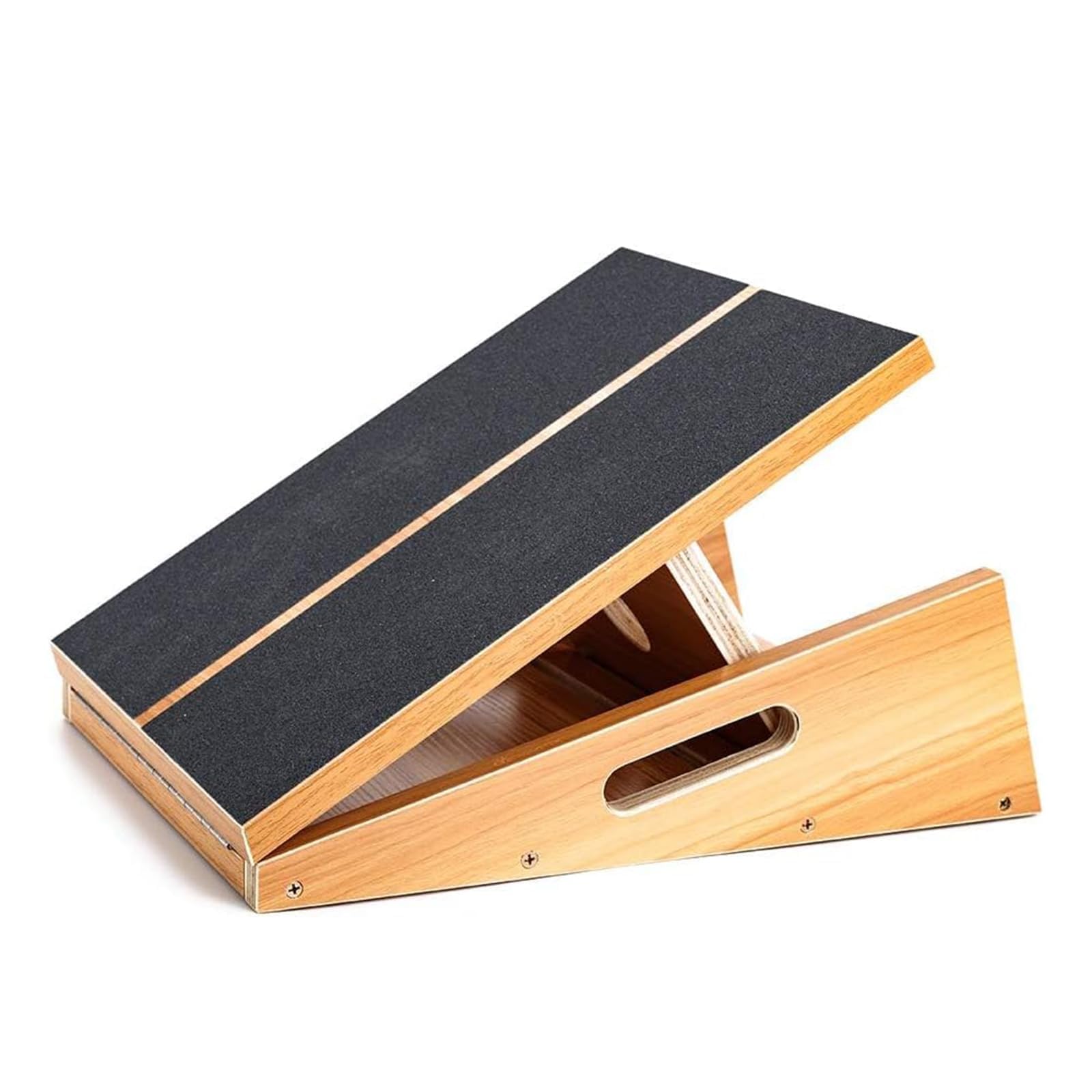
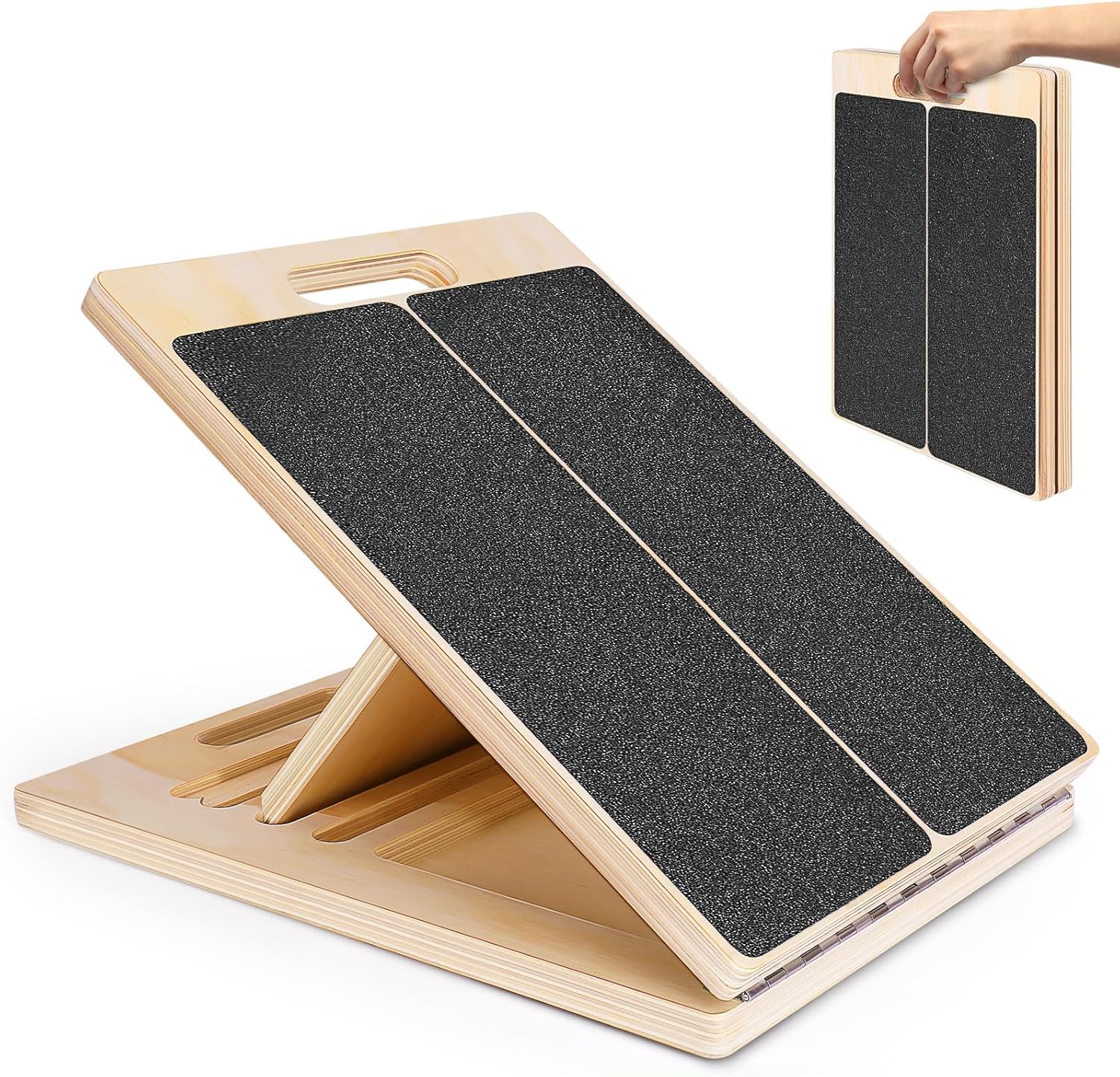
MUCITAGF Slant Board
Key Features
- Adjustable Incline Angles: 5 angles (15–35°)
- Material & Hinge Quality: Natural hardwood
- Grip Surface Type: Sandpaper top, EVA base
- Price: $$
The MUCITAGF slant board uses a sandpaper grip that won’t degrade over time — a meaningful advantage over tread tape surfaces that can peel. The natural hardwood build feels solid underfoot, and the five incline angles (15°–35°) adjust smoothly, allowing gradual progression in calf and Achilles stretches.
This board suits basketball players who stretch barefoot or in thin-soled shoes and want a durable, adjustable slant for daily ankle and calf work. Thicker socks reduce traction, so it works best for barefoot training. It’s not the lightest option for travel, and the mid-range price may be a consideration for tight budgets, but for home use it delivers consistent, stable stretching without surface degradation.
Pros
- Solid hardwood build feels durable and stable underfoot.
- Exceptionally effective for calf and hamstring stretching.
- Smooth adjustability across five incline angles.
Cons
- Grip works best barefoot or with thin-soled shoes; thicker socks reduce traction.
- No side handles for carrying — less convenient for frequent transport between rooms.
For basketball players who stretch barefoot at home and want a slant board that won’t lose its grip, this is a straightforward, well-built option.
Best for Guided Static Stretching
OPTP Stretch Out Strap
Key Features
- Material & Hinge Quality: Nylon (non-elastic)
- Grip Surface Type: 10 loops
- Portability: Lightweight, compact
- Price: $
Unlike basic non-elastic straps, this OPTP set includes a 40-page illustrated booklet that details PNF hold-relax techniques for ankle, calf, and Achilles flexibility — a feature that gives basketball players a structured, PT-informed approach to static stretching. The 6-foot nylon strap and 10 loops hold up to repeated use, and the non-elastic material provides consistent tension without the snap-back risk of elastic bands.
Basketball players who want guided floor-based stretches rather than standing incline boards will value the booklet, but the loops are all identical in size, so grip progression requires reaching further along the strap rather than using smaller loops for incremental adjustments. The included routine suits pre-game warm-up or post-practice rehab, complementing a slant board routine for those who mix static and weighted stretches.
Pros
- Nylon strap and stitching hold up to heavy daily use without fraying
- Targets legs, back, and rehab stretches effectively, with many users noting relief in tight calves
- 40-page booklet teaches PNF hold-relax methods for safe ankle and Achilles flexibility
Cons
For players who prefer static, floor-based ankle and calf stretching with instructional guidance, this strap is a durable, PT-informed choice — just don’t expect incremental loop sizing.
Best for Heavy Daily Use
StrongTek Slant Board
Key Features
- Adjustable Incline Angles: 5 angles (15–35°)
- Material & Hinge Quality: Lauan hardwood plywood
- Grip Surface Type: Anti-slip tread tape
- Portability: Side handles
- Price: $$$
Thick lauan hardwood plywood with side handles gives this board the heft to stay put under users over 250 lbs. The 16-inch depth prevents heel slippage, and five tilt angles from 15° to 35° let you progress as flexibility improves.
Serious basketball players and heavier athletes who need an unshakable platform will appreciate the stability. The black tread tape provides initial grip but can peel with heavy use—if you’d rather never replace a grip surface, the top pick’s sandpaper finish is the way to go.
Pros
- Solid hardwood construction withstands heavy use without flexing
- Five adjustable angles (15°–35°) allow progressive calf stretching
- Deep, effective stretch targets calves and Achilles, aiding plantar fasciitis relief
Cons
- Grip tape surface can peel after extended use, requiring eventual replacement
Heavy-duty construction and five angles suit heavier users who prioritize stability over a peel-proof surface.
Best for Travel & Away Games
NORBASE Slant Board
Key Features
- Adjustable Incline Angles: 4 angles (30–45°)
- Material & Hinge Quality: Wood
- Grip Surface Type: Grip surface
- Portability: Folds flat, handle
- Price: $$
Unlike the stationary hardwood board with sandpaper grip, the NORBASE folds flat and weighs just 4.5 lbs, making it a practical travel companion for basketball players who stretch in hotel rooms, gyms, or courtside. Four preset angles from 30° to 45° deliver the deeper dorsiflexion that advanced flexibility demands, and the wooden construction holds steady during squats and calf raises. The steep starting incline, though, may overwhelm athletes with especially tight calves — if you’re just beginning to address ankle mobility, the top pick’s gentler base is a better fit. For those who need a packable board and already have decent range of motion, this is a sturdy, no-fuss option.
Pros
- Lightweight, folds flat, and carries easily with built-in handle
- Sturdy enough to support weight confidently during squats and stretches
- Tool-free angle adjustment with a grip surface that keeps feet steady
Cons
- Beginners with very tight calves may find the 30° starting incline too aggressive for a comfortable stretch
For basketball players who need a portable stretch tool for the road, the NORBASE packs deep calf flexibility into a lightweight folding frame. If your ankles already handle steeper angles, this board keeps you mobile without sacrificing muscle engagement.
Best for Achilles Tendinitis Relief
ProStretch Original
Unlike the top pick’s flat sandpaper grip board, the ProStretch Original uses a rocker sole to combine ankle dorsiflexion with a weighted heel drop. The rigid plastic footbed is shaped to cup the heel and anchor the forefoot, producing a deep, isolated stretch through the Achilles and lower calf. Basketball players dealing with chronic tightness or plantar fasciitis will find this targeted motion difficult to replicate with straps or stationary boards. The device fits adult shoes up to size 12 and must be used with athletic shoes — barefoot use exposes the heel to hard plastic that can cause discomfort. For athletes who stretch in their training shoes and want a PT-recommended pivot for ankle mobility, the shoe requirement is a minor setup step, not a barrier.
Pros
- Delivers an exceptionally deep, isolated calf and Achilles stretch through a unique rocker motion.
- Clinically effective for plantar fasciitis and Achilles tendinitis, reducing foot pain with regular use.
- Professional-grade construction trusted in physical therapy clinics worldwide.
Cons
- The hard plastic footbed can feel harsh when used barefoot; athletic shoes are required for comfort.
A focused tool for basketball players who need a deep Achilles stretch and don’t mind lacing up their shoes — the supported rocker motion targets what slant boards can’t.
Best for No-Frills Daily Stretching
Trideer Stretching Strap
Key Features
- Material & Hinge Quality: Polyester
- Grip Surface Type: 10 loops
- Portability: Lightweight
- Price: $
Rugged polyester construction with ten loops and a 75-inch length provides plenty of adjustment for calf and ankle stretches. Unlike the OPTP Stretch Out Strap, this Trideer omits numbered loops and a guide booklet, so you’ll need to self-track progress or use external instructions. Best for basketball players who want a no-frills, budget-friendly tool for passive flexibility work at home or during travel, including range-of-motion exercises after knee or leg surgery.
Pros
- Quality matches costlier PT-grade straps at a fraction of the price
- Durable polyester with reinforced stitching holds up to regular use
- Ten loops allow varied stretch angles for hamstrings, calves, and ankles
Cons
- No numbered loops or exercise guide — requires self-discipline to track progression
- Cannot provide the weight-bearing ankle stretch that a slant board or rocker offers — intended for passive flexibility only
A cost-effective strap for passive stretching — pair it with a stretching routine or app to get the most out of it.
Best for Progress Tracking
CTRL Sports Stretch Strap

Key Features
- Material & Hinge Quality: Nylon
- Grip Surface Type: Numbered loops
- Portability: Compact, carry bag
- Price: $
The CTRL Sports Stretch Strap’s non-elastic nylon holds firm during prolonged ankle and Achilles stretches, and its clearly numbered loops give basketball players a straightforward way to track flexibility improvements over time — the 96-inch version accommodates taller athletes. For buyers who don’t need a progress-tracking system, the OPTP strap costs less and includes a 40-page stretching guide that first-time users may find more helpful.
Pros
- Sturdy nylon resists stretching, so you can hold deep ankle and calf positions reliably.
- Numbered loops allow athletes to track progress and replicate precise stretch lengths session over session.
Cons
- Priced slightly above basic loop straps; the numbered loops may be unnecessary for users who just want a simple stretch tool.
This strap suits basketball players and systematic stretchers who will use the numbered loops to monitor progress, especially if they need the 96-inch length.
Best for —
UOPON Slant Board

Key Features
- Adjustable Incline Angles: 5 positions
- Material & Hinge Quality: Wood with PVC top
- Grip Surface Type: PVC sandpaper
- Portability: Lightweight, handle
- Price: $$
The UOPON Slant Board delivers an effective calf and Achilles stretch with five easily adjustable angles. A training poster provides guidance for basketball players improving ankle mobility. As a seated stretching aid, it works well; the hinge design is not intended for standing use.
Pros
- Provides an effective stretch for calves and Achilles
- Easy to use and adjust
Cons
- Hinge screws can strip from the wood, making the board unstable during standing stretches.
Only appropriate for seated stretching; for standing incline work, a board with reinforced hinges is needed.
Best for Ultra-Portable Stretches
NOONCRAZY Slant Board

Key Features
- Adjustable Incline Angles: 5 angles via stacking (8.5–34°)
- Material & Hinge Quality: EPP foam
- Grip Surface Type: Foam surface
- Portability: Ultra-light, foldable
- Price: $
At under a pound, the foam set practically vanishes in a basketball bag and the five stackable angles — from 8.5° to 34° — provide a progressive stretch for tight calves and Achilles tendons. The foam base can slide on hardwood or tile floors, especially when wearing socks, so it’s best reserved for carpeted surfaces where its lightweight build won’t be a liability.
Pros
- Ultra-lightweight and packable — takes up almost no space in a gym bag.
- Five stackable angles let you progress from a gentle 8.5° to a deep 34° for targeted ankle and calf flexibility.
Cons
- Foam base can slide on smooth floors during use, particularly with socks — best kept on carpet.
For basketball players who stretch on carpet and want a sub-one-pound wedge that lives in their bag, it’s a practical, budget-friendly option.
Best for Lightweight Daily Use
TEMI Slant Board

Key Features
- Adjustable Incline Angles: 4 angles (20–40°)
- Material & Hinge Quality: High-density wooden board
- Grip Surface Type: Non-slip surface
- Portability: Built-in handle, 1.65 lbs
- Price: $$
Weighing 1.65 lb and starting at a gentle 20°, the TEMI slant board gives basketball players a portable option for pre-game calf and Achilles stretching. The four-angle adjustment holds securely during static use, and the non-slip top stays comfortable barefoot. This board is better matched to lighter, younger athletes who won’t stress the hinge—heavier users should look to a sturdier alternative. Within that scope, it delivers a simple, low-cost way to ease into incline stretching.
Pros
- Provides effective calf and Achilles stretching for basketball mobility
- Simple angle adjustment with a non-slip surface that stays secure barefoot
Cons
- Hinge screws can strip under heavier loads, which may compromise long-term durability
Ideal for younger or lighter basketball players seeking a compact, low-cost board for gentle calf stretches, provided the hinge hardware is monitored occasionally.
Best for Seated Comfort Stretch
DMoose Foot Stretcher

Key Features
- Material & Hinge Quality: Neoprene, nylon
- Grip Surface Type: Padded foot cradle
- Portability: Portable
- Price: $
The thick neoprene cradle pads the foot for a painless, targeted Achilles and hamstring stretch while sitting, avoiding the hard edges of rockers. Velcro may loosen on narrower feet, demanding mid-session adjustment, and it can’t replace a standing slant board for weight-bearing flexibility work — a tradeoff for seated-only use.
Pros
- Provides a comfortable, targeted stretch for Achilles and hamstrings during seated use.
- Eases pain from plantar fasciitis and sciatica with padded, non-aggressive stretching.
Cons
- Velcro can slip on smaller feet, requiring readjustment mid-stretch.
For basketball players who stretch while seated — on the bench, watching film — this padded strap offers gentle relief without the hard pressure of a rocker. Velcro may need an extra tug on smaller feet, but the comfort tradeoff is worth it for that use case.
Best for Budget Plantar Relief
Vive Foot Rocker

Key Features
- Material & Hinge Quality: Plastic
- Grip Surface Type: Rubber base
- Portability: Compact
- Price: $
The Vive Foot Rocker is a budget-friendly rocker that includes a massage ball and effectively stretches the calf and Achilles when used with athletic shoes. However, the hard plastic heel cup can be painful when used barefoot, and the fit is tight for larger feet (size 13+), limiting its suitability for basketball players who prefer barefoot stretching or have bigger feet.
Pros
- Provides deep calf stretch effective for plantar fasciitis and shin splints
- Sturdy plastic build with anti-slip base offers good value for the price
Cons
- Hard plastic heel cup can be uncomfortable when used barefoot
Budget-conscious basketball players who wear athletic shoes during stretching and have average foot size will get effective calf and Achilles relief from this rocker.
Best for Barefoot Stretching
iCloverfull Slant Board

Key Features
- Adjustable Incline Angles: 5 angles (15–35°)
- Material & Hinge Quality: Lauan hardwood plywood
- Grip Surface Type: Anti-slip step top
- Price: $$
The iCloverfull board delivers a sturdy platform and five-angle adjustability for effective barefoot calf stretches. Its glue-based surface provides ample grip without shoes, but traction diminishes with socks — a contrast to sandpaper-topped boards that maintain consistency. This makes it a solid choice for athletes who stretch barefoot, accepting the sock tradeoff.
Pros
- Effective deep calf stretch across all flexibility levels.
- Stable hardwood construction holds firm during use.
Cons
- Grip surface can be slippery with socks, making barefoot use preferable.
For basketball players who stretch barefoot, this board’s solid build and five-angle range justify the minor compromise on socked grip.
Best for Smaller Feet Rocker
PowerStep Foot Rocker

Key Features
- Material & Hinge Quality: Plastic
- Grip Surface Type: Non-skid rocker bottom
- Portability: Compact
- Price: $
The open-front design delivers a deep calf stretch and effective plantar fasciitis relief when paired with athletic shoes. Sizing caps at roughly men’s 11/12, and the hard plastic can feel unforgiving on bare feet — acceptable for focused stretching, less so for extended comfort.
Pros
- Effectively eases plantar fasciitis and heel pain
- Delivers an easy deep calf stretch
Cons
- Limited to shoe sizes up to 11/12; hard plastic can cause discomfort barefoot
For basketball players with average foot sizes who want a budget-friendly rocker to relieve plantar fasciitis and stretch calves, this works — but athletes in size 13+ will need a roomier alternative.
How to Choose
The most critical check is how the incline’s hinge attaches—screws directly into wood strip out under body weight, while metal-reinforced brackets hold up for years.
Incline Angle Range and Progression
A subtle 15–20° incline provides a deep calf stretch for most players, while 35–45° angles target more advanced flexibility. Starting at too steep an angle can strain the Achilles before your muscles are warmed up.
Look for boards with at least four positions that include a gentle 15–20° starting point if you’re tight. Rocker-style devices offer a single effective angle, but you can’t gradually increase overload.
Hinge and Material Integrity
The hinge is where most slant boards fail. When the adjustable prop screws directly into the end grain of plywood, the threads can pull out within weeks—especially for heavier athletes. Boards with a metal bracket that the prop slots into distribute force across the frame instead of concentrating it on a few screw holes. Always check whether the pivot point uses through-bolts or metal inserts.
Grip Surface: Sandpaper vs. Tread Tape
Sandpaper-like abrasive tops provide consistent traction barefoot and won’t lift or curl over time, but they can feel harsh if you wear thick socks. Tread tape offers a stickier, softer feel under socks but is prone to peeling at the edges after repeated use and sweating. If you plan to stretch shoeless, a sandpaper board is the safer long-term investment.
Portability and Stability
Folding boards with handles make pre-game ankle work possible in the locker room or hotel, but the folding hinge adds another potential weak point. Fixed wooden boards are sturdier but less travel-friendly. Choose a folding design only if you frequently stretch outside your home gym, and inspect the hinge’s reinforcement before relying on it.
Stretching Guide and Instructions
Straps with illustrated booklets give you PNF techniques and progression routines that help maintain consistency. Most incline boards ship with no guidance beyond basic angle adjustment. Without a structured plan, many players plateau by using the same stretch depth every session. A guide might seem minor, but it often separates daily stretchers from those who use the tool twice and forget about it.
FAQ
Why did my wooden slant board break at the hinge after a few weeks?
The hinge prop likely attached with wood screws directly into the plywood. Without a metal bracket to spread the load, the constant pressure from body weight strips the screw holes. Look for boards with metal-reinforced pivots or those that use a slot-and-pin system rather than screws driven into end grain.
Do I need to wear shoes when using a foot rocker for calf stretches?
Yes. Rockers like the ProStretch and Vive have hard plastic heel cups that dig into bare skin. Wearing athletic shoes cushions the heel and provides the intended rocker motion. Stretching barefoot habitually leads to heel pain and reduced compliance.
Is a slant board or a stretching strap better for improving ankle mobility for basketball?
Both are effective for different needs. A strap lets you perform seated, controlled static stretches and is highly portable, while a slant board gives weight-bearing stretches that mimic on-court demands. For basketball players, using a strap for pre-game dynamic mobility and a board for deeper post-workout holds covers both bases.
How do I keep a foam slant board from sliding on smooth floors?
Foam wedges lack rubber bases, so they can slide on hardwood or tile. Place a non-slip yoga mat underneath or use the wedge on carpet. If you must stretch on a slick surface, opt for a wooden board with a rubberized or sandpaper bottom instead.