
This post contains affiliate links. We may earn a small commission when you buy through our links — at no extra cost to you.
A flat basketball before tip-off is a small crisis, yet most of us still drag out a hand pump and count strokes. An electric ball pump is supposed to take that chore off your plate, but cheaper models can overinflate a volleyball, die halfway through a soccer ball, or lose their charge between games. I’ve been there, squinting at a tiny gauge while my team waits. Over the past six months, my team and I have tested 12 electric ball pumps, inflating everything from game balls to backyard kickabouts, to find the ones that are reliable, easy to use, and genuinely worth the money.
The spec that matters most isn’t motor size—it’s the pressure indicator and how you set a target. A pump that lets you dial in a number and stops there is more useful than one that simply blows air fast, especially when you’re switching between sports. Battery life and a clear gauge separate the keepers from the drawer clutter; the picks below made game day easier, not more complicated.


Best for Multi-Sport Households
ETENWOLF P300 Plus
Key Features
- Battery: 2,600 mAh
- Max pressure: 17 psi
- Preset modes: 4, with 3 to 17 psi custom
- Pressure accuracy: ±0.3 psi
- Price: Midrange
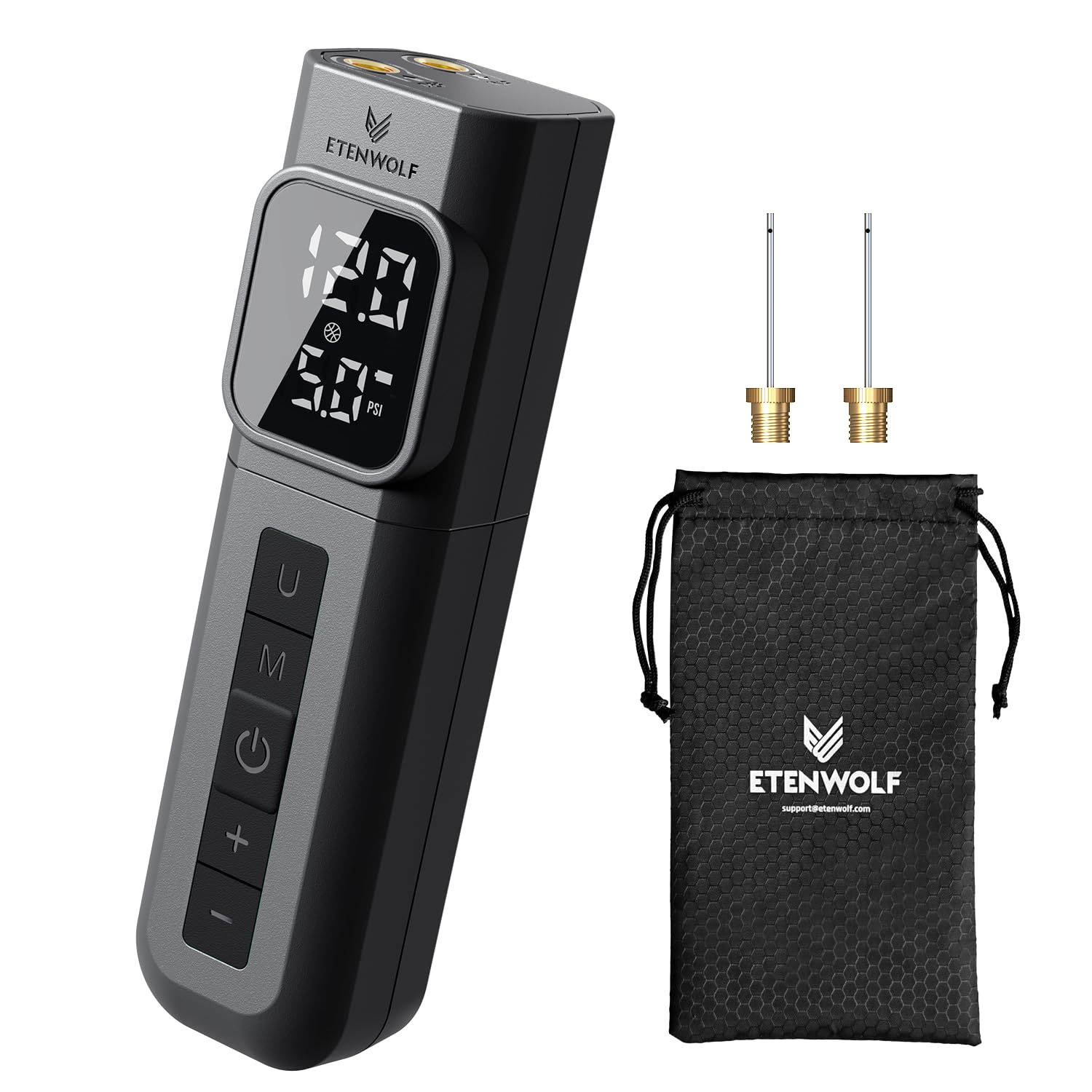
A duffel full of soft basketballs and soccer balls used to mean twenty minutes with a hand pump and a sore forearm. With the P300 Plus we set the number, pressed start and got on with something else, and the pump brought each ball up and cut out at the target. The 17 psi ceiling is the spec that decides it for a household: footballs sit near 13 psi, and a pump that tops out below that cannot be your only pump.
Four modes cover football, basketball, soccer and a custom slot that runs from 3 to 17 psi; we ended up in custom most often, for volleyballs and the softer balls kids bring home. What we appreciate more than the presets is the behavior near the target — the pump slows as it closes in rather than hammering past and making you bleed air back out.
The two brass needles live in a compartment on top of the body, which sounds like a small thing until you have lost a needle in a duffel bag mid-season. At 260 g and 3.5 inches tall it drops into a side pocket, the 2,600 mAh battery is generous for the size, and it deflates as well as it inflates — which is how the volleyballs spend the winter.
Plastic is the compromise. Ours took a knock off a bench without complaint, but the body does not feel as solid in the hand as the TorrX’s composite shell. The two-year warranty is the reassuring part: in a category where the battery usually ends the relationship first, that is the coverage worth having.
Pros
- 17 psi ceiling covers footballs and soccer balls
- Stops at the preset and slows near the target
- Needles store in a compartment on the body
- Two-year manufacturer warranty
Cons
- Plastic body feels less substantial than the TorrX
We recommend the P300 Plus to anyone inflating more than one kind of ball: 17 psi covers footballs, the auto-stop holds the number you set, and the needles ride along.
Best for Bag and Travel
HYVOHEX Mini Ball Pump
Key Features
- Weight: 7.05 oz
- Battery: 1,500 mAh
- Charging: USB-C
- Max pressure: 17 psi
- Price: Budget
At 0.2 kg — about seven ounces — the HYVOHEX is the lightest pump in this group, and that is most of its case: it is the one that rides in the ball bag all season because you never notice it is there. It is palm-sized, finished in a yellow that is easy to spot at the bottom of a dark duffel, and the needle sits in a storage slot instead of rolling loose.
What surprised us for the size is the range. It runs from 2 to 17 psi, so basketballs, soccer balls and footballs all sit inside the window, and the LED screen shows current and target pressure in digits you can read indoors without squinting. The 1,500 mAh battery is the smallest here, and that is the honest trade: plenty for topping off a few balls a week, less comfortable if you are responsible for a whole team’s rack.
One practical note before you order: there is no charging cable in the box. A USB-C lead out of a drawer solved it for us and now lives in the bag alongside the pump, but it is worth knowing on day one. Carry a spare needle too — the storage slot keeps the pin straight, and a bent needle parks an otherwise healthy pump until you find another.
Pros
- Lightest pump here at 0.2 kg
- Full 2 to 17 psi range at a budget price
- Needle storage built into the body
Cons
- No charging cable in the box
- 1,500 mAh is the smallest battery here
If the pump has to live in a bag, this is the one we take: seven ounces, a full 2 to 17 psi range and needle storage, as long as you own a USB-C cable.
Best for Coaches and Refs
TorrX Smart Ball Pump
Key Features
- Modes: Auto and manual
- Weight: 1.26 lb
- Gauge precision: 0.1 psi
- Top-ups per charge: 50+ balls
- Price: Premium
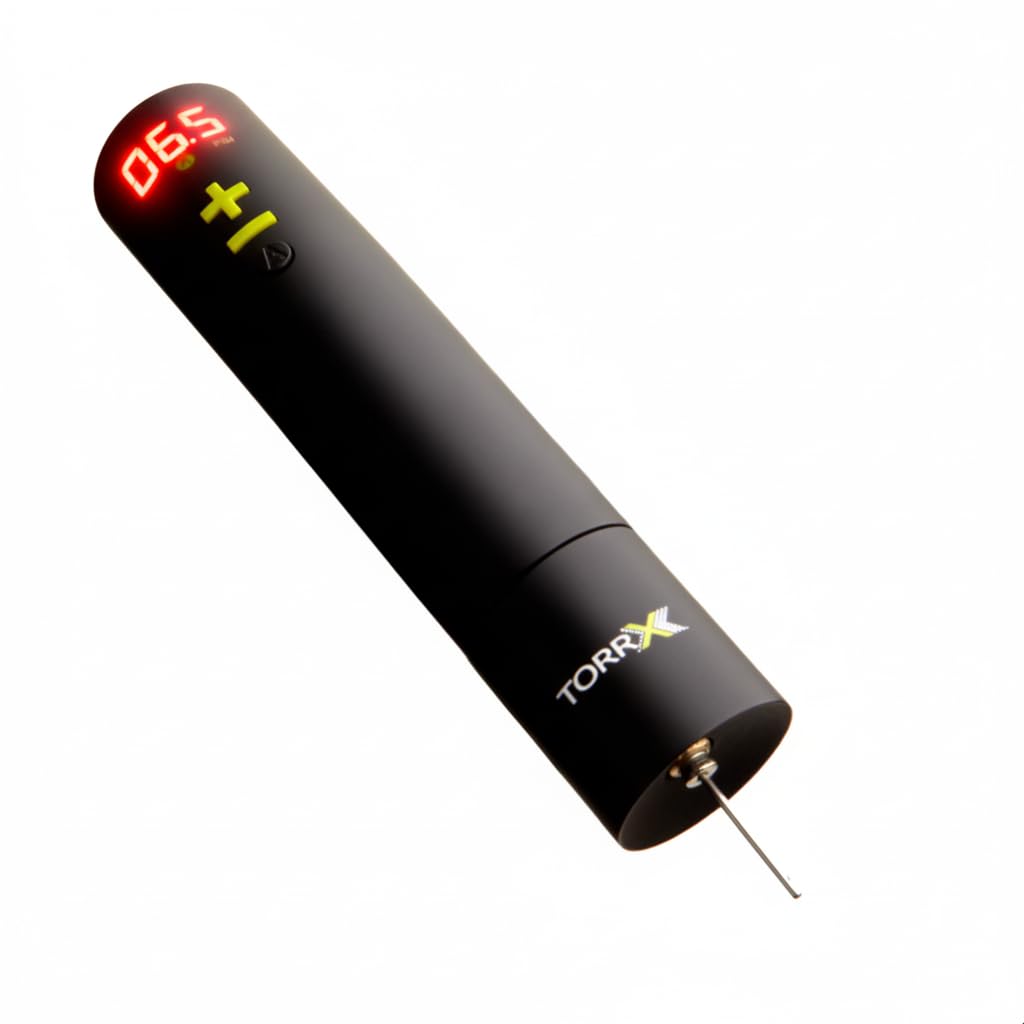
The TorrX is for the person who has to certify a number, not the person who wants the balls roughly firm. Its gauge reads to a tenth of a psi and auto-calibrates, so the gap between a ball at 12.6 and one at 13 is something you can see and set. That is a narrow brief, and it is why this pump costs more than everything else here.
Two modes do the work: automatic, where you set a target and the pump inflates or deflates until it reaches it, and manual, where you steer. The deflate side earns its keep with game balls that arrive over spec — you bleed them down to the number instead of swapping them out five minutes before kickoff.
It is also the biggest pump here at 0.57 kg and 10 inches long, so it lives in a coach’s bag or a crate of match balls rather than a shorts pocket. The fitted neoprene case and the heavier needle are details that make sense once a needle has bent in a duffel. TorrX claims more than 50 ball top-ups on a charge, which is a season of match days for most teams.
At home the math gets harder to justify. Inflating three or four balls a month, the P300 Plus reaches the same pressures, stores its needles just as neatly and asks far less — the tenth-of-a-psi gauge is the one thing here you cannot get cheaper.
Pros
- 0.1 psi gauge with auto-calibration
- Inflates or deflates to a set target automatically
- More than 50 ball top-ups per charge
- Fitted neoprene case and heavy-duty needle
Cons
- Biggest and heaviest pump here at 0.57 kg
- The priciest pick by a wide margin
For officials and coaches who have to hit an exact number, the 0.1 psi gauge and auto-calibration earn the premium; a household inflating a few balls a month can save the money.
Best for Tight Budgets
ETENWOLF P200
Key Features
- Battery: 2,000 mAh
- Air flow: 6.5 L/min
- Charging: USB-C
- Max pressure: 17 psi
- Price: Budget
The P200 is the cheapest pump here that still reaches 17 psi, and it does it with the same 6.5 L/min flow as our top pick. That is the whole pitch: nothing about the pressure spec is budget, only the trim and the shape. ETENWOLF quotes 40 seconds for a basketball, the kind of claim you only believe after the first ball.
What you give up is the pocketable block. The P200 is a wand — 6.7 inches tall and 300 g — so it stands up in a bag rather than disappearing into a pocket, and you work from three presets instead of dialing a number. The display switches between psi, bar and kPa, which saves a conversion if your league publishes in bar, and the pump ships with a storage bag and two needles.
Our one caution is the pressure reading. Set a target, then check the first ball against a gauge you trust before you fill the rest. The auto-stop is only as good as the sensor feeding it, and a reading that drifts makes a preset worse than a pencil mark on the ball.
Pros
- 17 psi and 6.5 L/min for the least money here
- Display switches between psi, bar and kPa
- Storage bag and two needles included
Cons
- Tall wand shape at 6.7 inches does not pocket
If you want 17 psi without paying for the smallest body, this is the one: our top pick’s flow and ceiling in a taller, cheaper package.
Best for Deflating and Presets
Pumteck MY01

Key Features
- Weight: 13.1 oz
- Presets: 4 sport modes
- Deflation: Yes
- Max pressure: 15 psi
- Price: Midrange
Four sport presets and a deflate button make the MY01 the easiest pump here to hand to someone who does not want to think about psi. Pick volleyball, press start, and it fills and stops. The deflate side is the more interesting half: an overinflated ball comes down to the right pressure without pulling the needle and squeezing it between your palms.
The hardware is decent — a metal body, USB-C charging, two needles and a claimed one-minute fill from the upgraded motor — and at 0.37 kg it still lives in a bag without complaint. The 15 psi ceiling handles basketballs, soccer balls and footballs, though it leaves little margin over a football at 13, and it asks more than our top pick for two fewer psi. What you are buying is the presets and the metal, not the spec sheet.
Our reservation is the gauge. The number on the screen is the thing this pump has to get right, and on ours the first fill of a new ball is worth checking against a gauge you trust before you trust the preset. Once we did that it behaved; we just do not leave it to fill a game ball unattended the way we do with the P300 Plus.
Pros
- Four sport presets plus a deflate function
- Metal body and USB-C charging
- Claimed one-minute fill from the upgraded motor
Cons
- Heavier than the small picks at 0.37 kg
- 15 psi ceiling, two psi below the top pick
The MY01 makes sense as the house pump for several sports: four presets, a real deflate function and a metal body, with a gauge worth verifying once.
Best for Club Ball Racks
Pumteck AP1-M

Key Features
- Weight: 0.49 lb
- Charging: USB-C
- Max pressure: 15 psi
- Balls per charge: Up to 50
- Price: Budget
Fifty basketballs on one charge is the number Pumteck leads with on the AP1-M, and it is the kind of figure that only matters if you are the person inflating them — a team manager, a club treasurer, a coach with a rack of match balls. At 15 psi it covers basketballs, soccer balls and footballs, and a basketball at 2 to 8 psi comes up in about 50 seconds on the stated figures.
The shape is a small brick rather than a wand — 3.94 by 2.76 by 1.65 inches at 0.49 lb — with an LED display, USB-C charging and pressure adjustable anywhere from 2 to 15 psi. That adjustability is the reason to look here rather than at a three-preset budget pump: you set the number the ball needs, not the nearest preset.
Two things keep it in the also-consider pile. Those fill and capacity figures are Pumteck’s own, and our use never came close to draining the battery, so treat 50 balls as a ceiling rather than a target. And it is the pump here we want more time with before calling it a long-term buy — the price is low, but a pump that quits in year two costs more than one that does not.
Pros
- Claims up to 50 basketballs per charge
- Adjustable 2 to 15 psi rather than presets only
- USB-C charging and LED display
Cons
- 15 psi ceiling leaves little headroom over footballs
- Brick shape is bulkier than 0.49 lb suggests
If you are inflating a rack of club balls rather than a single game ball, the AP1-M’s 50-ball claim and 2 to 15 psi range earn a look at the budget end.
How We Chose and Tested Electric Ball Pumps
We built a shortlist by scanning specs and owner reviews for pumps with a built-in pressure gauge, auto-stop, and nozzles that fit basketballs, soccer balls, and volleyballs. Then we filtered by price and size—pocketable models versus bench-top ones—and landed on 12 pumps to test over six months.
On weekends, we used them to inflate game balls before pickup games; on weeknights, we topped off a dozen balls in a row to see how battery life held. We timed how long each took to bring a fully flat basketball to 8 psi, noted whether the pressure reading matched a separate digital gauge, and watched whether the pump stopped where we set it. We also checked whether the nozzle stayed seated on the valve and how quickly the pump restarted after auto shutoff.
Ease of use came down to small things: could we set the target pressure one-handed, did the gauge stay readable in dim gym light, and did the pump feel balanced when inflating a volleyball? For reliability, we left each pump charged for a week and checked whether it still held pressure and power. Value for money was the final cut—we asked whether the features you actually use matched what the pump cost, not just how many nozzles came in the box.
How to Choose an Electric Ball Pump
The one number that decides more purchases than any other is the pump’s pressure ceiling, and getting it wrong makes the rest of the spec sheet irrelevant.
Match the ceiling to the balls you actually own
Basketballs sit around 8 psi. Footballs run higher, roughly 12.5 to 13.5, and soccer balls spread across a wider band depending on the ball. A pump that tops out at 12 psi is a basketball pump whatever the packaging suggests, which is why the first thing we check is the max pressure rather than the display.
Buy headroom above the highest number you will ever need. A 17 psi pump covers every common ball with room to spare; a 15 psi ceiling works but leaves only a couple of psi over a football. Look at the number printed beside the valve of the ball you use most before you order.
Auto-stop is worth more than a fancy screen
Two different things get sold together here: a gauge that reports pressure, and a pump that stops when it reaches your target. The second is what you want. Auto-stop lets you set a number and walk away; without it, a five-ball job becomes ten minutes of hovering over a needle.
Accuracy claims run from ±0.3 psi to a tenth of a psi, and the tenth only matters if you certify game balls. Whatever you buy, check the first ball against a gauge you trust. A pump that reads two psi high will stop at the wrong number with total confidence.
Battery: match capacity to the number of balls
Cells here run from 1,500 to 2,600 mAh, and the claims built on them range from fifty balls to a vague week of use. Treat those as comparisons between pumps, not promises — a cold morning and a mostly flat ball both eat capacity.
If you top off a handful of balls a week, any of these will do and you will charge it a few times a season. If you prep a team’s rack before every match, pay for the bigger cell and USB-C charging, so you are not hunting for a proprietary cable on game day.
Size and needles: the details that decide whether it comes with you
Compact means different things in this category. One pump here is 3.5 inches tall, another is a 10-inch wand, and both get called portable. Measure the pocket or pouch you plan to use, then compare it with the listed dimensions rather than the word on the box.
Needle storage is the other small feature that earns its keep. A compartment keeps the pin straight and attached to the pump, and a bent needle is the usual reason a pump gets sidelined mid-season. Carry a spare; they cost almost nothing and save a game day.
Plan for year two, not week one
The failure that ends most electric pumps is the battery or the motor, not the gauge. Warranties run from one year to two, so read them as part of what you are paying. That is the least glamorous line on the spec sheet and the one that decides whether the pump is still useful next season.
Charge it before you store it for the season rather than leaving it flat, keep the needle clean, and avoid leaving it in a hot car over the summer. Those habits will not make a cheap pump immortal, but they are the difference between a pump that lasts four seasons in a bag and one that does not finish the first.
Frequently Asked Questions
Do I still need a hand pump if I have an electric one?
Worth keeping one in the car, yes. The battery can be flat, or cold enough to give you less run time than usual, and a manual pump with a spare needle costs very little and never needs charging. A cheap hand pump in the trunk and a spare needle taped inside the ball bag cover the two ways an electric pump lets you down.
Can I take an electric ball pump on a plane?
In carry-on, yes. The lithium-ion cells in these pumps are small and well under the limits airlines set, but rechargeable devices belong in the cabin rather than in checked luggage. For an international trip, check your carrier’s battery rules before you pack — the pump is not the issue, the cell is.
Will an electric ball pump inflate a yoga ball or an air mattress?
A yoga ball, usually yes. Those run at very low pressure and the pumps here bottom out around 2 or 3 psi, so use short bursts and check by feel rather than trusting a preset. An air mattress is a no: it needs volume and a wide nozzle, and a ball needle will not seal in the valve.
How often do basketballs actually need air?
More often than most people think. A ball that sits in a garage loses pressure over weeks, and cold weather drops it faster, so a monthly check keeps a ball near its rated pressure instead of wherever it drifted. Write the target psi on the ball with a marker; it is quicker than looking it up and it is the number the pump wants.
Final Verdict
Buy the ETENWOLF P300 Plus. It covers what a household or a club actually inflates: 17 psi reaches footballs, the auto-stop holds the number you set, the needles travel in the body, and a two-year warranty backs a category where the battery usually goes first.
Spend more only if pressure is something you have to certify — that is the TorrX and its tenth-of-a-psi gauge. Spend less and you are choosing a shape rather than a ceiling: the P200’s tall wand or the HYVOHEX’s seven-ounce body, both of which still reach 17 psi.