
This post contains affiliate links. We may earn a small commission when you buy through our links — at no extra cost to you.
A shot trainer should turn practice into a rhythm: catch, shoot, catch again. The wrong one turns your driveway into a fetch-and-reset drill, with balls wedged in the net and a frame that wobbles after a month. I’ve spent enough evenings chasing rebounds to know the difference. What you’re really buying is more shots per hour and less time untangling equipment.
Over six months, my team and I put 12 basketball shot trainers through driveway sessions, gym runs, and a few very windy afternoons. We looked at how quickly each one assembled, how often balls jammed, how it held up after repeated use, and whether long sessions stayed comfortable. The best ones made shooting feel fun enough to keep going; the weak ones turned practice into maintenance. Value mattered too—not just price, but shots per dollar and how many shots each model could handle before a reset. The picks below are the ones that earned a permanent spot in the driveway.
Our Top Picks



The Best Basketball Shot Trainers, Reviewed
Jay Wolf Shooting Strap – Best Overall
Key Features
- Fits: Kids, youth, and adults
- Size: One size fits all
- Weight: 1.44 oz
- Material: Nylon, polyester
- Price: Midrange
The guide hand is the quiet saboteur of a jump shot. It rests on the side of the ball looking harmless, then rotates or pushes at the release and sends the shot long and flat. The Jay Wolf strap takes it out of the argument: the band keeps the off hand out of the release, so the only thing that can propel the ball is the shooting hand. The first few reps feel strange, then they feel like the shot you have been trying to find.
What we like is how little it asks of you. It weighs 1.44 ounces, goes on in about the time it takes to tie a shoe, and the same one-size band covers a kid and an adult, which is why it is the first aid we hand to a player who cannot feel what is wrong. Put it on and you cannot finish a rep with two hands pushing. The fault becomes obvious inside one set.
Comfort is where it asks for patience. The band sits tight enough to be felt on every release, and a long first session can leave the arm rubbed or the elbow sore, especially for a young player still fighting to shoot with two hands. Short sets solve it: 15 or 20 reps with the strap, then the same number without. What carries over is the feel of the shooting hand working alone.
There is nothing to charge, assemble, or adjust once it is on, which is why it lives in a gym bag rather than a garage. It will not do anything for a flat shot or a wandering elbow, and those need different tools, but for the flaw most players actually have it is the simplest thing here that works.
Pros
- Stops the guide hand from pushing the shot
- One size fits kids, youth, and adults
- Light enough to forget you have it on
- On in seconds between drills
Cons
If your off hand is pushing the shot, start here: a single strap that fits kids and adults and forces a one-handed release within a set.
Dr. Dish IC3 Rebounder – Best for High-Volume Practice
Key Features
- Weight: 35 lb
- Return arc: 180 degrees
- Frame material: Alloy steel
- Net height above rim: 17 inches
- Price: Premium
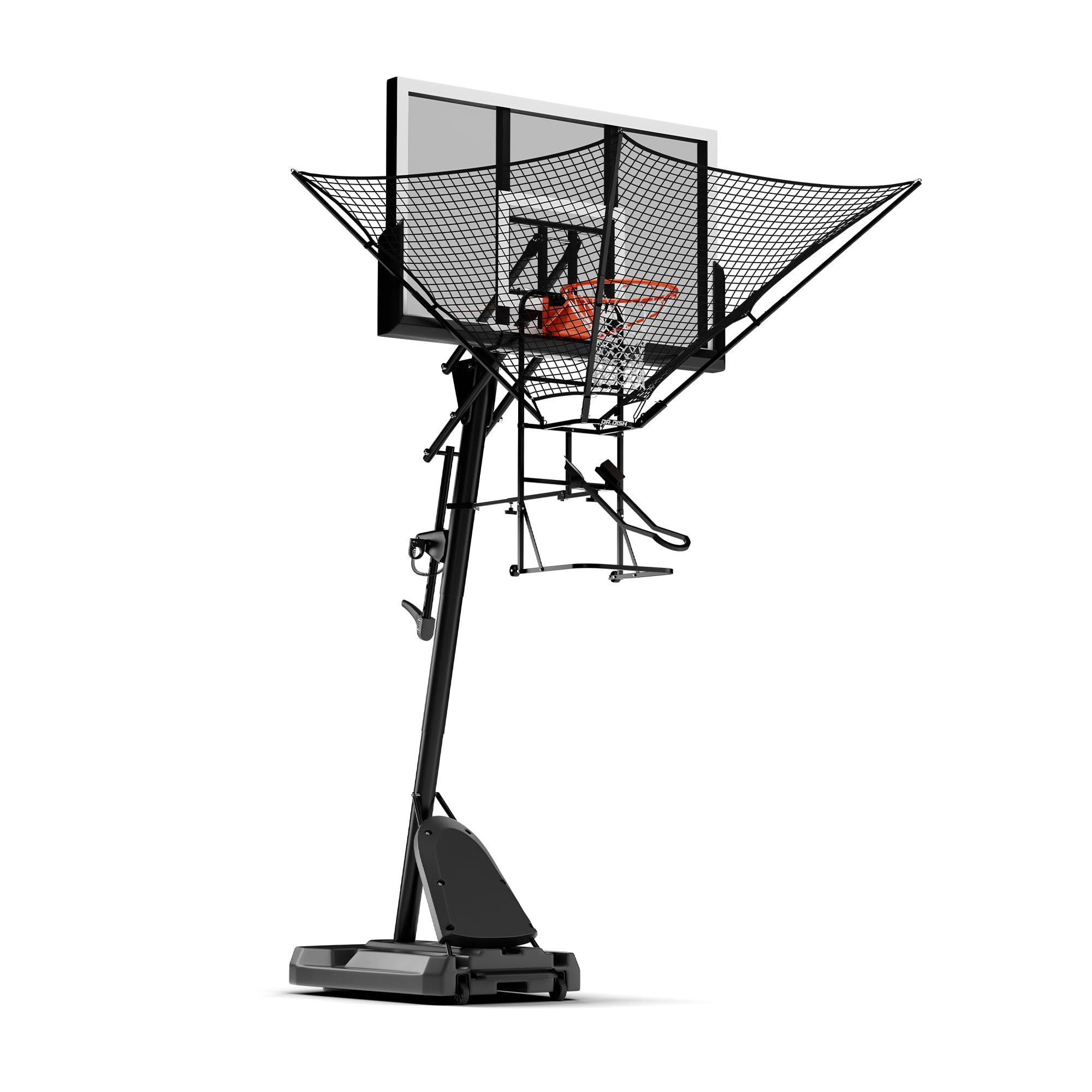
Chasing your own misses is the tax on practicing alone, and it is the tax the IC3 cancels. A steel frame hangs a weave net above the rim; makes and misses drop into it and run back down the ramp, and you are shooting again from wherever you are standing.
The ramp rotates 180 degrees by hand, so you can work from a wing or the top of the key without dragging the unit around, and Dr. Dish rates the setup at up to 800 shots an hour with two balls in rotation. The net hangs 17 inches above the rim, which is the detail we find most interesting: the maker’s pitch is that the height trains arc, and whether or not you buy that, shooting into a target above the rim changes what a good release feels like.
Where it earns its place in this guide is volume with a purpose. A young or streaky shooter is the worst candidate for solo practice, because every miss costs a jog and the session dies somewhere around attempt forty. With the net, misses cost nothing and the reps keep coming. We take 200 game-speed reps over 50 half-hearted ones every time, and that is the trade this machine makes.
What it asks in return is space. At 35 pounds with wheels it rolls around a driveway easily, but it is not something you fold into a trunk for the park, and it wants a hoop you can leave it hanging on. That is a fair trade for a family with a driveway hoop and an ambitious kid; it makes no sense for anyone shooting at a rented gym twice a week.
Pros
- Returns makes and misses without chasing
- 180-degree ramp for different floor spots
- Net sits 17 inches above the rim
- Sturdy steel frame that rolls on wheels
Cons
- Balls can wedge between net and rim
- Assembly takes patience and two people
Worth it for the solo shooter who wants hundreds of reps instead of dozens: it turns every miss into the next shot and never lets a session stall.
BALSMART Hand-Print Ball – Best for Young Beginners
Key Features
- Weight: 15.9 oz
- Material: Foam rubber
- Ball size: Kids size 5 (27.5 in)
- Hand colors: Blue right, yellow left
- Price: Midrange
We like the color-coded hands more than any other teaching cue in this group: blue for the right hand, yellow for the left, printed where the palms go, so a young player can look down, match colors, and check placement without a coach kneeling beside them.
It works because it is a reminder rather than a diagnostic. A kid who has not built habits yet will look at the hands; a teenager with a grooved, palm-heavy release will not, and should not be shopping here. The 27.5-inch size-5 ball is the right step for small hands, and the foam rubber cover is built for a driveway as well as a gym floor.
Sizes are the limit. The line covers a kids size 5 at 27.5 inches and a youth size 6 at 28.5 inches, so an adult or a strong teenager ends up practicing with a smaller, lighter ball than the one they play with. The placement lesson transfers; the release does not. That player is better off with a strap or a fork they can wear while shooting a regulation ball.
The day the hands land right without a glance is the day this ball has done its job. That is usually a season, not a career, and it is a good run for the money.
Pros
- Color-coded hands for right and left shooters
- Kids size 5 and youth size 6
- Foam rubber for indoor and outdoor use
Cons
The best first ball we found for a young shooter: color-coded hands make placement self-checking, and the youth sizes match small hands.
Shooters Fork (2-Pack) – Best Budget Pick
Key Features
- Hand fit: Either hand
- Material: Latex-free
- Pack size: Two forks
- Dimensions: 5.5 x 2.2 x 0.7 inches
- Price: Budget
A small clear plastic fork, wedged between your index and middle fingers, sounds like a joke someone plays on a rookie. Then you shoot: the fork holds those two fingers apart, the ball sits differently in your hand, and the release you thought you had is suddenly not the release you have.
Credit where it is due. This is the least expensive form aid in the group and one of the most convincing, because there is nothing to adjust and nothing to strap down. It fits either hand, it is latex-free for anyone who reacts to rubber straps, and the two-pack means one can live in a gym bag and one in the car.
We came in skeptical and came out recommending it, with a caveat about how it feels. The fork is noticeable on every single shot and new users fight it; the correction is the discomfort, which is why three sets of ten works better than a long workout. Put it on, shoot a set, take it off, and shoot the same shots again. The contrast is the lesson.
It will not teach the whole shot. There is no elbow work, no guide hand, and no arc in a piece of plastic this small, and it is not the tool for a player whose real problem is the shooting arm drifting.
Pros
- Separates index and middle fingers
- Fits either hand
- Two to a pack
- Least expensive way into form work
Cons
- Flimsy finger rings wear out
The cheapest way to feel what a fingertip release should feel like, and it comes two to a pack.
Shot Coach Form Aid – Best Multi-Area Form Aid
Key Features
- Size: One size
- Weight: 2.47 oz
- Material: Plastic
- Age range: All ages
- Price: Midrange
Five habits at once is a big promise for a piece of molded plastic, and Shot Coach gets closer than we expected: follow-through, shot-ready hands, elbow position, thumbing, and how tight the shooting arm stays to the body are all part of the same wearable.
It is the aid we point at for a player whose form is broadly right but drifts under pressure, someone who needs a checklist they can feel rather than a cue they have to remember. Slip it on and the wrong release corrects itself inside the first set; the right path starts to feel like the only one.
What it does not do is police the guide hand. If your off hand swings across the ball at the release, this will not stop it, and a strap such as the Jay Wolf is the better fit. Shot Coach is about the shooting arm: where the elbow sits, where the follow-through finishes, and whether your thumb is doing work it should not.
At 70 grams and one size, it is the easiest thing here to carry and one of the hardest to lose track of in a bag, and there is nothing to tighten between reps. Use it in short blocks, a dozen shots with it and a dozen without, rather than wearing it through an entire workout.
Pros
- Checks five form points in one piece
- No straps or adjustments
- One size for all ages
- 70 grams, easy to keep in a bag
Cons
- Awkward, cast-like feel at first
For a shooter whose elbow and follow-through drift, this wearable checklist makes the fault obvious, as long as the guide hand is not the real problem.
Crown x Starr Off-Hand Kit – Off-Hand Isolation
The box tells you who this is for: an off-hand shell, a pair of dribbling goggles, and a bonus shooting aid, which is a young player’s whole offseason in one purchase rather than an adult chasing the last five percent of a jumper.
The main piece is a plastic shell that goes over the off hand, with hook-and-loop straps instead of a band. It does the job a strap does, holding the guide hand where it cannot push the ball, and it goes on in seconds between reps.
The goggles are the bonus we did not expect to rate. Dribbling with your head up is the other half of being a useful guard, and most shooting aids ignore it entirely, so getting both in one box is genuinely useful for a kid learning to play rather than just to shoot.
The sizing runs large, though. Small hands, particularly a young player’s, can find the shell loose and awkward rather than instructive, which is the opposite of what a form aid should feel like. An adult or a big teenager will get on fine with it; for a small kid, a one-size strap such as the Jay Wolf is the safer buy.
Pros
- Holds the off hand out of the release
- Includes dribbling goggles and a bonus aid
- Straps on in seconds
Cons
- Runs large for small hands
- Built for right-handed shooters only
A two-tool kit for right-handed players working on the off hand and the handle, with goggles most shooting aids leave out.
How We Tested Basketball Shot Trainers
We started by researching the shot trainers sold by basketball specialty shops and big-box retailers, then narrowed the field by price, footprint, hoop compatibility, and the way each one returned the ball. We ended up with 12 models and used them for six months in driveways, a local gym, and a middle school court. Each unit was assembled solo with a stopwatch running, and we noted missing tools, vague instructions, and whether the frame felt solid before the first shot.
Shooting performance got the most time. We took 100-shot sessions from five spots on the floor and counted jams, wild returns, and balls that sat in the net instead of dropping back to us. We also varied shot arc and speed to see whether each trainer could handle a quick runner, a flat three, and a kid’s line drive without clogging. Shot capacity mattered here: on models that held multiple balls, we tracked how many shots we could take before a reset or reload was needed. The best sign of effectiveness was simple—we kept shooting because we wanted to, not because the trainer forced a stop.
Durability and comfort came from living with them, not just inspecting them. We left frames out on sunny and damp days, packed and unpacked the portable ones, and checked for bent rims, stretched nets, and loose joints after every few sessions. We also paid attention to how the return felt on our hands during long workouts and whether adjusters dug into our palms. Value was the final filter: we compared the number of usable shots per session against the setup time and the wear we saw, not just the sticker.
How to Choose a Basketball Shot Trainer
The right shot trainer makes your specific miss impossible to repeat, so diagnose the flaw before you shop for the gadget.
Start With the Miss, Not the Gadget
Film ten free throws from the side and watch three things: does the guide hand rotate or push at the release, does the elbow flare out, and does the ball leave from the palm or the fingertips? Each fault has a dedicated tool. A wrist strap holds the off hand back, a finger fork spreads the fingers, and a slip-on brace keeps the shooting arm stacked. An aid that claims to fix all three usually fixes none of them well, so buy for the fault you actually have rather than the one the packaging describes.
A flat shot is the exception. No wearable adds arc; that comes from aiming above the rim, which is why a high net or a rim target belongs in a different purchase than a form strap.
Fit Is Where These Aids Live or Die
One size fits all is a claim, not a measurement. An adult hand and a young player’s are not the same customer, and an aid that slides around gets left in the bag by the second practice. The two failure modes are a shell that is too big for small hands and a strap that has to be cranked down to stay put; both make the aid noticeable for the wrong reason.
Wear a new aid for a dozen shots at the start of a session and check whether it is still where you put it at the end. For a beginner under ten, the better first purchase is often not a wearable at all but a printed-hand ball in a youth size, because placement is easier to teach with something a kid can see.
An Aid That Moves Stops Teaching
A trainer only teaches while it sits in the same place every rep. Straps that loosen mid-session, shells that rotate on a small hand, and clips that pop off a rim all turn a teaching tool into a distraction you fight between shots. Look at how the thing attaches: hook-and-loop over a band holds far better than a smooth plastic shell, and anything that hangs on a rim is only as good as its fittings.
Cheap can absolutely be fine. The Shooters Fork is the least expensive pick here and we still recommend it, because there is nothing to adjust and nothing to slip out of position mid-set.
Rebounders Buy Reps, Not Form
A rebounder does not correct anything; it removes the jog. That is worth real money if you shoot alone, because solo practice dies at the first long rebound. The Dr. Dish IC3 catches makes and misses and sends them back down a ramp, which is how a session reaches several hundred shots instead of several dozen.
Set against that are 35 pounds of steel, a hoop you can leave it hanging on, and assembly that goes faster with two people. If volume is your bottleneck, it is the answer. If your release is the bottleneck, spend far less on a strap and shoot 50 free throws instead.
Frequently Asked Questions
How long before a shooting aid actually changes your shot?
Expect the change in feel within one session and a change in results over a few weeks, not days. The aid is feedback, and the carry-over comes from what you do after you take it off: shoot 10 to 15 reps without it at the end of every set, and keep score of your makes out of 10 so you are tracking something other than how the aid felt.
If the number has not moved after three weeks of short, regular sets, the aid is probably aimed at the wrong fault. Re-diagnose before you buy another one.
Can an adult use a hand-print training ball?
Only partly. The printed-hand balls here come in youth sizes, 27.5 inches (size 5) and 28.5 inches (size 6), so an adult would rehearse with a smaller, lighter ball than the one they play with. The placement lesson still reads, but the release will not transfer.
Adults get more from an aid they can wear while shooting a regulation ball: a guide-hand strap or a finger fork.
Can you wear a shooting aid during a game?
No. These are practice tools, and a strap or brace on your shooting hand comes off before tip-off. Use it in warm-ups and drills, then remove it for the last few shots of every session so the shot you rehearse last is your game shot.
If you are joining an organized team, ask the coach before bringing any aid to practice — gym time is short and some drills are not built around it.
Final Verdict
Start with the Jay Wolf shooting strap. It is the least complicated way to fix a shot that goes wrong at the release, one size covers a young player and an adult, and the correction is specific enough that you feel it in the first set of reps.
Buy the Dr. Dish IC3 only if you shoot alone and reps are the real bottleneck — it does not teach form, it removes the reason you stop practicing. And if you are buying for a beginner under ten, the BALSMART hand-print ball teaches placement before any wearable can.